
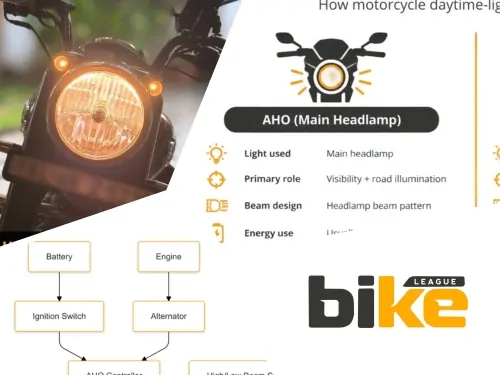
Long story short: Automatic Headlamp On (AHO) switches a motorcycle or scooter’s main headlamp on automatically according to the vehicle’s factory design. A dedicated daytime running light (DRL) is a different lighting arrangement intended mainly to make the vehicle more noticeable during daylight. This guide explains India’s automatic daytime-lighting requirement, the difference between AHO and DRLs, battery concerns, and responsible headlamp use.
Under India’s Central Motor Vehicles Rules, two-wheelers manufactured on or after 1 April 2017 must meet the automatic daytime-lighting requirement in Rule 105(1)(bb). This can be provided through one or two headlamps that switch on automatically while the engine is running, or through a compliant daytime running lamp (DRL) arrangement specified in the rule.
Source: MoRTH Notification G.S.R. 188(E), dated 22 February 2016, regarding automatic headlamp operation.
Key Takeaways
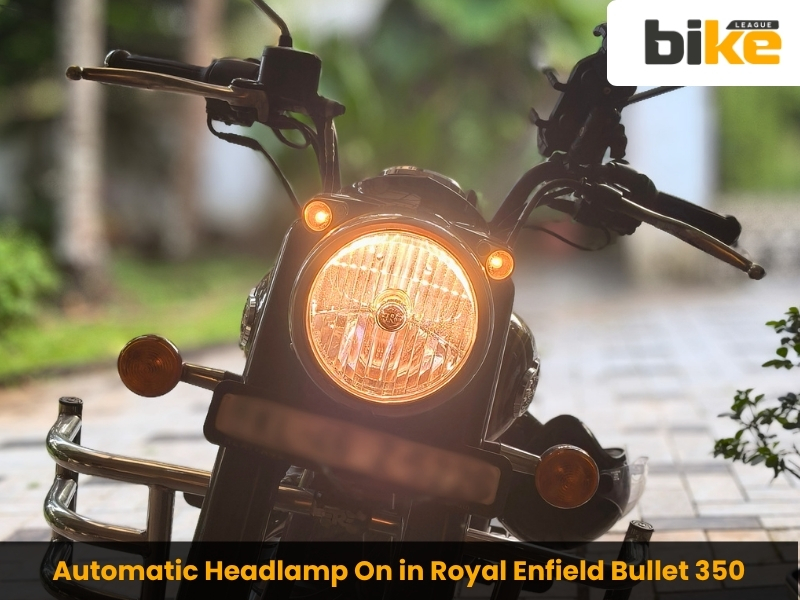
- The rule allows different factory lighting arrangements: Applicable two-wheelers may use automatically illuminated headlamps or a compliant DRL arrangement. See the Indian daytime-lighting rules for the manufacturing-date cut-off and conditions.
- Automatic daytime lighting is mainly about visibility: A forward-facing lamp may help other road users notice a motorcycle or scooter during the day, in rain, fog, at dawn, at dusk, and on shaded roads.
- India-specific benefits are not established by the cited evidence: International findings suggest possible safety benefits, but the sources used in this guide do not quantify the separate effect of India’s AHO requirement on crashes or fatalities.
- A healthy charging system should support factory lighting: If a vehicle has repeated hard-starting or weak-battery symptoms, the battery and charging system should be checked instead of assuming AHO is the only cause.
- Avoid altering factory lighting wiring: Cutting wires, fitting bypass switches or adding unsuitable relays can cause electrical faults, unreliable lighting or starting problems. Get a persistent issue checked by an authorised service centre.
What Is Automatic Headlamp On (aho) In Bikes And Scooters?
AHO turns on a motorcycle or scooter’s main headlamp automatically, so you don’t have to switch it on yourself. The way it works can vary depending on the vehicle’s electrical design, so check your owner’s manual for details about your model.
A dedicated daytime running light (DRL) is different. It’s mainly there to make your vehicle stand out during the day, not to light up the road. While both help with daytime visibility, a DRL isn’t the same as the main headlamp working through AHO.
Most motorcycles with main-headlamp AHO don’t have a regular headlight on/off switch. The headlamp comes on by itself, but you can still use the high-beam, low-beam, and flash-to-pass controls. Changing between high and low beam won’t turn the headlamp off. For details about your bike’s controls, check the owner’s manual.
What Is The Safety Purpose Of Aho?
Motorcycles and scooters are smaller than cars, buses, and trucks, so other drivers might not always notice them in traffic or when lighting changes. AHO is meant to make two-wheelers easier to see and recognize on the road.
India’s road-safety burden remains substantial. MoRTH recorded 480,583 road accidents, 172,890 deaths and 462,825 injuries in calendar year 2023. Two-wheeler users accounted for 44.8% of all road deaths. These figures provide national context, but they do not show how many crashes were caused by visibility problems or how much AHO alone changes crash outcomes.
So, AHO is just one way to help others see you better. It works best along with wearing a certified helmet, riding at safe speeds, keeping your vehicle in good shape, following lane rules, and other road safety practices.
Source: MoRTH: Road Accidents in India 2023.
What Are The Automatic Daytime-lighting Rules In India?
Automatic Daytime-lighting Requirement For New Two-wheelers
Notification G.S.R. 188(E), dated 22 February 2016, inserted Rule 105(1)(bb) into the Central Motor Vehicles Rules. It applies to every two-wheeler manufactured on or after 1 April 2017.
Under the rule, the vehicle must have one or two headlamps that automatically switch on when the engine is running. The rule also treats this condition as satisfied when the vehicle has a compliant daytime running lamp that automatically lights while the engine is running and turns off automatically when the headlamp is switched on.
That’s why lighting setups can be different from one motorcycle or scooter to another. To know what your vehicle has and how it works, check your owner’s manual.
Are The Aho Requirements Different In Kerala And Other Indian States?
The automatic daytime-lighting requirement discussed here comes from the Central Motor Vehicles Rules, not a separate Kerala-specific or state-specific AHO rule. The manufacturing-date cut-off and the permitted headlamp or DRL arrangements described in Rule 105(1)(bb) are the relevant national requirements.
The rule does not provide a regional exemption simply because a state has bright sunshine or less fog. Do not assume that factory automatic lighting can be disabled based on local weather or personal preference.
For questions about a particular enforcement notice or penalty, consult the relevant state transport department or traffic police. This guide does not establish a uniform AHO-specific fine for every state.
Source: MoRTH Notification G.S.R. 188(E), dated 22 February 2016 — amendment introducing Rule 105(1)(bb).
What Aho Does Not Mean
AHO doesn’t mean you should always use high beam. Choose the right beam for the road and traffic around you. Using high beam when it’s not needed, or if your headlamp isn’t aimed properly, can cause glare for other drivers.
Lighting Standards
Automatic switching and how well the headlamp works are separate things. AHO is about when the lights turn on, while technical standards cover things like how the beam is spread, how bright it is, glare, and testing.
The AIS-010 document linked below is from December 2004, with an update in July 2005. It explains lighting requirements for two- and three-wheelers. However, don’t assume this older version covers all the rules for today’s motorcycles or scooters.
If you need a new headlamp or bulb, check with your vehicle maker, the part manufacturer, or an authorised testing agency to find the right standard and version. Always use the replacement bulbs and headlamps your vehicle manufacturer recommends.
Technical reference: AIS-010 — December 2004 edition, including the July 2005 amendment, hosted by ARAI.
How Does Aho Work On A Motorcycle Or Scooter?
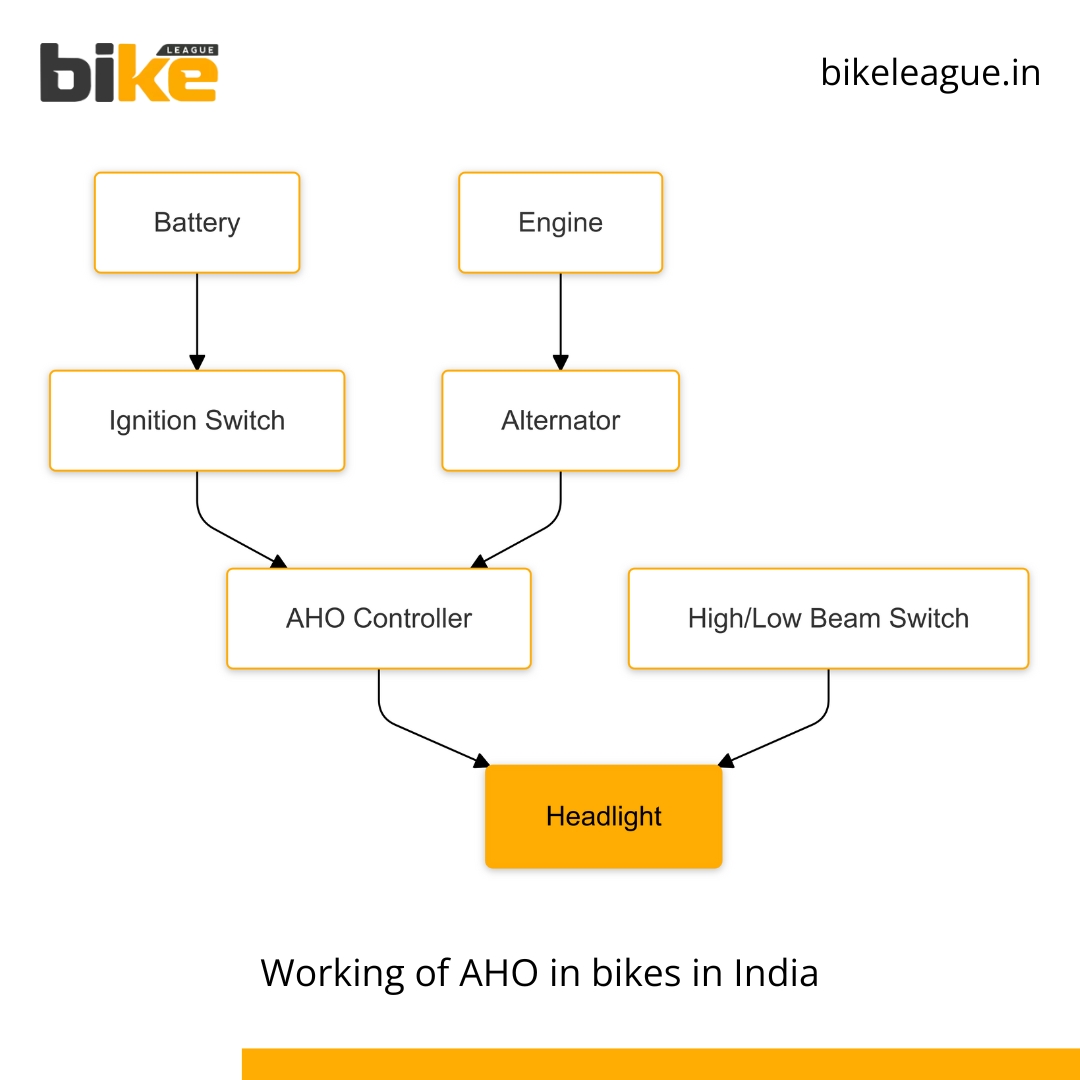
Typical Operation On A Petrol Motorcycle Or Scooter
The following is a general explanation, not a model-specific wiring diagram:
- The vehicle’s electrical system activates the main headlamp automatically according to its factory switching arrangement.
- While the engine is running, the charging system supplies electrical power. Battery charging depends on operating conditions, electrical demand, and the charging system’s condition.
- The rider uses the available low-beam, high-beam and flash-to-pass controls as described in the owner’s manual.
- On models using headlamp-based AHO, a conventional headlamp on/off switch is generally not provided.
Operation On An Electric Motorcycle Or Scooter
Electric two-wheelers do not use an engine-driven charging system. Their lighting activation and power supply follow the vehicle’s electrical design. Check the owner’s manual to identify when the headlamp or DRL activates and which lighting controls are available.
Aho Vs Manually Switched Headlights: What Changes?
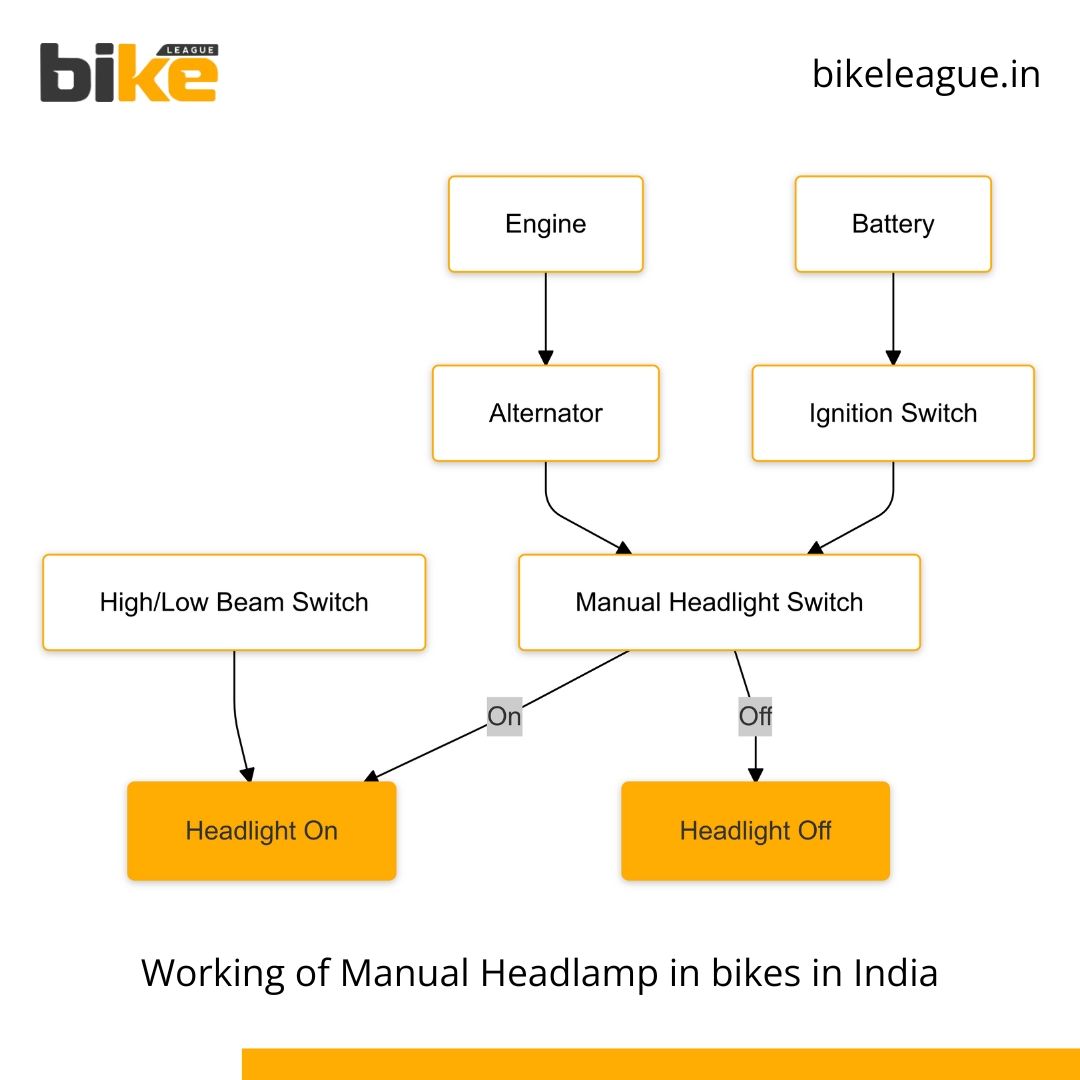
The main difference is how the headlamp is activated. With headlamp-based AHO, the factory electrical system switches the headlamp on automatically. With a conventional manually switched system, the rider uses a switch to turn the headlamp on and off.
| Feature | Headlamp-based AHO | Manually switched headlamp |
|---|---|---|
| Headlamp activation | Automatic, according to the vehicle’s factory electrical design. | The rider switches the headlamp on. |
| Daytime operation | Does not depend on the rider remembering to switch on the headlamp. | Depends on the rider switching it on. |
| Headlamp on/off control | A conventional headlamp on/off switch is generally not provided. | An on/off switch is provided. |
| Low beam, high beam and flash-to-pass | Available controls depend on the model. | Available controls depend on the model. |
| Road illumination | Depends on the headlamp design, condition, beam setting and aim. | Depends on the headlamp design, condition, beam setting and aim. |
Automatic switching does not, by itself, make a headlamp brighter or improve its beam pattern. AHO describes how the headlamp is activated, not the quality of its optics. Compare the actual headlamp equipment when assessing lighting performance, and check the owner’s manual for the controls on a particular motorcycle or scooter.
Aho, Drl, Low Beam And High Beam: What Is The Difference?
These terms each mean something different about motorcycle lighting. AHO is about the headlamp turning on automatically. A DRL helps others see your bike during the day. Low beam and high beam are the different settings for your headlamp.
| Term | What it describes | Main function |
|---|---|---|
| AHO | Automatic operation of the main headlamp. | Switches on the headlamp automatically according to the vehicle’s factory design. Available beam controls vary by model. |
| DRL | A daytime-running-light function. | Helps other road users notice the vehicle during daylight. It does not replace the headlamp for illuminating the road at night. |
| Low beam | A headlamp beam setting, also called passing beam. | Illuminates the road ahead while limiting glare towards other road users. |
| High beam | A headlamp beam setting, also called driving beam. | Provides longer-range illumination. Use it only when it will not dazzle oncoming road users or drivers ahead. |
DRLs are meant to help others see your vehicle during the day, not to light up the road at night. If your bike uses DRLs, make sure your headlamp and rear lights are on at night or in poor visibility. Don’t assume that just because the DRL is on, all your lights are working.
Technical reference: UK Department for Transport: how daytime running lights work. This reference explains DRL function, not Indian legal requirements.
Why Aho And Dedicated Drls Are Not Identical
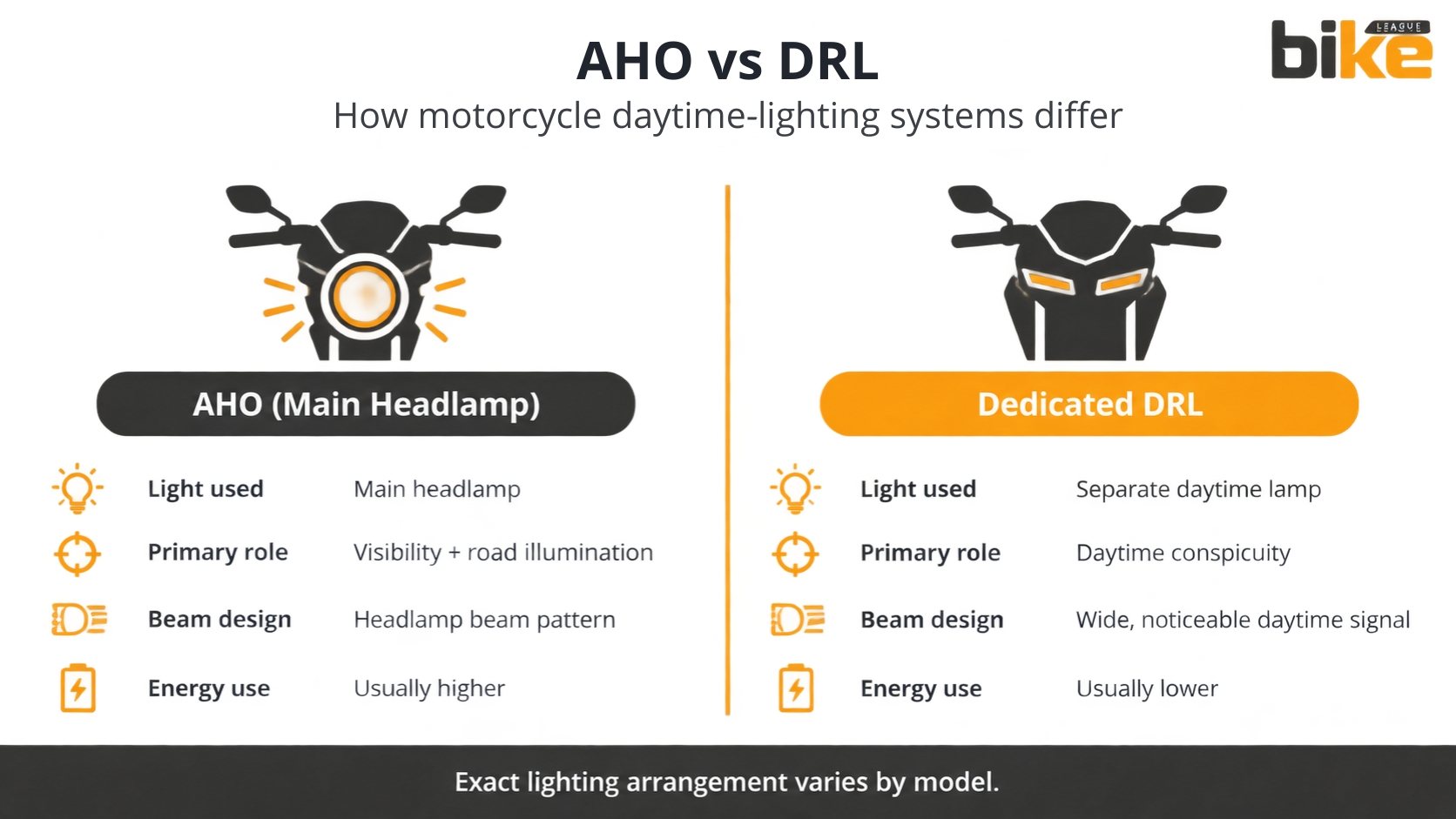
Both headlamp-based AHO and dedicated DRLs help make motorcycles easier to spot, but they work differently. A low-beam headlamp shines most of its light on the road and tries to avoid glaring at others. A DRL is mainly for making your bike stand out during the day.
A 2005 technical paper presented to UNECE’s Working Party on Lighting and Light-Signalling explained that daytime conspicuity depends on factors such as light intensity, beam distribution and background brightness. The authors argued that dedicated daytime-lighting designs could address some limitations of using low-beam headlamps continuously.
The paper does not directly compare current Indian motorcycles fitted with headlamp-based AHO against those fitted with dedicated DRLs. Some supporting comparisons concern passenger cars, while others use calculated visibility estimates under specified conditions. Its findings explain potential differences between lighting designs, but they do not establish that a particular DRL-equipped motorcycle is safer than a particular AHO-equipped model.
The paper is also a historical technical submission, not an Indian regulation or a recommendation for owners to modify factory lighting.
Source: Paine and colleagues (2005): Daytime Running Lights for Motorcycles — informal document GRE-55-17.
Does Aho Improve Road Safety?
AHO is intended to improve conspicuity. The motorcycle findings summarised in the international review by Elvik, Christensen and Olsen suggest that laws and campaigns promoting daytime motorcycle lighting were associated with approximately 5–10% fewer multi-vehicle daytime crashes. These findings concern international studies and should not be presented as a measured result of India’s AHO requirement.
How easily other road users notice a lit headlamp depends on conditions such as ambient light, weather, surrounding traffic, headlamp aim, obstructions and driver attention. The international findings cited above should not be treated as a guaranteed benefit for every riding situation.
So, think of AHO as just one part of staying safe. It doesn’t replace wearing protective gear, riding carefully, using indicators and mirrors, or keeping your brakes, tyres, and bike in good condition.
Sources: Institute of Transport Economics: Elvik, Christensen and Olsen, Report 688/2003; Minnesota Department of Transportation: Study of Mandatory 24-Hour Vehicle Lighting — summary of motorcycle findings.
What Does Night-time Lighting Research Tell Us?
A 2009 Honda study investigated FACE, or Facial Attention for Conspicuity Enhancement, using three lights arranged in an inverted triangle to resemble a face. In controlled night-time experiments, the researchers found that this arrangement improved motorcycle detection compared with a standard single-headlamp layout.
The study illustrates that lighting arrangement can influence motorcycle recognition, not simply whether a headlamp is on. However, it measured detection under experimental conditions, not real-world crash reduction. It did not evaluate India’s daytime-lighting requirements and should not be treated as advice to add aftermarket lamps.
Advantages Of Aho In Bikes And Scooters
- Improves daytime conspicuity: A lit headlamp can help other road users notice a motorcycle or scooter in traffic.
- Reduces dependence on rider memory: Automatic operation removes the need to remember to switch on the headlamp for daytime visibility.
- Provides lighting in changing conditions: Automatic headlamp operation can be useful when travelling through shaded roads, underpasses, rain, or changing daylight.
AHO helps others see you, but it’s not a replacement for wearing a helmet, riding at safe speeds, checking your mirrors, using signals, or following lane rules.
Possible Concerns With Aho
- Battery concerns require diagnosis: Hard starting or battery discharge should not automatically be attributed to AHO. See the battery and charging-system guidance below for possible causes and testing precautions.
- Bulbs are consumable parts: Halogen bulbs eventually need replacement, as with any lighting system.
- Glare can be a problem: An incorrectly aimed headlamp or unnecessary use of high beam can disturb oncoming traffic.
- Limited rider control: AHO-equipped models normally do not provide a conventional switch to turn off the main headlamp while the vehicle is operating.
Does Aho Drain A Bike Battery?
If your motorcycle or scooter is well maintained, its charging system should handle the original lights without any problem. AHO by itself usually won’t drain a healthy battery during normal rides.
You might notice battery problems if the battery is old or not fully charged, if the charging system isn’t working right, if the terminals are loose or corroded, if you’ve added extra electrical accessories, or if you mostly take short trips with lots of starts.
How To Check The Battery And Charging System
Before testing, read the vehicle’s service instructions and the multimeter’s instructions. Wear eye protection, remove metal jewellery, and keep sparks, cigarettes and flames away from the battery. Do not allow a tool or test probe to bridge the battery terminals. If the battery is cracked, leaking, or visibly damaged, do not proceed; have it professionally inspected.
Use the multimeter’s DC-voltage setting with the leads connected to the sockets specified for voltage measurement. If you are unsure how to use the meter or safely access the battery, have a qualified technician do the check.
Safety reference: Yuasa: Battery Safety.
For a typical 12V lead-acid motorcycle battery, use a digital multimeter at the battery terminals. Check the owner’s or service manual first because the specified values and test rpm can vary by model.
- Check the resting voltage: With the ignition off and after the battery has rested, a fully charged conventional 12V lead-acid battery commonly reads about 12.6V.
- Start the engine: Measure voltage directly across the battery terminals with the engine running.
- Raise engine speed as specified: A common charging-system check is performed at approximately 3,000–4,000 rpm. A reading in the region of 13.0V to 14.5V generally indicates that the charging system is supplying charge.
- Do not confuse charge level with battery health: A normal resting-voltage reading does not prove that the battery can supply enough current to start the engine. If starting problems continue despite an apparently normal reading, have a professional load-test the battery and check the charging system.
- Get the vehicle checked if symptoms continue: Repeated hard starting, dim lamps, a battery warning light, burning smell, blown fuses, or persistent battery discharge should be inspected by an authorised workshop or qualified technician.
Don’t cut, bypass, or change the original AHO wiring to fix a battery issue. Instead, find out if the problem is with the battery, charging system, wiring, regulator-rectifier, stator, or any extra accessory you’ve added.
Battery chemistry also matters. Yuasa lists approximately 12.8–13.0V for a fully charged AGM battery, compared with about 12.6V or higher for a conventional flooded lead-acid battery. Use the battery manufacturer’s specifications rather than treating one voltage figure as universal. These lead-acid figures should not be applied to lithium batteries.
Source: Yuasa Powersports Battery Technical Manual.
How To Reduce Glare From A Motorcycle Headlamp
- Use low beam around other traffic: Switch out of high beam when approaching oncoming road users or following another vehicle.
- Check headlamp aim: Ask a service centre to inspect and adjust the beam if it shines unusually high, dazzles others, or gives poor road illumination.
- Use approved replacement bulbs: Fit bulbs that match the vehicle manufacturer’s specified wattage and design.
- Choose lighting upgrades carefully: A replacement bulb or lamp must work correctly with the complete headlamp unit, including its reflector or projector, lens, wiring and beam aim. If an upgrade produces scattered light, excessive glare, electrical faults or an incorrect beam pattern, remove it and seek professional advice.
- Keep the lens clean: Dirt, yellowing, cracks, and moisture can reduce effective illumination and distort the beam pattern.
Don’t just trust a bulb’s advertised wattage, colour, or “plug-and-play” label. Check with the manufacturer, an authorised service centre, or a lighting expert to make sure the part fits your bike. After installing, make sure the beam is aimed right and doesn’t blind other drivers.
Can Aho Be Disabled?
Don’t cut wires, add bypass switches, or use the wrong relays to turn off AHO. Changing the original lighting circuit can cause electrical problems and affect how your headlamp works.
If you think there’s a problem with your battery, starting, or lights, get your vehicle checked by an authorised service centre or a qualified technician instead of bypassing the automatic lighting. Also, check your warranty terms before making any electrical changes.
Draft Aho Amendment: Proposed Low-beam-only Automatic Operation
MoRTH’s draft notification G.S.R. 736(E), dated 13 August 2026, proposes an amendment to Rule 105(1)(bb) of the Central Motor Vehicles Rules. The proposed wording states that, on and after 1 April 2028, Automatic Headlamp On shall operate in passing beam (i.e., low beam) only.
This date appears in the draft proposal; it should not be presented as a confirmed implementation deadline without checking the final notification. Publication of a draft in the Gazette does not, by itself, make the proposed amendment a final rule.
The proposal concerns automatic headlamp operation. It should not be described as a complete ban on using a motorcycle’s high beam.
Faq About Aho In Bikes And Scooters In India
1. Why Is My Bike’s Headlight Always On, Including During The Day?
If your motorcycle or scooter has headlamp-based Automatic Headlamp On (AHO), the main headlamp switches on automatically according to its factory electrical design. This is intended to help other road users notice the vehicle during the day. A continuously illuminated headlamp is therefore normally expected on an AHO-equipped model, rather than a fault.
This is also why many riders notice an always-on headlamp on BS6 motorcycles. However, the automatic daytime-lighting requirement is linked to the vehicle’s manufacturing date, not simply its BS6 emission classification. Rule 105(1)(bb) applies to two-wheelers manufactured on or after 1 April 2017 and permits automatically illuminated headlamp(s) or the compliant DRL arrangement specified in the rule.
If the headlamp stays on after the vehicle has been switched off, or behaves differently from the operation described in the owner’s manual, have the lighting system checked by an authorised service centre or qualified technician.
Source: MoRTH Notification G.S.R. 188(E), dated 22 February 2016.
2. Is Aho Mandatory For All Two-wheelers In India?
Rule 105(1)(bb) applies to two-wheelers manufactured on or after 1 April 2017. The relevant date is the manufacturing date, not the purchase date or first-registration date. The required automatic daytime lighting may be provided through automatically illuminated headlamp(s) or through a compliant DRL arrangement described in the rule.
3. How Does Aho Work Technically?
AHO is integrated into the factory electrical system so that the headlamp illuminates automatically according to the model’s design. The circuit differs between vehicles, so the owner’s manual or an authorised workshop is the best source for model-specific information.
4. Does Aho Drain The Bike Battery Significantly?
Not normally on a motorcycle or scooter with a healthy battery and properly functioning charging system. Repeated hard starting or battery discharge should be investigated rather than automatically attributed to AHO.
Battery type, charging-system condition, loose connections, additional accessories and frequent short trips can affect the diagnosis. See the battery and charging-system guidance for testing precautions and battery-specific voltage information.
5. Can I Disable Aho On My Bike?
Avoid cutting wires or adding bypass switches to turn off the factory lighting system. If you suspect a battery, starting, or lighting fault, have an authorised service centre or qualified technician inspect the vehicle rather than bypassing AHO. Check the manufacturer’s warranty terms before making electrical modifications.
6. What Is The Difference Between Aho And Drl?
AHO automatically uses the vehicle’s headlamp. A DRL is a separate or integrated lamp intended mainly to make the vehicle easier to notice during the day. The arrangement varies by model.
7. Can I Ride At Night Using Only The Drl?
No. A DRL is intended to help other road users notice the vehicle during daylight, not to illuminate the road at night. Ensure the appropriate headlamp and rear lighting are operating in darkness and poor visibility. Do not assume that an illuminated DRL means all the necessary lights are on; check your owner’s manual for the vehicle’s lighting controls.
Source: MoRTH Notification G.S.R. 188(E), dated 22 February 2016.
8. Why Do Some Riders Receive “lights Off” Gestures During The Day?
Some road users may not be aware that newer motorcycles and scooters can have automatic headlamp operation. Riders should continue to use the correct beam setting and avoid unnecessary high-beam use.
9. Has Aho Reduced Accidents In India?
The international research cited in this guide suggests that daytime motorcycle lighting can reduce some multi-vehicle daytime crashes. However, these sources do not establish how many crashes or deaths India’s AHO requirement has prevented. Changes in national crash totals alone cannot isolate AHO’s contribution from other road-safety factors.
10. Can I Add Aho To An Older Motorcycle Or Scooter?
Before adding automatic headlamp operation to an older motorcycle or scooter, ask the vehicle manufacturer or an authorised service centre whether a suitable, manufacturer-supported solution is available for your exact model. Do not assume that a universal aftermarket kit is compatible simply because it is advertised for motorcycles.
Ask the workshop to assess the existing lighting circuit, charging capacity, wiring, switches and protection devices before recommending any changes. The installation should preserve correct headlamp operation and the beam controls provided on the vehicle.
There is no single installation price that can be quoted reliably for every motorcycle or scooter. If a suitable solution is available, request an itemised quotation covering the parts, labour and any additional electrical work. Confirm the effect on any remaining warranty before approving the installation.
Manufacturer guidance: Royal Enfield Classic 500 owner’s manual — electrical-load and modification warnings. This is model-specific guidance, not evidence that Royal Enfield offers an AHO retrofit kit.
11. Does Aho Need Special Maintenance?
Follow the lighting and electrical-system maintenance instructions in your vehicle’s owner’s manual. The exact checks depend on the model; automatic headlamp operation does not mean that every motorcycle or scooter has a separate AHO controller requiring scheduled servicing.
Check that the headlamp activates as described in the owner’s manual, the available low-beam, high-beam and flash-to-pass controls work correctly, and the lens is clean and undamaged. Have the headlamp aim checked if the beam gives poor road illumination or dazzles other road users.
Use replacement bulbs or headlamp assemblies specified for your vehicle. If the lamp flickers, fails repeatedly, or operates alongside hard-starting or battery-discharge symptoms, have a qualified technician inspect the lighting circuit and charging system instead of bypassing AHO.
For related checks, see the battery and charging-system guidance and headlamp alignment and glare guidance in this article.
12. Does Having Aho Reduce My Bike Insurance Premium?
Do not assume that factory-fitted AHO automatically qualifies your motorcycle or scooter for an insurance discount. Check the insurer’s current quotation, policy wording and eligibility conditions.
If an insurer or agent offers an AHO-related discount, request written confirmation of its conditions and the part of the premium to which it applies.
Sources: ICICI Lombard two-wheeler policy wording — approved anti-theft-device endorsement; HDFC ERGO — no-claim bonus information. These references explain other insurance discounts; they do not establish an AHO-specific discount.
Sources And Further Reading
- Government notification: MoRTH G.S.R. 188(E), dated 22 February 2016, regarding automatic headlamp operation
- Draft amendment: Copy of MoRTH G.S.R. 736(E), dated 13 August 2026, proposing changes to automatic headlamp operation — hosted by third-party compliance service Ricago. This is a draft reference, not confirmation of a final rule or implementation deadline.
- Historical technical standard: AIS-010 — December 2004 edition, including the July 2005 amendment, hosted by ARAI
- Government report: MoRTH — Road Accidents in India 2023
- Research review: Elvik, Christensen and Olsen — Daytime Running Lights: A Systematic Review of Effects on Road Safety, Institute of Transport Economics, Report 688/2003
- Government research report: Minnesota Department of Transportation — Study of Mandatory 24-Hour Vehicle Lighting, including a summary of motorcycle findings
- Historical technical paper: Paine and colleagues (2005) — Daytime Running Lights for Motorcycles, informal document GRE-55-17 presented to UNECE’s Working Party on Lighting and Light-Signalling
- Manufacturer research: Maruyama, Tsutsumi and Murata (2009) — Study of FACE Design, Lighting System Design for Enhanced Detection Rate of Motorcycles, Honda R&D Technical Review
- Technical explanation: UK Department for Transport — Daytime Running Lights. This reference explains DRL function, not Indian legal requirements.
- Battery manufacturer guidance: Yuasa Powersports Battery Technical Manual
- Battery manufacturer safety guidance: Yuasa — Battery Safety
- Further reading: Davoodi and Hossayni (2015) — Role of Motorcycle Running Lights in Reducing Motorcycle Crashes during Daytime: A Review of the Current Literature
Related Guides From Bikeleague India
- Motorcycle Headlights in India — Types, Beam Settings and More
- Motorcycle Battery — Different Types and Tips to Extend Life
- Motorcycle Kill Switch and Key Switch — Know the Differences
- Motorcycle Service — What Owners Need to Know
- Defensive Riding for Bikers in India — Traffic and Safety Tips
Conclusion
Automatic Headlamp On and dedicated daytime running lights are different lighting arrangements intended to help other road users notice motorcycles and scooters. Their operation depends on the vehicle’s factory design. Use the available lighting controls responsibly and follow the owner’s manual.
The international research cited in this guide suggests that daytime motorcycle lighting can offer safety benefits, but it does not quantify the separate effect of India’s automatic daytime-lighting requirement. Keep the headlamp correctly aimed, use high beam responsibly, maintain the battery and charging system, and avoid unauthorised wiring changes.
If you have questions about AHO, headlamp alignment, motorcycle batteries, or two-wheeler maintenance, email bikeleagueindia@gmail.com or leave a comment below.