
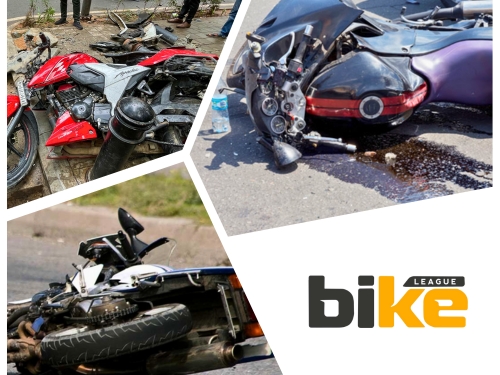
Long story short: Learn about the causes of road motorcycle accidents in India, statistics, including fatality rates. Explore solutions for safer roads and better bike riding practices.
Motorcycles and scooters are an essential mode of transportation for millions in India, offering affordability and convenience in both urban and rural settings. Nevertheless, the popularity of two-wheelers also brings significant safety challenges. This article explores the causes of the high rate of motorcycle accidents in India, presents key statistics—including fatality rates—and discusses practical solutions to make roads safer for all.
Key Takeaways On The Causes Of Motorcycle Accidents
- High Rate of Two-Wheeler Accidents: Motorcycles and scooters account for a significant share of road accidents and fatalities in India, with overspeeding, non-helmet use, and poor road infrastructure as major contributors.
- Key Risk Factors Identified: Human behaviours (such as speeding, alcohol use, and distraction), poor road conditions, and inadequate vehicle maintenance are leading causes of motorcycle accidents.
- Government and Insurance Initiatives: The government and insurance companies are implementing legislative measures, infrastructure improvements, and awareness campaigns to promote road safety and reduce accident rates.
- Enforcement and Awareness Challenges: Despite new laws and safety features, weak enforcement and low public compliance continue to hinder substantial improvements in motorcycle safety
motorcycle safety
. - Need for Comprehensive Approach: Lasting progress depends on strong enforcement, use of advanced technologies, widespread public awareness, and continuous evaluation of safety strategies.
Motorcycle Accident Statistics In India (2017-2024)
Below is a table summarising data on motorcycle accidents and fatalities in India:
| Year | Total Road Accidents | Two-Wheeler Accidents* | Two-Wheeler Fatalities | Contributing Factors |
|---|---|---|---|---|
| 2017 | 464,910 | ~148,000 | 44,366 | Speeding, no helmets, overtaking, poor roads |
| 2018 | 467,044 | 150,093 | 45,893 | Drunk driving, speeding, signals ignored |
| 2019 | 449,002 | 143,768 | 44,666 | Night visibility, no gear, road defects |
| 2020 | 366,138 | 115,113 | 38,743 | COVID curbs; higher speeds |
| 2021 | 412,432 | 137,982 | 42,884 | Post-COVID traffic surge, aggressive riding |
| 2022 | 461,312 | 149,001 | ~46,400 | Overloading, poor maintenance |
| 2023 | 480,583 | ~360,000 (75%) | 77,539 (44.8%) | Overspeeding (68%), no helmets (~54k), ages 18-45 |
| 2024* | ~473,000 | N/A | ~76,000 est. (45%) | UP/TN highest; speeding, helmets; daily ~485 deaths |
*2024 provisional; two-wheelers ~45% deaths (up from 30% in 2014). No full 2025/2026 data yet; focusing on helmets could cut fatalities by 25%.
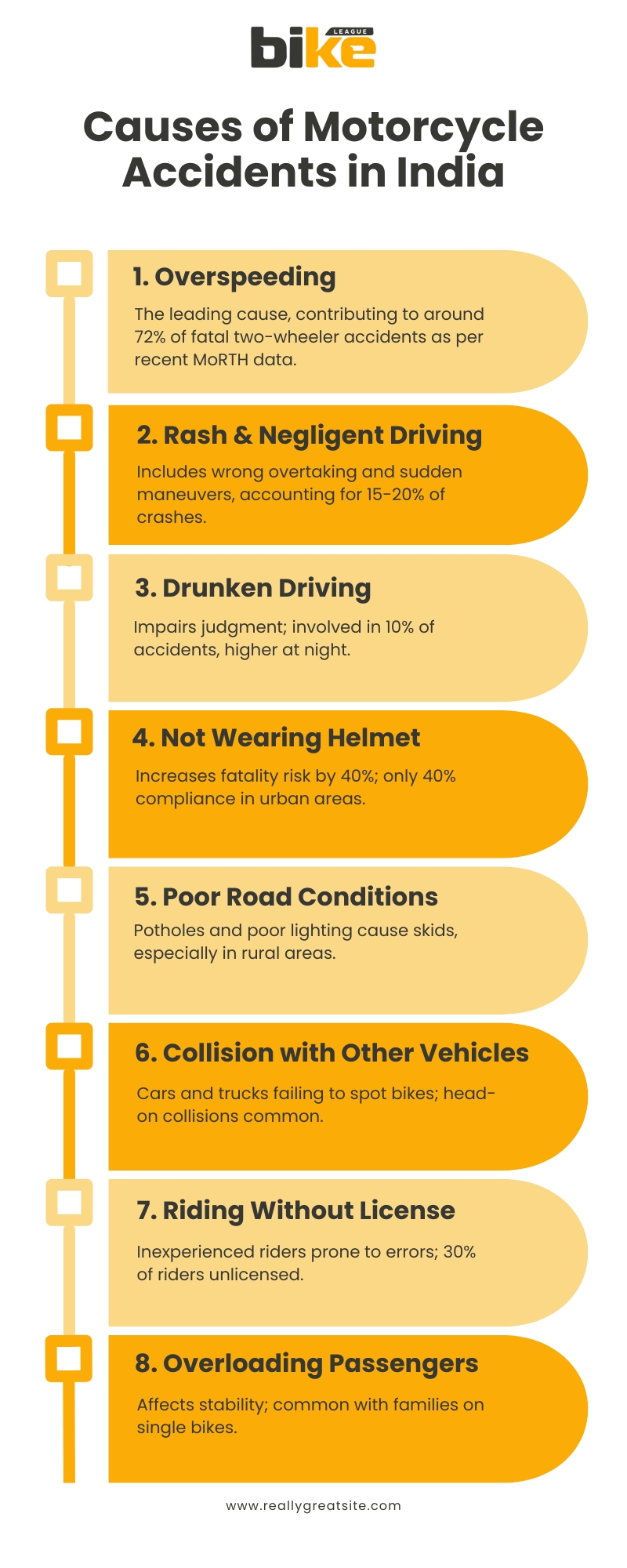
Detailed Analysis Of The Causes Of Motorcycle Accidents In India
Motorcycle accidents remain a major problem in India, impacting many people every year. To understand the issue more clearly, here are the main causes of these accidents and the factors that affect road safety.
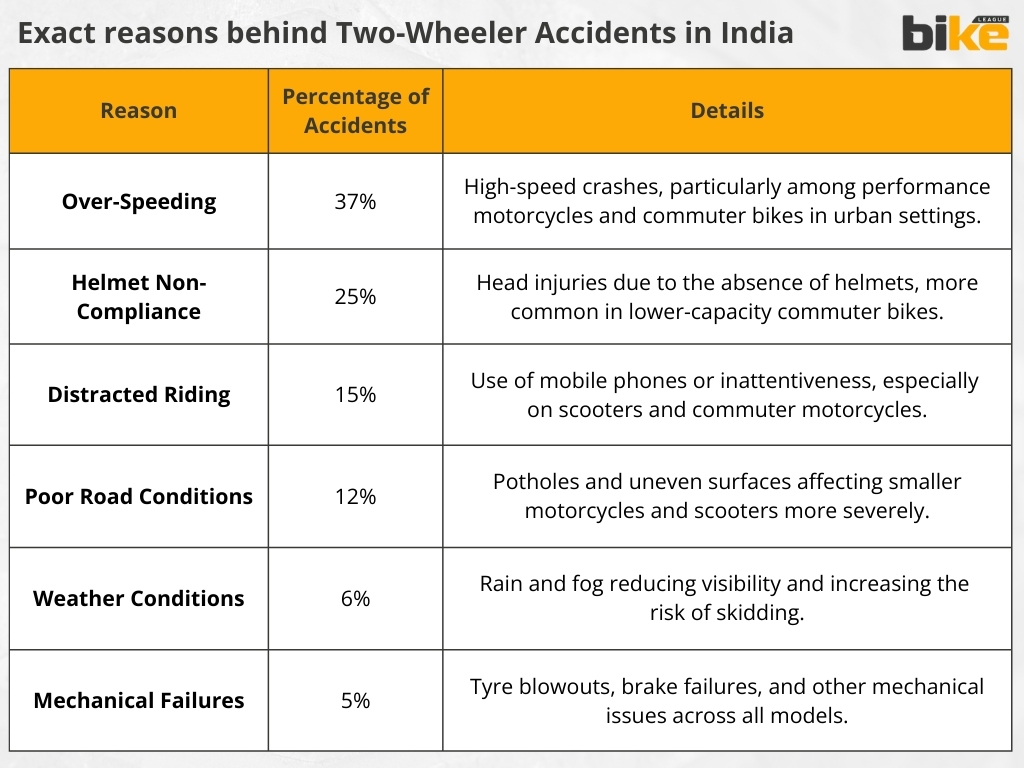
1. Speeding As A Leading Cause Of Motorcycle Accidents
Percentage of cases: 37%
Speeding is one of the main reasons for motorcycle accidents. High-performance bikes and scooters like the KTM Duke 200/390 and Yamaha R15 can be harder to control, especially in cities and towns.
2. Helmet Non-compliance
Impact on fatalities: 25%
Many riders and pillion passengers neglect helmet use despite mandatory laws, significantly increasing the risk of head injuries. This one ranks second among the causes of motorcycle accidents in India.
3. Alcohol And Drug Influence
Fatality contribution: 15%
Riding after drinking alcohol or using drugs affects judgment and slows reaction time, which can cause serious accidents.
4. Poor Road Infrastructure As A Cause Of Motorcycle Accidents
Involvement in accidents: 12%
Potholes, poor signage, and poor lighting increase the risk of accidents, especially in rural areas.
5. Mechanical Failures
Percentage of cases: 8%
Poor maintenance, including worn-out brakes and tyre blowouts, directly contributes to accidents.
6. Weather Conditions
Accidents during adverse weather: 6%
Rain and fog make it harder to see and reduce grip on the road, which puts two-wheelers at risk. To stay safe, ride slower, keep a safe distance from other vehicles, and check that your brakes and tyres are in good shape.
7. Distracted Riding As A Growing Cause Of Motorcycle Accidents
Contributing factor: 5%
Using mobile phones and other distractions while riding is becoming a bigger problem, especially in cities.
By understanding these causes, we can take steps to ride more safely and, as a result, reduce motorcycle accidents in India.
Some Of The Common Motorcycle Models Involved In Accidents In India
1. Commuter Motorcycles (100cc–150cc)
Popular Models
- Hero Splendor
- Honda Shine
- Bajaj Pulsar 150
- TVS Apache RTR
Commuter motorcycles are very common in India, but they also have challenges. In fact, about 45% of motorcycle accidents involve this type; therefore, it is important to know the reasons.
Key Accident Factors
- Lack of Protective Gear: Many riders neglect helmets, significantly increasing the risk of injury.
- Speeding: Riders often push the limits even with smaller engines.
- Unsafe Overtaking: The hustle of urban traffic can lead to dangerous decisions.
2. Performance Motorcycles (150cc–300cc)
Popular Models
- KTM Duke 200/390
- Royal Enfield Classic 350
- Yamaha R15
Performance motorcycles attract riders who enjoy speed, but caution is important. Moreover, these bikes are involved in about 20% of motorcycle accidents in India, often at high speeds.
Key Accident Factors
- Over-Speeding: The allure of speed can lead to reckless behaviour.
- Rider Inexperience: Not all riders are prepared for these machines’ power.
- Reckless Driving: Stunts and thrill-seeking can put riders and others in harm’s way.
3. Scooters (electric And Ic Engine)
Popular Models
- Honda Activa
- TVS Jupiter
- Bajaj Chetak Electric
Scooters are popular for commuting, especially in busy cities. However, they are also involved in about 25% of motorcycle accidents in India.
Key Accident Factors
- Braking Limitations: Many scooters lack advanced braking systems, making stopping challenging.
- Stability Issues: At higher speeds, scooters can become unstable.
- Road Awareness: Young riders often lack awareness of their surroundings.
4. Luxury And Touring Motorcycles
Popular Models
- Harley-Davidson Street 750
- Triumph Bonneville
- Kawasaki Ninja
Luxury and touring motorcycles make up a small part of the market, but they are involved in some of the most serious accidents. Consequently, they account for about 5% of motorcycle accidents in India.
Key Motorcycle Accident Factors
- Highway Over-Speeding: Riders often exceed safe limits on long stretches.
- Inadequate Training: Many don’t receive the proper training to handle these heavy bikes.
- Fatigue: Long-distance travel can wear down even experienced riders.
What Are The Most Common Situations For Motorcycle Accidents In India?
Here are the most common situations where motorcycle accidents happen in India, along with their main causes and statistics:
1. Left-hand Turn Accidents
Left-hand turn accidents account for more than 50% of motorcycle accidents in India. These typically occur when a vehicle turns left at an intersection and collides with an oncoming motorcycle. The primary reasons for these accidents include:
- Poor visibility of motorcycles to other drivers
- Misjudgment of motorcycle speed by turning vehicles
- Failure to yield the right of way to motorcyclists
2. Rear-end Collisions
Rear-end collisions are another common type of motorcycle accident, often occurring in heavy traffic or when vehicles fail to notice motorcycles slowing down or stopping. Contributing factors include:
- Tailgating
- Distracted driving
- Sudden braking by motorcyclists
3. High-speed Collisions
Speeding is a major cause of motorcycle accidents in India. High-speed crashes often lead to serious injuries or deaths because riders have little protection. In 2022, 28% of riders in fatal crashes had used alcohol, showing how dangerous speeding and substance use can be together.
4. Lane-switching Accidents
Lane-switching accidents often happen in crowded Indian cities. These occur when motorcyclists change lanes or when other vehicles move into a motorcycle’s lane. Lane-splitting, where motorcycles ride between slow or stopped cars, makes this problem worse. It can be risky because other drivers may not expect a motorcycle between lanes.
5. Accidents On Wet Or Slippery Roads
Weather plays a big role in motorcycle accidents. Wet or slippery roads, especially during the monsoon, make it easier to skid or lose control. Motorcycles are less stable than cars, so riders should slow down, avoid sudden moves, and check that their tyres have enough tread for better grip on wet roads.
6. Collisions With Heavy Vehicles
Crashes between motorcycles and large vehicles, such as trucks, are common on highways. These accidents are often deadly because motorcycles are much smaller and lighter than trucks.
7. Accidents Due To Road Infrastructure Issues
Bad road conditions are a major cause of motorcycle accidents in India. Potholes, poor lighting, and missing signs make riding dangerous. Not having separate lanes for different vehicles also increases the risk of accidents.
8. Demographic Insights And Risk Factors
Knowing which groups are most affected by motorcycle accidents helps create better safety programs. A study in South Delhi found that most victims were men aged 21-30 (93.6%). Young riders, especially those aged 18 to 25, are more likely to have accidents because they lack experience and take more risks. They often:
- Speeding
- Performing stunts
- Violating traffic rules
- Riding under the influence of alcohol or drugs
What Are The Contributing Factors To Road Motorcycle Accidents In India?
Motorcycle accidents in India are a serious problem, caused by rider behavior, road conditions, and vehicle problems. Here are the main factors that increase the risk.
1. Human Factors
- Risky Behaviours: Young male riders often push the limits with reckless riding habits, making risky choices on the road.
- Alcohol and Drug Use: Recent statistics show that motorcycle riders were more likely to be found under the influence in fatal crashes compared to drivers of other vehicle types in 2022.
- Distraction: The growing trend of using mobile phones while riding poses a serious threat, as it distracts riders and compromises their reaction times.
- Helmet Non-Use: A staggering number of riders skip wearing helmets, which drastically increases the likelihood of severe injuries or fatalities in case of an accident.
2. Road Conditions
- Poor Infrastructure: Neglected roads riddled with potholes and insufficient lighting pose dangers that can easily lead to accidents.
- Traffic Density: The chaotic mix of vehicles on the road, particularly in bustling urban areas, escalates the chances of collisions.
3. Two-wheeler Issues
- Poor Maintenance: Many young riders rely on second-hand motorcycles that often suffer from a lack of proper upkeep, increasing the risk of mechanical failures.
- Lack of Safety Features: Unfortunately, a significant number of motorcycles in India lack basic safety features like anti-lock braking systems (ABS), which could make a real difference in preventing accidents or lessening injuries.
Knowing these factors is important for reducing motorcycle accidents. Furthermore, more awareness, education, and better roads can help make riding in India safer.
What Initiatives Is The Government Taking To Improve Road Safety For Two-wheeler Users In India?
First, let us understand the key Government bodies responsible for road safety in India.
1. Key Government Bodies Responsible For Road Safety
Several government bodies are involved in road safety initiatives in India:
1. Ministry of Road Transport and Highways (MoRTH)
This is the apex body responsible for formulating and administering rules, regulations, and laws related to road transport in India. It is crucial in setting national road safety standards and promoting a road safety culture.
2. National Highways Authority of India (NHAI)
An autonomous agency under MoRTH, NHAI is responsible for developing, maintaining, and managing National Highways, ensuring they are constructed and maintained to high safety standards.
3. Central Road Research Institute (CRRI)
This autonomous body under MoRTH conducts research and provides technical support for road safety and infrastructure development.
4. National Road Safety Council (NRSC)
Chaired by the Minister of MoRTH, the NRSC is an apex body that takes policy decisions on road safety and coordinates with various stakeholders to implement these measures nationwide.
5. State Transport Departments
Each state’s transport department implements road safety measures per the Motor Vehicles Act 1988.
6. National Road Safety Board
Constituted in 2021, this board plays a crucial role in formulating policies and strategies for road safety.
2. Recent And Ongoing Government Initiatives
The Indian government has implemented several initiatives to enhance two-wheeler safety:
1. Legislative Measures
Several legislative measures have been implemented or proposed to enhance two-wheeler safety.
1.1 Motor Vehicle Amendment Act, 2019
This amendment introduced stringent penalties for traffic violations, aiming to enforce road safety regulations more strictly.
1.2 Mandatory Safety Features
- Automatic Headlight On (AHO): Since April 2017, all new motorcycles in India must have headlights that switch automatically when the ignition is turned on.
- Anti-Lock Braking System (ABS) and Synchronised Braking System (SBS): As of April 1, 2019, ABS is mandatory for all two-wheelers above 125 cc, while SBS is required for those under 125 cc.
1.3 Helmet Regulations
The government has mandated that all helmets sold in India must comply with compulsory quality control certifications (BSI & ISI).
1.4 Increased Fines And Penalties
The Motor Vehicle Act amendment included increased fines for violations such as riding without a helmet, speeding, and other traffic infractions.
2. Infrastructure Improvements
A range of infrastructure improvements is being implemented to enhance the safety of two-wheeler riders on our roads:
2.1 Dedicated Two-wheeler Lanes
Exclusive two-wheeler lanes are being created on state highways and city roads to separate them from other vehicles, significantly reducing accident risks.
2.2 Advanced Stop Boxes
Inspired by Taipei, advanced stop boxes will be introduced at intersections, allowing two-wheelers to stop ahead of other vehicles for increased visibility and safety.
2.3 Pedestrian Bridges And Underpasses
New pedestrian bridges and underpasses are being constructed to separate pedestrian and bicycle traffic from vehicle traffic, helping reduce accidents.
2.4 Mandatory Road Safety Audits
Road safety audits will now be mandatory on state highways and urban roads to identify and fix hazardous areas for two-wheelers.
2.5 Integrated Road Accident Database (irad)
The Integrated Road Accident Database will track accidents to effectively identify and address dangerous locations.
2.6 Speed Management Devices
Speed management devices will be installed on urban roads and highways to enforce speed limits and enhance overall safety for all road users.
Altogether, these steps aim to make roads safer for two-wheeler riders and everyone else.
3. Awareness And Education Campaigns 3.1 Public Awareness Campaigns Have Been Launched To Promote Road Safety Among Two-wheeler Riders. These Initiatives Aim To Change Public Attitudes Towards Safety Regulations And Encourage The Use Of Protective Gear. 3.2 Road Safety In School Curriculum The Government Has Proposed Including Road Safety Education In School Curricula And Organising Annual Road Safety Workshops. This Proactive Approach Targets Youth, Who Constitute Over 50% Of Road Fatality Victims, Aiming To Instil Safe Driving Habits From An Early Age. 4. Enforcement Strategies Several Enforcement Strategies Have Been Implemented: Increased Fines And Penalties: The 2019 Motor Vehicle Act Amendment Significantly Increased Traffic Violation Fines. Use Of Technology: Some Cities Have Implemented E-challan Systems And Over-speed Violation Detection Cameras To Enhance Enforcement. Traffic Police Initiatives: Traffic Police In Cities Like Delhi Have Actively Issued Challans For Violations. In 2018, Over 2.8 Million Challans Were Issued Against Two-wheeler Riders In Delhi Alone. Stricter Enforcement Of Helmet Laws: Despite Existing Laws Mandating Helmet Use, Enforcement Remains Weak, Particularly For Pillion Riders. There Is A Need For More Stringent Enforcement And Quality Checks On Helmets Sold In The Market. What Role Do Insurance Companies Play In Promoting Road Safety For Motorcycle Users In India? 1. Initiatives By Insurance Companies For Two-wheeler Safety Insurance Companies In India Have Implemented Several Initiatives To Promote Road Safety For Two-wheeler Users: 1.1 Public Awareness Campaigns
Insurance companies conduct educational campaigns to promote safe driving among all road users, including two-wheeler riders, thereby raising road safety awareness.
1.2 Safety Features And Technologies
Collaborating with vehicle manufacturers, insurance companies encourage the integration of safety features in two-wheelers, such as All-Time Headlight On (AHO) for improved visibility.
1.3 Partnerships And Collaborations
Insurance firms partner with government bodies, NGOs, and manufacturers to create comprehensive safety initiatives tailored for two-wheeler users.
1.4 Usage-based Insurance (ubi)
UBI connects premiums to driving behaviour, categorised into Pay As You Drive (PAYD) based on distance and Pay How You Drive (PHYD) based on driving habits, rewarding safer driving with lower premiums.
1.5 Telematics And Real-time Feedback
Telematics technology monitors driving behaviour through devices or apps, providing real-time data that helps insurers adjust premiums and encourages safer driving habits.
1.6 Incentives For Safety Features
Insurers often offer premium discounts for two-wheelers with advanced safety features, such as anti-lock braking systems (ABS).
1.7 Reward Programs For Safe Driving
Some insurance companies offer rewards to policyholders with clean driving records, such as discounts on renewal or extra coverage at no additional cost.
2. Collaborations With Government Bodies
Insurance companies in India are actively collaborating with government bodies to enhance road safety measures:
2.1 Data Sharing
Insurance companies collaborate with government bodies to share data and insights, contributing to a broader understanding of road safety issues.
2.2 Joint Initiatives
Partnerships between insurers, government agencies, and non-governmental organisations focus on implementing key initiatives to improve road safety, such as promoting non-motorised transport and engaging the private sector in road safety programs.
2.3 Public-private Partnerships
These collaborations involve joint efforts in data sharing, risk assessment, and the implementation of safety measures to create a safer road environment.
What Is The Impact Insurance Companies Play On Motorcycle Safety Statistics In India?
While two-wheelers continue to contribute significantly to road fatalities in India, innovative initiatives from insurance companies are gradually changing the safety landscape:
1. Increased Awareness And Compliance
Introducing mandatory insurance policies and comprehensive coverage options has heightened awareness among two-wheeler users of the critical importance of road safety and compliance with traffic laws. Riders are becoming more mindful of their responsibilities on the road.
2. Reduction In Fatalities And Injuries
With this increased awareness comes a noticeable shift in driving behaviour. More riders are cautiously approaching the road, resulting in a slow yet encouraging improvement in safety statistics.
3. Challenges And Opportunities
Even with these improvements, problems such as insurance fraud, high costs, and limited coverage in rural areas persist. Still, insurance companies are finding new ways to help improve road safety.
What Is The Impact Of Government Initiatives On Road Motorcycle Accidents In India?
1. Insights From Experts
Numerous studies and expert analyses shed light on how effective recent government initiatives have been in curbing two-wheeler accidents:
1.1 Compliance And Behavior
A study in Delhi painted a concerning picture of low compliance among two-wheeler riders, particularly regarding the use of ISI-marked helmets and adherence to speed limits. This lack of compliance is a significant risk factor for accidents.
1.2 Enforcement Challenges
While new safety features and stricter penalties are commendable, enforcement remains a significant hurdle. Robust enforcement is essential for these road safety laws to truly succeed.
1.3 Technological Integration
Experts advocate using technology, such as CCTV cameras, to monitor traffic violations more effectively, thereby improving compliance and enforcement.
1.4 Public Awareness
A strong consensus emerges among experts: public awareness campaigns and educational initiatives are vital to changing rider behaviour and promoting road safety.
2. Assessing Effectiveness
Looking at the data and expert insights, the effectiveness of government initiatives in curbing two-wheeler accidents in India can be viewed through several lenses:
2.1 Mixed Results
While there have been advancements in vehicle safety standards and legal frameworks, the rising toll of fatalities indicates that the results haven’t met expectations just yet.
2.2 Positive Developments
Measures such as dedicated lanes, infrastructure upgrades, and harsher penalties reflect positive steps, echoing successful practices seen in other countries.
2.3 Enforcement Gaps
However, the gap between policy and practice remains a significant barrier due to enforcement challenges and low rider compliance.
2.4 A Comprehensive Approach Is Essential
The government’s multi-faceted strategy, focusing on infrastructure, education, and emergency response, is commendable. Yet, successful implementation and ongoing evaluation are crucial.
2.5 Technology Utilisation
There’s substantial potential to leverage technology in traffic management and enforcement, drawing on effective models from countries like Japan.
2.6 Expanding Public Awareness
While integrating road safety education into school curricula is a step in the right direction, there’s an urgent need for more widespread, sustained public awareness campaigns.
2.7 Long-term Vision
Many of the initiatives are still fresh, and their full impact may take time to be reflected in statistics. Continuous monitoring and adaptation of strategies will be vital for making tangible progress.
India is making progress toward making roads safer for two-wheeler riders. However, lasting change will require strong enforcement, advanced technology, and greater public awareness.
Other Related Links From Bikeleague India
- Is Automatic Headlamp On in bikes successful in India?
- TVS Motors Growth: Unprecedented Two-Wheeler Story FY21-25
- Different types of motorcycles explained
- Bajaj partnerships in India: What you need to know
- Two Wheeler Road Tax in India: A Detailed Explanation
Conclusion
Motorcycle accidents in India remain a critical road safety challenge, driven by a combination of human behaviour, infrastructure shortcomings, and gaps in enforcement. While government and insurance company initiatives have contributed to greater awareness and incremental improvements, lasting progress will depend on a comprehensive approach that combines stricter enforcement, ongoing public education, technological advancements, and a culture of responsible riding. By working together, riders, policymakers, and the broader community can help pave the way for safer journeys and a significant reduction in road fatalities.
If you have questions or want more information, email us at bikeleague2017@gmail.com or comment below. We are always happy to help. To stay updated and join our community, follow Bikeleague India on social media. Let’s ride safely together!

Thorough analysis of the causes of motorcycle accidents in India! The statistics on speeding and helmet non-compliance are alarming. Distracted riding with smartphones is also a rapidly growing concern in city traffic like Bangalore. One thing worth adding — having adequate two-wheeler insurance with personal accident cover and zero dep is crucial for riders given these risk factors. For bike owners in Bangalore exploring motor insurance options with comprehensive add-ons, this is a helpful resource: https://insurancesupport.online/locations/karnataka/bangalore/motor-insurance
Thank you for sharing this valuable insight. This is helpful for understanding rider safety and the importance of proper insurance coverage.