
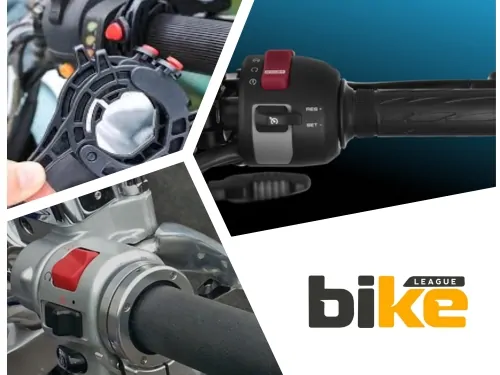
Long story short: Long motorcycle journeys can be tough—discover how cruise control transforms comfort, safety, and endurance for riders.
Cruise control used to be found only in luxury cars, but now it is becoming common on many types of Indian motorcycles. With better highways and more people interested in long rides, riders want features that make travel more comfortable, convenient, and safe. Whether built-in or added later, motorcycle cruise control is changing the experience for both enthusiasts and daily commuters.
So, what is cruise control, and how can it help riders in India? This guide covers the different types of motorcycle cruise control, their pros and cons, safety tips, and the latest trends. Whether you ride long distances or mostly in the city, you’ll find useful information here about cruise control in India.
Key Takeaways
- Motorcycle cruise control is increasingly accessible in India, offering comfort and convenience for both touring enthusiasts and daily commuters.
- There are multiple types of cruise control systems—mechanical, electronic, and adaptive—each with distinct benefits and installation considerations for Indian motorcycles.
- Safe usage and proper maintenance are crucial for maximising the advantages of cruise control, with practical tips and troubleshooting advice tailored to Indian road conditions.
- Legal, regulatory, and warranty factors should be considered before installing aftermarket cruise control to ensure compliance and rider coverage.
- The Indian market is witnessing rapid innovation in cruise control technology, with future trends pointing toward greater integration, affordability, and adoption across a wider range of motorcycles.
What Is Cruise Control In Motorcycles?
Cruise control allows riders to maintain a steady speed without constantly holding the throttle. This is especially helpful on long highway rides, as it reduces fatigue and ensures a consistent speed.
What Are The Different Types Of Motorcycle Cruise Control?
- Standard Electronic Cruise Control
- Adaptive (Radar-Based) Cruise Control
- Mechanical Throttle Locks
Let’s take a closer look at the different types of motorcycle cruise control.
1. Standard Electronic Cruise Control
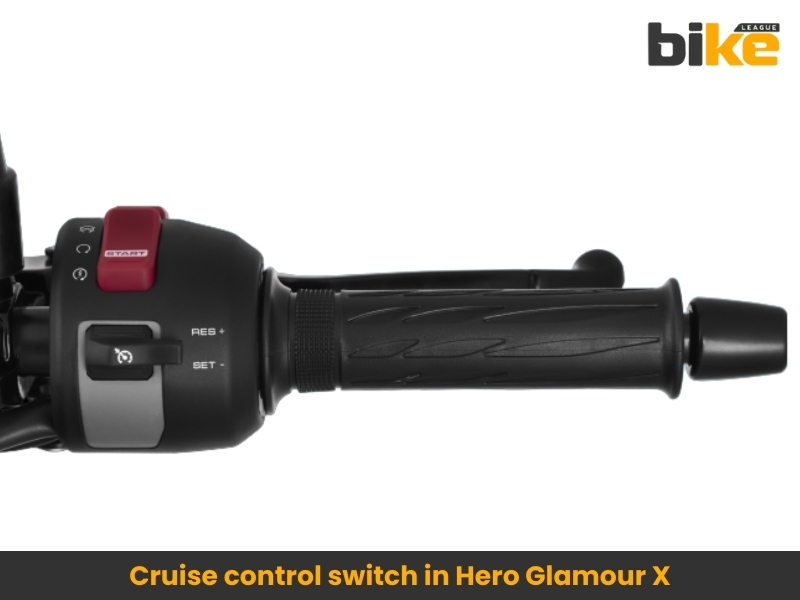
How Standard Electronic Cruise Control Works
Motorcycle cruise control connects to the speedometer, fuel injection system, and throttle. Once you reach your chosen speed and press the button, the system keeps that speed for you, so you don’t have to hold the throttle all the time.
If you use the brakes or pull the clutch, cruise control turns off automatically for safety. You can also change your speed with the control buttons or turn off the system by twisting the throttle or using the brakes.
List Of Some Motorcycle Models In India Featuring Standard Electronic Cruise Control
- KTM Duke 390
- KTM 390 Adventure
- Suzuki Hayabusa
- Kawasaki Ninja ZX-10R
- Harley-Davidson Pan America 1250
- BMW S 1000 R
- Ola Electric S1 Pro
- Odysse Electric Hawk Plus
- OLA Roadster
- Kawasaki Z900
- Kabira Mobility KM3000
Pros Of Standard Electronic Cruise Control
- Reduced Rider Fatigue: No need to constantly operate the throttle, leading to less strain during long rides.
- Improved Fuel Efficiency: Maintaining constant speed helps optimise engine performance. It can boost mileage, especially over highway journeys.
- Speed Regulation: Helps prevent speeding, especially in zones with strict enforcement.
- Convenience for Touring: Makes long-distance travel less tiring and more enjoyable, especially on open highways.
Cons Of Standard Electronic Cruise Control
- Limited Use in Urban Traffic: Cruise control is most effective on open highways, as frequent stops and unpredictable traffic in cities make it unsuitable for regular urban use.
- Potential Drowsiness: Maintaining a steady speed for long periods can reduce rider alertness.
- Reaction Time: Leg relaxation may increase the time taken to react in emergencies.
- Expense & Complexity: Still limited mainly to mid- and high-end motorcycles; aftermarket options are costly and complex to install/repair.
- Maintenance Concerns: More electronics mean more points of failure; repairs can be expensive and complex compared to throttle locks or manual systems.
Step-by-step Flow Of Cruise Control Working On Motorcycles
- The rider accelerates to the target speed and presses the ‘SET’ button.
- The ECU stores the desired speed.
- The throttle actuator maintains this set speed by monitoring and adjusting the throttle position.
- Pressing the brakes or clutch, or manually turning OFF the system, immediately disengages cruise control as a safety measure.
- The RESUME/ACCEL/DECEL buttons enable incremental speed changes without requiring manual throttle input.
2. Adaptive Cruise Control
Adaptive Cruise Control (ACC) is a system that automatically changes your bike’s speed to keep a safe distance from vehicles in front. Unlike regular cruise control, which just keeps a set speed, ACC uses radar sensors to watch traffic and can adjust the throttle or apply the brakes when needed.
ACC is mostly found on high-end touring and adventure motorcycles that have electronic throttle control. It is one of the closest features to semi-autonomous riding available for two-wheelers.
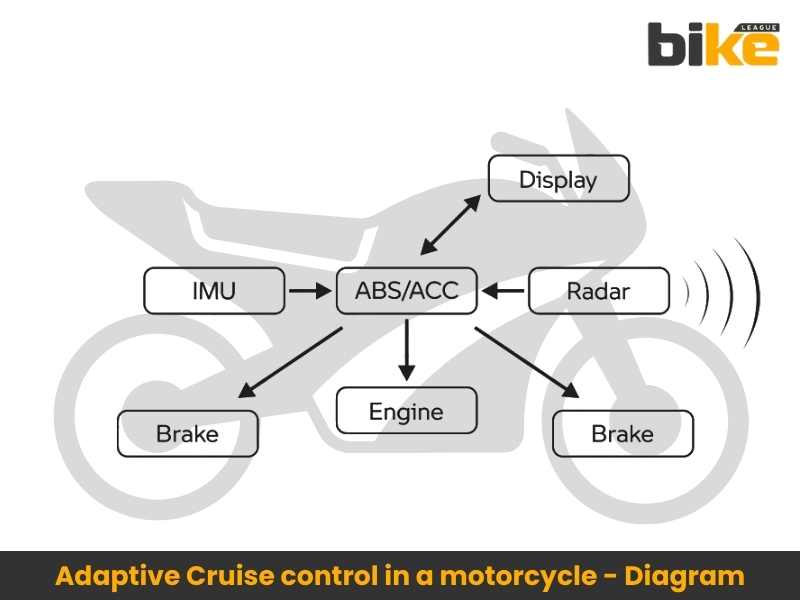
How Does Adaptive Cruise Control Work?
Some high-end motorcycles have adaptive cruise control (ACC), which uses a radar sensor to watch the traffic ahead. ACC automatically changes your speed to keep a safe distance from vehicles in front.
If a vehicle in front slows down, the system reduces the throttle or applies the brakes to keep a safe distance. When the road is clear again, it speeds back up to your set speed.
List Of Some Models In India Having Adaptive Cruise Control
Here is a list of motorcycles available in India that feature Adaptive Cruise Control (ACC):
- KTM 1290 Super Adventure S / EVO
- Kawasaki Ninja H2 SX SE
- Harley Davidson Low Rider S
- Ducati Scrambler Full Throttle
- Ducati Multistrada V4
- Honda Gold Wing
- Harley Davidson Sportster S
Pros Of Adaptive Cruise Control
- Reduces rider fatigue: ACC minimises the need for constant throttle, brake, and clutch adjustments on long highway rides, making touring much more comfortable.
- Improves safety: By automatically maintaining distance from vehicles ahead and sometimes assisting with braking, ACC helps avoid rear-end collisions and promotes safer group or urban riding.
- Smoother ride: Consistent speed and smooth automatic adjustments reduce abrupt acceleration or braking, leading to a more relaxed and controlled experience.
- Advanced features: Modern ACC systems may support group ride modes, collision warnings, brake assist, and multi-level distance settings.
- Promotes fuel efficiency: Maintaining a steady speed and avoiding sudden accelerations can improve fuel economy during long journeys.
Cons Of Adaptive Cruise Control
- Higher cost: Motorcycles with ACC are significantly more expensive due to added sensors, specialised software, and integration requirements.
- Complexity and maintenance: ACC systems require calibration, sensor care, and can be costly to repair if damaged.
- Unpredictable road challenges: On chaotic or unpredictable roads, ACC may struggle with erratic traffic, sudden lane changes, and significant obstacles, demanding rider vigilance and manual intervention.
- Potential overreliance: Riders might become complacent or rely too heavily on the system, slowing reaction times during sudden incidents.
- Compatibility issues: Aftermarket installation is rarely feasible; ACC is generally available only in select new, high-end models, limiting widespread adoption and upgrade possibilities.
- Weather and visibility limits: Radar and camera-based systems can be less effective in heavy rain, fog, or dust.
Adaptive Vs Standard Cruise Control In Motorcycles
The table below compares adaptive cruise control and standard cruise control on motorcycles.
| Feature | Standard Cruise Control | Adaptive Cruise Control (ACC) |
|---|---|---|
| Functionality | Maintains a fixed speed set by the rider | Automatically adjusts speed to maintain safe distance from vehicles ahead |
| Speed Adjustment | Rider adjusts speed manually | System automatically accelerates or decelerates based on traffic conditions |
| Traffic Interaction | Does not respond to slower traffic or obstacles | Detects and reacts to other vehicles with radar or sensors |
| Brake Control | No automatic braking | Can apply brakes automatically to maintain safe following distance |
| Throttle Control | Maintains throttle position electronically | Controls throttle and sometimes brakes for smooth speed control |
| Safety | Disengages when brakes or clutch are applied | Adds collision warning, safe distance keeping, and adaptive speed changes |
| Use Cases | Suitable for long, open highway stretches with steady traffic | Best for varying traffic and dynamic road conditions, including stop-and-go traffic |
| Technology Complexity | Simple system with throttle control | Complex system with radar, sensors, electronic control unit, and braking integration |
| Rider Convenience | Reduces fatigue by eliminating constant throttle operation | Enhances safety and convenience by handling distance and speed dynamically |
| Cost and Availability | Common in mid to high-end motorcycles | Mostly available in premium adventure and touring motorcycles |
3. Mechanical Throttle Locks
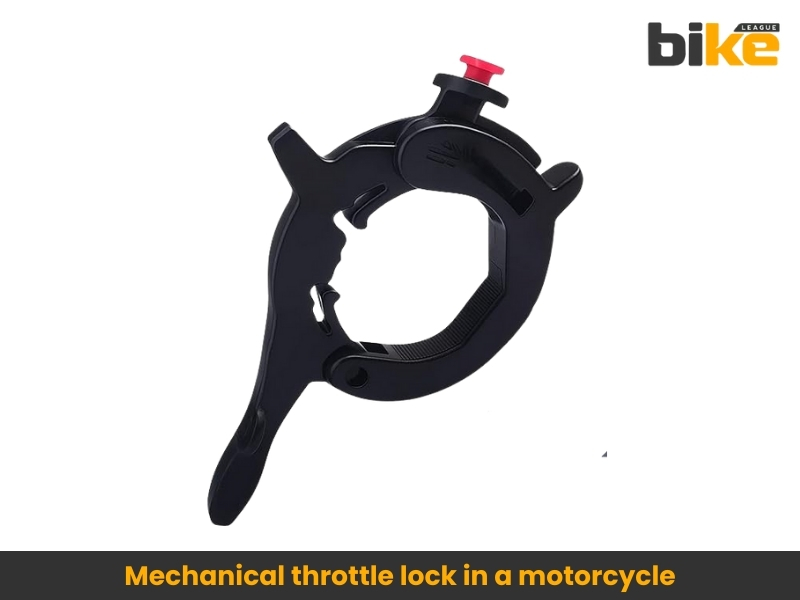
Mechanical throttle locks work by adding friction to the throttle sleeve under the grip, so the engine speed stays steady at the position you choose. Devices like the Kaoko and ATLAS Throttle Lock attach to the end of the grip and can be turned on or off quickly with your thumb or palm. Unlike electronic cruise control, you have to adjust these locks by hand, but you can override them instantly for safety.
Pros Of Mechanical Throttle Locks
- Reduces wrist fatigue: Great relief on long rides—no need to grip the throttle constantly.
- Affordable and universal: Easy to install, fits nearly any motorcycle, no electrical modification required.
- Quick installation/removal: Most take 5–10 minutes to install and can be transferred between bikes.
- Doesn’t interfere with electronics: Can be used alongside electronic cruise control or heated grips.
- Instant override: Friction-based locks can be disengaged quickly by rolling off the throttle for emergency braking.
Cons Of Mechanical Throttle Locks
- No automatic speed adjustment: Unlike adaptive electronic systems, mechanical locks don’t react to changes in terrain, incline, or traffic—manual input is needed.
- Potential safety risks: If a rider forgets the lock is engaged, reaction time may be reduced in emergencies.
- Grip ergonomics: Some locks can make grips or handlebars feel cramped, especially rubber sleeve styles.
- Less precise for fine adjustment: Finding the optimal friction and position for steady cruising can take practice, and cheaper models may loosen with vibration or over time.
- Not true cruise control: The device holds throttle position, so speed can vary with wind, hills, or load changes.
What Are The Specific Safety Features Of Cruise Control Systems In Motorcycles?
- Automatic Disengagement: Engaging the clutch or brakes instantly turns off the cruise control, giving the rider complete control when necessary.
- Electronic Fault Monitoring: Most systems monitor for throttle, sensor, and brake malfunctions, disabling cruise if any abnormality is detected.
- Speed Limit & Gear Restrictions: Many systems only engage at speeds above 32 km/h and in higher gears, preventing activation in low-speed, high-traffic situations.
- Manual Cancel Controls: Riders can easily deactivate cruise with a dedicated switch or throttle override.
- Adaptive Cruise Control (ACC): Premium models feature radar-based ACC, which automatically adjusts speed to maintain a safe following distance and sometimes even modulates speed in curves for improved stability.
- Throttle-by-Wire Presets: Modern systems offer precise electronic throttle control, reducing the risk of accidental acceleration or system “runaway”.
How Does Cruise Control Affect The Overall Riding Experience In Varied Weather Conditions In India?
1. Monsoon & Rainy Conditions
- Reduced Traction: Cruise control should not be used on wet or slippery surfaces. It can delay the rider’s response time to unexpected hydroplaning or a sudden loss of grip, increasing the risk of accidents.
- Hydroplaning Danger: If the motorcycle begins to hydroplane while cruise is engaged, the system may not reduce speed as quickly as required, leading to loss of control.
- Recommendation: Riders should turn off cruise control in the rain or on waterlogged roads to maintain manual speed management and responsiveness.
2. Hot Summers
- Tyre & Engine Stress: Consistent high-speed cruising can further heat tires and engines, so regular checks for tyre pressure, coolant, and engine temperature are crucial.
- Fatigue Reduction: Cruise control offers a significant comfort advantage on long, hot highway stretches by helping prevent fatigue from holding the throttle for hours.
3. Fog, Dust, And Winter
- Limited Visibility:In fog and low-visibility scenarios, quick speed adjustments are often required. Cruise control could delay these reactions, making manual operation safer.
- Curve and Corner Response: Adaptive systems (with curve control) help by adjusting speed based on lean angle or curves, but for standard cruise, disengagement before curves is widely recommended.
What Are The Best Practices For Riders While Using Cruise Control On Bikes?
Here are a few tips riders should consider while using cruise control.
- Avoid Over-Reliance: Cruise control, especially on long, straight highways, can lead to reduced stimulation and increased drowsiness or inattentiveness; studies indicate longer reaction times when relying solely on cruise control.
- Take Regular Breaks: Stop every hour or so to stretch, hydrate, and refocus—this is vital for managing both mental and physical fatigue.
- Change Riding Routine: Vary your speed (where safe and legal), adjust your position, and periodically turn cruise control off to stay engaged.
- Stay Hydrated and Fed: Dehydration and low blood sugar can seriously impact alertness; drink water and snack as needed.
- Use Music or Audio Cues: Stimulate your senses with safe music or audio (not noise-cancelling earbuds), but don’t drown out essential road sounds.
- Mental Engagement: Practice visualisation, scan for hazards, and anticipate traffic changes instead of zoning out.
- Riding with a group: Group riding makes the journey more engaging, helps maintain alertness, and provides regular stop cues.
What Are The Common Issues Riders Face With Cruise Control On Motorcycles?
In India, riders using cruise control on bikes like the KTM 390 Adventure, TVS Apache RTR 310, Suzuki Hayabusa, Harley‑Davidson Pan America, and others often report the following issues:
- Cruise won’t engage at all: Sometimes the indicator light comes on briefly, but the system refuses to activate, especially below the minimum speed threshold (around 32–40 km/h) or if the bike is in a low gear.
- Cruise drops out unexpectedly: The system may suddenly disengage on highways, especially after hitting potholes, bumps, or rough patches, which may indicate a loose sensor, a wiring issue, or a faulty brake/switch input.
- Erratic speed changes or hunting: Instead of holding a steady speed, the bike may accelerate and decelerate in a loop, indicating a faulty throttle sensor, servo, or misaligned throttle‑by‑wire components.
- Accidental or “stuck” engagement: Mechanical throttle locks or poorly calibrated electronic systems can sometimes stay engaged when the rider expects them to disengage, delaying braking response in traffic.
- Intermittent or “no‑set” behaviour: Cruise control works only sometimes, often when the bike is cold, or only above a certain speed; this is usually linked to dirty or loose electrical connections, a failing sensor, or a switch that is not fully clicking.
- Water damage or heat‑related glitches: After heavy monsoon riding or on long, hot, highway stretches, moisture ingress or heat stress can cause wiring or sensor faults, leading to undefined error states or failure to engage.
- Aftermarket kit failures: Universal or mechanical throttle‑lock kits can loosen, jam, or interfere with throttle return, posing a risk of unintended acceleration if not properly maintained or adjusted.
What To Do If Cruise Control Fails Mid‑ride?
Cruise control can sometimes glitch while you’re riding, especially on long highway runs. Knowing how to react quickly and safely makes a big difference. Here’s a simple, doable checklist:
1. Stay Calm And Keep Both Hands On The Handlebars
The first instinct should be control, not panic. Grip the handlebars firmly, keep your body relaxed, and avoid sudden jerks or swerves.
2. Immediately Disengage Cruise Control
Use the handles:
- Press the brake lever fully; this must cancel the cruise.
- Or pull in the clutch and roll off the throttle.
If the system still feels like it is resisting or “holding” the throttle, apply the brakes firmly and shift down to reduce engine speed.
3. Check For Obvious Warning Signs
Look at the instrument cluster:
- Do the ABS/Check‑engine/TC lights stay on or flash unexpectedly?
- Does the cruise indicator light remain on even after braking?
If any of these are abnormal, take a note of the condition and avoid using cruise control for the rest of that ride.
4. Test Responsiveness At A Safe Opportunity
Once you reach a safe, low‑traffic stretch (or a rest area), test:
- Whether the throttle returns to idle smoothly.
- Whether the brake and clutch switches respond normally (brake lights come on, engine rpm drops when the clutch is pulled).
If the throttle feels sticky, slow to return, or the brakes don’t feel normal, do not use cruise control again until the bike is inspected.
5. Disable Cruise Control And Finish The Ride Manually
- If the system keeps cutting out, refuses to engage, or behaves erratically, turn it off completely and ride without it.
- Take extra breaks, stretch your wrists, and consciously manage your right-hand speed instead of relying on automation.
6. Book A Service Or Ask The Dealer For A Scan
At the earliest opportunity, get the bike checked by a trusted mechanic or authorised workshop.
Ask Them To
- Check brake/switch wiring, speed‑sensor plug, and all related fuses and connectors.
- Run a diagnostic scan if the bike’s manual supports cruise‑control fault codes.
7. Ride Safely When The Cruise Is Iffy
- Do not use cruise on broken tarmac, speed breakers, or in heavy traffic.
- If the system ever fails to disengage cleanly with the brakes or clutch, treat it as unsafe and stop using it until the problem is fixed.
What Are The Common Misconceptions About Cruise Control In Two-wheelers?
Many riders in India wonder if cruise control is safe, needed, or right for their bike and riding style. Here are some common myths and the real facts.
Myth 1: “cruise Control Is Unsafe On Motorcycles”
Reality: Modern electronic cruise control on bikes is designed with safety in mind. It automatically disengages the moment you touch the brake lever, pull the clutch, or twist the throttle, giving you full manual control back. On well‑built systems, it also has speed‑ and gear‑based restrictions (for example, enable‑only above 32 km/h and in higher gears), so it simply cannot be used in low‑speed, high‑risk situations. Used correctly on open highways and in good conditions, it is more of a comfort and consistency aid than a hazard.
Myth 2: “cruise Control Is Only For Big, Expensive Touring Bikes”
Reality: While it started on premium tourers and adventure bikes (like the BMW RT, KTM Super Adventure, and Ducati Multistrada), cruise control is now trickling down to mid‑range and even 125‑cc bikes such as the Hero Glamour X and OLA Roadster. The feature is increasingly about riding comfort and rider discipline—helping you hold a steady speed on straights—rather than being reserved only for long‑distance luxury machines. Once a bike has a ride‑by‑wire throttle and adequate electronics, cruise control can be integrated regardless of engine size.
Myth 3: “if Cruise Control Turns On, I Can ‘zone Out’”
Reality: Cruise control handles the throttle, not your attention. You still need to watch for traffic, lane‑cutting vehicles, sudden speed breakers, and road obstacles. In fact, many riders who misuse the system report higher fatigue and slower reaction time because they lean into autopilot mode. The safest use is to treat cruise control as a tool that reduces hand‑wrist fatigue, not as a license to stop paying attention. Disengaging it before curves, construction zones, or crowded stretches keeps you in control.
Myth 4: “any Throttle‑locking Device Is Just As Good As Proper Cruise Control”
Reality: Mechanical throttle locks or “Kaoko‑type” clamps can hold the throttle open, but they are not dynamically controlled systems. They do not talk to the ECU, do not sense speed changes, and might not disengage as cleanly, especially cheap units that loosen over time. Electronic cruise control, by contrast, lets the bike’s electronics hold a precise speed, and you can fine‑tune acceleration or deceleration from the handlebar buttons. For safety and refinement, electronic systems are superior; mechanical locks are a budget‑friendly add‑on, not a true replacement.
Myth 5: “cruise Control Is Useless On Indian Roads”
Reality: On chaotic inner‑city streets or narrow gullies, cruise control is indeed of limited use, and it’s wise to keep it off. However, on well‑paved highway stretches, interstate roads, and deserted stretches outside major cities, it becomes very useful for reducing fatigue and holding a steady, legal speed. Technologies like Hero and OLA’s fitting cruise, even on 125‑cc commuter‑touring models, are proof that the feature can be practical on Indian roads—if riders know when and where to use it.
Faq About Cruise Control On Motorcycles
1. Which Motorcycles In India Have Cruise Control As Standard?
Popular models include the Hero Glamour X, KTM 390 Adventure, TVS Apache RTR 310, OLA Roadster, Suzuki Hayabusa, and Kawasaki Ninja ZX-10R.
2. What Are The Benefits Of Cruise Control For Indian Riders?
It reduces wrist fatigue, enhances riding comfort on long trips, helps maintain legal speed limits, and improves fuel efficiency on highway travel.
3. Is Cruise Control Available On Budget Or Commuter Motorcycles?
Yes, with recent launches like the Hero Glamour X (in the 125cc segment) and the OLA Roadster, cruise control is now available on entry-level bikes.
4. Are Adaptive Or Radar-based Cruise Control Systems Available In India?
Adaptive cruise control is currently limited to premium bikes, such as some Ducati and BMW models. It is not commonly found on mass-market motorcycles in India.
5. How Is Cruise Control Activated Or Deactivated On Motorcycles?
To activate cruise control, use the handlebar switch once you reach your desired speed. It will turn off immediately when you use the brakes, clutch, or throttle.
6. Can Cruise Control Be Installed As An Aftermarket Feature On Any Bike?
You can add basic cruise control with mechanical throttle locks or universal kits. However, electronic cruise control is usually built into certain motorcycles.
7. What Are The Safety Risks Or Considerations Of Using Cruise Control?
Riders should always stay alert because cruise control cannot react to sudden changes in traffic. It is important to turn it off quickly during emergencies to stay safe.
8. Does Cruise Control Work On City Streets Or Only On Highways?
Cruise control works best on highways. In city traffic, where you often need to stop or change speed, it is not as helpful.
Other Related Articles From Bikeleague India
- What all basic motorcycle accessories should a rider have
- Braking in motorcycle – All expert tips for bikers
- Indian Roadmaster
- Bajaj Avenger Cruise 220
- Ducati Multistrada V2
Conclusion
As Indian roads and highways improve, motorcycle cruise control is becoming more than just a luxury. It is now a practical tool for comfort, safety, and efficiency. Whether you ride long distances or commute daily, knowing your options and following best practices can help you get the most out of this technology.
If you stay informed about legal rules, keep up with maintenance, and watch for new developments, you can use cruise control with confidence for a smoother and more enjoyable ride. Cruise control is set to become an important part of motorcycling in India, making every trip easier and more comfortable.
If you have more questions about motorcycle cruise control, feel free to email us at bikeleague2017@gmail.com, leave a comment, or reach out on Bikeleague India’s social media. We’re happy to help.