

Long story short: Confused about power & torque in Two‑wheelers? Learn how specs, dyno curves, and riding feel impact city commutes, touring, and track riding.
Understanding the difference between power and torque is essential for motorcycle riders. These two engine traits shape how a bike feels, affect acceleration, top speed, and fuel efficiency.
Daily commuters, touring riders, and sport bikers all benefit from knowing how torque and power affect performance. This guide explains torque and power, their relationship, and their impact on various riding scenarios and bike types.
Key Takeaways
- Torque and power are distinct but closely related engine characteristics that significantly influence a motorcycle’s performance.
- Torque controls how quickly a motorcycle accelerates, especially at low speeds. Power affects top speed and overall performance at higher RPMs.
- Different motorcycles use different torque-to-power ratios. These ratios cater to commuters, tourers, and sport riders.
- Understanding the roles of torque and power helps riders choose the motorcycle best suited to their riding style and intended use.
- Scenarios like overtaking, hill climbs, and city commuting show the real impact of torque and power choices.
What Is Torque?
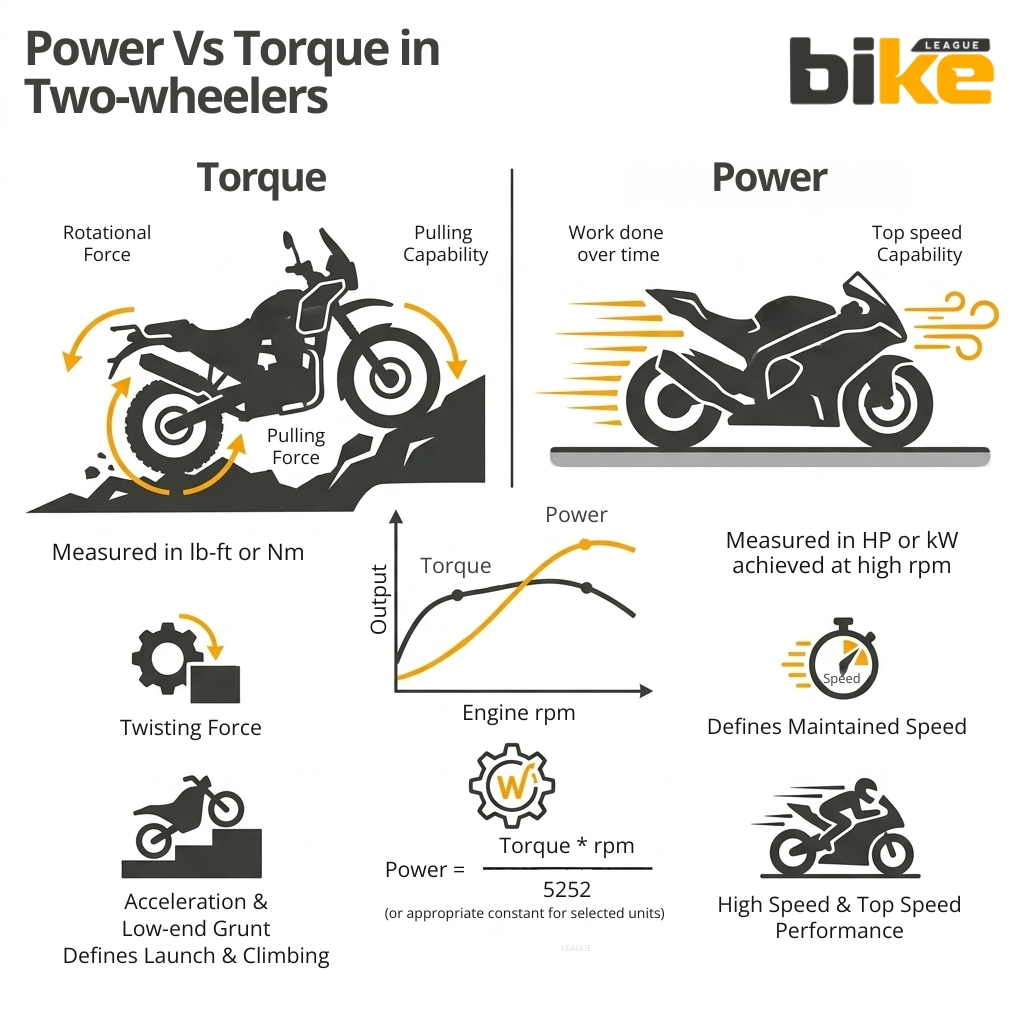
Torque is a twisting force—the kind that makes something turn or rotate. In an engine, torque is what turns the crankshaft. On motorcycles, it’s measured in Newton-meters (Nm). For riders, torque is the “pull” or “shove” you feel when you open the throttle, especially at low rpm.
Picture using a spanner on a nut: pushing harder, or using a longer spanner, increases torque because you’re applying more turning force. On a motorcycle, more torque at low engine speeds helps the bike pull away smoothly, climb hills, and carry extra weight with less effort.
What Is Power?
Power is simply how quickly work gets done. In engine terms, power shows how fast torque can be delivered. It’s usually measured as horsepower (hp), PS, or kilowatts (kW). Mathematically, for something that spins, power equals torque times how fast it’s spinning (rpm), with a constant added to suit the units. In imperial units, the common formula is:
Horsepower = Torque×RPM/5252
Here, torque is measured in pound-feet, and rpm is the engine’s rotational speed. The same idea applies in metric units, but the constant changes. If you spin the engine faster with the same torque, you get more power.
The Relationship Between Torque And Power
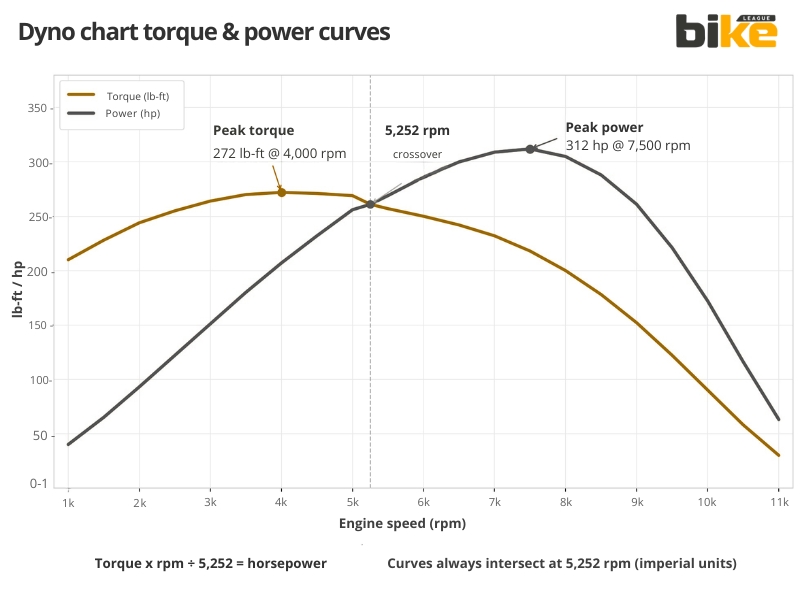
Power and torque are always linked—power is torque multiplied by rpm. If an engine holds its torque as revs climb, its power rises almost in a straight line with rpm. Dyno charts usually show power curves climbing with rpm, even if the torque curve stays flat.
Conceptually:
- Torque is how hard the engine can twist.
- Power is how quickly it can keep doing that twisting.
Both matter: you can’t have power without torque, and lots of low-end torque alone won’t give much power unless the engine can also spin quickly.
How Power And Torque Affect Two-wheeler Riding?
1. Getting Started, Low-speed Control, And Climbing Hills
At low speeds and in lower gears, the torque at the rear wheel decides how easily the bike gets moving and how relaxed it feels in traffic. Bikes with strong low-end torque let you pull away smoothly, use less throttle, and change gears less often—handy in city rides, when carrying a pillion, or tackling hills.
That’s why commuter, cruiser, and touring motorcycles usually have higher torque numbers at modest rpm. The goal is a strong, usable push rather than just chasing top-end power. Their single-cylinder, long-stroke engines are designed for a wide torque band in the lower and middle revs.
2. Accelerating Through The Gears
In each gear, acceleration feels strongest near the rpm where the torque at the wheel peaks. More torque at the tyre means a stronger forward push. When you factor in gearing, power becomes a better guide to overall acceleration. Power combines torque and rpm, allowing you to compare bikes with different gear ratios or engine designs.
In real riding, you change up to stay in the engine’s strong power band. High-revving sports bikes might feel weak at low rpm. Keep them near peak power, and they accelerate quickly. Bikes with lots of mid-range torque feel punchy without much revving.
3. Top Speed And Highway Cruising
A bike’s top speed mostly depends on how much power the engine can deliver compared to the force of air pushing back at high speeds. As you go faster, wind resistance climbs quickly, so the engine needs plenty of power at high rpm just to keep going. That’s why motorcycles built for sporty riding often highlight their high peak power—they’re designed to hold fast cruising speeds and reach top speeds out on the open road.
High torque at low rpm isn’t enough for really high speeds unless the engine is huge or the gearing is special. That’s why performance bikes mix decent torque with the ability to rev high, giving strong acceleration and the power needed for top speed.
4. Fuel Efficiency And Relaxed Riding
Engines with plenty of torque at low to mid rpm let you cruise at lower engine speeds for the same road speed. This usually means less noise and can help with fuel economy, as long as you ride smoothly. On the other hand, engines that only make their best power at high revs often tempt you to keep the revs up, which can use more fuel if you’re always chasing peak performance. For comfort, strong mid-range torque means fewer gear changes, smoother overtakes, and less need to change down hard—something most riders appreciate in daily use.
Torque Curves, Power Curves, And Engine Character
Visualising Torque And Power Curves
Imagine a dyno chart with two lines: a blue torque line and a red power line, both plotted against engine speed (rpm).
- Flat torque curve: The blue line stays steady for much of the rpm range, showing the engine delivers similar torque whether at low, mid, or high rpm. This gives smooth, predictable power in any gear.
- Rising power curve: The red line starts low and climbs as rpm increases, because power is torque multiplied by rpm. The curve peaks at high rpm, where the engine makes its maximum power.
- Peaky curve: If the torque line has a sharp hump, the engine feels weak below that rpm, then suddenly strong and urgent as you hit the peak—this is common in high-performance engines.
In real dyno charts, the intersection point of the torque (Nm) and power (hp) lines is often at 5252 rpm (in imperial units), because their relationship is calculated that way. Visualising these curves helps riders understand why some bikes feel strong and flexible everywhere, while others deliver a sudden rush only at high revs.
Understanding Torque And Power Curves
Dyno charts show how torque and power change as engine speed (rpm) rises. A flat torque curve means the engine delivers similar torque over a wide rpm range. This gives you predictable, flexible performance across different gears. Since power is torque times rpm, the power curve rises with engine speed until torque drops off or you hit the rev limiter. A peaky torque curve has a clear hump, indicating much more torque in a narrow rpm band. Bikes with this kind of curve often feel flat below the torque peak, but then surge forward once they hit that range. This encourages more aggressive, high-rev riding.
Long‑stroke Vs Short‑stroke Behaviour
In motorcycles, stroke length—the distance the piston travels—has a big effect on where torque is strongest in the rev range. Long-stroke engines usually deliver stronger low- to mid-range torque but can’t rev as high. This suits relaxed riding or carrying extra weight. Short-stroke or oversquare engines tend to rev higher, moving more of their useful torque and power towards the top end—great for sporty bikes. Tuning for different motorcycle roles
Tuning For Different Motorcycle Roles
Manufacturers design torque curves depending on the motorcycle’s purpose. Touring and cruiser bikes are tuned for strong torque at low and mid rpm. This helps them move heavy loads and tackle hills without frequent gear changes. Sportbikes are tuned for power near the redline. They may give up some low-rpm strength for top-end punch on fast roads and race tracks. Modern tech like advanced ECUs, variable valve timing, and clever intake or exhaust designs help widen the torque band. Even sporty bikes can perform well at low rpm and still deliver high peak power.
Power Vs Torque In Two-wheelers: Comparison Table
| Aspect / Question | Torque (Nm) | Power (hp / PS / kW) |
|---|---|---|
| What is it? | Twisting force at the crankshaft or motor; “pull” | Rate of doing work; how fast torque is delivered |
| What does it control in riding? | How strongly the bike can push at a given instant | How quickly the bike can keep accelerating and its top speed |
| Where in the rev range is it strongest? | Usually low to mid rpm for commuters/cruisers; higher for sporty engines | Usually higher up the rev range, near the redline |
| Best for | Quick launches, low-speed control, hills, carrying load | High-speed cruising, strong acceleration at higher speeds |
| Rider feel when it’s high | Strong shove, easy pull from low rpm, fewer gear changes | Urgent top-end rush, keeps pulling hard as revs rise |
| City traffic impact | Makes starts, u‑turns, and gaps effortless | Less important unless you rev hard and ride aggressively |
| Highway and touring impact | Helps with roll-on overtakes and relaxed cruising | Decides how fast the bike can go and how long it can hold high speeds |
| Fuel efficiency link | Good low‑rpm torque lets you cruise at lower revs | Chasing peak power at high rpm usually burns more fuel |
| Typical examples | Classic 350, Dominar 400, Avenger‑type cruisers | Duke 390, R15, RC390, full‑fairing sport/track bikes |
| Simple way to remember | “How hard it twists” – pulling strength | “How fast it works” – overall performance and speed |
Spec Sheets: How To Read Power And Torque Numbers In Two-wheelers
1. Peak Numbers Versus Real-world Performance
Spec sheets usually show only the peak power and peak torque, along with the rpm at which they occur. But those numbers alone don’t tell you how broad or usable the engine’s strong band really is—they just give you a clue.
A few things to check:
- Peak torque rpm: If it’s a lower number (like 4,000–5,000 rpm on a mid-capacity bike), you’ll get a stronger pull in the low to mid range.
- Peak power rpm: A higher number means the engine is more rev-happy and gives its strongest acceleration near the top of the rev range.
Two bikes might have the same peak torque but reach it at different rpm. The one that hits peak torque earlier usually feels stronger around town. At the same time, the other might need more revs and gear changes to feel exciting.
2. Gearing And Torque At The Wheel
Torque quoted in brochures is crankshaft torque. What actually accelerates the bike is torque at the rear wheel, which depends on the engine torque multiplied by the overall gear ratio (primary drive, gearbox gear, and final drive).
Lower gears multiply torque more. The same engine delivers much higher wheel torque in first gear than in higher gears. This is why acceleration is strongest in lower gears. A motorcycle with lower engine torque but shorter gearing can still feel punchy at the wheel. In contrast, a bike with higher torque but tall gearing may feel softer at low speeds.
3. Weight And Power‑to‑weight / Torque‑to‑weight
The effect of torque and power on real‑world performance is also influenced by motorcycle weight. Power‑to‑weight and torque‑to‑weight ratios give a better idea of how quickly a bike can accelerate than raw power or torque figures alone.
Lighter bikes with moderate power can feel lively. Heavier machines may need much more torque and power to deliver similar acceleration. Touring motorcycles often trade acceleration for stability and comfort. They rely on strong low‑rpm torque to mask their extra mass.
Matching Power And Torque To Two-wheeler Riding Style
1. City Commuting And Daily Use
In city riding, with lots of starts, stops, and lower speeds, strong low- to mid-range torque matters more than a sky-high peak power number. Engines that give you useful torque early on make for smoother getaways, less shifting, and less need to rev hard every time the light turns green.
Commuter motorcycles, scooters, and upright bikes are usually tuned this way, making them easy to ride for beginners and simple to handle in dense traffic. Automatic scooters use a CVT (continuously variable transmission) to keep the engine in its torque band, which means smooth, step-free acceleration.
2. Highway Touring And Pillion Riding
For highway touring, especially when you’re carrying luggage and a passenger, it helps to have both good mid-range torque and enough power. Strong torque makes overtaking easy, without needing to shift down all the time. Enough power at cruising speeds helps you maintain pace on hills or when facing a headwind.
Touring bikes often use multi-cylinder or larger single-cylinder engines that emphasise a wide, flat torque curve rather than chasing the highest revs. They might not have the highest peak power on paper. Still, their torque delivery makes them great companions for long rides in the real world.
3. Sport Riding And Track Use
For aggressive riding and track days, having lots of power at high rpm really matters. Riders usually keep the engine buzzing near its power peak, using close-ratio gearboxes to get the most acceleration out of corners and down the straights.
These engines might feel a bit weak at low rpm compared to torquey commuters or cruisers. Still, once you’re in the right rev range, they deliver quick acceleration and high top speeds. You’ll see high horsepower numbers and higher peak torque rpm on their spec sheets—signs of an engine built for top-end excitement.
4. Summary Table: Typical Tuning Focus
| Motorcycle role | Torque focus | Power focus | Rider feel |
|---|---|---|---|
| City commuter / scooter | Strong low‑end, early peak torque | Moderate peak power at lower rpm | Easy launches, smooth in traffic, minimal shifting batteryswapstation+1 |
| Tourer / cruiser | Broad low‑mid torque band | Adequate but not extreme peak power | Relaxed cruising, easy overtakes with load |
| Sport / track bike | Modest low‑end, strong mid‑to‑top torque | High peak power at high rpm | Explosive acceleration when revved, high top speed v1moto+1 |
Real‑world Example: Royal Enfield Classic 350 Vs Ktm Duke 390 Vs Bajaj Dominar 400
To make the torque–power discussion more concrete, compare three popular Indian motorcycles with very different characters:
- Royal Enfield Classic 350 (relaxed torquey single)
- KTM 390 Duke (rev‑happy performance naked)
- Bajaj Dominar 400 (power cruiser / tourer)
1. Royal Enfield Classic 350: Easy, Low‑end, And Mid‑range
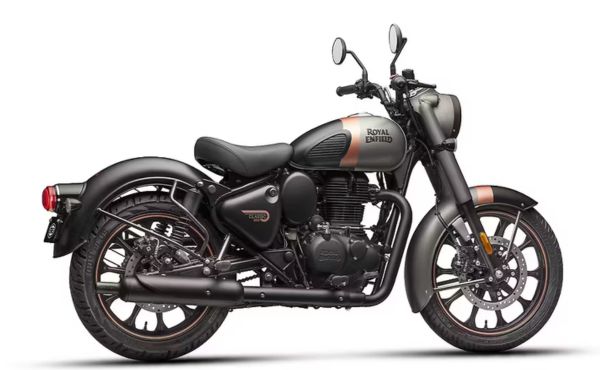
The Classic 350’s 349 cc single produces about 20.48 PS at 6,100 rpm and 27 Nm at just 4,000 rpm.
Click the link to know more details: Royal Enfield Classic 350
On the road, this means:
- Torque comes in early, so it pulls cleanly from low rpm without needing many downshifts.
- The strongest shove is in the low‑to‑mid band (around 3,000–5,000 rpm), perfect for city speeds and relaxed highway cruising around 80–90 km/h.
- Top‑end rush is modest; the bike prefers short‑shifting and riding the torque rather than chasing the redline.
This is a textbook example of a broad, low‑rpm torque curve tuned for comfort and simplicity rather than peak power.
2. Ktm 390 Duke: Strong Mid‑range, High‑rpm Power
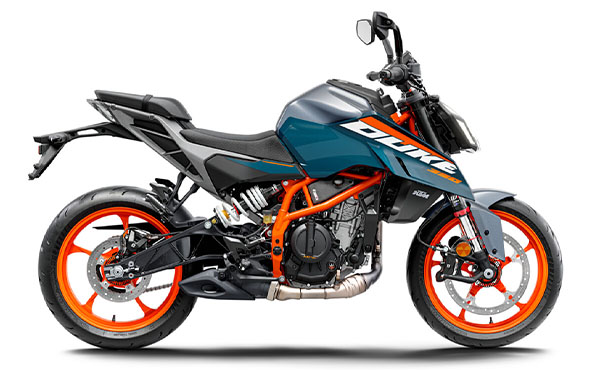
The latest KTM 390 Duke uses a 398.63 cc single that makes about 46 PS at 8,500 rpm and 39 Nm at 6,500 rpm.
Click the link to know more details: KTM 390 Duke
On the road, this means:
- Compared to the Classic, the Duke’s torque peak sits higher in the rev range, so the engine wakes up properly only once you spin it past the mid‑range.
- There is still decent torque from around 5,000 rpm upwards, but the bike feels most alive when kept near 6,500–9,000 rpm, where both torque and power are strong.
- Acceleration is far quicker than the Classic 350, especially once rolling. Still, the rider has to use the gearbox actively and enjoy revs.
This shows a mid‑to‑top biased torque curve: less lazy at the bottom, much more aggressive as revs rise.
3. Bajaj Dominar 400: Mid‑range Grunt For Touring
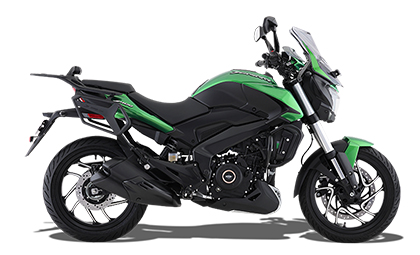
The Dominar 400’s 373.3 cc single produces about 40 PS at 8,800 rpm and 35 Nm at 6,500 rpm.
Click the link to know more details: Bajaj Dominar 400
On the road, this means:
- Peak torque sits in the mid‑range, but the engine is tuned to deliver a strong, linear pull that suits highway speeds.
- At 90–110 km/h in top gear, the motor is already in its useful torque band, so roll‑on overtakes feel easier than on the Classic without needing the Duke’s high‑rev aggression.
- Compared with the Duke, power delivery is smoother and slightly more relaxed, matching its power‑cruiser / touring role.
This is a mid‑range‑focused tune: more urgent than the Classic, but less exciting than the Duke.
4. How Do These Three Feel Back‑to‑back
Moving From Classic 350 → Duke 390
- You gain a lot of top‑end power and much quicker acceleration.
- You also need to rev the engine higher and shift more often to stay in the power band.
Moving From Classic 350 → Dominar 400
- You get noticeably stronger mid‑range for highway work and touring.
- The bike still feels friendly enough at lower rpm, so the transition is easier than jumping straight to a high‑revving KTM.
Together, these three Indian motorcycles nicely illustrate how similar displacement singles with different torque and power peaks can feel completely different on the road.
How Do Electric Two‑wheelers Deliver Torque And Power?
Electric motorcycles and scooters still obey the same physics: torque is the twisting force at the motor, and power is torque multiplied by speed. However, the way this torque and power are delivered feels fundamentally different from a petrol engine because there is no combustion cycle, no gearbox, and no need to “build” revs.
1. Instant Torque From 0 Rpm
In a petrol engine, torque gradually builds as you rev higher, so you feel a gentle increase in pull as you open the throttle and shift gears. With an electric motor, maximum torque is available almost instantly from 0 rpm—the moment you apply the throttle.
This “instant torque” is why most electric bikes and scooters feel quick and responsive right from a standstill, even if their peak power in kilowatts looks modest compared to similar petrol machines.
In city riding, this makes e-two-wheelers true “twist-and-go” machines:
- No clutch or gear changes
- Strong acceleration from a standstill
- No waiting for the right rev range to get moving
2. Typical Torque And Power Curves
Electric motors usually provide a broad, flat torque band at low and mid speeds. In many cases, you get near-peak torque from 0 rpm up to a certain “base speed.” After that, the system moves into a different mode, often called constant-power or field-weakening.
When you reach this region:
- Torque begins to drop as speed rises.
- Power stays close to its peak, so the bike can reach higher top speeds without the motor spinning extremely fast.
- This is quite different from most petrol engines. There, torque normally peaks in a narrower rpm range, then drops off, while power keeps building until close to the redline.
So, on an electric bike, you get a strong shove from the start. Still, once you hit the top-speed zone, there isn’t much extra push left—unlike a high-performance petrol engine, which can keep pulling hard right up to the redline.
3. Real‑world Riding Feel And Practical Impact
City And Traffic Use
Electric two-wheelers really stand out in stop-and-go traffic. Instant torque gives you quick launches from every red light and smooth, easy control at low speeds. You do not need to rev the motor hard. Even mid-sized e-scooters and commuter e-motorcycles, often rated at 50–100 Nm of torque, feel lively in the city. Their power numbers on paper may look modest, but they deliver strong performance.
Highway And Touring
On the highway, electric bikes show their main limitation. Once the motor reaches its top speed, acceleration drops off. Torque is lower at higher speeds, and many models use a fixed gear ratio. Some electric bikes feel strong and responsive below 80–90 km/h. They can flatten out more quickly than petrol bikes, which keep pulling as the revs climb.
Performance‑focused Electric Bikes
High‑performance electric motorcycles combine high‑torque motors with multi‑speed gearboxes or advanced controllers so the system can exploit the instant low‑end torque while still achieving top speed and sustained acceleration.
Even here, though, the feel is “flat” and immediate rather than a gradual build‑up, so the rider’s experience is more predictable and less reliant on precise gear‑shift timing.
4. Comparing The Torque And Power Between Electric And Petrol Engines
Because electric bikes deliver instant, low-end torque, they often feel quicker in city traffic than their spec-sheet power numbers might suggest. For example, an e-motor with 95–100 Nm of torque and 30–40 kW of power can match many sub-400cc petrol bikes in 0–60 km/h acceleration—even with lower peak power on paper. Of course, top-end speed and high-speed performance still depend on the motor and battery’s power output, as well as aerodynamics, weight, and gearing.
So, if you’re comparing an electric and a petrol bike, here’s what to pay attention to:
- Torque at low rpm for city riding and quick launches
- Power at higher speeds for highway performance
- Overall weight and battery placement, which affect how the torque translates to the rear wheel
Practical Tips For Two Wheeler Riders
1. Choosing A Bike Based On Power And Torque
When you’re checking out a new motorcycle or scooter, here’s what to keep in mind:
- Look at both the peak torque and the rpm at which it occurs to judge how strong the engine feels in the low and mid ranges.
- Consider peak power and its rpm to see how high-revving or performance-focused the engine is.
- Factor in the bike’s kerb weight to get a sense of how lively e will feel.- Think about how you’ll actually use the bike: city rides, highway cruising, touring, sporty riding, or a mix.
- Spec numbers only tell part of the story—test rides are essential to really feel the character of the engine and the gearing.
- Many riders end up preferring engines with a strong, usable mid-range rather than ones that only come alive right at the redline.
2. Riding Technique To Use The Engine’s Strengths
Knowing where your engine makes its best torque and power makes it easier to pick the right time to shift gears. If you want a quick overtake, drop a gear to get the rpm into the strong mid-range or just below peak power—this works better than opening the throttle at low rpm in a high gear.
For relaxed cruising and better fuel efficiency, stay in a gear that keeps the engine in the early part of its torque band. This way, you avoid unnecessary revving but still have enough pull for smooth acceleration without constantly shifting.
Common Myths And Clarifications About Power And Torque In Two-wheelers
1. Torque Gives Acceleration, And Power Gives Speed
Reality: Acceleration depends on torque at the wheel, which is affected by both the engine and gearing. Power (torque × rpm) is a better measure of overall acceleration. Torque gives force at the wheel; power shows how long the bike can keep accelerating as speed rises.
2. High‑torque Bikes Are Always Faster
Reality: More peak torque doesn’t always mean quicker acceleration. A smaller, high-revving engine can out-accelerate a big-torque cruiser if it produces more power overall.
3. Peak Numbers Are Everything
Reality: Peak numbers don’t tell the whole story. Bikes with a broad torque band are easier and more enjoyable to ride than those that only make power in a narrow range. A well-balanced mid-capacity bike can feel stronger in daily use than a high-powered machine that’s only fast near redline.
4. Higher Capacity Always Means More Torque
Reality: Engine size isn’t everything. The way an engine is designed—its bore and stroke, tuning, compression, and even the intake and exhaust—matters just as much. Sometimes, a well-tuned smaller engine can actually deliver more torque at certain rpms than a big, lazy single.
5. More Peak Power = Automatically Faster In The City
Reality: For city riding, what really matters is how much torque you have at low and mid-range rpm, and how the bike is geared. Peak power at the redline isn’t nearly as useful when you’re weaving through traffic.
6. Torque Is Only For Cruisers, Power Is Only For Sport Bikes
Reality: Every bike needs both power and torque. Even sport bikes rely on mid-range torque to drive out of corners—not just on peak power at the top end.
7. Power‑to‑weight Only Matters On The Track
Reality: A lighter bike with decent power feels more lively in every situation, is less tiring to ride, and often overtakes better than a heavier machine with more horsepower.
8. Same Bhp = Same Performance
Reality: Two bikes with the same horsepower on paper can feel completely different to ride. Gear ratios, torque curves, aerodynamics, and even rider weight can all affect how a bike performs.
Faq About Power And Torque In Two-wheelers?
1. What Is The Difference Between Power And Torque In Motorcycles?
Power is a measure of how quickly work can be done, usually expressed in horsepower (HP) or kilowatts (kW). At the same time, torque is a measure of rotational force, typically expressed in Newton-meters (Nm) or pound-feet (lb-ft). Torque determines how forcefully the bike accelerates, especially at lower speeds. In contrast, power influences the motorcycle’s top speed and sustained performance.
2. Why Does Torque Matter For Everyday Riding?
Torque is crucial for quick acceleration, ease of overtaking, and carrying heavy loads. It makes riding in stop-and-go traffic or up steep inclines smoother and less strenuous on the engine.
3. Is Higher Power Always Better For Motorcycles?
Not necessarily. While higher power enables higher top speeds and strong performance at high RPMs, it may not always translate into better real-world usability, especially in urban environments or for touring at lower speeds.
4. How Does Gearing Affect The Feel Of Power And Torque?
Gearing multiplies torque at the wheels. Lower gears provide more torque for quick starts, while higher gears are for cruising. The same engine can feel very different depending on the final drive ratio and gear selection.
5. Do Heavy Bikes Need More Torque Or More Power?
Heavier bikes often benefit from higher torque figures to move off the line more easily and handle additional weight from luggage or a pillion. However, sufficient power is also needed to maintain speed on highways.
6. Why Do Some Bikes Feel Stronger At Low Speeds But Run Out Of Breath At High Rpms?
This is usually because they produce peak torque at lower RPMs but have limited power at the top end. Such bikes are tuned for city use and comfort, rather than outright speed.
7. How Do I Choose Between A High-torque And A High-power Motorcycle?
Consider your riding conditions. If you ride mostly in the city or carry loads, prioritise torque. For sporty riding or frequent highway use, higher power and the ability to rev higher may be more satisfying.
8. Can I Improve My Bike’s Torque Or Power With Modifications?
Yes, modifications such as exhaust upgrades, air filters, and remapping can alter torque and power curves. However, gains are often modest and may affect reliability, fuel efficiency, and emissions compliance.
9. Does Rider Weight Affect The Importance Of Torque?
Yes. Heavier riders or those carrying luggage will notice the benefits of higher torque, as it helps the bike accelerate more easily from a stop and climb hills with less effort.
10. What Should I Look For During A Test Ride Regarding Power And Torque?
Pay attention to how the bike responds at different RPMs, especially at low and mid-range revs. Notice the ease of takeoff, overtaking, and how comfortable the bike feels at your typical riding speeds.
Glossary Of Technical Terms In This Article
- Torque: A measure of rotational force produced by the engine, typically expressed in Newton-meters (Nm) or pound-feet (lb-ft). Torque determines how much force your motorcycle can use to accelerate, especially at low speeds.
- Power: The rate at which work is done, usually expressed in horsepower (hp) or kilowatts (kW). In motorcycles, power reflects how quickly the engine can do work, influencing top speed and acceleration.
- RPM (Revolutions Per Minute): The number of times the engine’s crankshaft completes one full rotation every minute. Higher RPMs often mean higher power output but may require the engine to work harder.
- Dyno Chart: A graphical representation of a vehicle’s torque and power output across different RPMs, measured using a dynamometer.
- Gear Ratio: The relationship between the number of rotations of the input gear (engine) and the output gear (wheel). Affects how torque and speed are delivered to the wheels.
- Kerb Weight: The weight of a motorcycle in ready-to-ride condition, including all fluids, fuel, and standard equipment.
- Oversquare Engine: An engine where the bore (cylinder diameter) is larger than the stroke (piston travel distance). Typically designed for higher RPMs and greater power.
- Undersquare Engine: An engine where the stroke is longer than the bore. Tends to produce more torque at lower RPMs.
- Field-Weakening: In electric motors, a technique that reduces the strength of the magnetic field to allow the motor to spin faster, often used at high speeds to increase power.
- ECU (Engine Control Unit): The electronic brain of modern motorcycles that manages fuel injection, ignition, and other engine parameters for optimal performance.
- Remap: The process of altering the ECU’s programming to change how the engine behaves, often to increase power or torque.
- Throttle: The mechanism controlling the amount of air (and sometimes fuel) entering the engine, which in turn controls engine power output.
- Peak Torque/Power: The maximum torque or power an engine produces, usually at a specific RPM.
- Transmission: The system that transmits power from the engine to the wheels, consisting of gears and related components.
- Redline: The maximum safe engine speed, usually marked on the tachometer. Running the engine beyond this can cause damage.
- Horsepower (hp): A unit of power. One horsepower equals 746 watts. Commonly used to quantify engine output.
- Newton-Meter (Nm): The metric unit of torque. One Nm is the torque resulting from a force of one newton applied at a distance of one meter.
- Fuel Efficiency: The distance a motorcycle can travel per unit of fuel, often measured in km/l or mpg.
- Test Ride: A trial run of a motorcycle by a potential buyer to assess performance, comfort, and suitability.
- Drag: The aerodynamic resistance encountered by a motorcycle as it moves through the air, affecting top speed and efficiency.
Other Related Links From Bikeleague India
- Aprilia SR 125
- Aprilia SR 125 hp-e
- Ducati Multistrada V4 Pikes Peak
- Harley Davidson X 440
- Bajaj Chetak 3503
Conclusion
Power and torque are more than just numbers on a spec sheet. They shape how a motorcycle feels, performs, and responds during rides. Knowing their differences and how they interact helps you choose the right motorcycle for your needs.
Whether you want effortless city acceleration, strong mid-range for touring, or exciting top-end performance, balancing torque and power is key. Understanding these concepts helps you get more from your motorcycle and enjoy safer, more efficient rides. For more questions, email bikeleague2017@gmail.com or leave a comment below.