
Long story short: Time to get the basics and tips covered related to the bike or motorcycle engine oil and types right here in this article.
Understanding the right engine oil for your motorcycle is essential for keeping your bike running smoothly, improving performance, and ensuring a long engine life. With so many options and recommendations out there, it can be confusing to know which oil is best for your ride.
This article explains what motorcycle engine oil is, the different types available, how to choose the right one, and key maintenance tips. Our goal is to help you make smart choices and keep your bike running well.
Key Takeaways
- Choosing the correct engine oil is crucial for your motorcycle’s performance, engine protection, and longevity.
- There are three main types of motorcycle engine oils: mineral, semi-synthetic, and fully synthetic. Each type has its own benefits and is best suited for different situations.
- Regularly checking and changing your engine oil according to the manufacturer’s recommendations helps prevent engine wear and costly repairs.
- Factors such as your bike model, riding style, and climate should influence your oil selection for optimal results.
- Understanding oil viscosity and certification standards ensures you select the right oil for your motorcycle’s specific needs.
How Motorcycle Engine Oil Works
Motorcycle engine oil performs several key tasks to protect and enhance engine performance, including lubrication, cooling, cleaning, and cushioning engine components.
- Lubrication: Engine oil puts a thin layer between moving metal parts, like the pistons and the crankshaft, so they don’t rub directly against each other. This helps reduce wear and tear.
- Cooling: When the engine runs fast, it gets hot. Oil helps by removing heat from critical parts, allowing the engine to run smoothly without overheating.
- Cleaning: As oil moves around inside the engine, it picks up tiny pieces of dirt and metal. It carries these things to the oil filter, which catches them, preventing them from damaging the engine.
- Sealing: Oil helps close small gaps between the piston rings and the walls inside the cylinder. This maintains engine power and prevents gas leaks, allowing the engine to operate more efficiently.
- Protection under pressure: Oil pumps move the oil under pressure to reach hard-to-access areas like bearings and cam lobes. This makes sure all important parts get lubrication, even when the engine is running at high speeds.
Most motorcycles use a wet-sump system, in which oil sits in a pan at the bottom of the engine. An oil pump sends the oil through the engine to keep parts moving smoothly. In some two-stroke bikes, oil mixes with fuel to lubricate the engine as the fuel-air mix passes through.
After circulating, the oil flows back to the sump and cools before the cycle repeats. This ongoing process helps the engine run smoothly, even in tough conditions.
Types Of Motorcycle Engine Oil
There are three main types of bike engine oil:
- Mineral Oils (MO)
- Semi-Synthetic Oils (SS)
- Fully Synthetic Oil (FS)
Now, let’s look more closely at each type of bike engine oil.
1. Mineral Oil (mo)
Mineral oils are made from processed petroleum and are the most affordable option for small engines. These engines usually don’t run at high speeds or carry heavy loads. New or smaller bikes often use mineral oil, but it needs to be changed more often and doesn’t last as long as other types.
Pros Of Mineral Oil
- Low cost compared to synthetic oils.
- Ideal for commuter bikes and older motorcycles.
- Provides adequate protection and lubrication for engines running at low mechanical outputs.
Cons Of Mineral Oil
- Lower resistance to oxidation and heat leads to increased fuel consumption and reduced engine performance.
- Needs to be changed more frequently than synthetic oils.
- It is not suitable for high-performance bikes or in extreme conditions.
2. Semi-synthetic Oil (ss)
Semi-synthetic oil combines the protection of mineral oil with the improved performance of synthetic oil. It’s a good option for bikes with 150-300cc engines and is more expensive than mineral oil. For bikes under 150cc, mineral oil is usually the better choice.
Pros Of Semi-synthetic Oil
- Provides better oxidation resistance and improved low-temperature properties compared to mineral oil.
- Offers added protection against oxidation and is suitable for various motorcycle engines.
- More economical than fully synthetic oils while still offering good protection.
Cons Of Semi-synthetic Oil
- It may not offer the same level of performance and protection as fully synthetic oils.
- The level of synthetic oil in the blend can vary, affecting performance.
3. Fully Synthetic Oil
Fully synthetic engine oil is the most expensive, but it is made from pure chemicals rather than crude oil. It works best for high-performance bikes, like off-road or racing models. This oil lasts longer and provides excellent protection.
Pros Of Fully Synthetic Oil
- Excellent heat resistance properties and a high level of lubrication.
- Provides superior performance, low viscosity, and high tolerance to temperature extremes.
- Reduces engine drag, prevents sludge buildup, and extends the time between oil changes.
Cons Of Fully Synthetic Oil
- More expensive than mineral and semi-synthetic oils.
- Overkill for motorcycles that do not require high-performance oil.
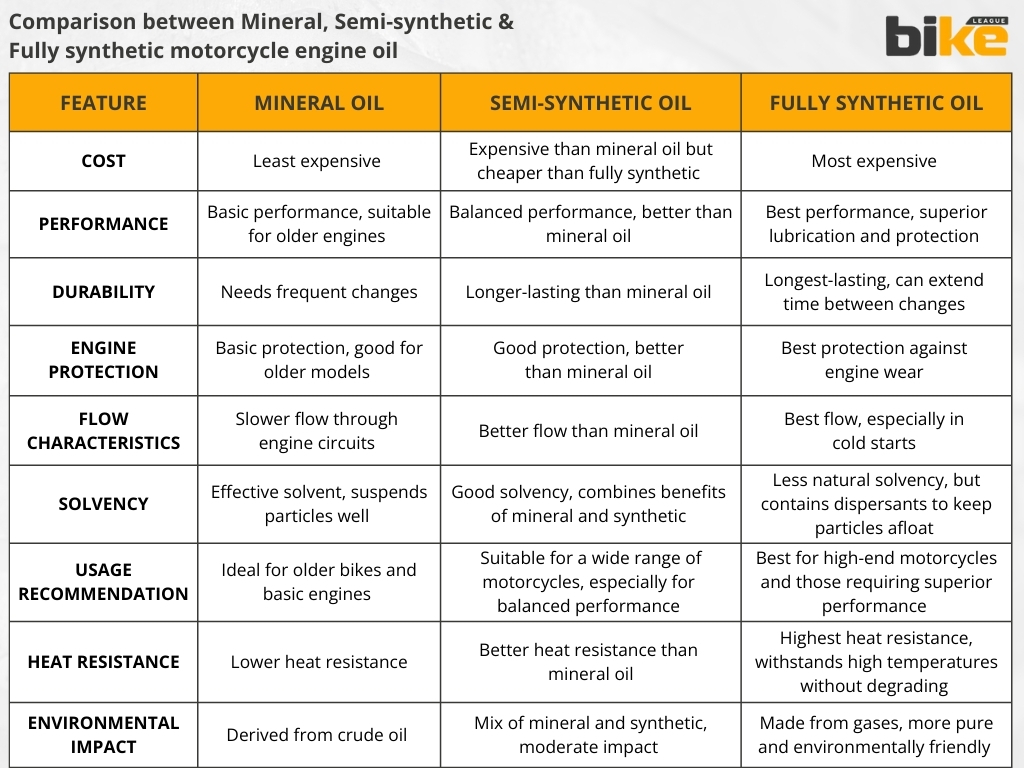
Comparison Of Different Types Of Motorcycle Engine Oil – Table
The table below compares the three main types of motorcycle engine oil in India: mineral, semi-synthetic, and fully synthetic. It shows their main features and common uses.
| Feature | Mineral Oil | Semi-Synthetic Oil | Fully Synthetic Oil |
|---|---|---|---|
| Source | Refined from crude oil | Blend of mineral + synthetic | Chemically engineered synthetic |
| Cost | Least expensive | Moderately priced | Most expensive |
| Viscosity Stability | Lower, breaks down faster | Better than mineral | Excellent, stable across temperatures |
| Engine Protection | Basic protection | Good protection with additives | Superior protection, reduces wear |
| Heat Resistance | Suitable for low/moderate heat | Better heat resistance | Excellent thermal & oxidation resistance |
| Change Interval | Shorter (2,000–2,500 km) | Moderate (3,000–4,000 km) | Longest (4,000–6,000+ km) |
| Suitable Bike Types | Entry-level/commuters (100–125cc) | Mid-capacity (125–200cc), mixed use | High-performance & premium bikes (180cc+) |
| Performance | Basic, for daily city riding | Balanced mileage & performance | Best smoothness, power & mileage gain |
| Additives | Limited | Contains detergents, anti-wear | Advanced additive packages |
What Specific Intervals Should I Follow For Changing The Oil Based On My Motorcycle Type And Oil Types In India?
How often you need to change your motorcycle’s oil in India depends on your bike’s engine size, how you use it, and the type of oil you use: mineral, semi-synthetic, or fully synthetic.
| Motorcycle Type | Oil Type | Change Interval (km) | Time Interval |
|---|---|---|---|
| 100–125cc commuter | Mineral | 2,000–2,500 | 6 months |
| 100–125cc commuter | Semi-synthetic | 3,000 | 6 months |
| 100–125cc commuter | Synthetic | 4,000–5,000 | 12 months |
| 150–200cc mid-range | Mineral | 2,500–3,000 | 6 months |
| 150–200cc mid-range | Semi-synthetic | 3,500–4,000 | 6–12 months |
| 150–200cc mid-range | Synthetic | 5,000–6,000 | 12 months |
| 250cc+ performance | Mineral | 3,000 | 6 months |
| 250cc+ performance | Semi-synthetic | 5,000 | 12 months |
| 250cc+ performance | Synthetic | 6,000 | 12 months |
| Scooters 90–125cc | Mineral | 2,000 | 6 months |
- If riding in harsh conditions, heavy traffic, or hot climates, reduce the interval by 20–30%.
- Always follow manufacturer guidelines in the owner’s manual for best results; these override general intervals.
- Choose the highest-grade oil allowed by the manufacturer for longer intervals and better performance.
What Are The Key Considerations For Choosing Bike Engine Oil?
1. Manufacturer Recommendations
Refer to your motorcycle’s owner’s manual for the manufacturer-recommended oil grade and type. Using the specified oil ensures optimal engine performance and longevity.
2. Riding Conditions
You should also think about your riding conditions when choosing engine oil. Some oils handle very hot or cold weather better because they stay stable and flow well in extreme temperatures.
3. Oil Change Intervals
Changing your oil regularly keeps your engine healthy. Most bikes need an oil change every 5,000 kilometres, but fully synthetic oils can last 7,000 to 10,000 kilometres. Always check the oil’s colour. If it turns black, it’s time to change it.
Which Are Some Of The Best Bike Engine Oil Brands?
Here, we are not recommending individual engine oil because engine oil type varies among models, but instead, we are suggesting some of the best brands, and they are
How To Read Motorcycle Engine Oil Grade?
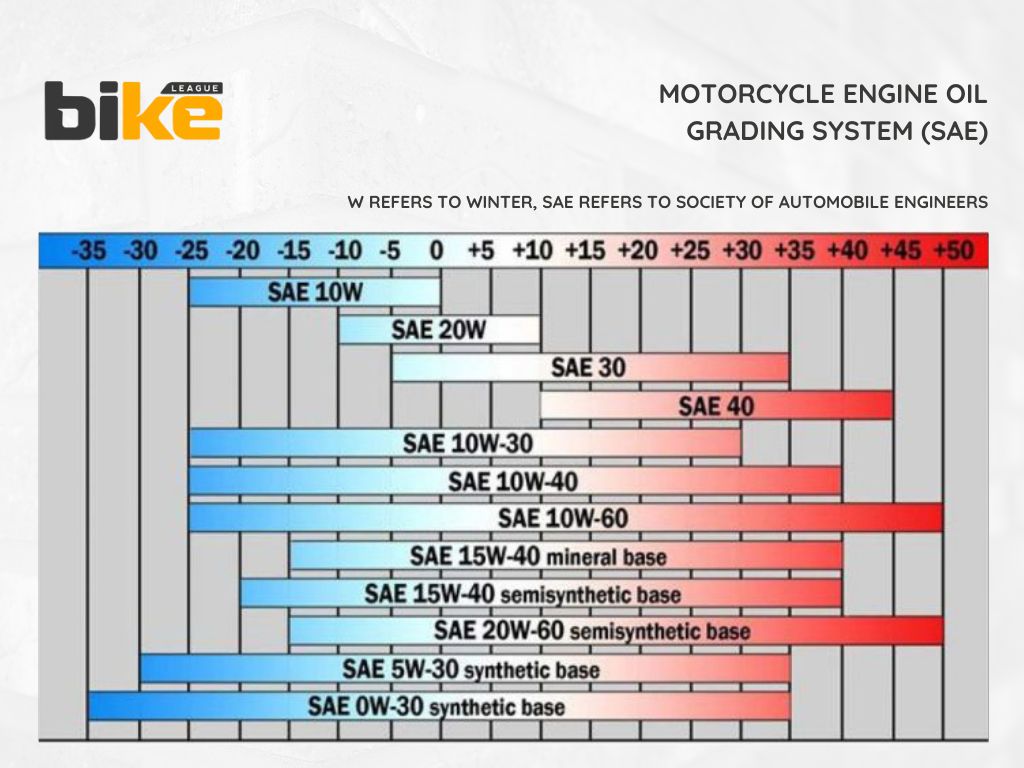
The name SAE number also refers to the engine oil grade code. SAE refers to the Society of Automotive Engineers. The letter W refers to ‘Winter’ in the code. The first number indicates how oil flows at low temperatures, such as during engine start-up. The second number is defined by how oil flows at temperatures higher than a standard engine’s operating temperature.
Thin, low-viscosity oils flow more easily to protect engine parts at cold temperatures. Thick, high-viscosity oils are typically more effective at maintaining film strength, which protects engines at high temperatures. For example, a 5W-20 will flow more effortlessly than a 10W-20 at start-up temperatures, and a 10W-40 will flow more effortlessly than a 10W-50 at regular engine operating temperatures.
The chart below recommends engine oil based on the outside temperatures.
Does Motorcycle Engine Oil Expire?
Yes, motorcycle engine oil does expire, but it lasts much longer than food. The date on the container is a guideline, so it’s best to use the oil within that period. Here’s what you should know about oil expiration:
Unopened Oil
- Conventional oil: Generally has a shelf life of 2-5 years.
- Synthetic oil: Can last up to 10 years when stored unopened in a cool, dry place.
Opened Oil
- Once the container is opened, the oil degrades due to exposure to air and moisture.
- It’s recommended to use opened oil within 1-2 years.
How To Change Motorcycle Engine Oil?
Change your bike’s engine oil according to your owner’s manual. The manual gives step-by-step instructions, and you can do the job at home with the right tools. Make sure your bike is on its centre stand or use a paddock stand if needed.
The general steps for a bike engine oil change are as follows:
- Warm up the engine: Run the motorcycle for 5-10 minutes to warm the oil. Warm oil drains faster and more completely.
- Prepare the workspace: Park the bike on a level surface, use the centre stand or paddock stand to keep it upright and stable. Gather the necessary tools, including a wrench/spanner, drain pan, funnel, gloves, and fresh engine oil.
- Locate the drain plug and oil filter: Refer to the owner’s manual for exact locations. Typically, the drain plug is located at the bottom of the engine crankcase. At the same time, the oil filter is positioned on the side.
- Drain old oil: Place the drain pan under the drain plug. Loosen and remove the plug carefully, allowing the oil to drain out fully. Be cautious as the oil might be hot.
- Remove and replace oil filter (if applicable): Unscrew the oil filter using an oil filter wrench or by hand (refer to manual). Replace the filter with a new one, lubricating the new filter’s rubber seal with a small amount of fresh oil before installation.
- Reinstall drain plug: Clean the drain plug and gasket/seal ring. Screw it back securely, but avoid overtightening to prevent stripping the threads.
- Add fresh oil: Using a funnel, pour the recommended quantity and grade of fresh engine oil into the oil filler cap opening. Check the owner’s manual for the correct oil type and quantity.
- Check oil level: Use the dipstick or sight glass to confirm oil level is within the recommended range. Add more if necessary.
- Run the engine and check for leaks: Start the motorcycle and let it idle for a few minutes. Check the drain plug and filter for any leaks.
- Dispose of old oil properly: Collect used oil in a sealed container and take it to authorised disposal or recycling centres.
Are There Any Signs That Indicate The Need For An Oil Change Before The Six-month Mark In A Motorcycle In India?
Yes, there are specific signs that indicate a need for a motorcycle oil change before the usual six-month mark in India:
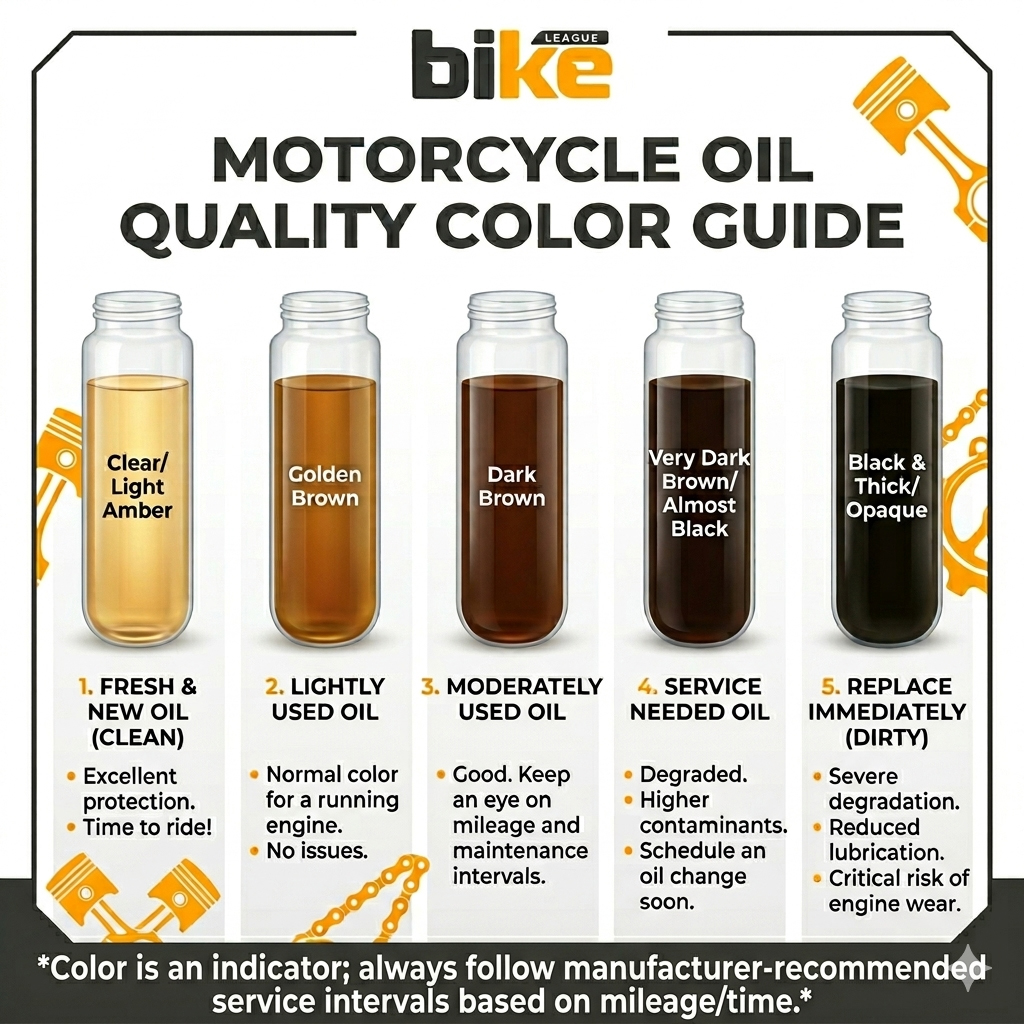
- Dark, thick, or blackened oil: Engine oil that has turned very dark or has sludge deposits shows degradation and poor lubrication, signalling immediate replacement.
- Low oil level: A noticeable drop in oil volume on the dipstick or sight glass requires topping up or changing the oil if it occurs frequently.
- Unusual engine noises or vibrations: Increased engine noise, rough clutch operation, or vibrations often mean poor lubrication and oil breakdown.
- Engine overheating: Feeling excessive heat on legs or bike parts due to ineffective oil heat dissipation indicates the oil is losing its properties.
- Reduced throttle response or power: The engine may feel less responsive or sluggish, an indirect sign that the oil is unable to maintain optimal performance.
- Burning smell: A distinct burning oil smell during riding indicates oil degradation or leakage.
- Oil warning light or dashboard alerts: Some motorcycles have sensors to alert to low oil pressure or quality issues.
- High-stress riding conditions: Frequent city traffic, high heat, dusty roads, and excessive idling can accelerate oil degradation and require earlier changes.
- First service oil change: For new motorcycles, the first oil change is often recommended between 500–700 km to remove break-in contaminants, regardless of time.
Check your oil regularly for colour, level, and consistency. Paying attention to these signs helps you change the oil on time, which protects your engine and prevents expensive damage.
Understanding Api, Jaso And Other Engine Oil Standards
While SAE grades explain oil thickness (viscosity), they don’t tell you about oil quality or compatibility with your motorcycle’s engine and clutch system. That’s where certifications like API and JASO come in. These standards help you choose the right engine oil, not just by viscosity.
1. Api (american Petroleum Institute) Classification
API ratings indicate the quality and performance level of engine oil. For motorcycles, you’ll usually see labels like API SL, SM, SN, or SP.
- Higher letter = newer standard: For example, API SN is newer and better than API SL.
- Better protection: Newer API oils offer improved oxidation resistance, engine cleanliness, and wear protection.
- Backward compatible: Higher-grade oils can generally be used in older engines unless specified otherwise.
For most modern motorcycles in India, API SL or above is recommended.
2. Jaso (japanese Automotive Standards Organisation)
JASO is especially important for motorcycles because it considers wet clutch compatibility, which is common in most bikes.
There are three main JASO ratings:
- JASO MA: Suitable for motorcycles with wet clutches, ensures proper friction and smooth gear shifting.
- JASO MA2: A stricter version of MA, which offers better clutch performance and is recommended for modern high-performance bikes.
- JASO MB: Designed for scooters with automatic transmissions (no wet clutch), reduces friction for better fuel efficiency.
Important tip: Never use JASO MB oil in a motorcycle with a wet clutch—it can cause clutch slippage.
3. Why These Standards Matter
Choosing oil based only on SAE grade (like 10W-40) is not enough. You should always check:
- API rating for overall oil quality
- JASO rating for clutch compatibility
Example:
If your bike recommends 10W-40, the ideal label should look like:
- SAE 10W-40
- API SN
- JASO MA2
This ensures the oil has the right thickness, high performance, and proper compatibility with your engine and gearbox.
4. Quick Buying Checklist
Before buying engine oil for your motorcycle, check:
- SAE grade (e.g., 10W-30, 10W-40)
- API rating (minimum SL, preferably SN or higher)
- JASO rating (MA/MA2 for bikes, MB for scooters)
Knowing about these certifications helps you choose the right oil, which leads to a longer-lasting engine, smoother performance, and a better riding experience.
What Are The New Motorcycle Engine Oil Technologies And Trends In India?
Engine oil technology is changing quickly, and Indian riders are now seeing the benefits of new formulas that offer better protection, performance, and efficiency. Here are the main technologies and trends shaping the motorcycle engine oil market in India today.
1. Ester-based Engine Oils
Ester oils represent the highest tier of synthetic engine oil technology. Brands like Motul (300V and 7100) and Savsol (Ester5) use ester-based formulas for premium performance.
What Makes Ester Oils Special
- Stronger oil film: Ester molecules naturally cling to metal surfaces, creating a durable protective layer even under high stress.
- Better heat resistance: Ester oils maintain stability at extreme temperatures, ideal for hot Indian climates and high-performance riding.
- Increased engine power: Reduced friction leads to smoother engine operation and noticeable horsepower gains.
- Lower oil consumption: More stable under heat, so you need to top up less often.
- Better gearbox and clutch protection: JASO MA2-approved ester oils ensure smooth gear shifts and prevent clutch slippage.
Popular Ester Oils In India
- Motul 300V 4T – Pure racing oil with ESTER Core® technology, for track use only
- Motul 7100 4T – 100% synthetic with esters, ideal for high-performance road bikes and spirited riding
- Savsol Ester5 EsterMax 9000 4T 10W-40 – Fully synthetic ester oil for modern high-performance engines
2. Nano-additive Technology
Nano-additives are ceramic or metal-based particles added to engine oil to fill micro-scratches and coat engine surfaces.
Benefits Of Nano-additives
- Fill micro-scratches on cylinder walls and piston rings
- Restore compression pressure and improve power output
- Reduce noise and vibration levels
- Improve fuel efficiency (up to 21% in some claims)
- Reduce harmful emissions
Note: Modern high-quality engine oils already contain advanced additive packages. Adding extra nano additives is generally unnecessary unless you have an older engine needing restoration.
3. Bio-based And Biodegradable Engine Oils
Bio-based engine oils are made from renewable plant sources (such as vegetable oils) and are more environmentally friendly than conventional petroleum-based oils.
Market Trends In India
- India’s bio-degradable engine oil market is expected to grow significantly from 2025 to 2031
- Growing environmental awareness is driving demand for sustainable lubricants
- Higher cost and limited availability currently restrict widespread adoption
While still niche in India, bio-based oils are worth watching for eco-conscious riders.
4. Fully Synthetic Oil Adoption Is Rising
The Indian two-wheeler engine oil market is shifting toward fully synthetic oils:
- Market value: USD 1.19 Bn in 2025, projected to reach USD 1.55 Bn by 2032
- Key growth driver: Rising use of synthetic oils and increased engine care awareness
- 10W-40 remains the most popular grade in India
Recent Launches In India (2025–2026)
- Gulf Syntrac – Fully synthetic motorcycle engine oil range launched at India Bike Week 2025, targeting premium and high-performance bikes
- Motul 7100 – Widely available and popular for Royal Enfield, Yamaha, Bajaj, and other premium bikes
Common Motorcycle Engine Oil Myths – Busted
Many myths about motorcycle engine oil in India are shared by mechanics or fellow riders. Let’s clear up some of the most common ones with facts.
1. Synthetic Oil Causes Leaks In Old Engines
Myth: Fully synthetic oil can cause leaks in older motorcycles.
Reality: Synthetic oil does not cause leaks. However, because it flows more easily and cleans up sludge buildup, it may reveal existing weak seals or cracks. The oil is not the problem—the engine condition is.
2. Thicker Oil Is Always Better For Engine Protection
Myth: Using thicker oil (like 20W-50 instead of 10W-40) gives better protection.
Reality: Thicker oil may protect better at high temperatures, but it flows poorly during cold starts and can reduce engine efficiency. Always use the viscosity recommended in your owner’s manual for balanced performance.
3. You Must Change Oil Every 3,000 Km, No Matter What
Myth: All bikes need an oil change at a fixed 3,000 km interval.
Reality: Oil change intervals depend on oil type and riding conditions. Fully synthetic oils can last much longer, while mineral oils need more frequent changes. Always follow manufacturer guidelines.
4. Black Oil Means It’s Bad
Myth: If engine oil turns black, it must be changed immediately.
Reality: Oil turning dark is normal—it means the oil is cleaning the engine and holding contaminants. Instead of colour alone, check oil thickness, level, and engine performance.
5. More Expensive Oil Means Better Performance For Every Bike
Myth: Fully synthetic oil will always improve performance, even in small commuter bikes.
Reality: High-end oils are designed for high-performance engines. Using them in low-capacity commuter bikes may not provide noticeable benefits and can be an unnecessary expense.
6. You Can Switch Oil Brands Frequently Without Any Issue
Myth: Changing oil brands regularly has no impact.
Reality: While occasional switching is fine, frequently changing brands with different additive packages may affect performance consistency. It’s better to stick to a reliable brand and specification.
7. Engine Oil Additives Are Always Beneficial
Myth: Adding aftermarket oil additives improves engine life.
Reality: Modern engine oils already contain advanced additive packages. Extra additives can sometimes disrupt the oil’s balance and do more harm than good unless specifically recommended.
8. Scooter And Motorcycle Engine Oils Are The Same
Myth: You can use the same oil in both scooters and motorcycles.
Reality: Most motorcycles use wet clutches and require JASO MA/MA2 oils, while scooters typically use JASO MB oils. Using the wrong type can affect performance and clutch operation.
Common Mistakes To Avoid With Motorcycle Engine Oil
Even if you pick the right engine oil, simple mistakes can shorten your engine’s life and hurt performance. Here are some common mistakes riders should avoid:
1. Overfilling Engine Oil
Adding more oil than required can increase internal engine pressure, leading to leaks, foaming, and reduced performance. Always maintain oil levels within the recommended range using the dipstick or sight glass.
2. Mixing Different Oil Types
Mixing mineral, semi-synthetic, and fully synthetic oils can affect performance and reduce the effectiveness of additives. While it may not cause immediate damage, it’s best to avoid mixing unless absolutely necessary.
3. Ignoring Oil Filter Replacement
Changing oil without replacing the oil filter means contaminants remain in circulation. A clogged filter reduces oil flow and can harm engine components over time.
4. Using The Wrong Oil Grade
Using incorrect viscosity (e.g., 20W-50 instead of 10W-40) can affect lubrication, fuel efficiency, and engine wear. Always follow manufacturer-recommended grades.
5. Delaying Oil Changes
Running old or degraded oil reduces lubrication and increases engine wear. Delayed oil changes are one of the most common reasons for poor engine performance.
6. Not Checking Oil Levels Regularly
Low oil levels can lead to severe engine damage. Make it a habit to check oil levels every few weeks or before long rides.
7. Using Car Engine Oil In Motorcycles
Car oils are not designed for wet-clutch systems and can cause clutch slippage on motorcycles. Always use motorcycle-specific oil with a JASO MA/MA2 rating.
Faq Related To Bike Engine Oil
1. What Are The Functions Of Bike Engine Oil?
Engine oil functions to minimise friction, reduce wear, clean the engine, improve engine parts, form a seal, dampen shock, and prevent corrosion.
2. What Is An Engine Oil Grade?
Engine oil grade refers to a set of specifications or codes that correspond to the type of engine oil. It primarily describes the type of engine oil used and accounts for external environmental conditions. More technically, engine oil grade refers to the viscosity or resistance to flow. The lower the number, the better it will flow.
3. When To Change Motorcycle Engine Oil?
Engine oil must be changed every 2,500-3,000 miles or every six months, depending on the type of engine oil. Synthetic and semi-synthetic oils last longer, so ask a bike technician or shop owner for the same. For mineral oil, oil replacement is recommended every 2000-3000 miles. Anyway, an oil change is mandatory every six months, regardless of any other factors.
4. What Happens When The Engine Oil Change Is Late?
A delay in engine oil changes results in performance loss and reduced fuel efficiency. Overall, it affects the engine’s life and the vehicle’s performance.
5. How To Check For Bike Oil Replacement?
Check the oil colour by loosening the engine oil bolt and allowing oil to drip into the oil pan. This method varies across models, and alternative methods are available for some of them. If the colour is dark, it is time to replace the oil. Brand-new engine oil is always clear and almost transparent.
6. Is It Mandatory To Change The Oil Filter While Changing The Oil?
Yes, when you change the engine oil, it’s also a good idea to replace the oil filter. An oil filter protects the engine from potential damage by removing contaminants that can accumulate in the motor oil. Like engine oil, your bike’s oil filter becomes clogged or damaged after a specific period. Change the engine oil filter once a year or after every two general services. Check the owner’s manual for this information.
7. What Is A Bike Engine Flush?
An engine flush is an aftermarket chemical additive that cleans accumulated engine sludge and deposits.
8. How To Flush The Motorcycle Engine Or Engine Oil?
Add the engine oil flush to the crankcase before the regular oil change. An oil flush cleans the engine’s internal components of sludge and grease deposits, leaving them fresh for new lubrication.
9. What Is The Recommended Engine Oil Quantity For The Motorcycle?
For that, check the owner’s manual. The quantity of oil should neither be excessive nor insufficient; service manual guidelines must be strictly followed. As the owner’s manual mentioned, the oil quantity should be higher when changing the filter. The last point is critical to note.
10. Should The Bike Engine Be Warm While Changing The Oil?
Yes. The engine oil is thicker and colder during the early morning hours. To loosen the oil, drive the motorcycle or warm the engine for a short time.
11. Does Motorcycle Engine Oil Burn?
Yes. Suppose an issue exists with the engine components, such as the piston rings. In that case, oil deposits can accumulate on the engine spark plugs or the valve bottoms. That means the oil enters the combustion chamber and burns away.
12. How To Fix An Oil Leak In A Motorcycle?
A motorcycle engine oil leak is not a DIY task and should be handled by a technician. If an engine oil leak is present, turn off the motorcycle immediately and inform the technician. Coordinate the remaining steps with the technician. Nowadays, several companies offer roadside assistance, such as Royal Enfield, which is a great initiative.
Other Related Articles From Bikeleague India
- Bike maintenance at home: Save money & time on services
- Mileage in Two wheelers – Proven & useful tips
- Different types of cooling in two wheelers
- Motorcycle service – All things you need to know explained
- Motorcycle storage – Short & long term storage tips & precautions
Conclusion
Choosing the right motorcycle engine oil is key to keeping your bike running well, reliable, and lasting longer. If you understand oil types, change intervals, and what your manufacturer recommends, you can make smart choices that fit your riding style and engine needs.
Remember, checking your oil regularly and changing it on time will keep your engine running smoothly and help you avoid expensive repairs later. Pay attention to your bike’s needs, and you’ll enjoy many worry-free miles.
If you have more questions, you can email us at bikeleague2017@gmail.com or leave a comment below. We’re always happy to help. You can also connect with us on our social media pages.