
Long story short: Tyres are to a motorcycle what shoes are to our legs. Tyres are crucial, as they are the only part that touches the tarmac while riding. Here we discuss types of motorcycle tyres such as tubeless and radial, and their pros and cons.
Tyres are key to your motorcycle’s safety, performance, and how it feels to ride. Since they are the only part touching the road, the type and quality of tyre you choose will affect handling, comfort, and safety.
This article covers the main types of two-wheeler tyres, including tubeless, tube-type, bias ply, and radial tyres. We’ll explain their pros, cons, and best uses, so you can choose the tyres that fit your riding style and needs.
Key Takeaways
- Tyre selection significantly impacts motorcycle safety, handling, and comfort.
- There are key construction types: tubeless, tube-type, bias ply, and radial—each with distinct pros and cons.
- Usage-specific tyres (street, touring, dual-sport, sport, off-road, racing) are designed for different riding environments and needs.
- OEM tyres offer balanced performance, while aftermarket tyres allow for customization based on riding style.
- Always match tyre size, load rating, and type to your motorcycle’s specifications for optimal performance and safety.
Types Of Two-wheeler Tyres Based On The Material Construction
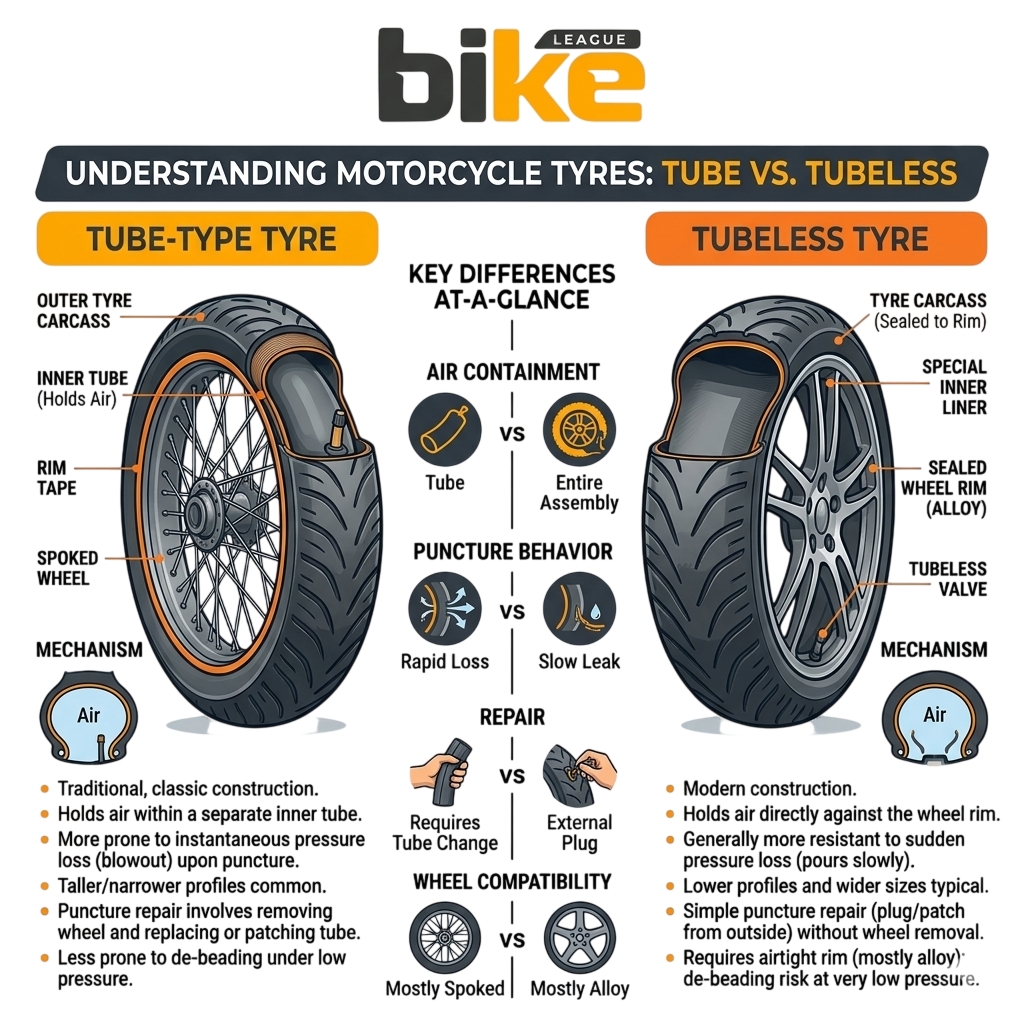
1. Tubeless Tyres
These motorcycle tyres are rigid, durable, and constructed from strong rubber compounds. They reduce the risk of sudden deflation and can operate at lower air pressure, thereby improving balance and stability.
Pros Of Tubeless Tyres
- Improved air impermeability and resistance to heat and weather.
- Easier to repair and maintain.
- Better fuel efficiency due to lighter weight.
Cons Of Tubeless Tyres
- Higher initial cost compared to tube-type tyres.
2. Tube-type Tyres
These motorcycle tyres are a traditional option, as they are easier to repair and replace due to their straightforward design, but are more prone to air loss when punctured.
Pros Of Tube-type Tyres
- Simplicity in design and easier to repair.
- Generally cheaper than tubeless tyres.
Cons Of Tube-type Tyres
- Vulnerable to sudden air loss in case of punctures.
- Heavier and less fuel-efficient compared to tubeless tyres.
Compare the features of tube and tubeless two-wheeler tyres in the chart below.
| Feature | Tube Tyres | Tubeless Tyres |
|---|---|---|
| Construction | Inner tube inside the tyre to hold air | No inner tube between the tyre and the rim |
| Installation | More complex and time-consuming to install and repair | Easier and quicker to install and repair |
| Heat Dissipation | Generates more heat due to less flexibility | Better heat dissipation due to direct contact with the rim |
| Ride Comfort | Stiffer ride due to the inner tube | Smoother ride due to the absence of an inner tube |
| Load Capacity | Suitable for heavier loads due to stiff sidewalls | Generally lower load capacity compared to tube tyres |
| Performance | Suitable for moderate speeds and off-road conditions | Better performance at high speeds and on modern machines |
| Durability | High mileage, durable for long-distance riding | Generally durable but depends on the construction |
| Puncture Susceptibility | More susceptible to punctures due to the inner tube | Less susceptible to punctures |
| Compatibility | Compatible with spoked rims and off-road bikes | Compatible with modern cast rims |
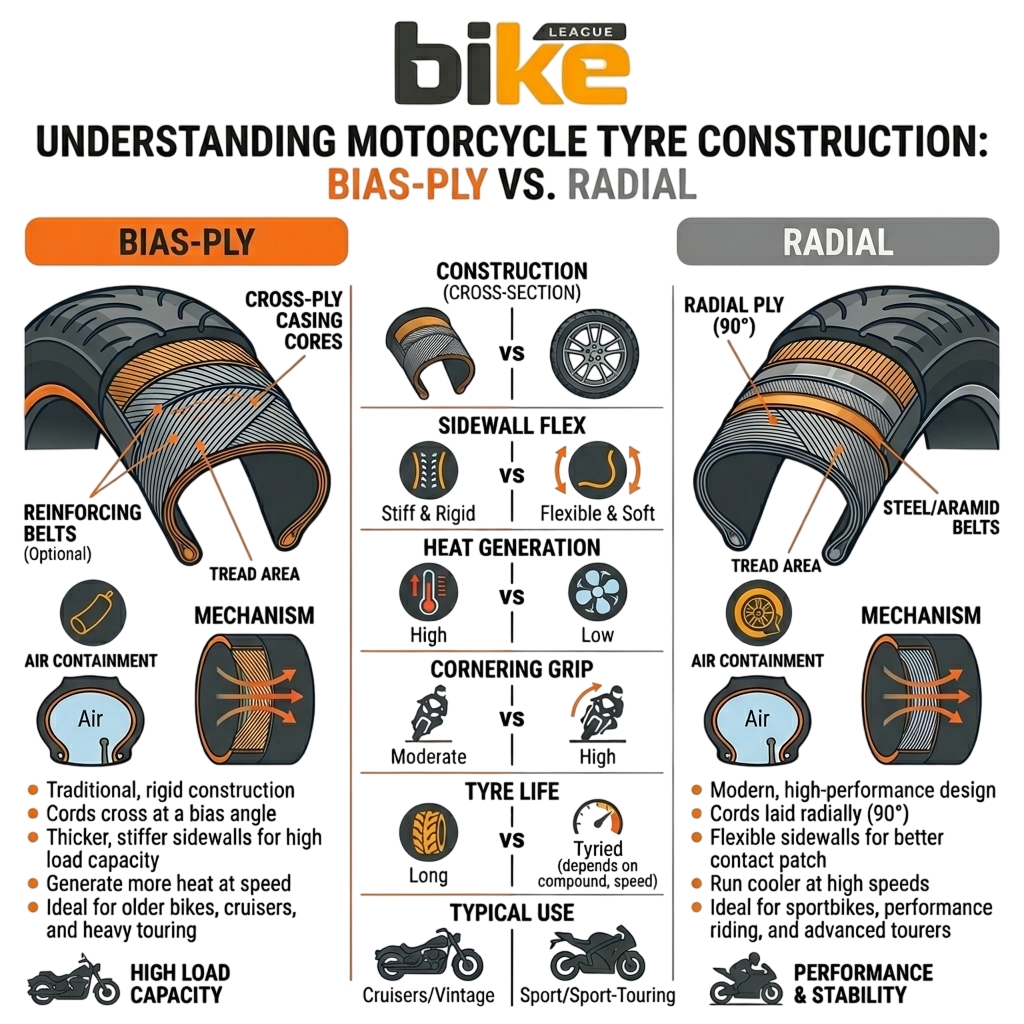
3. Bias Ply Two-wheeler Tyres
This type of motorcycle tyre, also called diagonal tyres, has a carcass made of ply cords running diagonally to the tread’s centre line. These cords run bead to bead in alternating layers, creating a crisscross pattern.
Advantages Of Bias Ply Tyres
- Load Capacity: Bias ply tyres have very stiff sidewalls, making them suitable for heavier motorcycles or bikes carrying heavier loads. This rigidity allows them to carry greater weight and perform well under heavy loads.
- High Mileage: These tyres are known for their high mileage capabilities, making them a durable option for long-distance riding.
- Compatibility with Tubes: Bias ply tyres can be used with tubes, which is necessary for spoked rims and off-road riding.
Disadvantages Of Bias Ply Tyres
- Heat Dissipation: One of the main downsides is their poor heat dissipation, which can affect performance and longevity.
- Ride Comfort: While beneficial for load capacity, the stiff sidewalls can result in a less comfortable ride than radial tyres.
4. Radial Tyres
This motorcycle tyre has a different construction. The ply cords radiate at 90-degree angles to the tread’s centre line. The cords run directly from bead to bead. This allows for a more flexible sidewall than other types.
Advantages Of Radial Tyres
- Heat Dissipation: Radial tyres dissipate heat better due to their construction, which includes steel belts that help manage heat more effectively.
- Ride Comfort: The thinner and more flexible sidewalls act as a ‘spring,’ absorbing bumps and providing a smoother ride.
- Performance: Radial tyres offer better grip, especially when leaning into corners, and are suitable for high-speed, sporty purposes. They are essential for more powerful motorcycles with a rigid chassis.
Disadvantages Of Radial Tyres
- Puncture Susceptibility: The thinner sidewalls are more susceptible to punctures while providing comfort.
- Load Capacity: Radial tyres generally have a lower load capacity compared to bias ply tyres due to their softer sidewalls.
Differences Between Bias Ply And Radial Two-wheeler Tyres
- Construction: Bias ply motorcycle tyres have diagonal ply cords, while radial tyres have ply cords that run radially.
- Sidewall Rigidity: Bias ply tyres have stiffer sidewalls, making them better for heavy loads, whereas radial tyres have softer sidewalls, providing a smoother ride.
- Heat Management: Radial tyres dissipate heat better, which enhances performance and longevity, especially at high speeds.
- Application: Bias ply tyres are suitable for moderate speeds and heavier loads, often used in touring and off-road motorcycles. Radial tyres are preferred for high-performance, sporty motorcycles due to their superior grip and handling.
Check out the comparison between bias ply and radial two-wheeler tyres in the table given below.
| Feature | Radial Tyres | Bias Ply Tyres |
|---|---|---|
| Construction | Ply cords run radially at 90 degrees to the centreline | Ply cords run diagonally from bead to bead in a crisscross pattern |
| Installation | Requires specific rims designed for radial tyres | Can be used with tubes, suitable for spoked rims |
| Heat Dissipation | Superior heat dissipation, enhancing performance and longevity | Poor heat dissipation, affecting performance and longevity |
| Ride Comfort | More comfortable ride due to flexible sidewalls | Less comfortable ride due to stiff sidewalls |
| Load Capacity | Lower load capacity due to softer sidewalls | Higher load capacity, suitable for heavy motorcycles |
| Performance | Better grip and handling, especially at high speeds | Suitable for older vehicles and off-road conditions |
| Durability | Longer lifespan compared to bias ply tyres | High mileage but shorter lifespan compared to radial tyres |
| Puncture Susceptibility | More susceptible to punctures due to thinner sidewalls | Less susceptible to punctures due to thicker sidewalls |
| Compatibility | Compatible with spoked rims and off-road bikes | Compatible with modern cast rims |
Types Of Two-wheeler Tyres Based On Usage Conditions
1. Street Tyres
Street motorcycle tyres are designed to provide two key advantages: durability for long-term use and reliability on paved roads. Smooth tread patterns with diagonal grooves enhance water dispersion and reduce the risk of hydroplaning.
Pros Of Street Tyres
- Long durability and reliability
- Better grip on wet surfaces due to more treads
Cons Of Street Tyres
- Limited performance on off-road terrains
Motorcycle Street Tyres Examples
| Brand | Tyre Model / Series | Compatible Motorcycles | Tyre Sizes (Front / Rear) | Official Link |
|---|---|---|---|---|
| MRF | Nylogrip, Masseter-X | Bajaj Pulsar, TVS Apache, Honda Shine, Yamaha FZ | 100/80-17 (Front), 130/70-17 (Rear) | Know More |
| Apollo | Actizip, Alpha H1 | KTM Duke series, Bajaj Pulsar, TVS Apache | 110/70-17 (Front), 150/60-17 (Rear) | Know More |
| Michelin | Pilot Street, Road 5 | Bajaj Dominar, Kawasaki Ninja, KTM Duke | 110/70 ZR17 (Front), 150/60 ZR17 (Rear) | Know More |
| CEAT | Milaze, Zoom XL | Royal Enfield Himalayan, Bajaj Pulsar, TVS Apache | 100/90-19 (Front), 110/70-17 (Rear) | Know More |
| Pirelli | Diablo Rosso, Scorcher 11 | TVS Apache, Yamaha FZ, Suzuki Gixxer | 100/80-17 (Front), 140/75 R15 (Rear) | Know More |
| TVS Eurogrip | ATT 455 | TVS Apache, Honda CB Shine | 100/90-19 (Front), 120/80-18 (Rear) | Know More |
2. Dual Sport Or Adv Tyres
Dual-sport or adventure (ADV) tyres give riders versatility and adaptability, offering reliable traction on both on-road and off-road surfaces due to their unique tread pattern.
Pros Of Dual Sport Or Adv Tyres
- Versatile, suitable for both on-road and off-road use
- Good traction on slick and muddy terrains
Cons Of Dual Sport Or Adv Tyres
- May not offer the best performance on either surface compared to specialised tyres
Dual Sport Or Adv Tyres Examples
| Brand | Tyre Model / Series | Compatible Motorcycles | Tyre Sizes (Front / Rear) | Official Link |
|---|---|---|---|---|
| Pirelli | SCORPION™ Rally STR | Royal Enfield Himalayan, Triumph Tiger 900/1200, KTM Adventure | 90/90 R21 (Front), 150/70 R18 (Rear) | Know More |
| Eurogrip | Trailhound SCR | Royal Enfield Interceptor, Continental GT 650, KTM 390 Adventure | 80/20 road-offroad tread | Know More |
| Mitas | ENDURO TRAIL+ | KTM 390 Adventure R, KTM 125 Enduro R | Aggressive tread for offroad grip | Know More |
| Michelin | Anakee Wild | Royal Enfield Himalayan, BMW G310 GS, KTM Adventure | 90/90-21 (Front), 150/70-17 (Rear) | Know More |
| Metzeler | Karoo 4 | BMW GS series, Triumph Tiger, KTM Adventure | 110/80 R19 (Front), 150/70 R17 (Rear) | Know More |
| Bridgestone | Battlax Adventure Trail | Kawasaki Versys, Suzuki V-Strom, BMW GS | Multiple sizes typical for ADV | Know More |
Touring tyres provide the advantage of durability for long-distance rides and feature deep tread patterns that enhance water dispersion. Their more complex rubber compounds ensure they last longer on highways.
Pros Of Touring Tyres
- Excellent water dispersion, reducing the risk of hydroplaning
- Long mileage and good traction in wet conditions
Cons Of Touring Tyres
- Heavier and may not provide the same level of grip as sport tyres
Touring Tyres Examples
| Brand | Tyre Model / Series | Compatible Motorcycles | Tyre Sizes (Front / Rear) | Official Link |
|---|---|---|---|---|
| Reise tourR | ReiseMoto | Royal Enfield Classic, Royal Enfield Thunderbird | Common sizes: 90/90-19, 120/80-18 | Know More |
| Michelin Road 5 | Michelin | Bajaj Dominar, KTM Duke series, Kawasaki Ninja | 110/70 ZR17 (F), 150/60 ZR17 (R) | Know More |
| Pirelli Sport Demon | Pirelli | BMW G310 GS, KTM 390 Adventure, Triumph Tiger | 110/70-17, 140/70-17, 150/60-17 | Know More |
| Bridgestone Battlax BT-46 | Bridgestone | Kawasaki Versys, Suzuki V-Strom, BMW GS series | 110/80-19, 150/70-17 | Know More |
| Apollo Actigrip | Apollo | Bajaj Pulsar, TVS Apache, KTM Duke | 100/80-17 (F),130/70-17 (R) | Know More |
Sport or performance tyres offer the major advantage of maximum grip and superior performance in dry conditions. They are ideal for motorcycles needing excellent handling and high-speed stability.
Pros Of Sport / Performance Tyres
- Superior grip and handling at high speeds
- Lightweight and superb handling
Cons Of Sport / Performance Tyres
- Faster wear and tear due to softer rubber compounds
- Not ideal for wet or off-road conditions
Sport / Performance Tyres Examples
| Brand | Tyre Model / Series | Compatible Motorcycles | Tyre Sizes (Front / Rear) | Official Link |
|---|---|---|---|---|
| Apollo | Pilot Street, Road 5 | KTM 200 Duke, KTM 250 Duke, TVS Apache RR 310, KTM RC200, KTM RC390, KTM Duke 390, Mahindra Mojo | 110/70 ZR17 (Front), 150/60 ZR17 (Rear) | Know More |
| Michelin | Pilot Street, Road 5 | Bajaj Dominar, Benelli TNT series, BMW K1600 GTL, KTM 200 Duke | 110/70 ZR17 (Front), 150/60 ZR17 (Rear) | Know More |
| Metzeler | Sportec M5, M7 RR | Bajaj Dominar, Benelli TNT series, BMW K1600 GTL, KTM 200 Duke | 110/70 ZR17 (Front), 150/60 ZR17 (Rear) | Know More |
| Pirelli | Diablo Rosso II, Sport Demon | Widely suitable for sport and racing motorcycles | Common sizes: 110/70-17, 140/70-17, 150/60-17 | Know More |
| MRF | Revz, Masseter-X, Zapper Q | Wide compatibility with Indian sport and racing bikes | Example sizes: 100/80-17, 130/70-17, 140/60-17 | Know More |
| TVS Eurogrip | Protorq Sport HR | Mainly for Indian sportbikes like TVS Apache | 110/70-17 (Front), 150/60-17 (Rear) | Know More |
Sport touring tyres are a hybrid between sport and touring tyres. They provide performance and grip comparable to sports tyres, while offering enhanced durability and ruggedness for longer rides.
Pros Of Sport Touring Tyres
- Balanced performance and durability
- Suitable for long rides with good traction and mileage
Cons Of Sport Touring Tyres
- May not excel in either sport or touring performance compared to specialised tyres
6. Off-road Tyres
Off-road tyres feature knobby, deep treads for maximum grip on loose dirt, mud, sand, or gravel. These tyres are less stable on paved surfaces but excel in off-road conditions.
Pros Of Off-road Tyres
- Excellent traction on unpaved terrains
- Designed to handle tough and rough conditions
Cons Of Off-road Tyres
- Unstable and noisy on paved roads
Off-road Tyres Examples
| Tyre Model | Brand | Compatible Motorcycle Models | Tyre Sizes (Front / Rear) | Official Link |
|---|---|---|---|---|
| Scorpion Rally STR | Pirelli | Hero Xpulse, KTM Enduro, VT 1300CX, KTM Travel, Triumph Tiger, Honda Africa Twin | 110/70-17 (F), 150/70-18 (R) | Know More |
| Anakee Adventure | Michelin | Hero Xpulse, Triumph Tiger, Benelli TNT, Royal Enfield Himalayan | 90/90-21 (F), 150/60 R17 (R) | Know More |
| Ralco Moto Cross | Ralco | Hero Xpulse 200 4V, Yezdi Adventure, Royal Enfield Himalayan | 90/90-21 (F), 120/80-18 (R) | Know More |
| CEAT Gripp XL | CEAT | Royal Enfield Himalayan, Yezdi Adventure, Honda Africa Twin | 90/90-21 (F), 120/90-17 (R) | Know More |
| MRF Mogrip Meteor-M | MRF | Royal Enfield Himalayan, Yezdi Adventure, Honda Africa Twin | 90/90-21 (F), 120/90-17 (R) | Know More |
| Karoo 3 | Metzeler | Benelli Leoncino, BMW R1200 GS, Suzuki V-Strom, Triumph Tiger, Adventure bikes | 110/80 R19 (F), 150/70-17 (R) | Know More |
7. Racing Tyres / Slicks
This type of motorcycle tyre, also known as slicks, provides the ultimate grip and is used exclusively for professional motorcycle racing. These tyres have a smooth surface with no tread, maximising the contact patch with the road for superior traction.
Pros Of Racing Tyres / Slicks
- Maximum grip and performance on race tracks
- Can handle high speeds, rapid acceleration, and quick turns
Cons Of Racing Tyres / Slicks
- Not suitable for everyday use or wet conditions
- High wear rate and limited lifespan
Racing Tyres / Slicks Examples
| Brand | Tyre Model / Series | Compatible Motorcycles | Tyre Sizes (Front / Rear) | Official Link |
|---|---|---|---|---|
| Apollo | Alpha H1 | KTM 200 Duke, KTM 250 Duke, TVS Apache RR 310, KTM RC200, KTM RC390, KTM Duke 390, Mahindra Mojo | 110/70 ZR17 (Front), 150/60 ZR17 (Rear) | Know More |
| Michelin | Pilot Street, Road 5 | Bajaj Dominar, Benelli TNT series, BMW K1600 GTL, KTM 200 Duke | 110/70 ZR17 (Front), 150/60 ZR17 (Rear) | Know More |
| Metzeler | Sportec M5, M7 RR | Bajaj Dominar, Benelli TNT series, BMW K1600 GTL, KTM 200 Duke | 110/70 ZR17 (Front), 150/60 ZR17 (Rear) | Know More |
| Pirelli | Diablo Rosso II, Sport Demon | Widely suitable for sport and racing motorcycles | 110/70-17, 140/70-17, 150/60-17 | Know More |
| MRF | Revz, Masseter-X, Zapper Q | Wide compatibility with Indian sport and racing bikes | 100/80-17, 130/70-17, 140/60-17 | Know More |
| TVS Eurogrip | Protorq Sport HR | Mainly for Indian sportbikes like TVS Apache | 110/70-17 (Front), 150/60-17 (Rear) | Know More |
Oem Vs Aftermarket Tyres: When Should You Switch?
One important topic many riders ask about is the difference between OEM tyres and aftermarket tyres. OEM (Original Equipment Manufacturer) tyres are the ones fitted by the motorcycle maker at the factory. They are selected to match the bike’s intended balance of comfort, handling, efficiency, and cost. Aftermarket tyres, on the other hand, are replacement tyres you buy later from tyre brands or dealers based on your own riding needs.
What Are Oem Tyres?
OEM tyres are designed to work with the motorcycle’s original setup and character. In simple terms, they are chosen to provide a balanced, all-round experience for the average buyer, rather than maximum performance in a single area.
Advantages Of Oem Tyres
- Matched to the motorcycle’s factory settings and intended ride feel.
- Usually offer a balanced mix of grip, mileage, comfort, and efficiency.
- Safe and hassle-free choice when you want a direct replacement.
Disadvantages Of Oem Tyres
- May not be the best option for riders with specialised needs such as touring, aggressive cornering, or frequent off-road use.
- Choice is limited because you are sticking to the original specification and tune.
What Are Aftermarket Tyres?
Aftermarket tyres are replacement tyres available from different brands in the same approved size and specification, or in some cases in alternative fitments recommended by experts. They allow riders to choose a tyre based on their usage pattern, road conditions, and priorities such as stronger wet grip, better highway stability, longer life, or improved off-road traction.
Advantages Of Aftermarket Tyres
- Wider range of choices across brands, tread patterns, compounds, and riding applications.
- Can improve specific areas such as wet grip, cornering confidence, comfort, or durability.
- Often better suited for riders who have moved beyond the bike’s original usage pattern.
Disadvantages Of Aftermarket Tyres
- Not every aftermarket tyre will improve the motorcycle overall; some may trade mileage for grip, or comfort for sharper handling.
- Choosing the wrong tyre type or size can negatively affect handling, braking, and fuel efficiency.
Oem Vs Aftermarket Tyres: Main Differences
| Feature | OEM Tyres | Aftermarket Tyres |
|---|---|---|
| Purpose | Balanced for the motorcycle’s original factory character | Chosen to suit the rider’s personal needs and riding style |
| Choice | Limited to factory-selected options | Wide variety of brands, patterns, and compounds |
| Performance Focus | General all-round performance | Can focus on grip, mileage, touring, sport, or off-road use |
| Fitment Confidence | Easy direct replacement | Needs careful selection of size, load rating, and speed rating |
| Best For | Riders happy with the bike’s original behaviour | Riders wanting better performance for a specific use case |
When Should You Continue With Oem Tyres?
- If you are satisfied with the current grip, comfort, and stability of your motorcycle.
- If your riding is mostly regular city commuting and occasional highway use.
- If you want the safest and simplest replacement without changing the bike’s original feel.
When Should You Switch To Aftermarket Tyres?
- If your riding style has changed, for example, more touring, faster highway riding, or more off-road use.
- If you want a tyre with better wet-weather grip, stronger cornering confidence, or longer tread life.
- If the OEM tyre wears out too quickly or does not suit your real-world road conditions.
- If you are upgrading within the manufacturer-recommended tyre size, load index, and speed rating.
Important Things To Check Before Switching
- Always match the correct tyre size recommended in the owner’s manual.
- Check the load rating and speed rating before buying.
- Choose the tyre type according to usage: street, touring, ADV, off-road, or sport.
- Do not switch just because a tyre looks wider or more aggressive; wrong fitment can affect handling and mileage.
In short, OEM tyres are the right choice if you want to preserve the motorcycle’s original balance, while aftermarket tyres make more sense when you want to tune the bike for your own riding conditions. The best option is not always the most expensive tyre, but the one that matches your bike, your roads, and your riding style.
Faq Related To Different Types Of Two-wheeler Tyres
1. What Are The Main Types Of Two-wheeler Tyres Available In India?
Two-wheeler tyres can be broadly classified into tubeless and tube-type tyres. Tubeless tyres are preferred because they better maintain air pressure and provide a smoother ride. In contrast, tube-type tyres are more traditional and often used in older models.
2. What Are The Two Different Two-wheeler Tyre Constructions Available?
Tyres can be constructed as radial or bias (cross-ply). Radial tyres offer better performance at high speeds. They are cooler during long rides, while bias tyres are more durable and suitable for heavy loads.
3. What Are The Different Rubber Compounds Used In Tyres?
Tyres are made from rubber compounds, including soft, medium, hard, and dual. Soft compound tyres provide better grip but wear out faster, while hard compound tyres last longer but offer less traction. Dual compound tyres combine the benefits of both.
4. Which Type Of Motorcycle Tyres Is The Best One?
It all depends on the user’s preference. We recommend tubeless tyres instead of tubeless tyres, as they offer more safety. All other tyre options depend on road type and riding environment.
5. Which Is Better, The Bias-ply Tyre Or The Radial Tyre?
It purely depends on ride conditions and user preferences.
6. Is Tyre Size An Essential Factor When Choosing Two-wheeler Tyres?
Yes, skinny tyres offer more mileage and longevity and are less expensive. At the same time, wider tyres provide more traction and grip, but they also reduce mileage and decrease longevity. Always stick to the tyre size mentioned in the owner’s manual; otherwise, it will affect the whole performance and ergonomics of the motorcycle.
7. What Is The Tread Pattern In Two-wheeler Tyres?
Tread refers to the rubber surface on the tyre that makes contact with the road. A tread pattern is the tyre design comprising channels and grooves to dissipate water away from the contact patch. Without a tread pattern, a tyre cannot be used in wet conditions and is prone to excessive slipping and loss of control. Tyre tread patterns differ among tyre types used for various road conditions.
8. How Often Should I Replace My Motorcycle Tyres?
Most motorcycle tyres should be replaced every 5 years, even if they appear to have sufficient tread. However, if you notice cracks, uneven wear, or a significant drop in grip, replace them sooner. Always check the manufacturer’s recommendations.
9. Can I Mix Different Types Or Brands Of Tyres On My Motorcycle?
It is not recommended to mix different types or brands of tyres on the same motorcycle. Mixing can lead to unpredictable handling and reduced safety, as each tyre may have different grip levels and construction characteristics.
10. What Tyre Pressure Should I Maintain For My Two-wheeler?
Always follow the tyre pressure recommended in your motorcycle’s owner’s manual. Proper tyre pressure ensures optimal grip, fuel efficiency, and tyre lifespan. Use a reliable gauge and check pressure regularly, especially before long rides.
Other Related Articles From Bikeleague India
Other Related Articles From Bikeleague India
- Best bike tyre brands for your motorcycle in India
- Aftermarket Motorcycle Silencer Rules in India – Explained
- Top 10 powerful bikes in 150cc-160cc in India
- Bike tyre polish in India: Elevate your motorcycle tyre look now
- TVS Sport
Conclusion
Knowing the different types of two-wheeler tyres, from construction styles like tubeless, tube-type, bias ply, and radial, to options for street, touring, sport, and off-road, is important for every rider. Choosing the right tyre improves your bike’s performance and safety, and helps match your ride to your needs and conditions.
Check your motorcycle’s specifications and think about your riding style, environment, and what matters most to you before choosing tyres. Picking the right tyres means you’ll have a safer, smoother, and more enjoyable ride every time.
We’ve gone over the different types of two-wheeler tyres and answered some common questions. If you still have questions, you can email us at bikeleague2017@gmail.com or leave a comment below. We’re happy to help. You can also reach out to us on social media.