
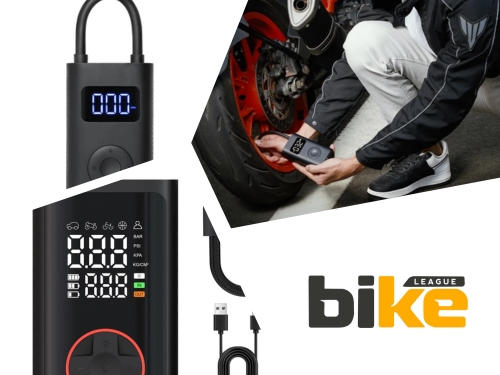
Long story short – A good motorcycle tyre inflator helps you maintain the correct cold tyre pressure at home and restore pressure after a slow leak on the road. This guide explains the main motorcycle tyre inflator types, top motorcycle tyre inflators, how to choose one, safety and testing advice, and common questions from Indian riders.
Having the right tyre pressure impacts fuel efficiency, tyre life, grip, and braking, especially on wet or monsoon-affected roads. While fuel-station air pumps are handy, their readings can be unreliable, so many riders keep their own inflator and pressure gauge at home or in their bag. This guide will help you understand the types of inflators available in India, choose one that suits your riding style, and use it safely and correctly.
Key Takeaways
- Always use the cold-tyre-pressure figure from your bike’s pressure sticker or owner’s manual — never a generic PSI figure from another vehicle, the internet, or the tyre sidewall.
- A 12V DC wired inflator works well for most riders at home; a cordless model is better for touring, where you may not want to access the bike battery on the roadside.
- Look for a clear gauge, preset auto-cutoff, useful cable or hose length, and a maximum pressure rating comfortably above your motorcycle or scooter’s specified cold-pressure requirement. Around 18–20 L/min or more is usually adequate for routine motorcycle and scooter use.
- For consistent readings before a long ride, use the same reliable personal gauge or inflator each time and periodically compare it with a known-good reference. Fuel-station gauges can vary in maintenance and may not match your own gauge exactly.
- An inflator restores pressure — it does not repair a puncture, valve leak, rim leak, or damaged tyre. Carry a separate repair kit alongside it.
Quick Picks: Best Motorcycle Tyre Inflators In India
How we selected these: We compared power source, airflow rate, gauge accuracy, auto-cutoff, build quality, portability, and price across current Indian listings. No single brand dominates this category, so verify the exact variant, warranty, and current price before ordering.
Prices and specifications last checked: September 2026. Listings, variants, warranty terms and discounts can change; verify the live product page before ordering.
| Category | Our Pick | Why |
|---|---|---|
| Best for one-bike, home-parked owners | Amazon Basics Metal Compact Portable Tyre Inflator | 12V DC wired, metal body, ₹1,500–₹2,000 — usually the best price-to-performance ratio for garage use |
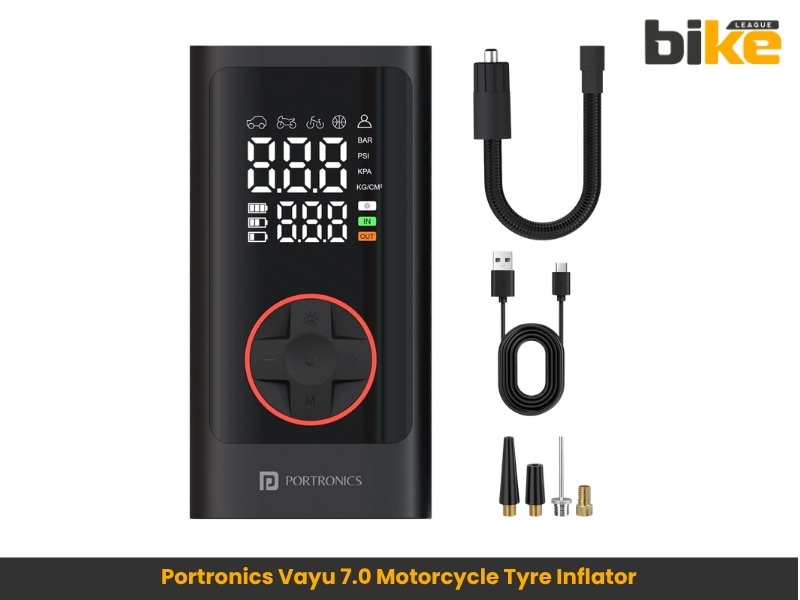
| Best cordless option | Portronics Vayu 7.0 | Cordless, dual battery, doubles as a 5W power bank, ₹1,849 |
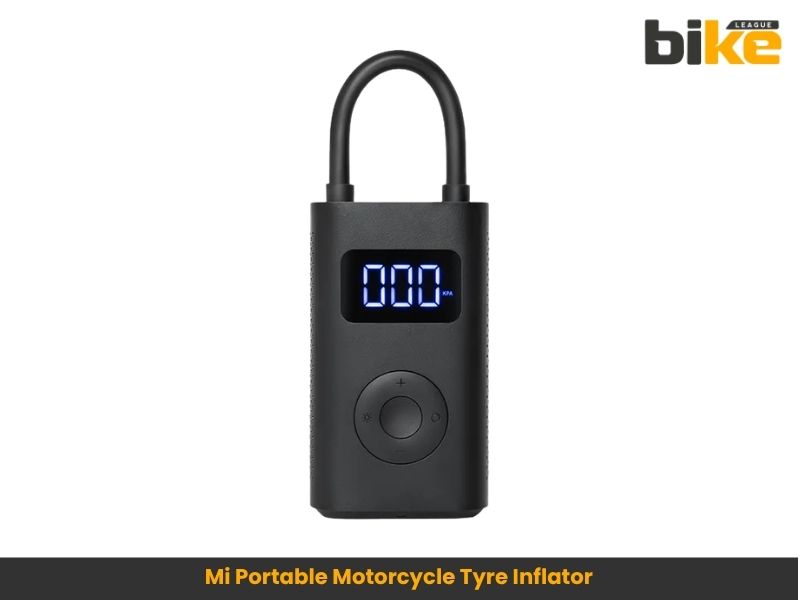
| Best compact touring option | Xiaomi Mi Portable Electric Air Compressor | Compact cordless option for touring; verify exact model weight, battery capacity, charging port and current price before purchase |
| Best for home use with a car too | AGARO TI2157 | Dual power (12V DC + 230V AC), claimed 35 L/min, 120W motor |
| Best high-output / multi-vehicle option | iBell CA12-95 | Claimed 40 L/min, 180W copper-armature motor, made in India |
These picks are based on listed specifications, price range, form factor and intended use. Product variants, availability, warranties and discounts change frequently, so verify the exact model, seller, auto-cutoff function, cable or hose length, supplied adapters and current price before ordering. Detailed specifications and buying links appear in the product table below.
What Is A Motorcycle Tyre Inflator?
A tyre inflator (also called a tyre air pump or portable air compressor) is a device that pushes compressed air into a tyre through the valve to bring it to the correct pressure. For motorcycles and scooters, inflators generally fall into three categories: manual foot/hand pumps, 12V DC electric pumps that draw power from the vehicle’s battery, and battery-powered cordless electric pumps with an internal rechargeable cell.
Keeping correct tyre pressure isn’t just about ride comfort. Under-inflated tyres increase rolling resistance and heat build-up, lowering fuel efficiency and accelerating edge wear. Over-inflated tyres reduce the contact patch, hurting grip and braking. A personal inflator also means you won’t be stranded if a puncture or slow leak happens away from a fuel station.
A bicycle hand pump can technically add air to a motorcycle tyre if the valve type matches, but it takes far longer and is impractical beyond a minor top-up. For a single motorcycle or scooter, a compact 12V or cordless inflator is usually more practical than a full-size air compressor. It is designed for topping up tyres, not running pneumatic tools. A full-size compressor makes more sense only if you also use air tools or maintain a home workshop.
Tyre Inflator Vs Fuel-station Air Vs Co₂ Cartridge Vs Foot Pump
You don’t have to own an inflator if you don’t want to. Here’s how the alternatives compare, in case you’re weighing whether to buy one.
| Option | Accuracy | Speed & Convenience | Best For |
|---|---|---|---|
| Personal 12V/cordless inflator | High, if checked against a known-good gauge | Fast; always available at home or on tour | Riders who want a consistent, verifiable pressure reading every time |
| Fuel-station air pump | Can vary by equipment condition; may not match your own gauge | Convenient when available; may involve queues or unavailable equipment | Occasional top-ups when you can cross-check pressure later |
| CO2 cartridge inflator | Fixed volume per cartridge, not adjustable to an exact PSI | Very fast one-time inflation, but cartridges are single-use | Emergency roadside top-up when weight and space matter more than precision |
| Manual foot/hand pump | Depends on the attached gauge, usually analogue | Slow and tiring for a full fill | Cheap backup when you have no power source at all |
If you only need an emergency top-up once in a while, a CO2 cartridge or a manual pump can work as a backup. But for regular pressure checks at the accuracy a long ride deserves, a dedicated electric inflator with a digital gauge remains the most practical choice.
How Motorcycle Tyre Inflators Work
All motorcycle-compatible inflators work on the same basic principle: an electric motor (or a manual piston, for foot pumps) compresses air and forces it through a hose into the tyre valve. The differences that matter for buyers are:
Power source — 12V DC wired inflators connect directly to the bike or car battery and generally deliver more consistent airflow since they aren’t limited by an internal battery’s charge. Cordless models use built-in lithium-ion batteries (commonly 2,000–6,000 mAh) and trade a bit of power for portability. Most cordless models charge via Micro-USB or USB Type-C (verify the exact port for your variant), so you can charge from a power bank, laptop, or wall adapter.
Airflow rate (L/min) — This indicates how quickly an inflator can move air. Many portable bike-focused inflators fall between roughly 15 and 35 L/min, but real inflation time depends on tyre volume, starting pressure, battery charge, hose losses, and duty cycle. Off-road and adventure riders may benefit from a higher-airflow unit, a durable hose fitting and storage that keeps dust away from the valve connector. Choose a model that suits how often you expect to adjust pressure between road and trail conditions, rather than relying on a single L/min figure.
Pressure gauge type — Digital gauges are easier to read at a glance and work well with preset auto-cutoff. A digital display is not automatically more accurate than a good analogue gauge — accuracy depends on calibration. Check a new inflator against a reliable standalone pressure gauge before relying on it for long-distance riding.
Nozzle and adapters — Check that the inflator ships with a valve adapter compatible with motorcycle Schrader valves (the standard type on nearly all Indian bikes and scooters), plus extra adapters for bicycles or sports balls if you want the versatility. Wired 12V models typically include a cigarette-lighter plug or crocodile clips; some cordless models add an LED work light as a bonus, though it’s not something to prioritise over airflow, gauge accuracy, or auto-cutoff.
Can An Inflator Over-inflate Or Damage Your Tyre?
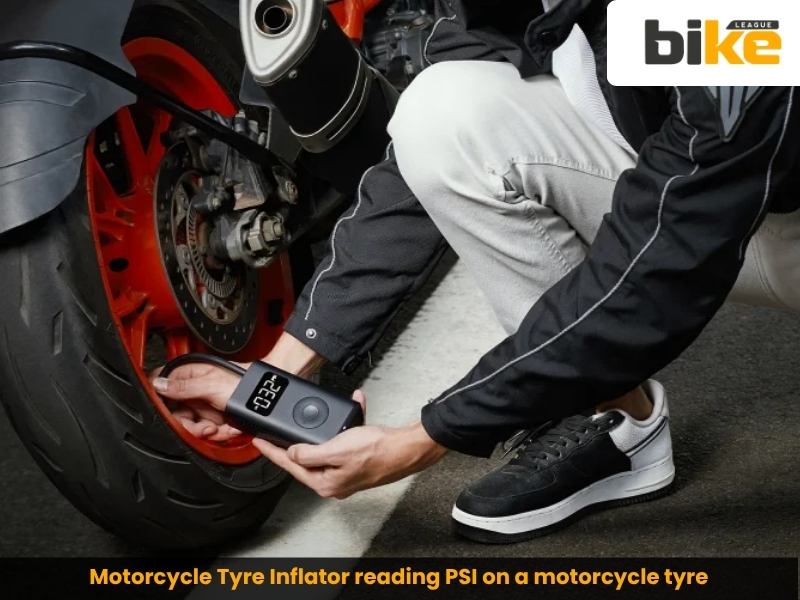
Yes, this is a real risk with an inflator that lacks auto-cutoff or with a rider who isn’t watching the gauge. Over-inflating beyond the manufacturer’s recommended cold pressure reduces the tyre’s contact patch, which can hurt grip and braking and increase the risk of a harsher ride over potholes. A poorly calibrated gauge that reads low can also tempt a rider to keep adding air past the safe limit without realising it.
An inflator itself doesn’t damage a healthy tyre through normal use, but a few practices increase risk:
How To Reduce The Risk Of Over-inflation Or Inflator Misuse
- Always check your bike’s specified cold-tyre PSI before you start, and don’t exceed it “for extra mileage” — that’s a myth (see below).
- Use a preset auto-cutoff target where the inflator supports it, rather than watching the gauge and guessing when to stop.
- Compare a new inflator’s reading against a separate, trusted gauge before relying on it for critical pre-ride checks.
- Don’t run a compact inflator continuously to fill multiple flat tyres — this can overheat the motor and trigger thermal cutoff, and in rare cases affect the accuracy of the reading as the unit heats up.
- If a tyre keeps losing pressure right after topping up, that’s an unresolved leak, not something an inflator can fix — get it inspected rather than repeatedly topping it up.
Tubeless Vs. Tube-type Tyres: Why It Matters On The Road
Most newer Indian motorcycles and scooters use tubeless tyres, but many commuter and older bikes still run tube-type tyres — check your bike’s spec sheet or the tyre sidewall (tubeless tyres are usually marked “Tubeless”).
Tubeless tyres: The tyre itself holds the air against the rim, with no separate inner tube. A small nail or screw puncture in the tread can often be temporarily plugged with a tubeless repair kit and re-inflated with your inflator, letting you ride cautiously to a proper repair shop.
Tube-type tyres: Air is held by a separate rubber tube inside the tyre casing. A puncture usually means you need to remove and patch or replace the tube — plug kits made for tubeless tyres don’t work here. An inflator can sometimes buy you a short distance if the leak is very slow, but a tube-type puncture generally needs a tyre shop, not just air.
The inflation process itself is identical for tubeless and tube-type tyres — the difference only comes up if the tyre is punctured.
Types Of Motorcycle Tyre Inflators
| Type | Typical Price Range | Airflow | Max Pressure | Best For |
|---|---|---|---|---|
| Manual foot/hand pump | ₹200–₹900 | Manual (no L/min rating) | Up to 160 PSI | Budget backup, occasional top-ups |
| 12V DC wired electric inflator | ₹1,200–₹2,700 | 18–35 L/min | 100–150 PSI | Home use, garage-parked bikes, riders who don’t mind a cord |
| Cordless battery-powered inflator | ₹1,800–₹3,500 | 15–17 L/min | 120–150 PSI | Touring riders, roadside emergencies, no battery access needed |
| Heavy-duty metal-body inflator | ₹2,500–₹5,500 | 30–35 L/min | 150 PSI+ | Multi-vehicle households (bike + car), frequent/commercial use |
Prices are indicative street prices on Indian e-commerce platforms and fluctuate with sales; always check current listings before buying.
1. Manual Foot/hand Pumps
Pros: Cheapest option, no battery or cord needed, works anywhere, very durable.
Cons: Slow and physically tiring for a full fill, no digital readout on most budget models, less precise.
2. 12v Dc Wired Electric Inflators
Pros: Fast and consistent airflow straight from the battery, no charging needed, usually the best price-to-performance ratio.
Cons: Needs access to the bike’s battery terminals or a 12V socket, less convenient if the tyre goes flat away from the vehicle, cord length can be limiting.
3. Cordless Battery-powered Inflators
Pros: Fully portable, works anywhere including far from the bike, convenient for touring and emergencies, some double as a power bank.
Cons: Slower airflow than wired models in most cases, needs charging in advance, generally costs more for comparable performance.
4. Heavy-duty Metal-body Inflators
Pros: Highest airflow and durability, suited for households with both a bike and a car, better heat dissipation.
Cons: Bulkier and heavier to carry, priciest category, often overkill for a single-motorcycle owner.
There’s no separate “off-road” inflator category, but off-road riders should prioritise a higher-airflow unit, durable hose fittings and dust-protected storage over other features, since pressure is often adjusted between terrain types mid-ride.
How To Choose The Right Tyre Inflator
| Feature | Why It Matters | What to Check |
|---|---|---|
| Airflow Rate | Determines how long a top-up or full fill takes | Around 18–20 L/min or more is usually adequate for routine use; compare claimed airflow, hose quality, and duty-cycle guidance for larger tyres or frequent pressure changes |
| Gauge Accuracy | A misreading gauge risks under- or over-inflation | Compare against a separate trusted gauge before relying on it |
| Auto-cutoff | Reduces the risk of over-inflation and helps stop the unit at a preset target pressure | Test the preset function at a safe pressure, but remain nearby while the inflator is operating |
| Power Source Fit | Wired vs cordless changes where and how you can use it | 12V for home/garage use, cordless for touring and roadside emergencies |
| Max Pressure Rating | Should sit comfortably above your bike’s specified cold pressure | Choose a maximum-pressure rating comfortably above your motorcycle or scooter’s specified cold-pressure requirement; avoid using the tyre sidewall maximum as your inflation target |
| Nozzle/Adapter Fit | Must seat on a Schrader valve without leaking | Confirm Schrader compatibility and check for extra adapters if needed |
| Build & Portability | Determines how well it survives touring, heat, and monsoon storage | Metal body for home units; sealed pouch/case for cordless touring units |
What To Buy By Budget
Under ₹1,000
Manual foot pumps sit here (roughly ₹200–₹900). At the top of this tier you can also find basic clamp-style budget electric options. This tier suits occasional top-ups on a tight budget, but expect no digital readout and limited durability.
₹1,000–₹2,500
This is where most riders should shop. It covers wired options like the Amazon Basics Metal Compact Tyre Inflator, and cordless options like the Portronics Vayu 7.0 and Xiaomi Mi Portable Electric Air Compressor. Look for a digital gauge and a working auto-cutoff at this price point.
₹2,500–₹5,000
Dual-power units like the AGARO TI2157 (12V DC + 230V AC) sit here, worth it if you also own a car and want one inflator for both. This tier generally brings higher claimed airflow (30–35 L/min) and a metal body.
Premium (₹4,000+)
Heavy-duty, high-output units like the iBell CA12-95 (claimed 40 L/min, copper-armature motor) fall here. Appropriate for multi-vehicle households or frequent, near-commercial use where duty cycle and durability matter more than price.
Which Brands To Look For
No single brand dominates the Indian market for motorcycle-focused inflators, and brand alone isn’t a reliable indicator of quality. What matters more is the power type (wired, cordless or dual), a verified airflow/pressure spec for the exact variant, a working auto-cutoff, and the seller’s warranty terms. Amazon Basics, Portronics, Xiaomi, AGARO, and iBell are commonly available names across these categories on Indian e-commerce platforms — verify the specific model and current listing before ordering.
Recommended Inflators By Riding Scenario
| Riding Scenario | Recommended Type | Key Features to Look For |
|---|---|---|
| Home-parked daily commuter | 12V DC wired inflator | Best price-to-performance, digital gauge, auto-cutoff |
| Long-distance touring | Cordless battery-powered inflator | No battery access needed, compact enough for a tail bag, verified charge time |
| Off-road / adventure riding | Cordless or 12V inflator suited to your available power source | Useful airflow, durable hose fittings, protected storage and verified duty-cycle guidance |
| Multi-vehicle household (bike + car) | Heavy-duty metal-body or dual-power inflator | 30–35 L/min+, higher duty cycle, mains/12V dual power if needed |
| Monsoon riding | Any type, stored in a water-resistant pouch | Sealed charging port/connector, avoid leaving it exposed to rain |
Questions To Ask Before You Buy
- What’s my bike’s specified cold-tyre PSI, front and rear? Check the sticker or manual — don’t guess.
- Will I mainly use this at home, or do I need to carry it while touring? This decides wired vs cordless.
- Do I also own a car or other vehicle that could share the inflator? If yes, a dual-power or heavy-duty unit may be worth the extra cost.
- Does the seller’s listing confirm a working auto-cutoff and the exact airflow spec for my variant, not just the product family?
- What’s my realistic budget? Match your answer against the budget-tier breakdown above rather than buying the cheapest option and upgrading later.
Best Motorcycle Tyre Inflators In India
Here are five motorcycle-compatible inflators actually sold in India across budget, mid-range, and premium price points. Treat the specifics below as a starting point drawn from current listings — verify the exact variant, auto-cutoff, supplied adapters, warranty, and current price before buying.
| Model | Power Source | Performance Details | Max Pressure | Battery | Weight | Street Price* |
|---|---|---|---|---|---|---|
| Xiaomi Mi Portable Electric Air Compressor | Cordless (built-in battery) | Airflow figure not stated for this exact variant; verify pressure-sensor accuracy on the official listing | 150 PSI | Rechargeable built-in battery; verify capacity, charging port, and charge time for the exact variant | Verify exact variant weight | ₹1,700–₹1,900 |
| Portronics Vayu 7.0 | Cordless (dual battery) | Airflow/motor wattage not published; manufacturer states ~4-5 PSI/min inflation rate | 150 PSI | 2× 2,000 mAh, Type-C, doubles as 5W power bank | Compact/pocketable | ₹1,849 |
| Amazon Basics Metal Compact Tyre Inflator | 12V DC wired | 120W motor; inflates a 165/80 R14 car tyre from 0–35 PSI in under 10 minutes; multi-unit display (PSI/kPa/BAR/kg/cm²); built-in LED light | 150 PSI | None — runs off bike/car battery | ~0.67 kg | ₹1,500–₹2,000 |
| AGARO TI2157 | Dual power: 12V DC + 230V AC | 120W motor, 35 L/min | 150 PSI | None (mains/12V only) | 1.75 kg | ₹3,000–₹3,500 (MRP ₹5,999) |
| iBell CA12-95 | 12V DC wired, heavy-duty | 180W copper-armature motor, 40 L/min | 150 PSI (analog gauge) | None — runs off battery | Heavier, metal body | Check current listing |
*Prices are indicative street prices on Indian e-commerce platforms as of September 2026 and fluctuate with sales; always verify the current listing before buying. Manual foot pumps remain the cheapest backup option (roughly ₹200–900) but aren’t included here as named models, since specs vary too widely by manufacturer.
How To Use Your Inflator Correctly
- Check your bike’s specified cold-tyre PSI first.
- Remove the valve cap, then press the inflator’s nozzle firmly onto the valve until it seats without hissing.
- Power on the unit. If it has a preset function, set your target PSI and let auto-cutoff stop it; otherwise monitor the gauge and switch off manually once you reach the target.
- Double-check the final reading with a separate gauge, then replace the valve cap.
Test Your Inflator Before A Long Ride
Run through this check whenever you’re about to rely on your inflator for a long ride.
- Charge or inspect the power source: Fully charge a cordless inflator, or check the cable, fuse, and battery clips on a wired model.
- Cross-check the gauge: Compare the inflator’s pressure reading with a trusted standalone gauge.
- Test auto-cutoff: Try it at a low target pressure before relying on it during a roadside emergency.
- Confirm hose reach: Make sure the hose reaches both wheels without pulling sideways on the valve stem.
- Run it briefly: Check for excessive heat, unusual noise, a loose hose fitting, or air leaking from the valve head.
- Pack it properly: Store the inflator, adapters, valve caps, puncture kit, gloves, and a torch in a water-resistant pouch.
Wiring A 12v Inflator Safely
- Keep the power cord and clips away from the exhaust, chain, and any moving or hot parts.
- Connect crocodile clips or the 12V plug securely before switching the inflator on, and disconnect before moving the bike.
- Don’t use an inflator with a frayed, cut, or damaged cord/clip.
- Check your inflator’s manual on whether it should be used with the engine running or off — some manufacturers recommend running the engine to avoid drawing down a weak battery, while others don’t require it. A short top-up usually draws little power, but avoid operating a compact 12V inflator continuously with the ignition off on a weak battery.
Using And Storing Your Inflator
Fitting An Inflator For Touring
If you plan to carry an inflator while touring, both size and storage are just as important as airflow. Compact cordless models are usually light enough for a tail bag, tank bag or, if there’s space, under the seat. Be sure to check the weight and size of the model you pick. Bulkier 12V wired inflators with a hose and longer power cord are best kept in a saddlebag, tail bag, or your home toolkit, where you can coil the cord without bending it. Always use a pouch to protect the hose and connector from dirt, which helps ensure a good seal at the valve.
In the monsoon or hot weather, store your inflator in a sealed pouch and make sure the charging port or wired connector stays dry. Wipe off any water before putting it away, keep it out of direct sunlight inside a parked vehicle during the hottest part of the day, and never submerge or spray it with water.
What To Do When A Tyre Loses Air During A Ride
- Pull over safely first. Signal early, move off the road surface, and get onto a stable, level spot before you stop.
- Check whether it is a slow leak or a flat. Do not continue riding on a visibly soft or flat tyre. If you inflate it and it continues losing pressure, arrange a repair, recovery, or roadside assistance rather than repeatedly topping it up.
- Identify tube-type vs tubeless (see above) — this determines your options.
- For a tubeless tyre with a small tread puncture: a plug/repair kit can offer a temporary fix, followed by inflating to your bike’s specified cold pressure with your inflator.
- For a tube-type tyre, a sidewall puncture, or a valve/rim leak: topping up air is usually only a stalling measure. These need tube removal, a professional patch, or roadside assistance.
- If you can’t identify or fix the cause, call roadside assistance or a nearby mechanic rather than continuing to ride, especially on tube-type tyres or if the leak is fast.
Do not use a plug kit for sidewall damage, shoulder damage, a large hole, exposed cords, a damaged bead or a visibly damaged tyre. A temporary roadside plug is not a universal tyre repair. Ride cautiously to a tyre professional for inspection, repair or replacement as soon as possible.
Important: A tyre inflator restores air pressure — it does not repair the underlying problem. It cannot fix a puncture, a leaking valve, a cracked rim, or a damaged tyre casing. Carry a separate plug/repair kit (for tubeless tyres) alongside your inflator.
Do not ride if the tyre has a sidewall cut, bulge, exposed cords, a damaged bead, a visibly bent rim or rapid pressure loss. Arrange recovery or professional assistance instead.
Motorcycle Tyre Emergency Kit Checklist
| Item | Purpose |
|---|---|
| Portable tyre inflator | Restores pressure after a slow leak or temporary repair |
| Separate pressure gauge | Verifies the inflator’s displayed PSI |
| Tubeless plug kit | Temporary repair for a small tread puncture in a tubeless tyre |
| Valve caps and valve-core tool | Helps address missing caps and some valve-related leaks |
| Small pliers | Helps remove a nail or screw before a temporary tubeless repair |
| Disposable gloves | Keeps hands cleaner during roadside work |
| Torch or headlamp | Helps inspect and repair a tyre after dark |
| Water-resistant pouch | Protects the inflator, hose, adapters, and repair kit |
How To Maintain A Motorcycle Tyre Inflator
Monthly Inflator Checklist
- Charge level (cordless/hybrid models) — top up even if unused, so it’s ready in an emergency.
- Hose condition — check for cracks, kinks, or a loose connection at either end.
- Valve adapter/nozzle — confirm it still seals properly on your bike’s Schrader valve.
- Quick pressure test on a known tyre to confirm the gauge still reads correctly.
- Battery health (cordless models) — replace if run-time has dropped noticeably or it no longer holds charge.
Compact inflators aren’t designed for user-level internal repair. If yours won’t charge, can’t reach pressure, or the gauge is misreading, check your warranty first and contact the manufacturer or authorised seller’s support rather than attempting a DIY fix.
Safety Tips For Using A Tyre Inflator
- Measure pressure when tyres are cold, before riding, not right after a ride.
- Never exceed your bike’s specified cold pressure to “improve mileage” — see the myths section below.
- Keep cables and clips clear of the exhaust, chain, and moving parts when using a 12V wired unit.
- Don’t run a compact inflator continuously to fill multiple tyres back-to-back — let it cool per the manufacturer’s guidance.
- Store the inflator in a sealed pouch, away from monsoon moisture and peak summer heat.
- Recheck pressure with a separate gauge before any long or high-speed ride.
Common Mistakes When Buying And Using Motorcycle Tyre Inflators
1. Choosing An Inflator With No Auto-cutoff
Mistake: Buying the cheapest unit purely for price, without checking if it has a working preset/auto-cutoff.
Why it’s risky: Without auto-cutoff, over-inflation is easy if you get distracted mid-fill.
What to do instead: Spend slightly more for a model with a verified auto-cutoff function.
2. Ignoring The Airflow Spec For The Exact Variant
Mistake: Assuming every unit in a product family shares the same L/min rating as the flagship variant.
Why it’s risky: A slower unit can take far longer than expected, especially on larger or off-road tyres.
What to do instead: Confirm the airflow spec for the exact listing you’re buying, not the product family in general.
3. Never Cross-checking The Gauge
Mistake: Trusting the inflator’s built-in gauge from day one without comparison.
Why it’s risky: A digital display is not automatically accurate — calibration varies by unit.
What to do instead: Compare against a separate, trusted gauge when the inflator is new, and periodically afterward.
4. Skipping The Cold-pressure Rule
Mistake: Checking and adjusting pressure right after a ride, when tyres are warm.
Why it’s risky: Pressure rises as tyres heat up, so a warm reading gives a falsely high number.
What to do instead: Always measure cold, before riding.
Common Myths About Tyre Inflators
Myth: Higher Psi Always Means Better Fuel Efficiency
Over-inflating beyond the manufacturer’s recommended pressure reduces the tyre’s contact patch and can hurt grip and ride comfort without meaningfully improving mileage, and increases the risk of a harsher ride over potholes.
Myth: A Car Inflator Works Exactly The Same For Bikes
Most car-rated inflators do work on motorcycle Schrader valves, but riders should confirm the nozzle fits properly and set the pressure specifically for the bike, since car and bike PSI requirements are very different.
Myth: Fuel Station Air Is Always Free And Accurate
Fuel-station gauges can vary in condition and may not match your own gauge. A personal pressure gauge or inflator helps you maintain a consistent baseline, but it should also be checked periodically against a known-good reference.
Myth: Nitrogen-filled Tyres Never Need Topping Up
Nitrogen leaks more slowly than regular air but still leaks over time, and most fuel stations top up nitrogen-filled tyres with regular air unless you specifically seek out a nitrogen refill point, so periodic checks are still needed.
Faq About Motorcycle Tyre Inflators In India
1. What Psi Should I Set For My Motorcycle Or Scooter Tyres?
Check the tyre-pressure sticker on your motorcycle or scooter, or consult the owner’s manual. Measure pressure before riding, when the tyres are cold. The correct front and rear figures can change by model, tyre size, passenger load and luggage, so do not copy PSI values from another vehicle or use the maximum PSI printed on the tyre sidewall.
2. How Often Should I Check My Tyre Pressure?
Once every 1–2 weeks, and always before a long ride. Tyres naturally lose a small amount of pressure over time even without a puncture, and temperature changes can also affect the reading.
3. Is A Digital Or Analog Gauge Better?
Digital gauges are easier to read in low light and make preset auto-cutoff convenient. A digital display is not automatically more accurate than a good analogue gauge — accuracy depends on calibration. When you buy a new inflator, compare its reading with a separate, trusted pressure gauge; if the readings differ by more than a couple of PSI, note the difference and consider recalibration, servicing, or replacement.
4. Do I Need A Heavy-duty Inflator If I Only Own One Bike?
No. A standard 12V or cordless electric inflator in the 18–25 L/min range is sufficient for a single motorcycle or scooter. Heavy-duty metal-body units suit households that also inflate car tyres regularly.
5. Will An Inflator Drain My Bike’s Battery?
A short top-up usually draws little power, but avoid operating a compact 12V inflator continuously with the ignition off on a weak battery. Follow the inflator manufacturer’s instructions on whether the engine should be running. If the engine is running, use the motorcycle only in a well-ventilated outdoor area and keep cables clear of hot and moving parts.
6. What Is The Best Tyre Inflator For A Motorcycle In India?
There isn’t one universal “best” model — it depends on how you’ll use it. For a single home-parked bike, a 12V DC wired inflator like the Amazon Basics Metal Compact Tyre Inflator is usually the most cost-effective choice. For touring or roadside emergencies, a cordless model like the Portronics Vayu 7.0 or Xiaomi Mi Portable Electric Air Compressor is more practical. Multi-vehicle households often prefer a higher-output unit like the AGARO TI2157 or iBell CA12-95.
7. Can I Use A Car Tyre Inflator For A Bike?
In most cases, yes — car-rated inflators generally work on motorcycle Schrader valves. Confirm the nozzle fits your bike’s valve properly, and set the target pressure for your motorcycle or scooter rather than reusing a car’s PSI figure.
8. How Do I Choose A Tyre Inflator For My Motorcycle Or Scooter?
Match the inflator to how and where you’ll use it: a 12V wired inflator if you mainly top up at home or in a garage, or a cordless model if you want to use it away from the bike’s battery. Beyond that, look for a Schrader-valve-compatible nozzle, a clear digital or analogue gauge, preset auto-cutoff, a maximum pressure rating comfortably above your bike’s specified cold pressure, and a hose or cable long enough to reach both wheels comfortably.
9. Is A Tyre Inflator Worth Buying?
For most riders, yes. A personal inflator lets you maintain correct cold tyre pressure at home rather than relying on inconsistently maintained fuel-station compressors, and it means you’re not stranded if a slow leak develops away from a fuel station. It doesn’t replace a puncture repair kit, but as a pressure-maintenance and emergency tool it earns its cost for most owners within the first year or two of regular use.
10. Can I Run My Inflator Continuously To Fill Several Flat Tyres?
Not safely with most compact units. Compact 12V and cordless inflators are built for short bursts, not continuous industrial use — running one non-stop can overheat the motor and trigger thermal cutoff or shorten its lifespan. Follow the manufacturer’s stated runtime and cooldown guidance in the manual, and let the unit rest if it feels hot.
Other Related Articles From Bikeleague India
- Bike nitrogen filling & air filling – FAQ & Myths
- Mileage in Two wheelers – Proven & useful tips
- Best bike tyre brands for your motorcycle in India
- Bike tyre polish in India: Elevate your motorcycle tyre look now
- Two wheeler tyre code – How to read & understand – Video
Final Verdict
Pick a 12V wired inflator if you usually check tyre pressure at home and want something fast and affordable. Go for a compact cordless model if you travel, want to be independent on the road, or prefer not to connect to the bike battery. Choose a higher-output or dual-power inflator only if you also have a car or need to use it more often.
No matter which type you pick, always use the cold-pressure number from your motorcycle’s sticker or manual. Check the gauge against a trusted reference, keep your inflator charged or in good condition, and remember that an inflator is for managing pressure, not for fixing punctures.
If you have more questions, email us at bikeleagueindia@gmail.com or share your thoughts in the comments below.