
Long story short: Learn how Triumph Blind Spot Radar Detection System works, its pros and cons, which Tiger 1200 variants have it in India, how it integrates with the TFT display and much more right here.
Motorcycle safety technology is advancing quickly, and Triumph’s Blind Spot Radar (BSR) is a great example. Not only does it tackle the important issue of blind-spot awareness, but it also brings advanced car-level safety to premium adventure bikes. Furthermore, this system represents a significant leap forward for riders who demand the latest in safety engineering.
As technology progresses, features like BSR are becoming essential for those who prioritise safety. In fact, many riders now expect such innovations as standard equipment. Consequently, Triumph’s implementation of BSR positions it as a leader in motorcycle safety.
This guide covers how Triumph’s Blind Spot Radar works, its pros and cons, which Tiger 1200 models in India have it, how it connects to the TFT display, its impact on Indian riders, and what to consider before buying. Additionally, you’ll find practical tips and insights to help you make an informed decision. As you read further, you’ll discover how each feature contributes to overall rider safety.
On the other hand, there are a few limitations to consider before deciding if it’s right for you. Ultimately, this guide aims to provide a balanced perspective so you can confidently evaluate the BSR system for your needs.
Key Takeaways
- Triumph’s Blind Spot Radar (BSR) brings advanced automotive-grade safety technology to premium adventure motorcycles, enhancing rider awareness and reducing the risk of blind-spot-related accidents.
- The BSR system is available only on select Triumph Tiger 1200 variants in India, so it’s important to verify model specifications before purchasing.
- Integration with the TFT display ensures that BSR warnings are clear and easily visible to the rider, improving usability and real-time safety feedback.
- While the system offers significant safety benefits, there are considerations regarding maintenance and potential performance impact, especially in challenging Indian riding conditions.
- Riders should weigh the pros and cons of the BSR system, including cost and maintenance requirements, to determine if it aligns with their personal safety priorities and riding style.
What Is The Triumph Blind Spot Radar?
The Triumph Blind Spot Radar is a factory-installed, rear-mounted radar system developed with Continental. It constantly checks the back sides of the motorcycle while you ride and warns you if another vehicle enters an area you can’t see in your mirrors. The system offers two main safety features:
- Blind Spot Assist (BSA):Warns the rider when a vehicle is detected in either blind spot zone alongside the rear of the motorcycle.
- Lane Change Assist (LCA): Escalates the warning intensity when the rider activates the turn indicator while a vehicle is approaching in the corresponding blind zone.
On Indian roads, where lane discipline can be unpredictable and vehicles often come from unexpected directions, having a radar system monitoring your rear is a significant safety improvement over relying solely on mirrors. Therefore, riders can feel more secure during everyday commutes and long-distance journeys alike. In comparison to traditional methods, radar-based detection adds an extra layer of security. For instance, it can alert you to risks that even attentive riders might otherwise miss. Thus, the BSR system gives peace of mind, especially in complex traffic scenarios.
What Are The Key Features Of The Triumph Blind Spot Radar?
- Continental Partnership: Developed together with Continental, a top automotive supplier with years of radar and ADAS experience. This is not an aftermarket add-on; it’s built into the motorcycle’s electronics and TFT display at the factory.
- Millimetre-Wave Radar Technology: Operates on a high-frequency radar band, the same technology used in premium cars for blind spot detection. This enables it to reliably detect targets in rain, low light, and fog conditions that would limit camera-based alternatives.
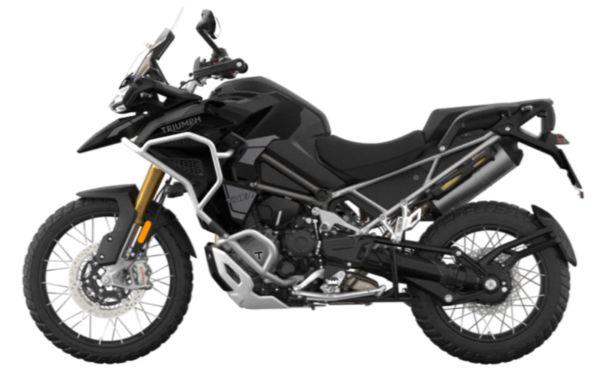
- Rear-Mounted Sensor: A compact radar module is mounted at the tail of the motorcycle, sweeping both rear quarters simultaneously. Its placement is purpose-designed for the Tiger 1200’s tail section, keeping it protected and aerodynamically integrated.
- TFT Display Integration: Warnings appear right on the 7-inch TFT instrument panel as visual signals on each side of the display. Riders can see alerts without taking their eyes off the road because the information is in their normal line of sight.
- Two Warning Levels: The system gives a steady light for regular blind spot alerts (BSA) and a stronger flashing alert (LCA) if you signal to change lanes into an occupied area. This way, the feedback matches the level of risk.
- Speed-Activated Operation: The radar activates once the motorcycle exceeds a low speed threshold (approximately 10 km/h) and deactivates when stationary, preventing false alerts in traffic queues or parking situations.
- No Rider Input Required: The system works in the background without any action from the rider. You don’t need to turn it on or manage it; it keeps you aware automatically during your ride.
- Works in All Weather and Lighting: Unlike camera-based systems, radar is not affected by darkness, glare, rain, dust, or fog. These conditions are common on Indian highways and expressways.
How Does The Triumph Blind Spot Radar Work?
To understand how the system works, it helps to look at the underlying radar physics and then how Triumph and Continental have engineered them for a two-wheeler.
The Technology Foundation: Millimetre-wave Radar
The Triumph Blind Spot Radar uses millimetre-wave radar, an electromagnetic sensor that emits radio waves in the 76–79 GHz range. These waves radiate from the rear sensor and reflect when they hit something solid, such as another vehicle. The system’s processor checks how long the waves take to return, their frequency shift (to measure speed), and the angle at which they return. This helps it determine where a vehicle is, how fast it’s moving, and whether it’s in a risky area.
Millimetre-wave radar at 77 GHz is superior to lower-frequency radar for this application because it provides finer angular resolution, longer-range detection, and greater resistance to interference from other signals. This is the same specification used in premium car OEM blind-spot systems from brands such as BMW, Mercedes-Benz, and Audi.
The Detection Zones
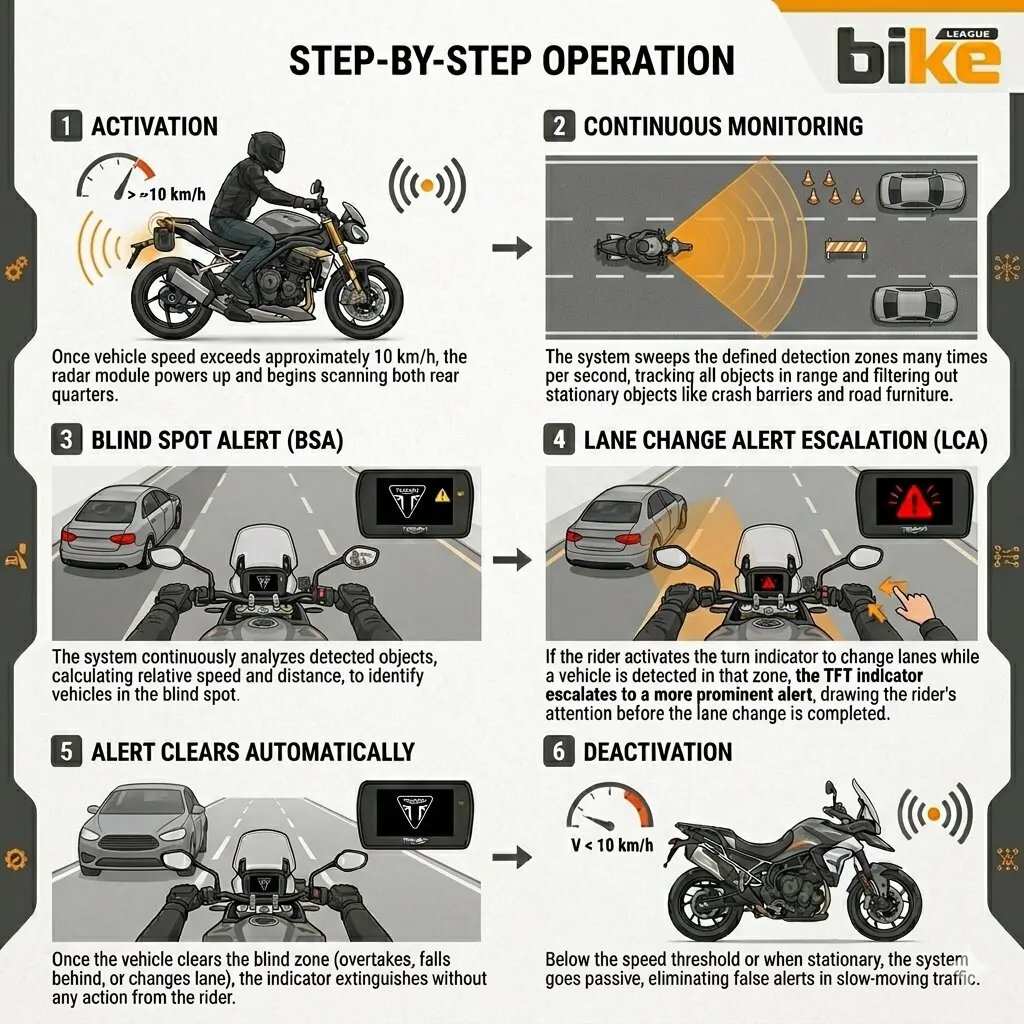
The radar module at the back of the Tiger 1200 scans a wide area behind and to both sides of the motorcycle. This covers the spots that most mirrors can’t show. The system can spot several vehicles at once and keep track of their speed and position in real time.
Unlike in a car, where the blind zone is a relatively fixed area beside the rear pillars, on a motorcycle, it changes slightly with lean angle in corners. The Continental radar system is designed to handle this by compensating for the lean-angle inputs available from the Tiger 1200’s IMU (Inertial Measurement Unit) to maintain accurate rear-zone monitoring even during cornering.
Step-by-step Operation
- Activation
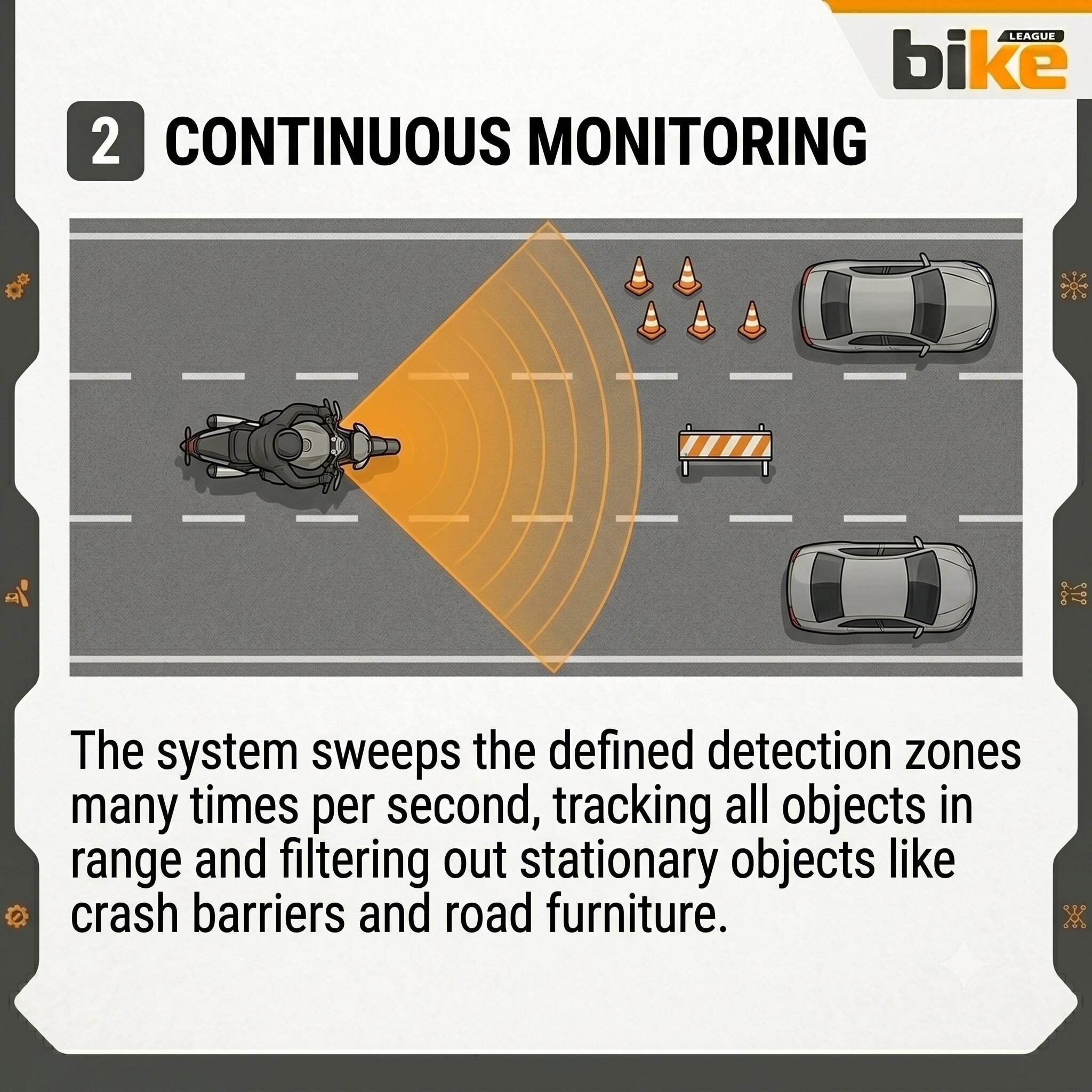
- Continuous Monitoring
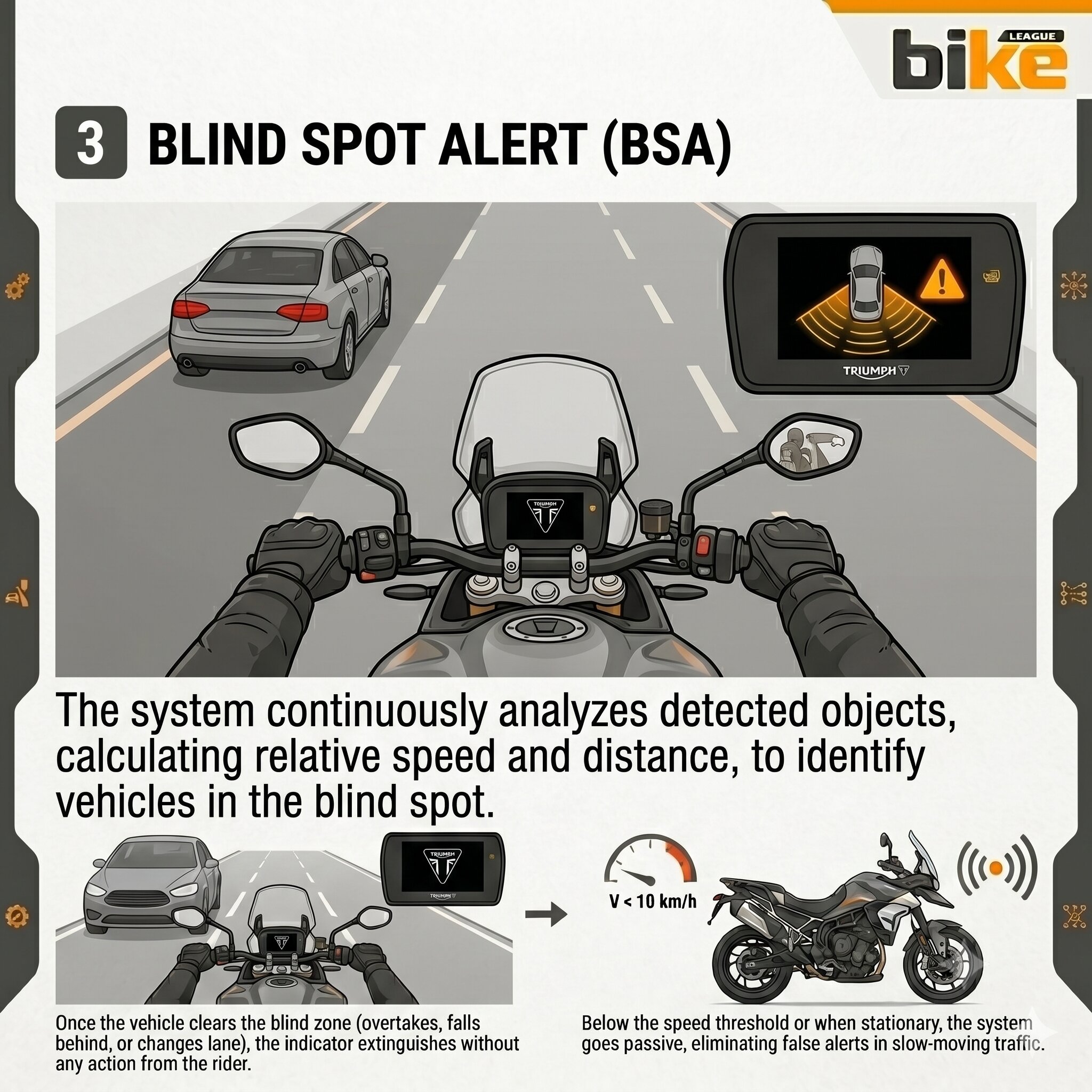
- Blind Spot Alert (BSA)
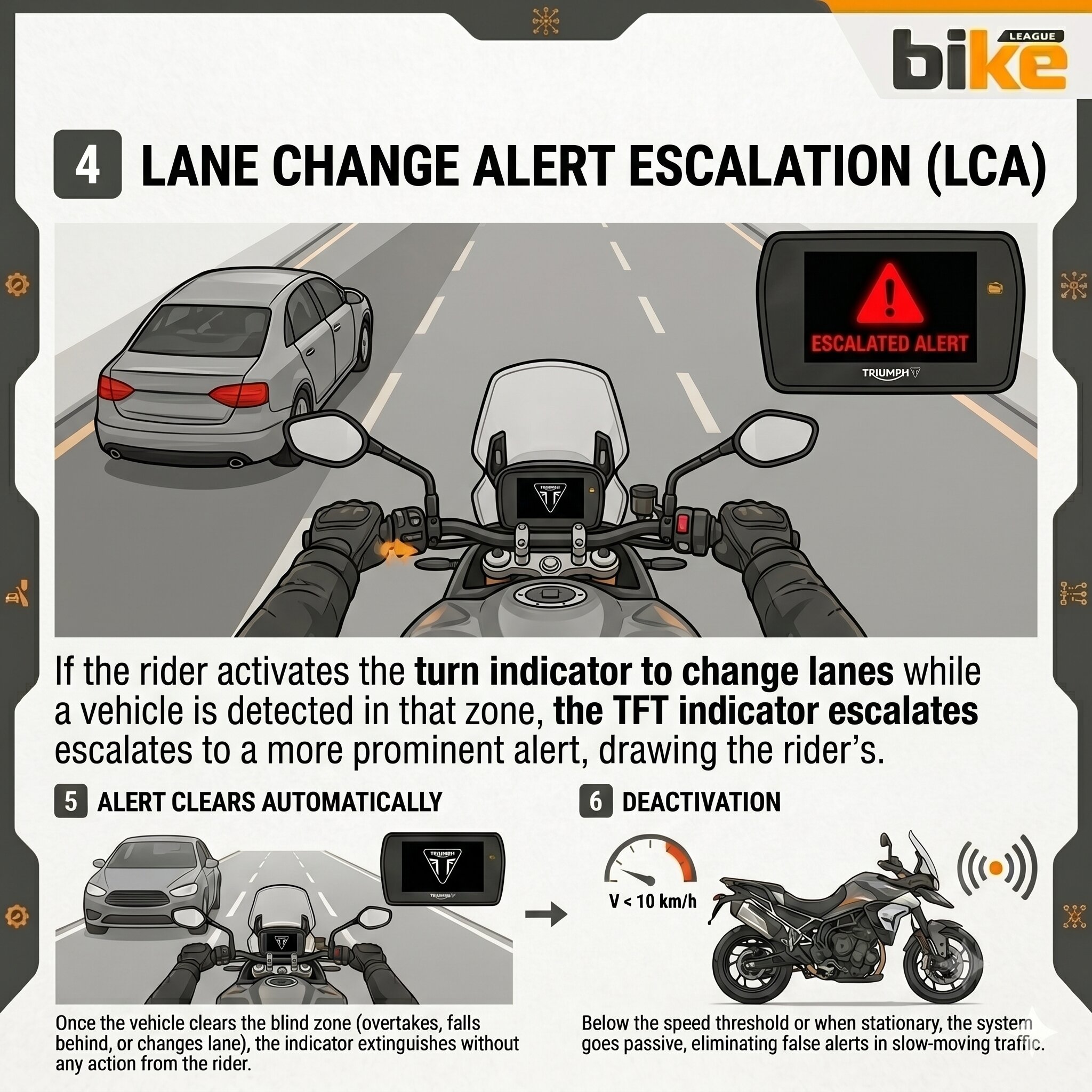
- Lane Change Alert Escalation (LCA)
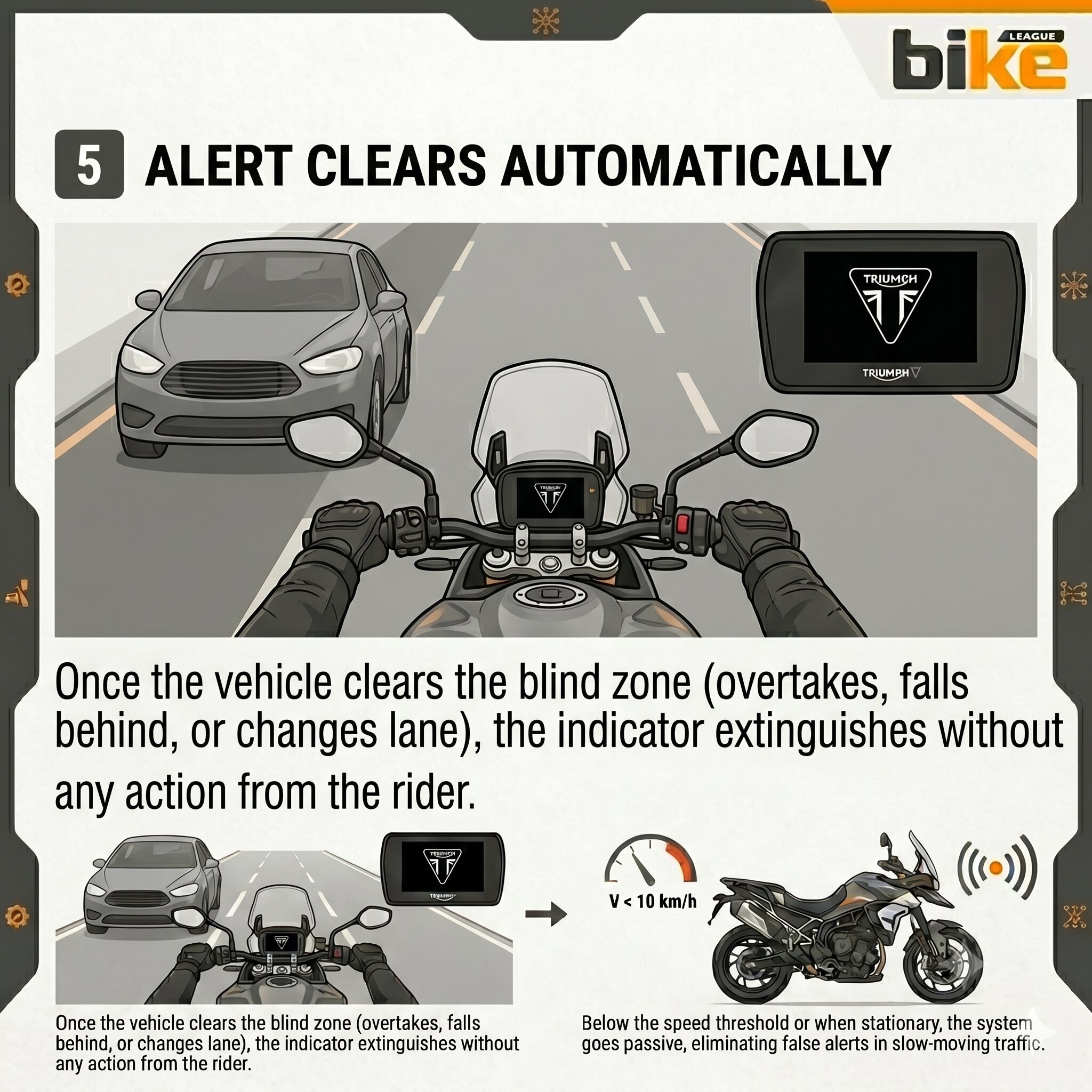
- Alert Clears Automatically
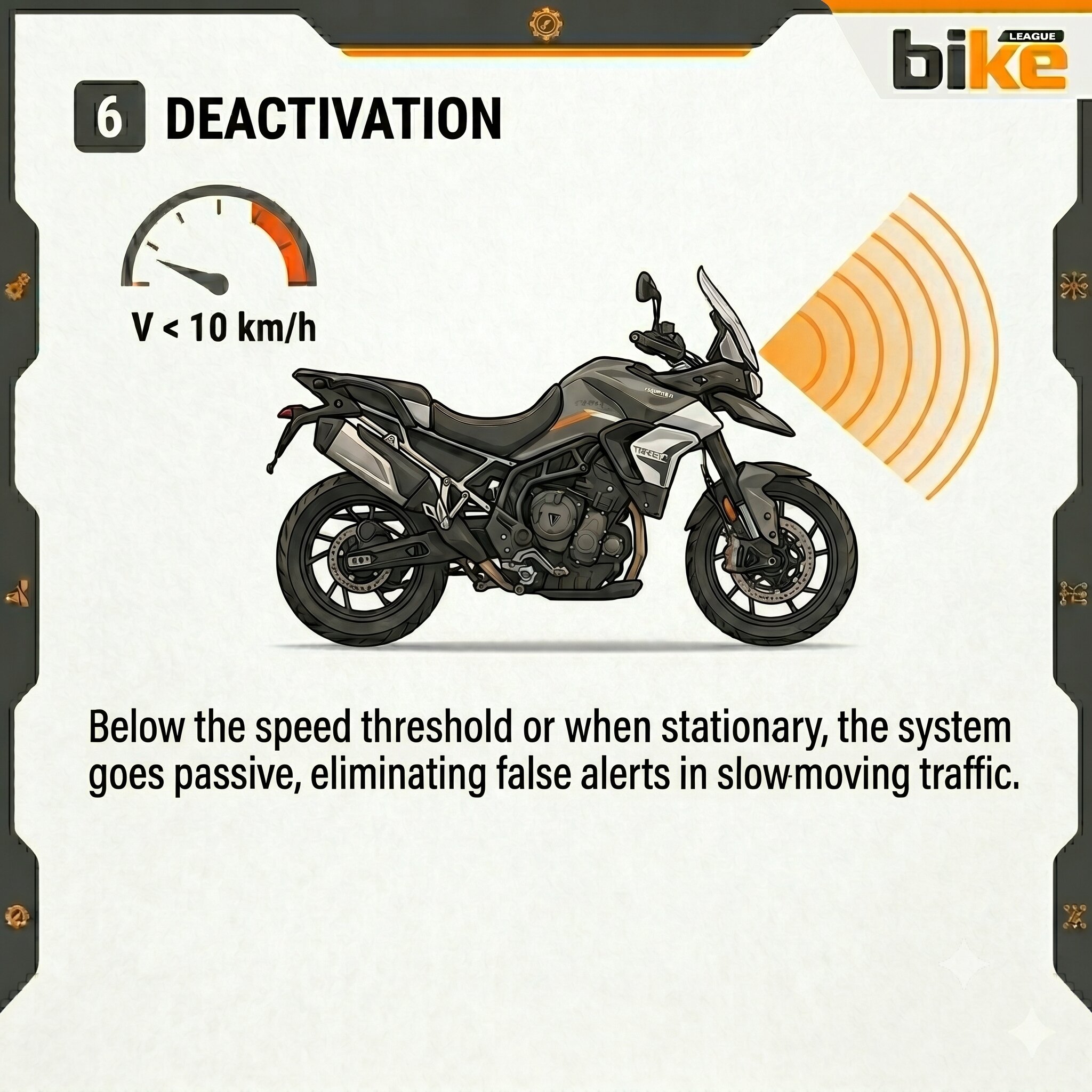
- Deactivation
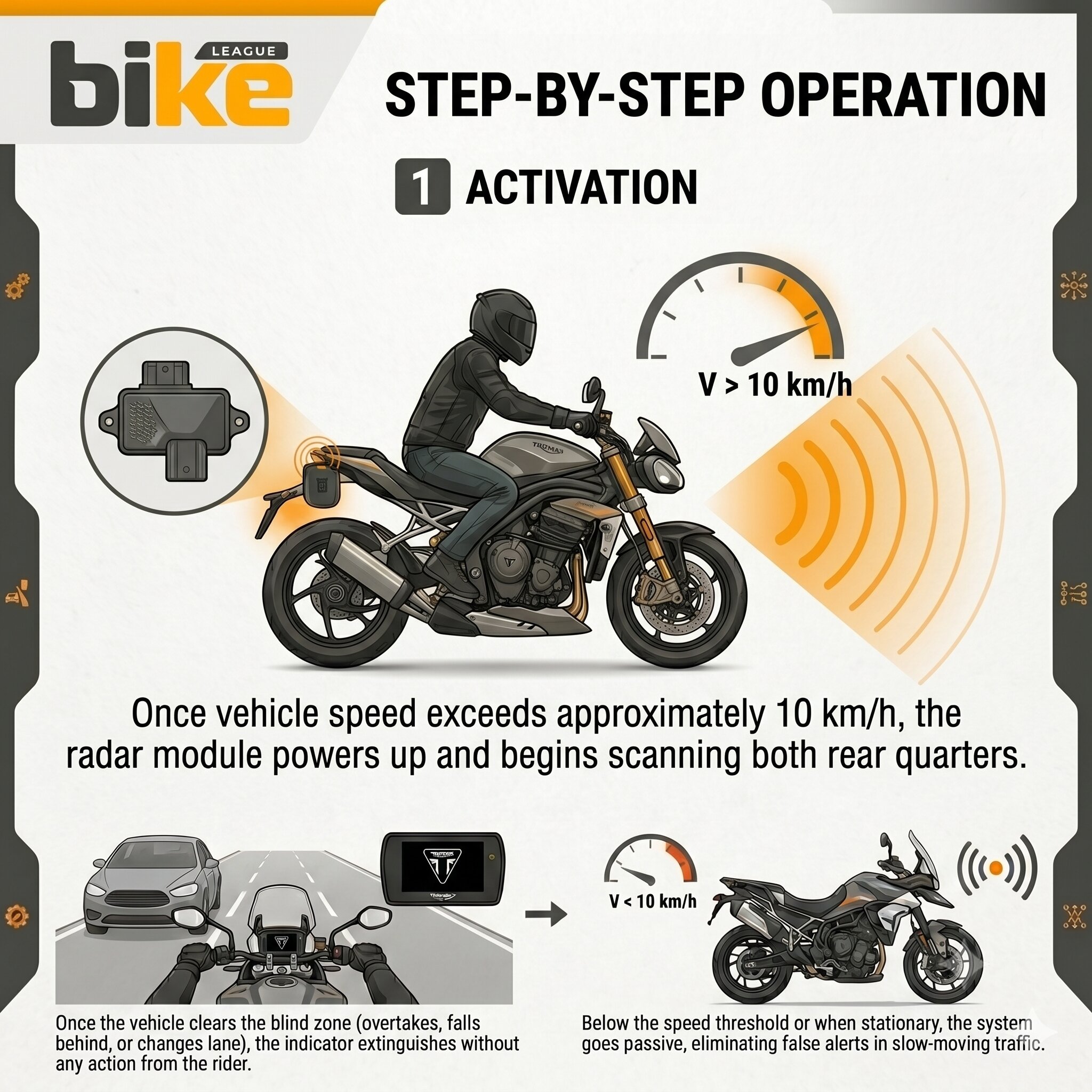
- Activation:Once vehicle speed exceeds approximately 10 km/h, the radar module powers up and begins scanning both rear quarters.
- Continuous Monitoring:The system sweeps the defined detection zones many times per second, tracking all objects in range and filtering out stationary objects like crash barriers and road furniture.
- Blind Spot Alert (BSA):The system sweeps the defined detection zones many times per second, tracking all objects in range and filtering out stationary objects like crash barriers and road furniture.
- Lane Change Alert Escalation (LCA): If the rider activates the turn indicator to change lanes while a vehicle is detected in that zone, the TFT indicator escalates to a more prominent alert, drawing the rider’s attention before the lane change is completed.
- Alert Clears Automatically: Once the vehicle clears the blind zone (overtakes, falls behind, or changes lane), the indicator extinguishes without any action from the rider.
- Deactivation: Below the speed threshold or when stationary, the system goes passive, eliminating false alerts in slow-moving traffic.
Which Triumph Models In India Have The Blind Spot Radar?
As of May 2026, the Triumph Blind Spot Radar is exclusive to the Tiger 1200 range in India and is only available on the two Explorer variants.
| Variant(s) | Blind Spot Radar |
|---|---|
|
|
Not Available |
|
|
Not Available |
|
|
Standard (Included) |
|
|
Standard (Included) |
The GT Pro and Rally Pro models do not have the Blind Spot Radar. This is a key difference between the Pro and Explorer versions, not just the tank size. Therefore, if you want this safety feature, you’ll need to choose an Explorer variant for now. Conversely, if you are satisfied with standard safety features and lower price, the Pro models may still be a suitable choice. Nevertheless, riders who prioritize advanced safety will likely find the Explorer variants more appealing.
Pros Of The Triumph Blind Spot Radar
- Covers the Most Dangerous Blind Spot: Motorcycle mirrors only show a narrow area behind you. The sides behind the rear wheel, where vehicles often approach, are true blind spots. The radar covers these areas without any extra effort from the rider.
- Works in Indian Riding Conditions: Indian roads involve constant lane movement, vehicles overtaking from both sides, and frequently poor visibility due to dust, rain, and night riding. Radar is immune to all of these factors, unlike camera-based solutions.
- Integrated Into the TFT, No Extra Display Needed: Unlike aftermarket BSD systems that need a separate indicator, the Tiger 1200’s alerts show up right on the built-in 7-inch TFT. The information is easy to see and doesn’t require extra installation.
- Passive Operation, No Extra Work for Rider: The system doesn’t need to be turned on, set to a mode, or managed. It runs in the background and alerts you only when there’s a risk.
- Lane Change Assist Is Especially Useful: The LCA feature is designed for the riskiest moment—when you’re about to change lanes and might not see an approaching vehicle. The system’s stronger alert at this time shows its real value.
- Continental Pedigree — Proven Automotive Technology: The system is not a motorcycle-industry experiment. Continental supplies radar and ADAS components to major car manufacturers globally. Applying this experience to the Tiger 1200 means that the underlying technology is well validated.
- Reliable in All Weather and Light: Unlike cameras or ultrasonic sensors, 77 GHz radar works just as well at night, in rain, dust, or glare. On Indian expressways, where these conditions are common, this reliability is a real benefit.
- Adds Real Value to Explorer Models: Explorer versions already offer a 30-litre tank and electronic suspension preload. The BSR provides a strong safety-related reason to pay more for these models than for the Pro versions.
Cons Of The Triumph Blind Spot Radar
- Only on Two Models: In India, only the GT Explorer and Rally Explorer come with BSR. If you prefer the lighter Pro models, you can’t get this feature, even as an add-on.
- Not Available as a Retrofit: Unlike the BMW ERC (which can be added to lower variants post-purchase), the Triumph BSR is not offered as a dealership-installed accessory for the GT Pro or Rally Pro. If you want the system, you must buy an Explorer.
- Higher Price: The GT Explorer costs about ₹1.5 lakh more than the GT Pro, and the Rally Explorer is about ₹1.5 lakh more than the Rally Pro. The BSR is included in this price, but if you prioritise other features, the extra cost may not be worth it.
- No Audio Warning: The system only uses visual alerts on the TFT display. In noisy situations, like with loud exhausts, wind, or helmet speakers, you might miss the alert if you’re not looking at the display often.
- Does Not Cover Front or Side Approaches: The radar is rear-facing only. It does not warn of vehicles approaching from the front or cutting in from the side at intersections. This is expected in a BSD system, but riders should not overrely on it as a full-coverage safety net.
- No Coverage in Slow Traffic: The system doesn’t turn on below about 10 km/h. In heavy, slow-moving city traffic, vehicles can enter your blind spot at low speeds without triggering an alert.
- New Technology, Limited Long-Term Data: Continental’s radar is proven in cars, but using it on big adventure motorcycles is still new. Data on how well it holds up in Indian conditions like heat, dust, and vibration will become clearer over time.
Triumph Blind Spot Radar Vs Competitor Systems: Comparison
A direct comparison across premium adventure brands reveals how Triumph’s BSR compares to competing safety technologies. Here’s a detailed breakdown of features, pros, cons, and pricing.
| Feature | Triumph Tiger 1200 (BSR) | BMW R 1300 GS (Radar Suite) | Ducati Multistrada V4 (Radars) |
|---|---|---|---|
| Radar Technology | Continental 77 GHz millimetre-wave (rear-only) | Continental-derived 77 GHz (front + rear dual radar) | Bosch millimetre-wave radar (front + rear) |
| Blind Spot Assist | Yes — BSA + LCA escalation | Yes — Blind Spot Detection | Yes — Blind Spot Detection |
| Adaptive Cruise Control | No | Yes — ACC with front radar | Yes — Radar Cruise Control |
| Radar Coverage | Rear quarters only | Front + rear (360° awareness) | Front + rear (full coverage) |
| TFT Integration | 7-inch TFT — visual indicators | 10.25-inch TFT — visual + menu integration | 6.5-inch TFT — visual alerts |
| Lane Change Assist | Yes — escalated warning on indicator | Yes — active warning | Yes — active warning |
| Audio Warning | No — visual only | Yes — visual + audio | Yes — visual + audio |
| Works in Rain/Low Light | Yes — radar immune to conditions | Yes — radar immune to conditions | Yes — radar immune to conditions |
| Speed Activation | Above ~10 km/h | Above ~15 km/h | Above ~30 km/h |
| Available On India Variants | GT Explorer & Rally Explorer only | R 1300 GS all variants (standard on most) | Multistrada V4 GT & Rally (India availability limited) |
| Retrofit/Accessory Option | No — not available for Pro variants | Yes — BMW ERC can be added to lower variants | No — factory-integrated only |
| Price Premium (India) | ~₹1.5 lakh over Pro variants | Included in base price (no separate premium) | Included in GT/Rally pricing |
| Engine Character | 1160cc T-plane triple (uneven firing) | 1300cc parallel-twin (balanced) | 1158cc V4 (V4 Granturismo) |
| Key Advantage | Best BSR-only value; dedicated blind spot focus | Full 360° radar + ACC + most comprehensive | Premium Italian engineering + full radar suite |
| Key Limitation | Rear-only; no ACC; visual-only alerts | Higher base price; heavier bike | Limited India availability; higher maintenance cost |
Key Takeaways
- Triumph is BSR-focused, BMW/Ducati are full-safety-suite: Triumph’s system delivers blind spot detection as its primary function. BMW and Ducati use radar for both blind-spot detection and adaptive cruise control, giving them 360° awareness, whereas Triumph’s rear-only coverage.
- Triumph offers the best value for blind spot-only buyers: If you want BSR without paying for ACC (which you may not use on Indian highways), Triumph’s ₹1.5 lakh premium over Pro variants is more affordable than BMW’s or Ducati’s full-system pricing.
- BMW is the most flexible: BMW allows riders to add the ERC (Easy Ride Clutch) and radar system to lower variants post-purchase, unlike Triumph, where BSR is Explorer-exclusive only.
- Ducati has limited India presence: While the Multistrada V4’s radar system is technically superior (Bosch sensors + audio warnings), Ducati’s smaller dealer network in India and higher maintenance costs make it less practical for long-term ownership.
- Audio warning matters in noisy conditions: Triumph’s visual-only alerts could be missed with loud exhausts, wind noise, or helmet speakers. BMW and Ducati’s audio-visual combination is more reliable for real-world riding in India.
- All three use Continental/Bosch automotive radar: The underlying technology is equivalent (77 GHz millimetre-wave), so detection reliability in rain/dark is similar across brands. Differences are in the feature set, not core radar performance.
Which System Is Best For Indian Riders?
| Rider Priority | Recommended System | Why |
|---|---|---|
| Best BSR value only | Triumph Tiger 1200 Explorer | Lowest premium for dedicated blind spot detection; no ACC cost bundled in |
| Full safety coverage | BMW R 1300 GS | Front + rear radar + ACC + audio warnings; most comprehensive package |
| Premium Italian engineering | Ducati Multistrada V4 GT/Rally | Bosch radar + V4 Granturismo engine + full radar suite |
| Best dealer network in India | BMW R 1300 GS | BMW Motorrad India has the largest premium dealer network; easier service |
Final Verdict
Triumph’s Blind Spot Radar is a well-designed option for riders who prioritise blind-spot safety over full 360° radar coverage. It’s the most affordable way to get radar-based safety on a motorcycle, but it doesn’t offer adaptive cruise control or audio alerts like BMW and Ducati do.
For riders on Indian expressways who often change lanes in heavy traffic, Triumph’s BSR is truly useful. But if you want full safety features, such as front radar for cruise control and audio alerts, the BMW R 1300 GS offers a more comprehensive set.
Ducati’s system is more advanced but costs more to own and has fewer dealers. Pick Triumph if you want the best value for blind spot safety, BMW for full safety features, or Ducati for top Italian engineering.
Triumph Blind Spot Radar Vs Conventional Mirrors: How Do They Compare?
| Feature | Triumph Blind Spot Radar | Conventional Mirrors Only |
|---|---|---|
| Technology | Continental 77 GHz radar | Optical (rider’s eyes) |
| Detection Zone | Rear quarters, both sides | Rear-centre only |
| Works in Low Light / Rain | Yes | Limited |
| Lane Change Alert | Yes — elevated warning on indicator | No |
| TFT Integration | Yes — on-screen warning indicator | No |
| Activation Speed | Above ~10 km/h | Always |
| Response Time | Milliseconds (automatic) | Reaction-dependent |
| Rider Input Required | No — passive monitoring | Yes — shoulder check |
Myths And Misconceptions About The Triumph Blind Spot Radar
Myth 1: The Bsr Will Automatically Prevent Lane Change Accidents
Reality:The system warns — it does not intervene. It does not apply brakes, steer, or restrict the throttle. The rider remains fully in control at all times. The BSR improves awareness; it does not substitute for rider judgment and road craft.
Myth 2: It Only Works On Highways
Reality: The system activates above approximately 10 km/h and operates wherever that speed is exceeded. It works on city roads, expressways, and in any mixed-traffic situation above the threshold. It simply deactivates at very low speeds to prevent false alerts.
Myth 3: The Radar Will Not Work In Heavy Rain
Reality: 77 GHz millimetre-wave radar is designed to work through rain, fog, and dust. This is a key advantage of radar over camera-based alternatives. The Triumph BSR is rated for all-weather operation and will continue to detect targets in conditions that defeat optical sensors.
Myth 4: It Is The Same As An Aftermarket Bsd System
Reality: The Triumph BSR is factory-integrated into the motorcycle’s electrical architecture and TFT display. Alerts appear in the instrument console without any additional hardware. Aftermarket systems require a separate indicator unit, additional wiring, and an independent power connection. They are also not calibrated to the specific dynamics of the Tiger 1200.
Myth 5: The System Drains The Battery
Reality: Radar modules of this type consume minimal power — well within the Tiger 1200’s electrical load budget. The system also deactivates at low speeds and when the bike is stationary, further minimising any current draw.
Myth 6: You Cannot Ride Without The System Active
Reality: The BSR is a passive awareness aid. If it malfunctions or is disabled, the motorcycle operates exactly as any Tiger 1200 without the system. No riding function depends on the radar’s operation.
Myth 7: The Gt Pro And Rally Pro Will Get Bsr As An Accessory In India
Reality: As of May 2026, Triumph India does not offer the Blind Spot Radar as an accessory for the Pro variants. It is exclusive to the Explorer models. Buyers interested in the system should confirm the system’s current availability with their local Triumph dealer, as accessory offerings may change.
Faq About The Triumph Blind Spot Radar
1. Which Triumph Models In India Currently Have The Blind Spot Radar?
As of May 2026, the Triumph Blind Spot Radar is standard on the Tiger 1200 GT Explorer and Tiger 1200 Rally Explorer. The GT Pro and Rally Pro do not include it, and it is not currently available as a standalone accessory for those variants.
2. Can The Blind Spot Radar Be Turned Off?
Triumph’s owner documentation should be referenced for the specific BSR deactivation procedure, if one exists. In most OEM implementations of this type, the system defaults to active whenever the speed threshold is met. Riders wanting to disable it should check their Tiger 1200 instrument menu or consult their dealership.
3. Does The Bsr Work When Lane Filtering Or Lane Splitting?
Lane filtering involves speeds typically above 10 km/h, so the radar is active. However, in very dense, slow-moving traffic where vehicles are extremely close together, the detection zone geometry may mean that some objects are not flagged as blind-spot risks even if they are technically alongside the bike. The system is designed for highway and open-road use cases.
4. How Does The Triumph Bsr Compare To Bmw’s Radar System?
BMW’s radar systems — fitted to models such as the R 1300 GS — also use Continental-derived millimetre-wave radar and offer similar Blind Spot Assist and Lane Change Assist features. BMW additionally uses forward-facing radar for Adaptive Cruise Control on some models, which Triumph does not currently offer on the Tiger 1200. Specifically for blind-spot detection, the two systems are broadly equivalent in terms of technology and function.
5. Does The Bsr Affect The Tiger 1200’s T-plane Triple Engine Character?
No. The BSR is a rear-mounted electronics module with no connection to the engine, ECU, or drivetrain. The Tiger 1200’s distinctive T-plane triple crank, with its uneven firing order and characterful exhaust note, is entirely independent of the radar system.
6. Is The Triumph Blind Spot Radar Covered Under Warranty In India?
Yes. As a factory-fitted component, the BSR is covered under Triumph’s standard new motorcycle warranty in India. Service and any warranty work must be carried out by authorised Triumph dealers. Confirm the current warranty terms with your dealership, as they may have been updated.
7. Will The Triumph Bsr Be Added To Other Models In The Future?
Triumph has not announced plans to extend the BSR to other models in India as of May 2026. The Tiger 1200 Alpine and Desert special editions — newer additions to the lineup — are reported to include the radar safety suite, which suggests Triumph sees this technology as a core part of its premium Tiger 1200 proposition going forward.
8. How Does The Bsr Perform On Indian Expressways Like The Nh48 Or Yamuna Expressway?
Multi-lane expressways where vehicles change lanes frequently and approach at high speed differentials are exactly the scenario for which this technology is most valuable. The radar’s ability to detect fast-approaching vehicles from behind — even in the dark or during rainfall — makes it particularly suited to the conditions on India’s premium expressways.
9. Does The Blind Spot Radar Require Any Special Maintenance?
The BSR system is designed to be low-maintenance. Routine checks during scheduled servicing are sufficient, focusing on keeping the radar sensor clean and free from obstructions. If any faults are detected, the system will typically display a warning on the TFT, prompting a visit to an authorised Triumph service centre.
10. Will Aftermarket Accessories Or Luggage Interfere With The Bsr?
Aftermarket accessories such as panniers or top cases, if not designed to accommodate the radar sensor, may partially block its field of view and affect performance. Triumph recommends using only approved accessories for Explorer variants with BSR to ensure optimal functionality and safety.
Technical Glossary
- ADAS (Advanced Driver Assistance Systems): Electronic systems in vehicles that provide automated, adaptive, and enhanced safety features such as radar-based warnings and interventions.
- Blind Spot Assist (BSA): A function that alerts the rider when a vehicle enters the rear-side zone not visible in standard mirrors.
- Continental: A leading global supplier of automotive technologies, including radar sensors used in Triumph’s BSR system.
- IMU (Inertial Measurement Unit): A sensor that measures acceleration and rotational rates, allowing the motorcycle to detect lean angle and movement for precise radar operation.
- Lane Change Assist (LCA): A feature that increases the urgency of alerts when a turn signal is activated, and a vehicle is present in the blind spot.
- Millimetre-Wave Radar: A radar system that operates at extremely high frequencies (typically 76–79 GHz) for high-resolution detection of objects in all weather and lighting conditions.
- OEM (Original Equipment Manufacturer): Parts or systems supplied by the original manufacturer, factory-fitted rather than aftermarket.
- TFT (Thin Film Transistor) Display: An advanced, high-resolution digital screen used for displaying motorcycle information, including radar alerts.
Other Related Links From Bikeleague India
- Defensive driving for bikers in India – The Ultimate guide
- Ultraviolette X-47 Desert Wing
- Triumph Tiger 1200 GT Explorer
- Triumph Tiger 1200 Rally Explorer
- Tiger 900 Rally Pro
Conclusion
Triumph’s Blind Spot Radar is a big improvement in motorcycle safety for Indian riders, especially in unpredictable traffic and with frequent lane changes. Its advanced radar, easy TFT integration, and hands-off operation make it a great tool for better awareness and lower risk.
However, it’s only available on certain models, so you should carefully consider the cost and maintenance involved. On the plus side, the benefits for safety-conscious riders are substantial. In summary, choosing a Tiger 1200 with BSR could be a game-changer for those who prioritize advanced riding safety.
If safety is your top concern and you ride on tough Indian roads, the Tiger 1200 Explorer with BSR gives you a real edge over regular mirrors and aftermarket options. Triumph’s focus on advanced safety sets a new standard for premium adventure bikes, giving riders more confidence and control on every ride.
If you have any questions or feedback, email us at bikeleague2017@gmail.com or leave a comment below. Follow Bikeleague India on social media for more updates and insights.