
Long story short: Peugeot’s motorised two-wheeler story goes back to 1898. Other brands like Royal Enfield, Indian Motorcycle, Triumph, and Harley-Davidson also have over a century of history. This article looks at how these famous motorcycle brands started, built their identities, and adapted over time.
A motorcycle brand’s story often starts before its first motorcycle. Some companies began with bicycles, weapons, or radio parts before moving into two-wheelers. Many also faced production stops, changes in ownership, or later revivals. These details are important when comparing the oldest motorcycle brands.
For example, Peugeot’s official history says its first petrol-powered two-wheeler appeared in 1898, making it the oldest motorised two-wheeler brand still operating. But being the oldest surviving brand is not the same as being the oldest brand with continuous motorcycle production.
This article looks at 14 historic motorcycle brands. It separates when each company started from when they reached key motorcycle milestones, and highlights important products, racing wins, and business changes. This is a heritage overview, not a complete ranking of the oldest manufacturers. Being included here does not mean a brand has always made motorcycles or still does today.
Key Takeaways
- This article explores 14 historic motorcycle brands, including Peugeot, Royal Enfield, Indian Motorcycle, Triumph and Harley-Davidson. It is a selected heritage overview rather than an exhaustive oldest-to-newest ranking.
- A company’s founding year is not necessarily the year it began making motorcycles. Comparing these brands requires distinguishing their business origins from their first motorcycle or motorised two-wheeler.
- A surviving brand name does not always mean uninterrupted motorcycle production. Production stoppages, ownership changes and later revivals are important parts of several brands’ histories.
- Distinctive motorcycles, engineering developments and racing achievements help explain how these manufacturers established their individual identities and reputations.
- These brands followed different paths to survival, including adapting their products, entering new markets and rebuilding under new ownership. Their histories should not be reduced to a single formula for success.
14 Historic Motorcycle Brands And Their Origins
Historic Motorcycle Brands: Origins And Motorcycle Milestones
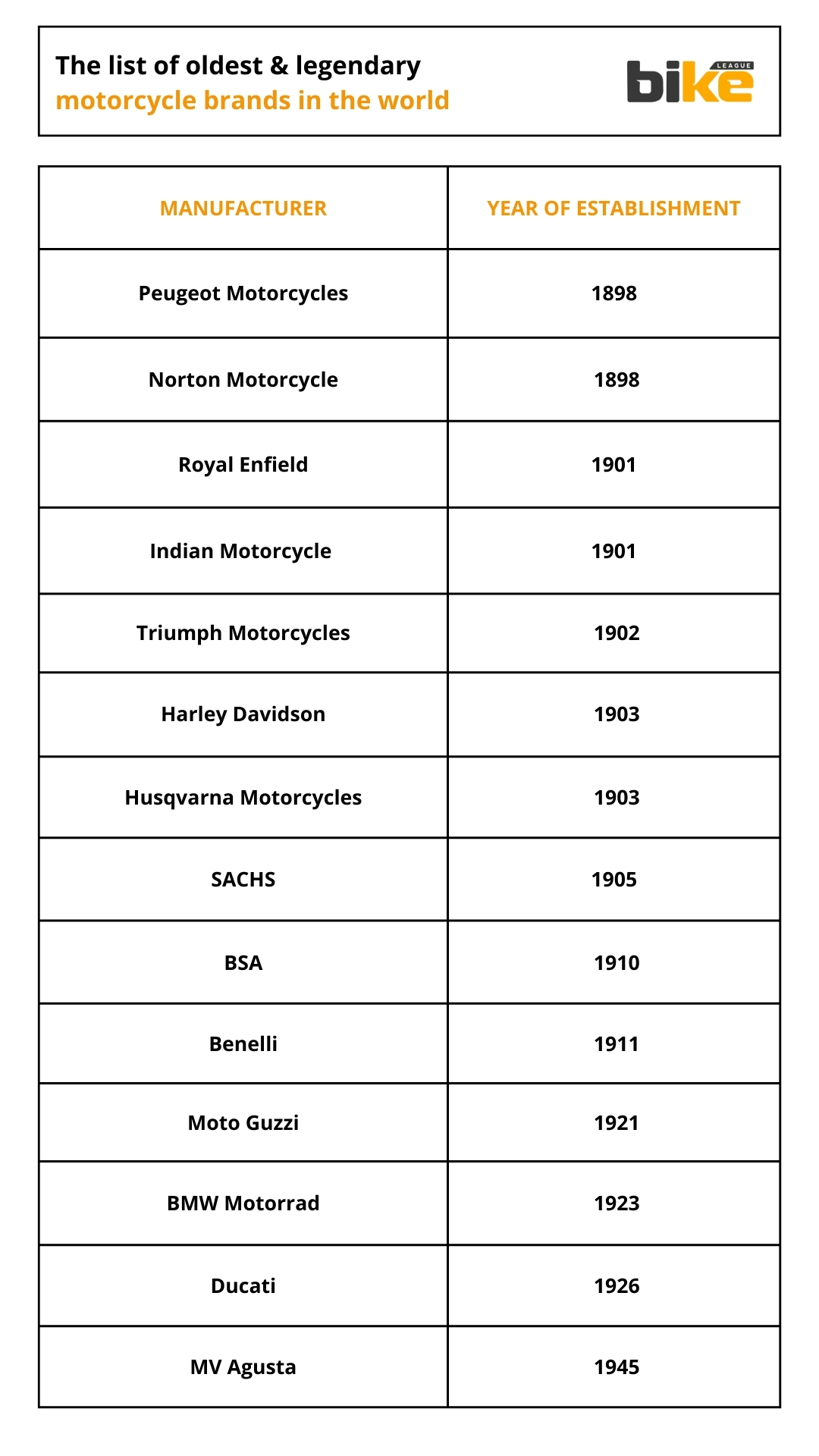
This table lists the brands in the same order as the profiles below, not by date. Company origins and motorcycle milestones are shown separately, since they are not always the same event. These dates do not mean the brands produced motorcycles without interruption.
| Brand | Company Origins | Motorcycle Milestone | How to Interpret the Dates |
|---|---|---|---|
| Peugeot Motorcycles | Earlier metalworking and bicycle businesses | 1898: petrol-powered two-wheeler | 1898 marks its motorised two-wheeler history, not the beginning of the wider Peugeot business. |
| Norton Motorcycles | 1898: fittings and parts business | 1902: Energette motorcycle | The company began before it produced its first motorcycle. |
| Royal Enfield | Earlier British bicycle business | 1901: first motorcycle | 1901 is the motorcycle milestone, not the start of its earlier bicycle activities. |
| Indian Motorcycle | Earlier Hendee bicycle business | 1901: first motorcycle | Its history includes production interruptions and later revivals. |
| Triumph Motorcycles | Earlier bicycle business | 1902: motorcycle production began | The original business and the later John Bloor-led operation are distinct chapters. |
| Harley-Davidson | 1903: motorcycle business established | 1903: early motorcycle development | The founding date relates directly to the motorcycle business. |
| Husqvarna Motorcycles | 1689: weapons factory | 1903: first motorised bicycle | Its industrial history is much older than its motorcycle production. |
| SACHS | Linked histories of Hercules and Fichtel & Sachs | No single debut year assigned in this article | Hercules’s origins, Sachs engine production and later Sachs-branded motorcycles should not be treated as one founding event. |
| BSA | 1861: Birmingham Small Arms established | 1910: first complete BSA motorcycle exhibited | The firearms business preceded motorcycle manufacturing. |
| Benelli | 1911: family workshop established | 1921: Velomotore introduced | The workshop’s founding year differs from its first motorcycle milestone. |
| Moto Guzzi | 1921: motorcycle company established | 1921: early motorcycle production | Its early motorcycles preceded the transverse V-twins later associated with the brand. |
| BMW Motorrad | BMW’s wider business predates its motorcycles | 1923: R 32 introduced | 1923 marks BMW’s first own motorcycle, not the foundation of BMW. |
| Ducati | 1926: radio-components company established | 1946: Cucciolo auxiliary-engine production | 1946 refers to bicycle-mounted engines, not the launch of a complete motorcycle in 1926. |
| MV Agusta | 1945: motorcycle business established | 1945: MV 98 introduced | The motorcycle business followed the Agusta family’s earlier aviation activities. |
Which Countries Do These Historic Motorcycle Brands Come From?
The brands in this article originally come from the following countries. Keep in mind that these origins are different from where the brands are owned, based, or make their motorcycles today.
- France: Peugeot.
- United Kingdom: Norton, Royal Enfield, Triumph and BSA.
- United States: Indian Motorcycle and Harley-Davidson.
- Sweden: Husqvarna.
- Germany: the Sachs and Hercules histories, and BMW.
- Italy: Benelli, Moto Guzzi, Ducati and MV Agusta.
Royal Enfield’s later move to manufacturing in India shows why a brand’s country of origin and its later manufacturing identity are not always the same.
1. Peugeot Motorcycles — Motorised Two-wheeler Origins: 1898
Peugeot started out in metalworking and bicycle making before moving into motorcycles. In 1898, it built a petrol-powered bicycle, which its official history marks as the start of its motorised two-wheeler legacy. This makes Peugeot the oldest motorised two-wheeler brand still operating.
This status is about the brand’s survival, not about every Peugeot motorcycle or scooter being made without interruption. Later, Peugeot also became known for scooters. For more on its oldest-brand claim, see Peugeot’s official historical timeline.
2. Norton Motorcycles — Founded: 1898; First Motorcycle: 1902
James Lansdowne Norton started his business in Birmingham in 1898, making parts for the two-wheel trade. Norton’s first motorcycle, the Energette, came out in 1902 with a 143cc single-cylinder engine. So, the company’s founding year is different from when it began making motorcycles.
Norton built its reputation through racing, especially at the Isle of Man TT, and with road bikes like the Commando. The company’s history also includes closures, changes in ownership, and times when production was limited. When TVS Motor Company bought Norton in 2020, it started a new chapter for the brand, but this does not mean Norton has been making motorcycles without interruption since 1898.
3. Royal Enfield — First Motorcycle: 1901
Royal Enfield made its first motorcycle in 1901, after first making bicycles in Britain. Bob Walker Smith and Jules Gobiet designed it, and it was shown at the Stanley Cycle Show in London. The engine sat in front of the steering head and used a long belt to drive the rear wheel.
The brand’s development in India is central to its survival story. In 1955, the British company partnered with Madras Motors to establish Enfield India, creating a manufacturing base that continued beyond the eventual closure of the British operation. The Bullet became a defining connection between Royal Enfield’s British origins and Indian identity. These milestones are documented in Royal Enfield’s official history.
4. Indian Motorcycle — First Motorcycle: 1901
Indian Motorcycle traces its motorcycle history to 1901 in Springfield, Massachusetts, following George Hendee’s earlier bicycle business. The brand became an important name in early American motorcycling, with racing and models such as the Scout and Chief helping establish its identity.
Indian’s long history does not mean it has always made motorcycles without a break. The original factory stopped production in 1953, and the Indian name went through several revival attempts. Polaris bought the brand in 2011, starting a new chapter. Indian is an example of a historic motorcycle name that has survived through stops and restarts.
5. Triumph Motorcycles — Motorcycle Production Began: 1902
Triumph’s motorcycle-production history dates to 1902, following its earlier bicycle business. Racing achievements and road motorcycles such as the Bonneville helped establish the brand’s British identity. The Bonneville name remains an important link between Triumph’s historical motorcycles and its later product development.
Triumph’s survival included a big change in business. After the original Meriden company closed in 1983, John Bloor bought the name and started a new factory. For a while, the older Bonneville was made under license while the new company got started. So, Triumph’s modern story is about both rebuilding and heritage.
6. Harley-davidson — Founded: 1903
Harley-Davidson started in Milwaukee, Wisconsin, in 1903, thanks to William S. Harley and the Davidson brothers. From the beginning, the company built a strong identity around American road riding, heavyweight bikes, and long-distance touring.
Harley-Davidson’s importance is about more than just style or freedom. The company became known worldwide while facing new competitors and changing markets. Founded in 1903, it is one of the earliest American motorcycle makers, but its history differs from brands that stopped and later returned.
7. Husqvarna Motorcycles — Industrial Origins: 1689; First Motorcycle: 1903
Husqvarna started as a weapons factory in Huskvarna, Sweden, in 1689. It began making motorcycles much later, in 1903, with a motorised bicycle. So, 1903 is when Husqvarna entered motorcycling, not when it started as a company.
Off-road competition subsequently became a defining part of the brand. The lightweight Silverpilen, introduced in 1955, and later motocross and enduro achievements helped shape Husqvarna’s reputation. Ownership changes and the relocation of motorcycle operations also form part of its development. Husqvarna’s official brand history separates these industrial and motorcycle milestones.
8. Sachs — A Motorcycle Heritage Linked To Hercules
Sachs motorcycles are linked to Hercules, but Fichtel & Sachs was a separate company making engines and engineering products. Hercules started making bicycles in Nuremberg in 1886 and later moved into motorcycles. These histories are related but should not be seen as one company or a single motorcycle debut date.
Sachs engines powered numerous lightweight motorcycles and mopeds, including Hercules machines. The businesses later became connected through ownership changes, and successor motorcycles were sold under the Sachs name. This is a linked manufacturing and branding history rather than a straightforward case of one motorcycle brand producing continuously since 1886. The available Hercules historical overview explains the relationship.
9. Bsa — Company Origins: 1861; First Motorcycle: 1910
BSA means Birmingham Small Arms, a company founded in 1861 that first made firearms. Later, it started making bicycles and motorcycles. The first full BSA motorcycle, the 3½ hp model, was shown at London’s Olympia Show in 1910 for the next season.
BSA went on to become a major motorcycle maker, with the Gold Star as one of its most famous models. The company later declined, and BSA returned under new ownership. The revived brand does not mean BSA has made motorcycles without interruption since 1910.
10. Benelli — Founded: 1911; First Motorcycle: 1921
Benelli started in Pesaro, Italy, in 1911 when Teresa Benelli opened a workshop for her six sons. It began as a repair shop and later became a motorcycle maker. In December 1921, Benelli launched the Velomotore, which its official history calls its first real motorcycle.
Tonino Benelli’s racing achievements helped bring recognition to the family business, including Italian championship successes in 1927, 1928, 1930 and 1931. Later ownership changes and production interruptions mean Benelli’s long history should not be presented as uninterrupted manufacturing since its workshop opened. Benelli’s official company history explains its workshop origins, early motorcycles and racing development.
11. Moto Guzzi — Established: 1921
Moto Guzzi was established in Italy in 1921, with motorcycle manufacturing centred on Mandello del Lario. Its early history included the Normale, a single-cylinder motorcycle, rather than the transverse V-twin configuration later associated with the brand.
This difference is important because Moto Guzzi’s famous modern engine layout does not cover its whole history. The brand has made racing bikes, early single-cylinder road bikes, and later shaft-driven V-twins. Moto Guzzi’s long life comes from this evolution, not from sticking to one design.
12. Bmw Motorrad — First Bmw Motorcycle: 1923
BMW existed before it started making motorcycles. The key motorcycle milestone was in 1923, when BMW launched the R 32, designed by Max Friz. Its boxer-twin engine set the layout that became a big part of BMW’s motorcycle identity.
BMW Motorrad later grew to include touring, sports, and adventure motorcycles. The R 32 is a clearer historical starting point than general claims about quality or technology. In 1923, BMW built its first motorcycle, but this was not the start of the larger BMW company.
13. Ducati — Founded: 1926; Cucciolo Engine Production: 1946
Ducati started in Bologna on 4 July 1926 as a radio-components company. It did not make motorcycles at first. After the Second World War, Ducati entered the powered two-wheeler market with the Cucciolo, a small engine made to fit on a bicycle.
In March 1946, Ducati manufactured its first Cucciolo engines under licence from SIATA. This is a motorised two-wheeler milestone rather than the launch of a complete motorcycle in 1926. Ducati’s later road and racing motorcycles belong to the development that followed. The distinction is documented in Ducati’s official Cucciolo history.
14. Mv Agusta — Motorcycle Brand Established: 1945
MV Agusta started its motorcycle business in 1945, building on the Agusta family’s earlier work in aviation. The first motorcycle, the MV 98, was launched in the autumn of that year. It was a small-capacity bike, not the high-performance models the brand is known for today.
Competition later became a key part of MV Agusta’s identity. Later models like the F4 and Brutale marked new stages in its growth. The brand is included here for its historical importance, not because it is as old as those that started making motorcycles around 1900. The brand’s official history records its motorcycle origins in 1945.
How Have These Historic Motorcycle Brands Survived?
These brands each took different paths to lasting success. Some changed their products and manufacturing over many years, while others came back after stopping production. Their histories show common themes, but having an old name does not always mean they produced motorcycles without breaks or were always successful.
1. Adapting Products And Manufacturing
A strong reputation by itself does not explain why a manufacturer survived. Changes in transport needs, competition, and technology pushed companies to create new products or change how they made them. For some brands here, making motorcycles was a step beyond their original business.
Ducati is one example. Founded as a radio-components company in 1926, it entered powered two-wheelers after the Second World War by producing the Cucciolo auxiliary engine in 1946. Its later motorcycle identity developed from that transition, rather than from motorcycle manufacturing at its foundation. Ducati’s Cucciolo history documents this turning point.
2. Building A Distinctive Motorcycle Identity
Recognisable motorcycles, engineering layouts and model names help connect different generations of riders with a brand. Examples discussed in this article include Royal Enfield’s Bullet, Triumph’s Bonneville, BMW’s boxer-twin motorcycles and Moto Guzzi’s later transverse V-twins.
But having a strong identity does not mean a manufacturer always used the same design. Moto Guzzi’s first motorcycles were different from the V-twins it is known for today. A brand’s history is more about the link between its products over time than about never changing.
3. Establishing A Reputation Through Racing
Racing and competition are important in the history of many of these manufacturers. Norton’s link to the Isle of Man TT, Husqvarna’s off-road wins, and MV Agusta’s racing background all help explain why these brands still matter to motorcycle fans.
Benelli is another example. Tonino Benelli’s wins in Italian championships brought attention to the family business in its early motorcycle years. Racing success helps explain a brand’s reputation, but it does not prove the quality or reliability of every motorcycle. This article looks at heritage, not at ranking brands by current build quality, reliability, or ownership.
4. Continuing Under New Ownership Or Returning After Closure
Changes in ownership, manufacturing partnerships, and revivals are key to understanding many brands on this list. Indian Motorcycle, Norton, Triumph, and BSA all have stories that need more detail than just a founding year. When a historic name comes back under a new company, it is not the same as the original manufacturer running without a break.
Royal Enfield illustrates the importance of manufacturing partnerships and geographical change. The establishment of Enfield India with Madras Motors in 1955 created a manufacturing base that continued after the British operation closed. Royal Enfield’s official timeline explains this connection between its British origins and Indian development.
In the end, these stories show different ways brands have lasted: by keeping production going, adapting under new owners, or bringing back old names. To compare them fairly, we need to see these differences instead of thinking every brand survived for the same reasons.
Frequently Asked Questions
1. What Is The Difference Between A Motorcycle Company’s Founding Year And Its First Motorcycle?
A founding year shows when a business started, and it may have made other products at first. The first-motorcycle date is when the company began making motorcycles. This article lists these milestones separately so people do not confuse an early company start with an early motorcycle launch.
2. Are All The Historic Motorcycle Brands Listed Here Still Making Motorcycles?
This article does not say whether every brand listed still makes motorcycles today. Some historic names are still used even if production stopped, ownership changed, or the brand was revived later. Just being old does not mean a brand is still making motorcycles now.
The profiles cover important historical milestones and details, especially for Sachs and Hercules. For up-to-date information on current production, available models, or sales in your country, check the manufacturer’s latest official sources.
3. Why Is This Article Not A Strict Oldest-to-newest Ranking?
This article looks at several historic motorcycle brands with different backgrounds and histories. To rank them fairly, you would need a single measure, like the first motorcycle made under each name. Instead, the profiles and comparison table point out the key milestones and explain important details.
4. Is Royal Enfield An Indian-origin Motorcycle Brand?
Royal Enfield began in Britain, where its first motorcycle appeared in 1901. Its Indian manufacturing history developed later, with the establishment of Enfield India in partnership with Madras Motors in 1955. Its British origins should therefore be distinguished from its later Indian manufacturing identity.
Indian Motorcycle is a different American brand that started making motorcycles in Springfield, Massachusetts, in 1901. The word “Indian” in its name does not mean the company came from India.
Related Articles And Brand Pages
Explore more motorcycle-brand information and India-focused articles from Bikeleague India:
- Top 10 bike brands by market share in India
- BSA motorcycles in India
- Husqvarna motorcycles in India
- Moto Guzzi motorcycles in India
- Motorcycle, scooter and e-bike brands in India
Conclusion
The stories of these 14 motorcycle brands show that lasting a long time can happen in different ways. A company’s start, its first motorcycle, and keeping its name are all separate milestones. Some companies kept going through changes in products, owners, and locations, while others came back after stopping production.
Knowing these differences makes comparing the brands more useful than just listing their founding years. The motorcycles, engineering changes, racing wins, and business changes discussed here show how these brands built their identities and why their histories still matter to riders today.
Do you have a question or want to suggest a historical correction? Email us at bikeleagueindia@gmail.com or leave your feedback in the comments below. You can also connect with Bikeleague India on social media.