
Long story short:In short, this guide explains how Yamaha’s Variable Valve Actuation (VVA) works in the engine, which bikes in India have it, its real-world pros and cons, performance effects, maintenance tips, common myths, and everything else you need to know.
Yamaha’s Variable Valve Actuation (VVA) is a popular innovation in small-capacity motorcycles. It first appeared on Yamaha’s 155cc liquid-cooled engines and gives you strong low-end torque for city rides as well as thrilling top-end power for highways. But what exactly is VVA, how does it work, and is it really as good as people claim for Indian riders?
This guide explains Yamaha’s VVA system in simple, practical language. You’ll learn how VVA works inside the engine and which Yamaha bikes in India have it. We cover pros and cons, compare VVA to other systems, and provide maintenance and performance tips. Common myths are also explained. With this information, you can decide if VVA is right for you. This guide is useful whether you own a Yamaha, plan to buy one, or simply love motorcycles.
What Is Yamaha Vva (variable Valve Actuation)?
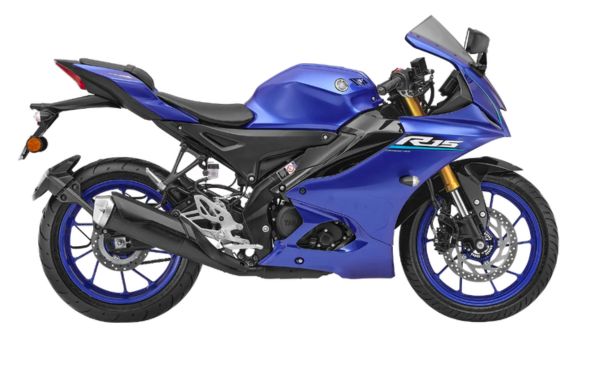
VVA, or Variable Valve Actuation, is Yamaha’s two-step variable valve timing system for the intake side of their 155cc liquid-cooled engines. In simple terms, it changes how long and how far the intake valves open depending on engine RPM. The engine offers two breathing modes in a single SOHC setup. One mode delivers better low- to mid-RPM torque and fuel efficiency. The other provides higher power at high RPM.
Single-cylinder motorcycle engines usually have to choose between valve timing that’s good for low-speed power or high-speed power, but not both. In the past, engineers had to compromise. Yamaha’s VVA solves this by using two different cam lobe profiles on the intake cam. The system switches between them using an electrically controlled rocker-arm pin managed by the ECU.
VVA is similar to other variable valve systems such as Honda’s VTEC, BMW’s ShiftCam, Ducati’s DVT, and Kawasaki’s KLCM, but it works in its own way and serves a distinct purpose. Yamaha’s VVA is a compact, two-stage system made for small, high-revving single-cylinder motorcycle engines.
What Are The Key Features Of Yamaha Vva?
- Two-Stage Valve Timing: VVA uses two cam profiles: a low-speed cam for smooth, strong low-to-mid RPM performance, and a high-speed cam for more intake flow and power at high RPM. Switching between them is what makes the system work.
- Electrically Actuated Rocker Pin: The cam switching mechanism uses an electrically driven actuator that pushes a locking pin in the rocker arm assembly. The ECU commands the switch at approximately 7,400 rpm. This enables rapid and repeatable cam changeover.
- Intake-Side Only: VVA only works on the intake valves. The exhaust valve timing stays the same. Yamaha focused on the intake side because that’s where variable timing makes the biggest difference for this engine design.
- Higher Intake Valve Lift at High RPM: When the high-speed cam kicks in, the intake valves open about 2 mm more than with the low-speed cam. This lets more air-fuel mixture in each cycle. As a result, the engine makes more power at high RPM.
- SOHC Architecture Retained: By using two cam profiles on a single intake cam, Yamaha keeps the engine compact, lightweight, and mechanically simpler than a DOHC setup. This approach still achieves performance characteristics that rival DOHC designs at this displacement.
- ECU-Controlled Switching: The engine’s ECU controls when to switch cam profiles, using both engine speed and throttle position. It’s not just about hitting a certain RPM. The ECU ensures the change occurs at the right time for smooth power delivery.
- Bidirectional Switching: VVA changes from low cam to high cam when RPM goes above 7,400, and switches back to low cam when RPM drops below that point. The system works automatically during regular riding.
- Paired With Assist and Slipper Clutch: All current Yamaha 155cc models in India have VVA along with an assist and slipper clutch. VVA improves power delivery, while the slipper clutch helps prevent rear-wheel instability during hard downshifts. These features work well together.
How Does Yamaha Vva Work?
To understand VVA, it’s important to know the main issue it solves: the trade-off between valve timing for low-speed torque and high-speed power.
The Engine Breathing Challenge
How much power an engine makes at any RPM depends on how much air-fuel mixture gets into the combustion chamber each cycle. Two things control this: how far the valve opens (valve lift) and how long it stays open (valve timing).
At low RPM, the piston moves slowly. If the valve stays open too long, some of the fresh mixture can be pushed back out as the piston changes direction, reducing efficiency and torque. That’s why a smaller, shorter cam profile works best at low speeds.
At high RPM, the piston moves very quickly. The intake process happens in a split second, so the valve needs to open wider and stay open longer to let in enough mixture. That’s when a bigger, longer cam profile is needed.
A fixed cam profile always means a compromise. It can be tuned for low-end torque or high-end power, but not both. VVA solves this by physically switching between two different cam profiles.
The Two-cam Architecture
Yamaha’s 155cc engine features a SOHC (Single Overhead Cam) layout with four valves per cylinder — two intake and two exhaust. The intake cam is machined with two adjacent cam lobe profiles of different shapes:
- Low-Speed Cam Lobe: A smaller profile with moderate lift and shorter opening duration, optimised for smooth power delivery and fuel efficiency between idle and ~7,400 rpm.
- High-Speed Cam Lobe: A larger profile with approximately 2 mm more valve lift and a wider opening duration, optimised for maximum intake flow and peak power above ~7,400 rpm.
Both cam lobes are always present on the camshaft. What changes is which lobe the rocker arm follows, and this is controlled by the rocker arm pin mechanism.
The Rocker Arm Pin Mechanism
The rocker arm assembly for the intake valves consists of two rocker arms sitting side by side on a shared rocker shaft:
- Primary Rocker Arm: Directly contacts the intake valve stems. This arm is what opens and closes the valves.
- Sub Rocker Arm: Sits adjacent to the primary rocker arm and follows the high-speed cam lobe. Under normal low-RPM operation, this sub arm rocks freely without transmitting any motion to the valves — it is effectively a free-wheeling arm that does nothing.
A spring-loaded locking pin inside the primary rocker arm handles the switching:
- Low-Speed Mode (0 – ~7,400 rpm): The locking pin is retracted by spring force. The sub rocker arm (following the high-speed cam) rocks independently, and its motion is not transmitted to the primary arm or valves. The primary arm follows only the low-speed cam lobe. The valves open and close with the smaller, fuel-efficient lift profile.
- High-Speed Mode (~7,400 rpm and above): The ECU signals the solenoid actuator to push the locking pin outward. The pin engages the sub rocker arm, locking both rocker arms together into a single rigid assembly. Now the larger high-speed cam lobe drives the combined unit, opening the intake valves wider and for longer. Peak airflow into the cylinder increases, enabling the engine to develop more power.
- Reversion to Low-Speed Mode: When engine RPM drops back below ~7,400 rpm, the ECU de-energises the solenoid, the pin retracts under spring force, and the two rocker arms decouple. The engine immediately reverts to the low-speed cam profile.
Step-by-step Operation During A Ride
- Step 1 : LOW-SPEED CAM PROFILE
- Step 2 : THE SWITCH & ENGAGEMENT MECHANISM
- Step 3 : HIGH-LIFT ENGAGEMENT PROFILE
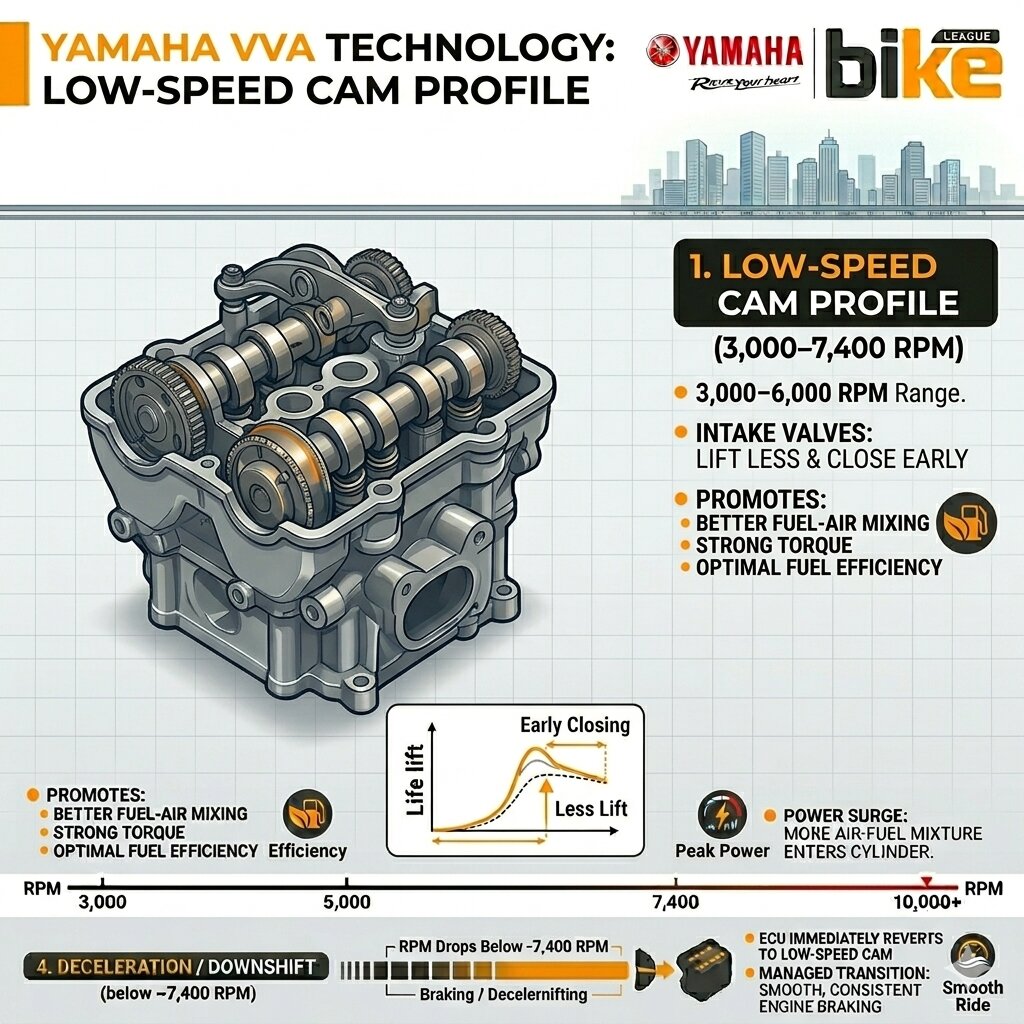
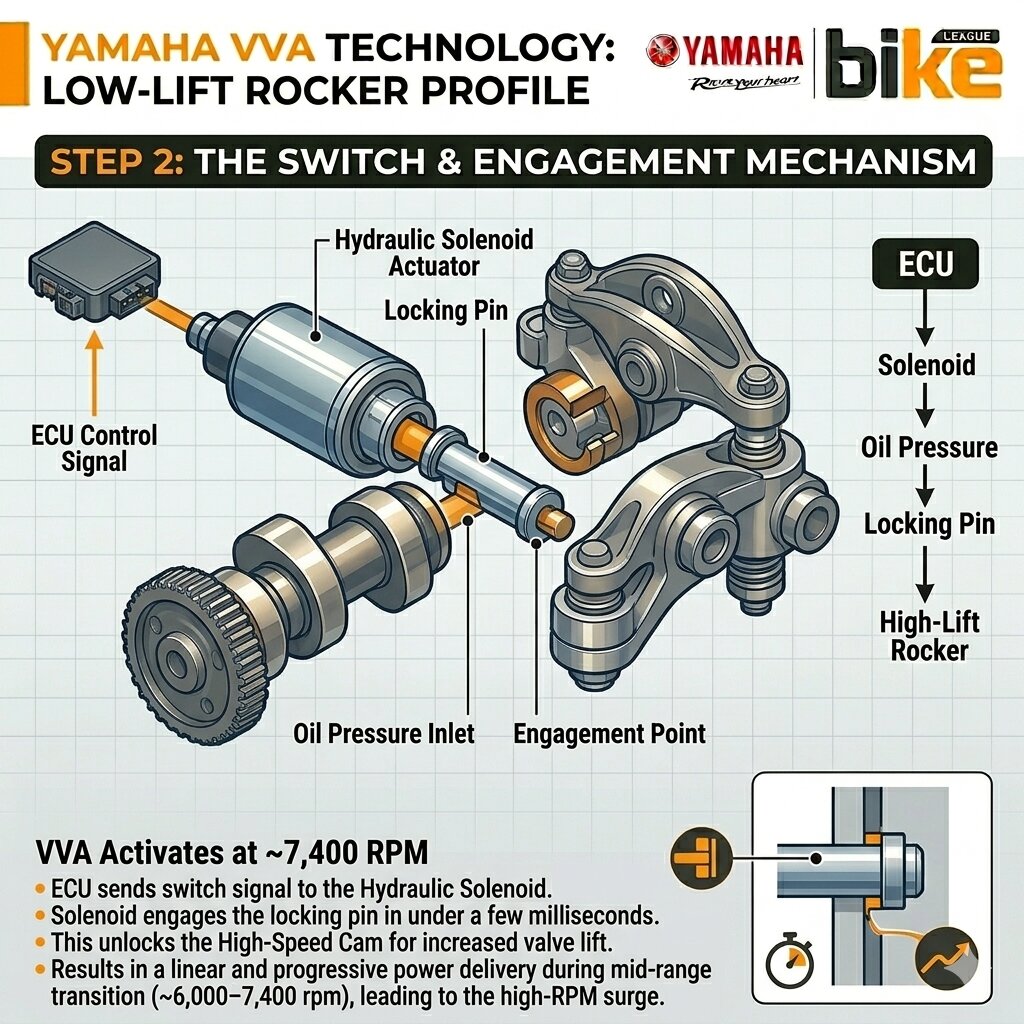
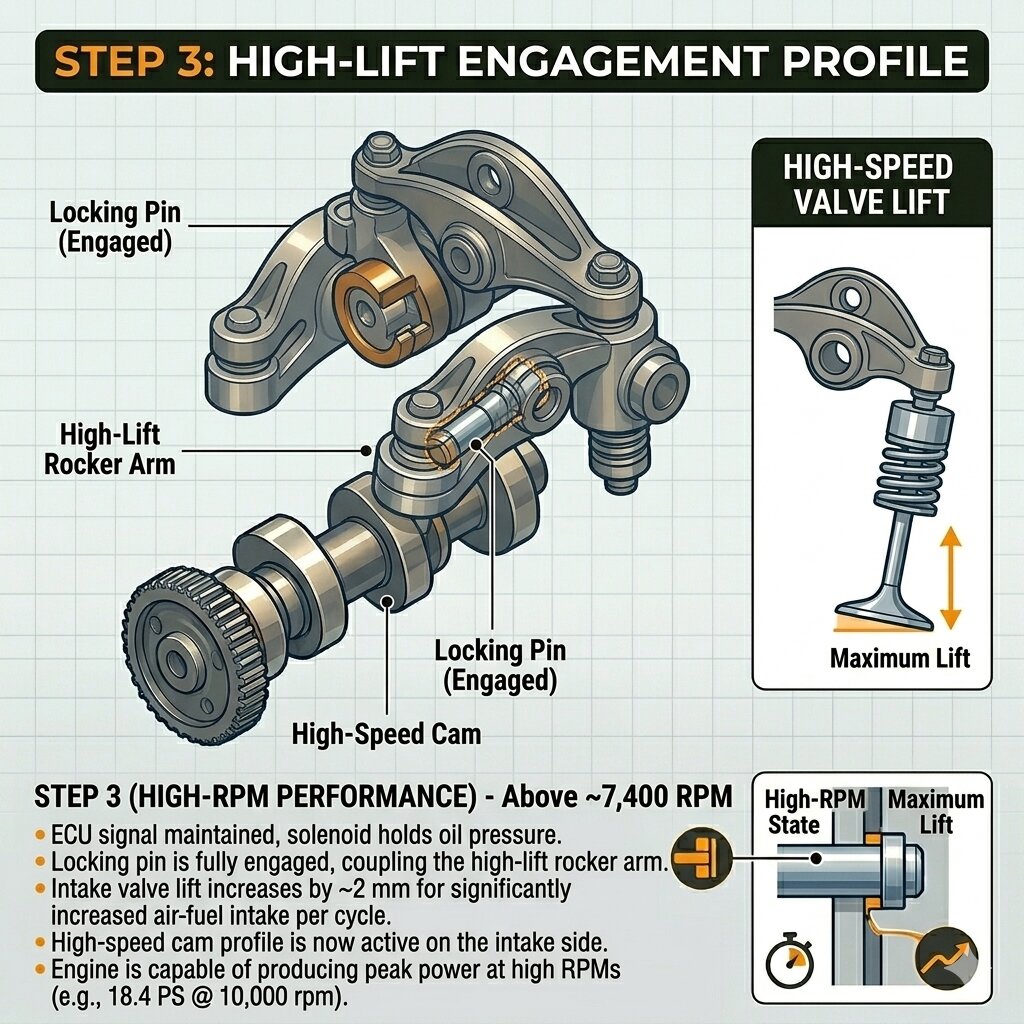
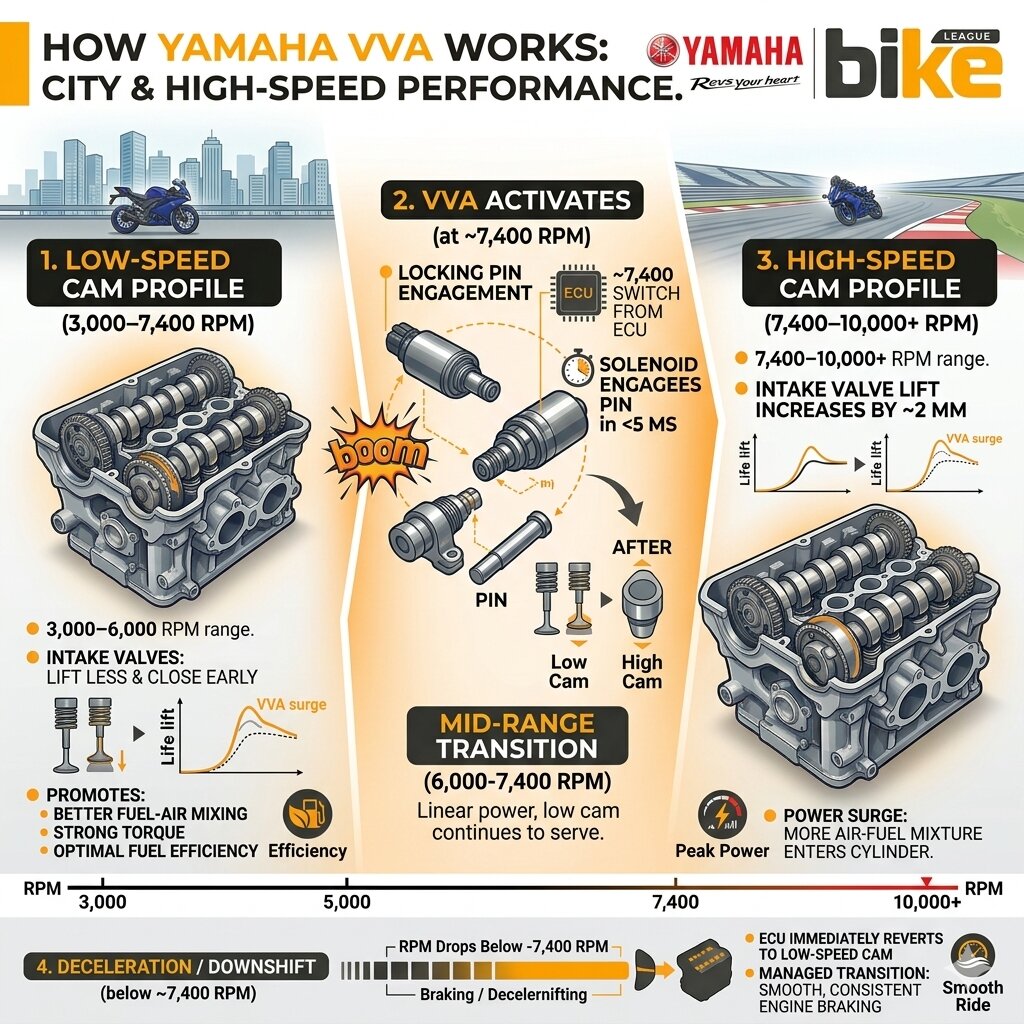
- City Riding / Low RPM: Engine operates on the low-speed cam profile. The intake valves lift less and close earlier relative to the piston position. This promotes better fuel-air mixing at low RPM, stronger torque at normal riding speeds (3,000–6,000 rpm), and better fuel efficiency.
- Mid-Range Transition (~6,000–7,400 rpm): The engine is approaching the cam-switch threshold. Power delivery is linear and progressive. The low cam continues to serve well in this range.
- VVA Activates (~7,400 rpm): The ECU sends the switch signal. The solenoid engages the locking pin in under a few milliseconds. The high-speed cam profile takes over. Intake valve lift increases by ~2 mm. More air-fuel mixture enters the cylinder per cycle. The rider feels a noticeable uptick in power delivery — a surge in the upper rev range that distinguishes VVA-equipped engines from conventional SOHC units.
- High-RPM Range: The engine continues to rev freely with the high-speed cam profile active. Peak power is developed here — the R15 V4, for instance, produces its rated 18.4 PS at 10,000 rpm, which is only possible because the intake side can flow adequately at such high engine speeds.
- Deceleration / Downshift: As RPM drops below ~7,400 rpm (during braking, gear changes, or roll-off), the ECU immediately reverts to the low-speed cam. The transition is managed to be smooth and does not create a step change in engine-braking character.
Which Yamaha Bikes In India Have Vva?
Starting in 2025–26, all Yamaha models in India with the 155cc liquid-cooled, 4-valve engine come with VVA as standard. The 149cc air-cooled Blue Core FZ-series and the 125cc scooters do not have this technology.
| Model | Engine | VVA |
|---|---|---|
| YZF-R15 V4 | 155cc Liquid-Cooled | Yes – Standard |
| YZF-R15M | 155cc Liquid-Cooled | Yes – Standard |
| YZF-R15S | 155cc Liquid-Cooled | Yes – Standard |
| MT-15 V2 | 155cc Liquid-Cooled | Yes – Standard |
| XSR155 | 155cc Liquid-Cooled | Yes – Standard |
| Aerox 155 / Version S | 155cc Liquid-Cooled | Yes – Standard |
All these models use the same 155cc liquid-cooled, 4-valve SOHC engine with VVA on the intake side. Power differences come from tuning changes like compression ratio and ECU mapping, but the VVA system itself is identical in each bike.
The FZ-FI V3, FZ-S FI V3/V4, FZ-X, and FZ-Rave all use a different 149cc air-cooled Blue Core engine without VVA. If you want VVA, you’ll need to pick one of Yamaha’s 155cc liquid-cooled models in India.
Pros Of Yamaha Vva
- Genuine Best-of-Both-Worlds Performance: This is the headline benefit, and it is real. You get tractable, smooth, and fuel-efficient performance in low-RPM city riding. High-RPM weekend runs become genuinely exciting, with a power surge at the top of the rev range that a conventional SOHC of this displacement cannot replicate. VVA delivers this surge mechanically, rather than simply approximating it.
- Stronger Low-End Torque for Indian Traffic: The low-speed cam profile is tuned for urban conditions. The R15 V4 and MT-15 pull cleanly from under 3,000 rpm in higher gears, making traffic filtering far less gear-dependent than many comparable performance bikes. This is the VVA benefit that most Indian riders will feel most often.
- Better Fuel Efficiency Than the Peak Power Figure Suggests: Because the engine uses the efficient low-cam profile for most urban riding, you get real-world fuel efficiency that is respectable for a bike of this performance level. Yamaha’s own tests recorded around 51 km/l for the R15 V4 under controlled conditions — VVA enables this efficiency.
- No Compromise in Peak Power: The high-speed cam profile is not constrained by fuel-efficiency considerations. At high RPM, the intake valves open as fully as the design requires for maximum power. This is why the 155cc Yamaha engine produces 18+ PS — a figure that is competitive against many 160–180cc conventionally valved engines.
- The VVA Surge is a Rewarding Riding Experience: The noticeable step-up in power delivery at ~7,400 rpm is one of the most talked-about aspects of VVA-equipped Yamahas. For enthusiast riders, this two-stage character gives the engine a personality that linear, single-cam engines lack. It rewards riders who use the full rev range.
- Compact SOHC Architecture: Achieving DOHC-competitive performance from a SOHC layout keeps the engine narrow, light, and mechanically simple. This directly benefits the motorcycle’s handling — particularly relevant for the R15 and MT-15, which are both praised for chassis agility.
- Proven Reliability: Yamaha introduced this engine family in 2017–2018. Riders across India have since accumulated millions of kilometres on these engines. The VVA mechanism rarely fails. Long-term reliability evidence from the Indian market is now substantial and broadly positive.
- Available at an Accessible Price Point: The YZF-R15 V4 sells for under Rs.~1.70 lakh ex-showroom — an extremely accessible price for a motorcycle with variable valve timing technology. Yamaha offers VVA as a standard feature in their 155cc models, rather than reserving it as a premium upgrade.
Cons Of Yamaha Vva
- The Cam-Switch Surge Can Feel Abrupt to Some Riders: The step-change in power delivery at ~7,400 rpm is part of VVA’s character, but riders coming from linearly-powered bikes may find it disorienting at first. In corners or during partial-throttle riding near the switch threshold, unexpected power upticks require some adjustment.
- Intake-Side Only — Exhaust Timing is Fixed: VVA only varies the intake valve timing. For maximum efficiency gains, variable exhaust valve timing would also be beneficial. Yamaha has chosen not to extend the system to the exhaust side in this displacement class, leaving some combustion optimisation potential unrealised.
- Not Available Across the Full Yamaha India Range: VVA is confined to the 155cc liquid-cooled platform. The much larger FZ-series owner base — commuters on the FZ-FI V3 or FZ-S FI V3/V4 — does not benefit from VVA. Riders seeking VVA must move to the higher-priced 155cc segment.
- Two-Stage System vs Continuously Variable: Yamaha’s VVA offers two discrete states — low cam and high cam. More sophisticated systems like BMW’s ShiftCam or Ducati’s DVT offer continuously variable valve timing, enabling finer optimisation across the entire rev range. VVA’s binary approach is effective, but it is a simpler implementation than what is available at higher price points.
- Added Mechanical Complexity vs Standard SOHC: The locking pin mechanism, rocker arm assembly, and solenoid actuator add components that are not present in a conventional single-cam engine. While reliability has been good in practice, the additional parts represent additional failure potential over a very long ownership period, particularly in India’s varied climate and road conditions.
- Service Requires Familiarity: Not all local mechanics are familiar with VVA-specific service requirements. While Yamaha’s authorised network can handle it, riders who prefer neighbourhood mechanics for routine servicing may encounter knowledge gaps when the valve train requires attention.
What Are The Performance And Maintenance Aspects Of Yamaha Vva?
Performance
VVA’s impact is clear when you compare the 155cc Yamaha engine’s torque curve to a similar SOHC competitor. Conventional engines show a steady but modest torque rise through the mid-range and gradually taper off after peak. The Yamaha 155cc VVA engine, however, has a noticeable torque step at the 7,400 rpm transition, giving the engine two distinct power characters.
In day-to-day Indian riding conditions, the low-speed cam profile is active for the vast majority of city riding. Torque is available below 3,000 rpm, making traffic riding and low-speed maneuvering easy without frequent downshifts. This is often cited by Yamaha R15 and MT-15 owners as a practical strength that the bike’s sporty image alone does not convey.
On open roads and at the track, the high-speed cam profile transforms the same engine into something noticeably more responsive above 7,400 rpm. The additional valve lift increases volumetric efficiency at high revs, which is why the engine can sustain power to 10,000 rpm and beyond without the flat-spot or taper that most SOHC units of this size exhibit.
Maintenance
Yamaha specifies a standard valve clearance check at the first 1,000 km service and then every 24,000 km thereafter for the 155cc VVA engine. The VVA mechanism itself does not require a separate service procedure at any scheduled interval under normal use.
The solenoid actuator that drives the rocker pin operates electrically. Under normal conditions, you do not need to maintain it. If the system develops a fault—usually signaled by a check engine light or the engine losing its two-stage character (running on high cam or low cam only)—an authorised Yamaha service centre can diagnose the problem. A dealer technician will replace the solenoid if necessary.
If you mostly ride in city traffic and rarely exceed the 7,400 rpm cam-switch threshold, you will use the high-speed cam components much less. While this is not a concern, it does mean that sustained high-RPM track-style riding will test the real-world durability of the high-speed cam path differently than normal street use. Long-term data from India shows the system remains durable under typical usage patterns.
Yamaha recommends engine oil changes every 3,000 km or 3 months (whichever comes first) for the 155cc liquid-cooled engine. Using the specified grade (typically 10W-40 or as per the owner’s manual) is particularly important for VVA because the rocker arm pin mechanism is oil-pressure-sensitive in some aspects of its operation. Using substandard oil or extending oil change intervals beyond specification is more consequential on a VVA-equipped engine than on a simple commuter motor.
Myths And Misconceptions About Yamaha Vva
1. Myth: Vva Is The Same As Vtec
Reality: Honda’s VTEC (Variable Valve Timing and Lift Electronic Control) and Yamaha’s VVA are both two-step variable valve systems, but they are independently developed, patented differently, and used in different contexts. VTEC originated in Honda’s four-cylinder car engines and later motorcycle versions; VVA is Yamaha’s proprietary implementation for small single-cylinder motorcycle engines. The principles overlap; the mechanisms and tuning philosophies differ.
2. Myth: Vva Makes The Engine More Likely To Break Down
Reality: This concern is understandable — more moving parts mean more potential failure points. In practice, the Yamaha 155cc VVA engine has been in production since 2017 and has sold in large numbers across India. Widespread durability failures related specifically to the VVA mechanism have not been documented as a pattern. With proper maintenance and the use of recommended oil grades, the system has proven reliable over normal use spans.
3. Myth: You Can Feel Vva Switching At Every Rpm Increment
Reality: VVA switches at a specific threshold (approximately 7,400 rpm). Below and above that point, engine behaviour is smooth and continuous. The switch itself produces a noticeable power step when you are accelerating hard through the threshold with the throttle open, but during light-throttle riding or gradual acceleration, it can be almost imperceptible. It is not a constant, rapid toggling.
4. Myth: Vva Requires Special Fuel To Work
Reality: VVA is a valve timing mechanism, not a combustion system that requires specific octane fuel. The 155cc Yamaha engine runs on standard pump petrol (87–91 octane, as specified in the owner’s manual). There is no premium fuel requirement specific to VVA. Using the correct fuel grade is important for any modern fuel-injected engine, but VVA does not add any special fuel specification.
5. Myth: Vva Only Matters For Track Riding
Reality: The low-speed cam profile — which is the one active during the vast majority of city riding — is the part of VVA that delivers torque, efficiency, and tractability in traffic. Indian urban riders benefit from VVA every day, even if they never explore the top of the rev range. The high-speed cam adds excitement on open roads; the low-speed cam is the one doing work in Bengaluru and Mumbai traffic.
6. Myth: The Fz-series Also Has Vva
Reality:
This is a common source of confusion. The FZ-FI V3, FZ-S FI V3/V4, FZ-X, and FZ-Rave use a 149cc air-cooled Blue Core engine — a completely different engine architecture from the 155cc liquid-cooled VVA unit. Blue Core is an efficiency-focused engine design, but it does not include VVA. Only the 155cc liquid-cooled family (R15, MT-15, XSR155, Aerox 155) has VVA in India.
7. Myth: More Expensive Variable Valve Systems Are Always Better Than Vva
Reality: More sophisticated systems like BMW ShiftCam (which varies both intake timing and lift continuously) or Ducati DVT do offer finer optimisation. But for the 155cc, 10,000 rpm, single-cylinder motorcycle context, two-stage VVA delivers the overwhelming majority of the benefit achievable from variable valve timing. The incremental gain from a continuously variable system at this displacement and price point would not justify the added complexity and cost. VVA is appropriately specified for its application.
Faq About Yamaha Vva
1. At Exactly What Rpm Does Vva Switch In The Yamaha R15 V4?
The standard cam-switch threshold is approximately 7,400 rpm. Some sources and Yamaha dealer documentation cite a range of 7,000–7,400 rpm for the transition zone. The ECU uses both RPM and throttle position to determine the precise moment, so the switch may occur slightly earlier or later depending on throttle load at that instant.
2. Can I Hear Or Feel Vva Switching While Riding?
Yes, if you are riding hard and passing through the switch threshold with the throttle open, you will feel a distinct surge in power delivery and hear a change in engine note. Under light throttle or while cruising, the transition is much subtler. Many riders describe the sensation as a second wind or a mini power kick at the top of the mid-range.
3. Does Vva Affect The Yamaha R15’s Fuel Efficiency Negatively?
No. VVA is one of the reasons the R15 V4 achieves surprisingly good fuel efficiency for a motorcycle of its performance level. The low-speed cam profile, active during most city riding, is tuned for efficiency. BikeWale’s road test returned approximately 51 km/l for the R15 V4, which is well above what a comparable conventional high-performance 155cc engine would return.
4. Is Vva Present On The Yamaha Aerox 155 Scooter?
Yes. The Aerox 155 and Aerox 155 Version S share the same 155 cc liquid-cooled engine architecture with VVA. However, the Aerox 155’s ECU mapping is tuned for a different power curve (peak at 8,000 rpm vs 10,000 rpm for the R15), so the VVA cam-switch character feels different — somewhat smoother — compared to the R15 or MT-15.
5. What Happens If The Vva Solenoid Fails?
If the solenoid actuator fails, the engine will typically default to one of its two cam states. A check engine light may illuminate, and the ECU may log a fault code. The motorcycle can usually still be ridden, but its power delivery character will be abnormal. Diagnosis and repair should be done at an authorised Yamaha service centre. Running the bike for extended periods in a fault state is not recommended.
6. Does Yamaha Vva Work On Both Intake And Exhaust Valves?
No. VVA on the Yamaha 155cc engine operates only on the intake valves. The exhaust valve timing is fixed. This is a deliberate design choice — the intake side offers greater gains from variable timing in this engine architecture, and limiting the system to intake keeps the mechanism compact and cost-effective.
7. How Does Vva Compare To Bmw Motorrad’s Shiftcam Technology?
BMW ShiftCam, as used on the R 1250 GS and related models, is a continuously variable system that shifts the camshaft axially to alter both timing and lift across a wide range of RPM — and it acts on both intake and exhaust. Yamaha VVA is a two-stage system operating only on the intake side. ShiftCam is considerably more sophisticated, but it is also fitted to motorcycles that cost many times as much as an R15. At their respective price points, both are well-suited to their applications.
8. Is The Xsr155’s Vva The Same As The R15 V4’s?
Yes. The XSR155, MT-15 V2, R15 V4, R15M, and Aerox 155 all share the same core 155cc VVA engine architecture. The differences between these models are in ECU tuning, compression ratio, and exhaust configuration rather than the VVA hardware itself.
9. Does The Type Of Oil Affect How Vva Works?
Yes, indirectly. The rocker arm pin engagement in VVA involves components that are lubricated by engine oil. While VVA is not a hydraulic system, oil viscosity and cleanliness affect the lubrication of the rocker arm assembly, including the pin mechanism. Using substandard oil or significantly overdue oil can increase wear on the VVA components over time. Always use the grade specified in the owner’s manual (typically 10W-40 JASO MA2).
10. Is Vva Covered Under Yamaha’s Standard Warranty In India?
Yes. As a factory-fitted, integral component of the engine assembly, VVA is covered under Yamaha India’s standard two-year/unlimited-kilometre warranty on new motorcycles. All VVA-related service or repair under warranty must be performed at an authorised Yamaha India service centre. For specific warranty terms, consult your owner’s manual or your nearest Yamaha dealership.
Glossary Of Key Terms
- VVA (Variable Valve Actuation): Yamaha’s two-step variable valve timing system for intake valves, allowing the engine to switch between cam profiles for better low-end torque and high-end power.
- SOHC (Single Overhead Cam): An engine design with a single camshaft operating both intake and exhaust valves, known for simplicity and compactness.
- ECU (Engine Control Unit): The electronic computer that controls engine functions, including when VVA switches cam profiles.
- Cam Profile: The shape of the cam lobe that determines how far and how long the valve opens; different profiles affect engine performance at various RPMs.
- Rocker Arm: The mechanical lever in the valve train that follows the camshaft and opens or closes the valves.
- Solenoid Actuator: An electrically controlled device that moves the locking pin to switch between cam profiles in VVA.
- Valve Lift: The distance a valve is opened by the cam; higher lift allows more air-fuel mixture into the cylinder.
- Blue Core: Yamaha’s family of fuel-efficient, air-cooled engines (without VVA) used in some models.
- Assist and Slipper Clutch: A clutch mechanism that reduces lever effort and prevents rear wheel hop during aggressive downshifts.
- VTEC: Honda’s variable valve timing and lift system, similar in concept to VVA but with different mechanisms.
- ShiftCam/DVT/KLCM: Variable valve timing systems from BMW, Ducati, and Kawasaki, respectively, each with unique approaches to valve control.
Other Related Links From Bikeleague India
- Top 10 Powerful Bikes in 150cc-160cc in India
- Yamaha Hybrid Technology (SMG): How It Works, Pros & Cons
- Motorcycle Hand Signals in India Explained
- Yamaha
- Kawasaki Z650
Conclusion
Yamaha’s Variable Valve Actuation (VVA) technology is a smart innovation for small-capacity performance motorcycles in India. It blends strong low-end torque with high-revving power, making riding enjoyable in city traffic and on highways. The system is reliable, affordable, and offers clear benefits in daily use. VVA is a real upgrade over traditional SOHC engines.
VVA has some limits, mainly its two-stage design and intake-only operation. Still, the benefits for Indian riders are substantial. If you are considering a Yamaha 155cc model, VVA is more than a technical feature—it’s a real improvement that boosts both performance and riding enjoyment.
If you still have questions, you can email us at bikeleague2017@gmail.com or leave a comment below. We’re happy to help. You can also reach out to us on social media.