
Long story short: In short, if you’re planning to buy a second-hand motorcycle or bike, here are the key things you should check before making your purchase.
Getting your first bike is always exciting, whether it’s new or used. If a new one is out of your budget, don’t worry. Buying a second-hand bike can help you save money. Just make sure to check these important points before you buy.
Key Takeaways
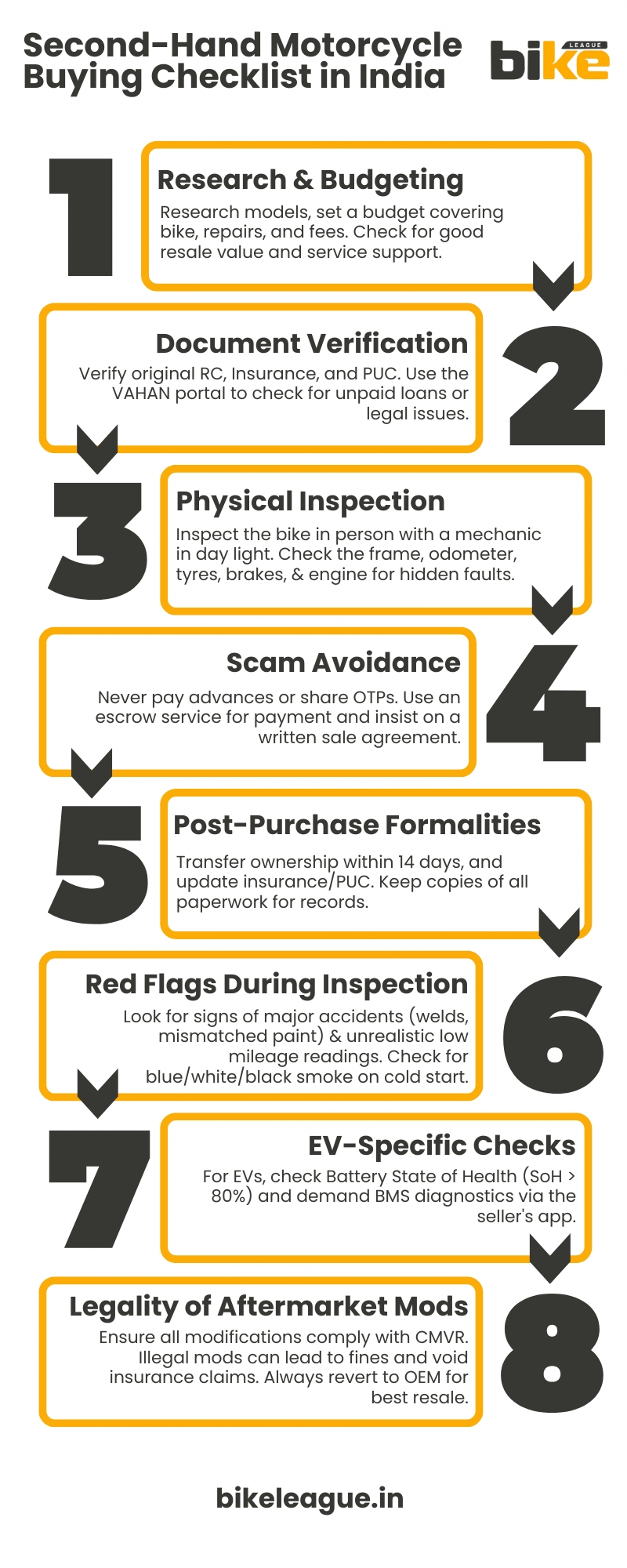
- Do Your Research and Set a Realistic Budget: Before you start shopping, figure out which motorcycle best fits your needs. Look for models that have good resale value and reliable service support. Make sure you budget for not just the bike’s price, but also repairs, transfer fees, and insurance.
- Double-Check All Documents: Always ask for the original Registration Certificate (RC), insurance papers, PUC certificate, and transfer forms. Use the VAHAN portal to verify the details and check for any unpaid loans or legal issues.
- Inspect the Bike in Person (Bring a Mechanic!): Check the bike yourself—look at the frame, odometer, tyres, brakes, suspension, and engine. If possible, bring along an experienced mechanic. They can spot hidden issues and help you get a fair price.
- Watch Out for Scams and Negotiate Wisely: Never pay any advance or share OTPs with sellers. Use an escrow service when making payments and insist on a written agreement. Negotiate the price using your research and what you learned from your inspection. Buying from a certified platform can also reduce your risk.
- Don’t Skip Ownership Transfer and Paperwork: Make sure you transfer the bike’s ownership in your name within 14 days, and update the insurance and PUC certificate. Skipping this step can get you fined or land you in legal trouble. Keep copies of all documents and agreements for your records.
What is the Second-hand motorcycle buying checklist in India?
This checklist guides you from research to what to do after buying, so you can avoid scams, get a fair price, and follow the rules—especially in busy cities like Delhi and Bengaluru.
1. Pre-Purchase Research & Budgeting
Before you start searching, set realistic expectations. Look for models that hold their value and have good service support, like Honda, Hero, or Bajaj.
- Think about what you need: a commuter bike like the Activa or Splendor, a performance bike like the Pulsar NS200, or an electric vehicle like an Ather or an Ola.
- Plan your budget. Expect to spend ₹20,000 to ₹1.5 lakh for the bike, plus ₹5,000 to ₹15,000 for repairs, ₹400 to ₹1,000 for transfer fees, and ₹2,000 to ₹5,000 for insurance.
- Research the bike’s fair value. Start with OBV.in for a baseline, check median prices on BikeDekho, and look for the lowest prices on OLX.
- Check the VAHAN portal to make sure there are no liens or theft records. Do not buy a financed bike unless the seller provides a No Objection Certificate (NOC).
2. Dealer vs Private vs Hybrid Quick Choice
Decide if you want to buy from a dealer, a private seller on platforms like OLX, or use a mix of both. The table below explains the differences.
| Buyer Profile | Recommended Type | Why | ₹1.2L Bike Example |
|---|---|---|---|
| First-time buyer | Dealer (Vutto/DriveX) | 100+ inspections, warranty, paperwork help | ₹1.32L (+10%) = Peace of mind |
| Mechanic-savvy | Private (OLX)** | 15-25% savings, VAHAN/mechanic verify | ₹96k (-20%) = Max value |
| EV buyer | Dealer | Battery SoH reports, charger warranty | Ola ReNew certified only |
| Budget commuter | Hybrid | BikeWale shortlist → Dealer inspect | ₹1.08L (-10%) safe savings |
Tip: Hybrid is the best option to consider.
3. Document Verification Checklist
Fake documents cause about 30% of disputes. Always check the original documents before you take a test ride.
| Document | Check For | Verification Tool/Link |
|---|---|---|
| RC (Registration Certificate) | Chassis/engine match frame stamps | VAHAN: https://vahan.parivahan.gov.in/vahan4dashboard/vahan/view/reportview.xhtml |
| Insurance | Valid, transferable NCB | Policy no. on insurer site |
| PUC Certificate | <6 months old | https://puc.parivahan.gov.in/puc/ |
| Forms 28/29/30 | Seller signed (interstate: Form 28 NOC) | Download: https://parivahan.gov.in/en/forms-all |
| Service History/NOC | No gaps, hypothecation-free | OEM app/dealer |
Tip: Written sale agreement (₹100 stamp); photocopy everything.
4. Physical Inspection Checklist
Bring a mechanic with you, which usually costs ₹1,500 to ₹2,500. Check the bike in daylight and test everything to make sure it works.
- Frame/Chassis: Dents, rust, welds, mismatched paint (accident signs).
- Odometer: Look for a realistic number of kilometres (less than 20,000 is ideal). Cross-check with service logs. If you suspect tampering, reduce your offer by 10-15%.
- Tyres and wheels: Make sure the tread is at least 1.5mm, the tyres are less than 5 years old, and the wheels are properly aligned.
- Brakes and suspension: Brake pads should have more than 30% life left, there should be no fork leaks, and the brakes should feel firm.
- Engine: There should be no smoke or unusual noise, the oil should be clean, and both self-start and kick-start should work.
- Electricals: Check that all lights, horn, and indicators work. If there are aftermarket parts, make sure they are legal.
- EV Extra: Battery SoH > 85% via app, charger test.
| Component | Pass Criteria | Red Flag | Fix Cost (₹) | Negotiate Deduction |
|---|---|---|---|---|
| Tyres | 1.5mm+ tread, & 5yr DOT | Worn/cracked/sidewall damage | 4-10k/pair | -5-10% |
| Brakes | >30% pad life, clean fluid | Sloppy grab, thin pads, pulsing | 2-5k pads + 2k fluid | -₹5k fixed |
| Engine | Clean startup, no smoke | Blue/white/black smoke, rattles | 10-30k (valves/rings) | -15% value |
| Suspension | Firm rebound, no leaks | Fork seal oil, bouncy shocks | 3-8k seals/shocks | -8-12% |
| Chain | Clean, 2-3cm slack | Rusty/stretched (>4cm slack) | 2-4k kit | -₹3k |
Tip: Always bring an experienced mechanic with you while doing a physical inspection
5. Test Ride & Scam Avoidance
During the test ride, try to follow your usual route or similar conditions. Afterward, use any problems you notice to help negotiate the price.
- During the test ride, make sure the gears shift smoothly, the brakes feel firm, there are no unusual vibrations, and the bike handles well.
- To avoid scams, never pay advances or share OTPs. Meet in public places and consider using an escrow service like Speedioo (costs ₹1,000 to ₹2,000).
- When negotiating, aim for a 15-25% discount with private sellers (e.g., “OBV shows ₹1.2 lakh”) or 8-12% with dealers (ask them to match Vutto’s price).
6. Negotiation & Payment
Use real data to make your offer. For example, you can say, “BikeDekho shows a median price of ₹1.2 lakh, but the brakes need a ₹5,000 fix. Can we agree on ₹1.05 lakh in cash?” Be prepared to walk away if the deal isn’t right. Only pay after you get the RC.
7. Post-Purchase Formalities (14-Day Deadline)
You must transfer ownership by law. If you skip this step, you could be fined between ₹300 and ₹5,000.
| Action | Timeline | Cost (₹) | Link/Provider |
|---|---|---|---|
| RC Transfer | 7-14 days | 150-300 | https://parivahan.gov.in/en/content/ownership-transfer |
| Insurance Update | Day 1-7 | 2k-5k | https://www.policybazaar.com/motor-insurance/two-wheeler-insurance/ |
| PUC Renewal | If expired | 100 | Emission center https://puc.parivahan.gov.in/puc/ |
| Full Service | Week 1 | 1-3k | OEM dealer |
Tip: Always check the VAHAN portal first, bring a mechanic, and use escrow for payments. Certified platforms reduce your risk by 80%. Following this checklist can save you ₹10,000 to ₹30,000 and help you find a reliable bike.
What are some common red flags to look for when inspecting a second-hand motorcycle in India?
Hidden problems like accident damage or tampering can cost you ₹10,000 to ₹50,000 in repairs. This inspection guide lists 15 common red flags you can spot during a daylight check with a mechanic (₹1,500 to ₹2,500). Use these to negotiate a 10-30% discount or decide to walk away.
1. Frame & Chassis Damage (Accident History – 25% of Problem Bikes)
Frame issues indicate crashes; repairs drop value 20-40% and compromise safety.
| Red Flag | What to Check | Danger Level | Negotiate Deduction |
|---|---|---|---|
| Dents/Cracks/Welds | Frame tubes, swingarm, fork lowers | High (crash history) | 20-30% |
| Mismatched Paint | Uneven colors, fresh paint overspray | Medium (hidden repairs) | 10-15% |
| Rust Patches | Under tank, chain area, exhaust mounts | Low-Medium (neglect) | 5-10% |
Tip: Use a straightedge to check the frame. If you find any bends, it’s best to walk away.
2. Odometer Tampering (30% Scam Prevalence)
Low readings inflate prices ₹20-30k; cross-check service logs.
- Unrealistic Mileage: Cluster Anomalies: Digital digits too perfect; worn buttons absent.
- Service Gaps: Invoices skip 30-50k km jumps.
Verify with the OEM app and a mechanic’s check. If you suspect tampering, reduce your offer by 10-15%.
3. Engine & Performance Warnings
Cold startup reveals 40% defects; no smoke/leaks essential.
| Component | Red Flag Signs | Cost to Fix (₹) | Walk-Away Threshold |
|---|---|---|---|
| Smoke on Startup | Blue (oil burn), white (coolant), black (fuel) | 10-30k | **Any smoke** |
| Rattles/Rumbles | Ticking valves, chain slap, bearing growl | 5-15k | Persistent noise |
| Oil Leaks | Weeps at gaskets, sump | 3-8k | Puddles under bike |
| Clutch Slip | Revs rise without speed | 8-12k | >20% slip |
Test sequence: Start the bike cold, let it idle for 5 minutes, then hold the throttle steady. It should run smoothly and not produce smoke.
4. Tyres, Brakes & Suspension Failures (Safety Critical)
Worn parts = immediate hazard; replace pre-ride.
- Tyres: 5yr DOT (week/year code).
- Brakes: Pads
- Suspension: Fork seal leaks (oil trails), bouncy shocks, uneven rebound.
| Item | Critical Fail | Replacement (₹) |
|---|---|---|
| Tires | Bald/uneven | 4-10k pair |
| Brake Pads | <2mm thick | 2-5k |
| Fork Seals | Weeping oil | 3-6k |
5. Electrical & Cosmetic Neglect
These issues show the bike hasn’t been well-maintained. They are usually easy to fix, but they are still warning signs.
- Dead Lights/Horn/Indicators: Wiring decay.
- Illegal Mods: Blue/red LEDs, loud exhausts (>80dB CMVR).
- Weak Battery: Slow crank (less than 12.6V); corrosion on terminals.
6. Test Ride Red Flags (Real-World Simulation)
Ride the bike for 10 to 15 minutes in traffic. Make sure it feels stable and handles well.
- Vibrations: Handlebar/footpeg shake (>40km/h = bearings).
- Gear/Brake Pull: Wanders left/right (alignment).
- Overheating: Gauge spikes, steam
7. India-Specific Red Flags
| Local Issue | Warning Sign | Check Tool |
|---|---|---|
| Hidden Lien | RC hypothecation | vahan.parivahan.gov.in |
| Stolen Bike | Filed chassis stamps | Match RC numbers |
| EV Battery Fraud | No app access, <85% SoH | Live BMS demo |
| PUC Expired | >6 months validity | pucparivahan.nic.in |
Tip: Always inspect the bike in daylight and bring a mechanic. Certified platforms like DriveX check over 100 points, which can be worth paying a 10-20% premium. If you find three or more red flags, use the repair costs to negotiate a lower price (for example, “Brakes ₹5,000, so please deduct that amount”).
What documents should I request from the seller to ensure the second-hand motorcycle’s legitimacy in India?
Fake documents cause about 30% of disputes after buying, leading to fines of ₹300 to ₹5,000 and legal trouble. Always ask for the required documents and check the physical originals. This proves ownership, clears any loans, and helps you transfer the bike at the RTO within 14 days. If any document is missing, it’s a big red flag—walk away from the deal.
1. Core Legal Ownership Documents (Mandatory for All Transactions)
These prove a clean title and enable Parivahan RC transfer.
| Document | Purpose | What to Check | Verification Tool/Link |
|---|---|---|---|
| Registration Certificate (RC) | Official ownership proof | Chassis/engine numbers match frame stamps; tax validity; no hypothecation | vahan.parivahan.gov.in → Enter chassis |
| Valid Insurance Policy | Legal riding + transferable No Claim Bonus (NCB) | Expiry >30 days; policy number active | Insurer portal (PolicyBazaar/HDFC ERGO) |
| PUC Certificate | Emissions compliance | Issued | https://puc.parivahan.gov.in/puc/ |
| Forms 29 & 30 (signed by seller) | Ownership transfer application | Fresh ink signatures; duplicate copies | Download: https://parivahan.gov.in/en/forms-all |
Red Flag: Photocopies only, mismatched names, or “arrange later”—scam alert.
2. Financial Clearance Documents (Critical for Financed/Interstate Bikes)
Hypothecation (loans) or interstate tax-due trap: 20% buyers post-sale.
| Document | When Required | Verification Steps | Consequence if Missing |
|---|---|---|---|
| Form 28 (NOC) | Interstate sales ONLY | Seller’s RTO issued; validity >30 days | Can’t re-register in your state (₹10k+ tax) |
| Financier NOC / Form 35 | RC shows hypothecation mark | Bank/NBFC letterhead + stamp; full repayment proof | Bank seizes bike post-sale |
| Road Tax Receipt | Confirms tax paid-up | Matches RC tax due date | RTO blocks transfer |
Tip: VAHAN portal catches 80% hidden liens instantly (chassis no. search).
3. Supporting & Verification Documents
Build dispute-proof transaction records.
- Seller ID Proof: Aadhaar/PAN/Passport matching RC name/address (KYC compliance).
- Service History Records: OEM invoices/logs (odometer tampering check; gaps deduct 10-15% value).
- Written Sale Agreement: ₹100 stamp paper listing bike specs (chassis/engine), price, date, signatures—legal contract for consumer forums.
What is the checklist or advice tailored to buying used EV bikes and scooters in India?
India’s used electric two-wheeler market is growing fast, with options on OLX, BikeWale, and certified platforms like DriveX and Ola ReNew. Battery warranties can be transferred (3-8 years or up to 1 lakh km), and bikes with SoH above 80% usually resell for 60-70% of their value. Be careful of scams on classifieds, especially fake SoH reports. Certified platforms use BMS diagnostics to reduce risk. For the safest deals, use Ola ReNew for grading and RetroEV for listings.
1. Platform Selection for Used EVs
Use EV-specific filters when searching. Avoid unverified classifieds that don’t offer battery diagnostics.
| Platform Type | Examples | EV Pros | Risks | Best For |
|---|---|---|---|---|
| Classifieds | OLX, Quikr | Low prices (₹30k-1.5L) | Fake batteries/scams | Budget with EV mechanic |
| Aggregators | BikeWale, Bikes4Sale | EV filters, price tools | No battery checks | Shortlisting Ather/Ola |
| Certified EV | DriveX, Ola ReNew, RetroEV | SoH reports, warranties | 10-20% premium | Battery reliability |
| OEM Exchange | CredR (Tork partner), Hero | Transferable warranty | Model-limited | Upgraders |
Tip: Demand platform inspection reports; cross-verify VIN on e-AMRIT for subsidies.
2. Battery Health Verification
The main thing to check is that the battery’s State of Health (SoH) is above 80% and it has fewer than 500 charge cycles. Use an app or diagnostic tool (costs ₹1,000 to ₹2,000) to confirm this.
- App scan (Ather/Ola/Bajaj) for SoH, cycles, voltage; test 80-100% charge → 20km ride for range drop. Less than 1% per km is ideal.
- Full discharge-charge cycle (4-8hrs); match claimed range (e.g., 100km → 70km used).
- No swelling/leaks; BMS logs for abuse (fast-charge overuse).
3. Warranty & Service History
Transferable for majors (Vida 5yr/75k km); confirm via OEM app.
- Seller provides service logs/software updates; contact the dealer with the VIN for the balance (e.g., Komaki 2-3yr).
- Covers capacity loss > 20%; excludes tampering—get written transfer confirmation.
- Platforms like DriveX extend a 1-year battery warranty on certified units.
4. Charging Infrastructure Check
Verify compatibility with 2025’s 10k+ stations (Tata Power EZ Charge).
| Component | Test Steps | Red Flags | Platform Tip |
|---|---|---|---|
| Port/Cable | Plug/unplug; check corrosion | Non-standard, frayed | Demand kit; test on public charger |
| App/BMS | Pair app; view live stats | No access/OTA fails | Ola ReNew includes |
| Home Fit | Time to 100% charge | >8hrs slow | EV Mitra subsidy eligible |
Tip: Test the platform demo charger if available.
5. Legal, Resale & Physical Checks
EVs are exempt from PUC requirements. For better resale value, look for models that are less than three years old.
- Vahan: No liens, FAME subsidy residuals transferable; interstate NOC.
- Physical: Motor heat/noise-free, frame straight; EV mechanic (₹ 1.5- 2.5k).
- Resale: High-demand (Chetak, iQube) retain 65%; avoid >4yr/low SoH. Less than 70% drops 40% value
| Age/SoH | Resale % | Platforms Boost |
|---|---|---|
| <2yr/90%+ | 70-80% | Ola ReNew premiums |
| 2-4yr/75-85% | 50-65% | DriveX certified |
| >4yr | <40% Avoid | Classifieds only |
Tip: Ask for a live video or a BMS report before meeting the seller. Certified platforms are the safest choice.
What is the checklist of top scams in used bikes, with actionable prevention tips and red flags in India?
Scams cost buyers lakhs of rupees every year. The most common problems are odometer tampering, fake documents, and online fraud. This checklist gives you the main red flags and practical steps to avoid scams, especially in cities like Delhi and Bengaluru.
1. Odometer Tampering (Mileage Fraud)
Sellers roll back odometers to inflate value by 10-20% (e.g., 50,000 km shown as 10,000 km on a 2022 Pulsar NS200, adding ₹20-30k). Common in classifieds.
Red Flags
- Unrealistically low km on old bikes (less than 10k km/year average).
- Odometer digits misaligned or digital resets suspiciously clean.
- Service history gaps despite “low usage.”
Prevention Tips
- Cross-check service records/OEM app data against odometer.
- Mechanic scan: Use diagnostic tools for hidden km logs (₹500-1k).
- Benchmark: OBV/BikeDekho median flags outliers (e.g., NS200 >25k km is unrealistic). Deduct 10-15% if tampered.
2. Fake Documents (RC/Insurance Fraud)
Forged RC, PUC, or insurance leads to RTO rejection or post-buy fines/challans. Interstate fakes from Mizoram/Delhi (15-year scrap rule) are rampant.
Red Flags
- RC name/address mismatches, seller ID, chassis/engine numbers altered.
- Expired PUC/insurance; hypothecation not cleared (Vahan check).
- No Forms 29/30 or NOC for financed/outstation bikes.
Prevention Tips
- Verify on Parivahan Vahan portal (chassis/engine, liens, theft).
- Physical match: Stamp numbers on frame/engine with RC.
- Demand originals + photocopies; written sale agreement (₹100 stamp). Platforms like DriveX verify docs.
| Scam Type | Red Flag Example | Verification Step | Cost to Fix |
|---|---|---|---|
| Fake RC | Mismatched chassis | VAHAN portal scan (chassis/engine vs RC) | ₹5-10k RTO correction / legal work |
| Expired PUC | >6 months old | Emission center / pucparivahan.nic.in check | ₹100 renewal |
| Hidden Loan | Hypothecation mark on RC | Financier NOC + Form 35; VAHAN hypothecation status | ₹10-50k clearance (loan payoff + charges) |
3. Online Fraud (Proxy/Advance Scams)
Scammers pose as “friends” on OLX, demand advances (₹2-10k “transport/booking”), or hijack listings (e.g., Ducati scams netting ₹6 lakh).
Red Flags
- Urgency: “Send ₹2k now or deal off”; UPI QR/screenshots.
- Proxy demands: “Friend handles docs/payment.”
- Interstate “deals” sans video/RC soft copy; too-good prices.
Prevention Tips
- No advances/OTPs; cash/escrow post-inspection (Speedioo ₹1-2k fee).
- Public daytime meets with friend; live video/BMS (EVs) pre-visit.
- Platform chat only; report fakes. Certified (Vutto) cuts risk 80%.
| Fraud Type | Common Ploy | Countermeasure | Platform Risk |
|---|---|---|---|
| Advance Scam | “₹5k booking” | Use escrow; pay only after in-person inspection at a public place | OLX/Quikr high |
| Proxy Buyer | “Friend pays” | Insist on meeting and verifying the real owner’s ID; avoid third-party payment deals | FB Marketplace |
| Fake Listing | Reposted ads | Reverse-search or trace original poster; cross-check images/details with other platforms | All classifieds |
Additional Scams & Universal Tips
- Accident-Hidden: Fresh paint/welds; test ride vibrations. Mechanic inspect (₹1.5-2.5k).
- EV Battery Swap: Fake SoH reports; demand app diagnostics (>85% ideal).
- Service Centre Upsell: Post-buy, insist on OEM; watch parts.
Stay alert, as scams often happen when buyers rush. Using certified platforms and professional help can save you a lot of trouble.
What are the aftermarket modifications or accessories (e.g., exhausts, lights, phone mounts), their legality, and the impact on insurance or resale value in India?
Modifications must comply with CMVR 1989 (AIS-140/156 norms) to avoid fines of ₹1,000-10,000, insurance claim rejections, or 10-30% resale drops amid RTO scrutiny and insurer crackdowns.
1. Common Aftermarket Modifications
Popular upgrades span performance, aesthetics, and convenience, but legality hinges on ARAI/CMVR certification:
- Exhaust Systems: Free-flow “silencers” boost power 5-10% but exceed 80-85 dB limits (e.g., Akrapovic clones).
- LED Lights/Headlamps: Projectors for better visibility; must match OEM wattage/colour (white/yellow only).
- Phone Mounts/GPS: Vibration-proof holders; no wiring changes.
- Handlebar Risers/Seats: Ergonomic tweaks; no structural frame alterations.
- Tyre Upgrades: Wider rubber (e.g., MRF Nylogrip); speedo error
- EV Add-ons: Fast chargers, range extenders; BMS-compliant only.
| Mod Type | Examples | Cost (₹) | Popularity |
|---|---|---|---|
| Exhaust | Leo Vince, Yoshimura clones | 5k-20k | High (performance seekers) |
| Lights | Philips LED kits | 2k-8k | Very High (night riders) |
| Mounts | RAM-X phone holders | 1k-3k | Commuters |
| Tyres | CEAT Gripp XL | 4k-10k/pair | All users |
2. Legal Compliance Under CMVR
All mods require ARAI type-approval; unlisted changes void RC compliance (fine ₹1,000-5,000 first offence). RTO inspections flag non-OEM parts during transfers/PUC.
Legal (Green Zone)
- Cosmetic: Stickers, mirrors, grips (no functional change).
- Safety: Disc brakes (OEM-spec), horn upgrades (≤100 dB).
- Accessories: Phone mounts, tank bags (non-electrical).
Illegal (Red Zone)
- Exhausts >80 dB or non-ABS/ECU mapped.
- Tinted/colored lights (blue/red banned).
- Frame cuts/welds, oversized tyres, and altering geometry.
- EV non-certified batteries/chargers (fire risk).
Verification Steps
- Check the ARAI sticker/part number matches OEM specs.
- PUC test post-mod (emissions/noise).
- RTO endorsement for major changes (₹500-2,000 fee).
3. Insurance Implications
Insurers (ICICI Lombard, HDFC ERGO) require prior disclosure; undeclared mods result in 20-50% claim deductions or total denial (Motor Tariff 2025).
- Add-On Coverages: “Zero Depreciation” + “Accessories” (up to ₹10k cover, 2-5% premium hike).
- Risk Uplift: Performance exhausts +10-20% premium; lights/mounts negligible.
- Claim Rejections: “Mod not declared” voids policy; restore OEM for settlements.
| Mod Impact | Premium Change | Claim Risk | Mitigation |
|---|---|---|---|
| Exhaust/Engine | +15-25% | High (tampering flag) | Declare to insurer + dyno/garage certification |
| Lights/Tyres | +2-5% | Low | Keep purchase invoices; ensure street-legal spec |
| Mounts/Seats | None | None | Treat as cosmetic only; no need to declare in most policies |
4. Resale Value Impact
Mods cut resale 10-30% on platforms like OLX/BikeDekho; buyers prefer stock bikes for easy transfers.
Value Boosters (+5-15%)
- OEM accessories (e.g., Royal Enfield touring kit).
- Safety: ABS retrofits (legal via RTO).
Value Killers (-20-40%)
- Illegal exhaust/noise violations (RTO rejection risk).
- Visible cuts/welds signal accidents.
- EV non-standard chargers drop SoH trust.
| Mod | Resale Boost/Drop | Buyer Perception | Fix for Sale |
|---|---|---|---|
| Legal LED Lights | +5-10% | Modern appeal | Ensure PUC valid and beam aligned |
| Free-Flow Exhaust | -20-30% | Fine risk, noise nuisance | Revert to OEM exhaust before listing |
| Phone Mount | Neutral | Practical utility | Remove if cracked/worn; tidy wiring |
| Wider Tyres | -10% | Speedo mismatch, handling doubts | Refit stock size tyres if possible |
5. Best Practices & Recommendations
- Buy Certified Parts: From BikeDekho-affiliated shops; retain invoices.
- Declare Everything: Inform insurer pre-install (PolicyBazaar tools).
- Resale Prep: Document mods, revert illegal ones (₹2-5k cost).
- EV Focus: Stick to OEM chargers; SoH warranty key for 60-70% retention.
Smart modifications can make your ride better without causing legal or financial problems. Always follow the rules to keep your insurance valid and get the best resale value. Check with your local RTO for state-specific rules, as fines are higher in big cities.
Which are the official government websites, forms & Links needed for Used Motorcycle Transactions in India?
Below are all official government portals, mandatory forms (28/29/30), and direct links essential for 2025 buyers—crucial for avoiding fines (₹300-5,000), legal liabilities, and post-sale disputes during RC transfers within 14 days.
1. Primary Government Portal: Parivahan Sewa (Ministry of Road Transport & Highways)
Official Website: https://parivahan.gov.in/
Key Services: Ownership transfer, RC verification, challan payments, smart card RC.
| Service | Direct Link | Purpose | Processing Time |
|---|---|---|---|
| Vehicle Ownership Transfer | parivahan.gov.in → Online Services → Vehicle Related → Transfer of Ownership | Online RC transfer (both parties) | 7-14 days same-state |
| VAHAN Vehicle Search |
https://vahan.parivahan.gov.in/vahan4dashboard/vahan/view/reportview.xhtml |
Check liens, hypothecation, theft, ownership history | Instant (chassis/engine no.) |
| Vehicle Scrutiny Report | parivahan.gov.in → Vehicle Scrutiny | Pre-transfer verification | 1-3 days |
2. Mandatory Forms for Ownership Transfer (Download Links)
| Form | Purpose | Official Download | Usage |
|---|---|---|---|
| Form 28 | No Objection Certificate (NOC) from seller | Form 28 PDF | Interstate transfers ONLY |
| Form 29 | Notice of Transfer of Ownership | Form 29 PDF | Mandatory for ALL transfers – Seller signs |
| Form 30 | Application for Transfer | Form 30 PDF | Mandatory for ALL transfers – Buyer signs |
| Form 35 | Hypothecation Removal (Financed bikes) | Form 35 PDF | Clear bank liens |
Tip: Right-click → “Save As” from Parivahan; print on A4, seller/buyer sign in duplicate.
3. State-Specific RTO Portals (Select Your State)
| State | Official Transport Department | Key Service |
|---|---|---|
| Delhi | https://transport.delhi.gov.in | Online appointments |
| Maharashtra | https://transport.maharashtra.gov.in/1035/Home | MUMBAI/PUNE RTO |
| Karnataka | https://transport.karnataka.gov.in | Bengaluru transfers |
| Tamil Nadu | https://tnsta.gov.in | Chennai/Coimbatore |
| Telangana | https://transport.telangana.gov.in/ | Hyderabad |
| Uttar Pradesh | https://uptransport.upsdc.gov.in/en-us/ | Lucknow/Noida |
There are more state-specific websites, and we have only mentioned some. To find out other websites, please enter the state name along with the word RTO in Google search, and you can find the website.
4. PUC (Pollution Under Control) Verification
- Official Portal: https://puc.parivahan.gov.in/puc/
- Purpose: Verify PUC validity (6-12 months); mandatory for transfer.
- Tip: PUC certificate must match chassis no.
5. Additional Government Resources
| Authority | Website/Link | Purpose |
|---|---|---|
| ARAI (Certification) | https://araiindia.com | Verify legal aftermarket parts |
| Traffic Police (Challans) | https://echallan.parivahan.gov.in | Clear pending fines |
| Smart Card RC Status | https://sarathi.parivahan.gov.in/sarathiservice/stateSelection.do | Track RC delivery |
What to Do If You Suspect a Used Motorcycle Scam in India?
India’s used two-wheeler market sees thousands scammed daily via OLX advances, fake RCs, or proxy buyers, with losses from ₹5k to ₹6 lakh per case. Immediate action within 24 hours maximises recovery (a 60% chance via the 1930 helpline) and stops further fraud. This step-by-step guide covers evidence collection, reporting channels, the FIR process, and consumer remedies.
Step 1: Freeze & Secure (First 30 Minutes – Critical)
Stop further damage immediately.
- Bank/UPI Freeze: Call bank IMMEDIATELY (24×7 fraud lines) to block account/card; report UPI via 1930 helpline (blocks scammer wallet instantly).
- Don’t Delete Evidence: Screenshot everything—chats, payments, profiles—before scammer blocks you.
- Secure Devices: Change passwords, scan for malware if remote access is given.
Step 2: Evidence Collection (Next 2 Hours – Builds Strong Case)
Strong evidence = 80% faster resolution.
Mandatory Screenshots/Documents:
| Evidence Type | What to Capture | Why Critical |
|---|---|---|
| Chats/Calls | Full OLX chat, WhatsApp, timestamps | Proves communication timeline & intent |
| Payments | UPI IDs, bank SMS, transaction screenshots | Trace money trail for bank reversal |
| Bike Details | Ad screenshots, chassis/engine no., seller profile | Identifies fraud vehicle & scammer account |
| Personal Info | Phone numbers, emails, bank details shared | Links scammer identity across platforms |
Tip: Use the “Scrollback” feature on WhatsApp—capture full conversation history.
Step 3: Report to Cybercrime Portal (5-10 Minutes – Official FIR Path)
Primary channel for 1.2M+ annual cyber complaints.
National Cybercrime Reporting Portal
- Visit: https://cybercrime.gov.in
- Select: “Financial Fraud” OR “Other Cyber Crime”
- Fill: Personal details + incident (date/platform/scammer no.)
- Upload: Screenshots, transaction proofs
- Get: Acknowledgement No. + forwarded to local cyber cell
Timeline: Instant complaint → Local cyber police within 24 hours.
Helpline 1930 (Financial Frauds Only)
- Call 1930 (24×7) → Give UPI/bank details
- Account blocked instantly → Cybercrime.gov.in FIR auto-generated
- 60% recovery rate within 7 days
Step 4: Platform-Specific Reporting (Parallel Action)
Report to OLX/BikeWale immediately—they ban accounts fast.
| Platform | Report Link/Phone | Action Taken |
|---|---|---|
| OLX | safety@olx.in / 9999140999 | Listing removal, account ban |
| BikeWale | support@bikewale.com | Ad suspension |
| Quikr | Platform “Report” button | User block |
Step 5: File Police FIR (Convert Complaint to FIR – Day 1)
An online complaint alone is insufficient—FIR needed for investigation.
- Take cybercrime.gov.in Acknowledgement No.
- Visit local police station/cyber cell
- Submit: Printouts + evidence + ID
- Police MUST register FIR
Timeline: FIR within 24 hours; investigation starts immediately./strong>
Step 6: Consumer Court (Civil Recovery – ₹50k+ Losses)
For monetary recovery beyond police action.
| Forum | Claim Limit | Filing Fee | Timeline |
|---|---|---|---|
| District Consumer Commission | Up to ₹50L | ₹200-2k | 3-6 months |
| State Commission | ₹50L-2Cr | ₹4k-6k | 6-12 months |
Step 7: Recovery & Follow-Up
Monitor progress and maximise recovery.
| Action | Who Contacts | Expected Timeline |
|---|---|---|
| Bank Refund | Bank fraud team | 7-30 days (RBI mandate) |
| UPI Reversal | NPCI via 1930 | 3-7 days |
| Cyber Cell Update | Investigating officer | Weekly status |
| Platform Ban | OLX support | 24 hours |
Success Rates & Timelines
- 1930 Helpline: 60% recovery (financial frauds)
- Cybercrime.gov.in: FIR in 24h → Investigation 1-6 months
- Consumer Court: 70% win rate with evidence (₹50k+ claims)
- 24-Hour Rule: First 24 hours critical—banks reverse transactions only then. CALL 1930 FIRST for UPI frauds. Save screenshots before the scammer deletes. Police/courts favour fast reporters with evidence.
Glossary of all abbreviations and terms used in this article
Here is the glossary of all abbreviations and terms used in this article, for the convenience of the reader and those who are planning to buy a second-hand motorcycle in India
- RC – Registration Certificate: Official document proving vehicle ownership and registration details, essential for RTO transfers and legal verification. Check chassis/engine numbers match frame stamps via the VAHAN portal.
- NCB – No Claim Bonus: Insurance discount for claim-free years, transferable on policy ownership changes; verify expiry > 30 days on the insurer portal.
- PUC – Pollution Under Control Certificate: Mandatory emissions compliance document valid 6-12 months; verify
- RTO – Regional Transport Office: Government authority handling vehicle registration, transfers, and licensing; state-specific portals for appointments and forms.
- VAHAN – Vehicle Registration database portal (parivahan.gov.in): Online system for checking liens, hypothecation, theft status, and ownership history using chassis/engine numbers.
- NOC – No Objection Certificate: Form 28 issued by seller’s RTO for interstate transfers; confirms no dues/objections.
- OEM – Original Equipment Manufacturer: Bike brand’s authorised dealer/service centre; source for service history, genuine parts, and post-buy servicing.
- SoH – State of Health: EV battery capacity percentage (e.g., >85% ideal); check via OEM app/BMS for used electric bikes/scooters.
- BMS – Battery Management System: EV software monitoring health, charge cycles, and safety; demand live demo/app access.
- CMVR – Central Motor Vehicles Rules: Legal regulations governing modifications (AIS-140/156 standards), noise limits (80-85 dB), and aftermarket legality.
- ARAI – Automotive Research Association of India: Certification authority for aftermarket parts; verify stickers/numbers for legal mods.
- FIR – First Information Report: Police complaint registration is mandatory for cybercrime investigation; convert the cybercrime.gov.in complaint via the local station.
- UPI – Unified Payments Interface: Digital payment system (PhonePe/GPay); freeze/report via 1930 for scam reversals.
- OTA – Over-The-Air: Wireless software updates for modern bikes/EVs; test app connectivity during inspection.
- DOT – Department of Transportation: Tire manufacturing date code (week/year); check sidewall for
FAQ about buying a second-hand motorcycle in India
1. What should I think about before buying a second-hand motorcycle?
Start by deciding how you’ll use the bike—whether it’s for daily commutes, long rides, or something else. Choose models that fit your needs, check if parts and servicing are easy to find, and set a realistic budget for the bike and any repairs.
2. Which documents do I need to check when buying a used motorcycle?
Always get the original Registration Certificate (RC), insurance papers, Pollution Under Control (PUC) certificate, and signed transfer forms (Forms 28, 29, and 30) from the seller. Double-check these on the VAHAN portal to be sure they’re genuine.
3. How do I make sure the documents are real?
Verify that the RC, chassis and engine numbers, and owner details all match on the VAHAN portal. Insurance and PUC should be up to date and match the bike’s registration details, too.
4. Is it important to bring a mechanic for inspection?
Absolutely! A trusted mechanic can spot hidden problems in the frame, engine, or suspension that you might miss—and can save you from big repair bills later.
5. How can I avoid getting scammed when buying a second-hand bike?
Never pay in advance or share OTPs. Pay only after seeing the bike and checking all documents. Meet the seller in a public place, use an escrow service if possible, and insist on a written sale agreement. Be wary of deals that sound too good to be true.
6. Can I negotiate the price of a used motorcycle?
Definitely. Use your research on the bike’s value, its condition, and any repairs it needs to negotiate a fair price. Don’t be afraid to walk away if the deal isn’t right.
7. What should I do right after buying the motorcycle?
Transfer the ownership to your name at the RTO within 14 days. Update the insurance and renew the PUC certificate if needed. Always keep copies of all your documents.
8. What red flags should I look out for?
Watch for tampered odometers, mismatched chassis or engine numbers, fake or missing documents, overly modified bikes, or sellers who refuse to share documents or allow a thorough inspection.
9. Are modifications allowed on used motorcycles?
Some modifications are legal, like cosmetic upgrades or phone mounts, but avoid illegal exhausts, lights, or structural changes—they can get you fined, cause insurance issues, or block registration.
10. What should I do if I suspect a scam or face issues after the purchase?
Save all evidence, such as chats, payment receipts, and documents. Report the issue to the cybercrime portal or your local police, and let the platform where you found the bike know. Act fast for the best chance at resolving the problem.
Other related articles from Bikeleague India
- Bike ownership transfer in India – step by step guide
- Bike Pollution Certificate – Key to Legal & Eco-Friendly Riding
- Second-Hand Bike Platforms in India – Detailed Guide
- Motorcycle service – All things you need to know explained
- KTM RC 390
Conclusion
Buying a second-hand motorcycle in India is a smart way to save money and get more value for your budget. With so many options available, it’s worth taking the time to research, inspect, and verify every detail before making your decision.
By following a thorough checklist—covering documents, physical inspection, and ownership transfer—you can avoid common pitfalls and scams. Once everything checks out, you’ll be ready to hit the road with confidence, knowing you’ve made a safe and informed purchase.
If you have any questions, email us at bikeleague2017@gmail.com. We’re always happy to help. You can also contact us on our social media accounts.