
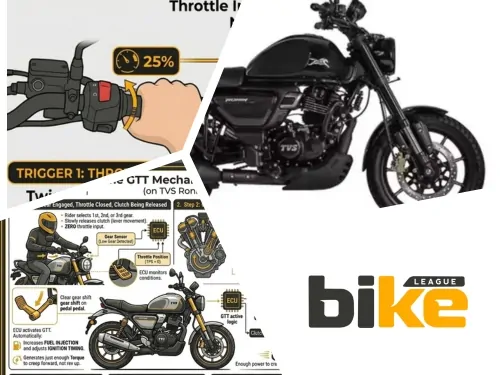
Long story short: Learn how TVS Glide Through Technology (GTT) works, what it actually does to the engine management system, its real-world pros and cons in Indian conditions, which TVS models carry it, and everything else you need to know right here.
TVS bikes like the Ronin, Apache RTR series, and Raider include Glide Through Technology (GTT), which helps make city riding smoother and less tiring, especially in India’s busy traffic. Whether you’re a beginner, a daily commuter, or a weekend rider, understanding GTT can help you get more out of your motorcycle. This guide covers what GTT is, how it works, its pros and cons, and why it matters for riders in India.
Key Takeaways
- The TVS Glide Through Technology (GTT) is designed to make low-speed riding smoother and more convenient, especially in urban traffic conditions.
- GTT allows the motorcycle to move forward at low speeds without throttle input, reducing the need for the rider to constantly coordinate the clutch and accelerator.
- This technology is particularly beneficial for new riders and those who frequently commute in stop-and-go city traffic, making daily rides less tiring.
- While GTT offers tangible advantages for comfort and ease of use, it has some trade-offs, such as limited effectiveness at higher speeds or on steep inclines.
- GTT is standard across all TVS Ronin variants (Base, Mid, and Top) AND available on multiple other TVS models, including Apache RTR 160 4V, Apache RTR 200 4V, Raider 125, and Apache RR 310.
What Is Tvs Gtt (glide Through Technology)?
GTT, or Glide Through Technology, is a software feature from TVS Motor Company. It lets your motorcycle move forward slowly in gear without you needing to use the throttle. The system works by automatically adjusting fuel injection and ignition timing through the engine control unit (ECU) to keep a steady, low power output when you release the clutch in low gears.
It’s similar to how an automatic car moves forward slowly when you take your foot off the brake, without pressing the accelerator. GTT gives the same effect on a manual motorcycle, but you still control how quickly the clutch connects. In stop-and-go traffic, the engine keeps just enough power to move the bike while you manage the clutch.
What Are The Key Features Of Tvs Gtt?
- ECU-Managed Idle Creep: GTT adjusts fuel injection quantity and ignition advance automatically to maintain a stable, low power output that moves the bike forward without throttle. The ECU does the work that the rider’s right hand would normally do.
- Works in Gears 1, 2, and 3 Only: GTT is active only when the motorcycle is in first, second, or third gear. In 4th and 5th gears, the system does not engage because those gears are intended for higher-speed riding, where idle creep is neither safe nor practical.
- Clutch Lever Fully Retained: The rider always controls the rate of clutch engagement manually. GTT supports the engine side; the clutch side is entirely in the rider’s hands. This is not a clutch-by-wire system.
- Auto-Disengagement at Speed: GTT disengages automatically as soon as any throttle input is given or when the bike reaches approximately 10 km/h. Above that speed, normal manual throttle and gear control resume.
- No Additional Hardware Required: GTT is entirely a software-level feature implemented through the fuel injection and ignition ECU. There are no additional mechanical or electronic components added to the motorcycle specifically for GTT.
- Stall-Prevention Effect: Because the ECU is actively managing fuelling to maintain minimum torque, the engine is less likely to stall when the clutch is released slowly without throttle — particularly useful for new riders still learning clutch control.
- Available Across All Variants: GTT is not reserved for a premium trim. Every variant of the TVS Ronin — Base, Mid, and Top — comes with GTT as standard.
- Pairs With Assist and Slipper Clutch: The Ronin also has an assist and slipper clutch. While GTT helps during engagement (moving off), the slipper clutch helps during aggressive downshifts, preventing rear-wheel hop. Together, they cover both sides of the clutch-effort equation.
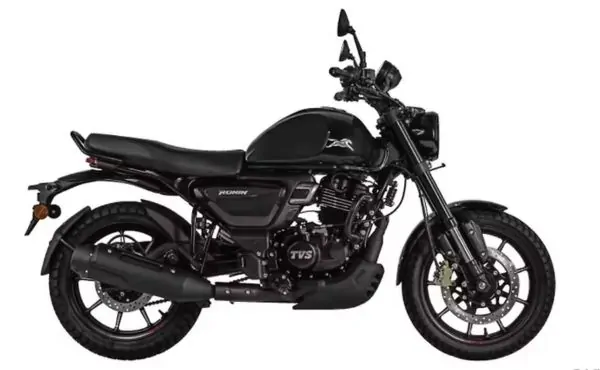
How Does Tvs Gtt Work?
To understand GTT, it’s useful to know why motorcycles stall and what idle means for a fuel-injected engine.
The Problem Gtt Solves
On a regular motorcycle, if you slowly release the clutch in first gear without using the throttle, the rear wheel can slow the engine down. If the engine speed drops too much before the clutch is fully engaged, the engine stalls. To avoid this, you need to give some throttle or carefully slip the clutch, which takes practice and focus, especially in busy city traffic.
On a carburetted motorcycle, the idle circuit gives a fixed fuel-to-air mixture at idle. On a fuel-injected bike, the ECU can adjust injection timing, duration, and ignition timing as needed. GTT uses this flexibility to help you while riding.
The Gtt Mechanism: Step By Step
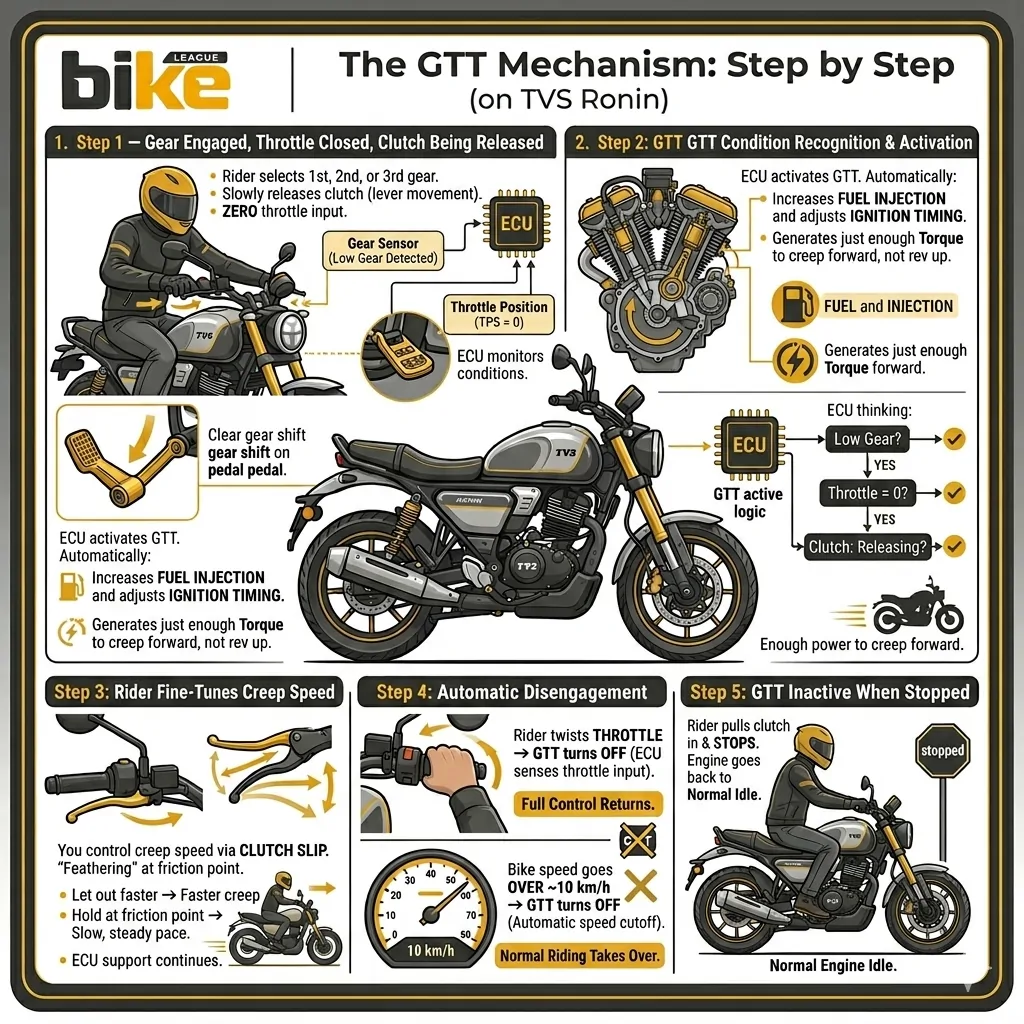
Step 1 — Gear Engaged, Throttle Closed, Clutch Being Released
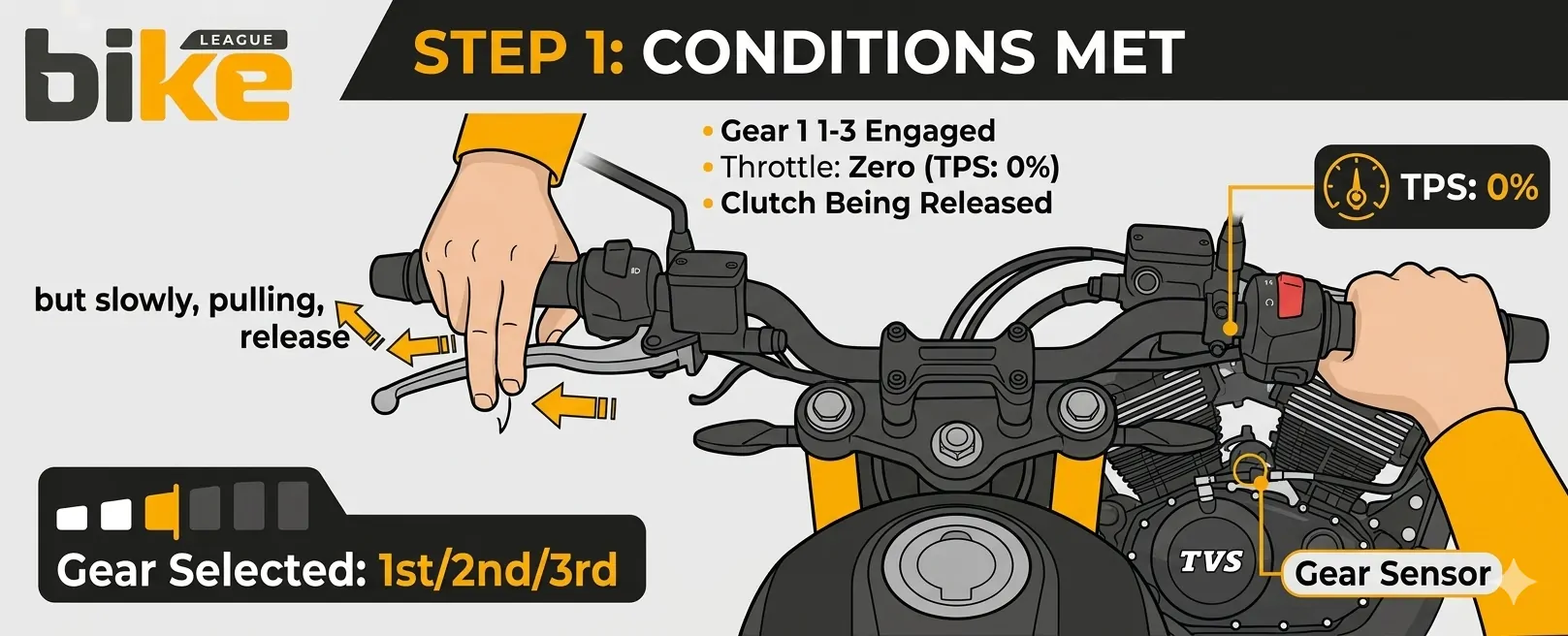
The rider selects 1st, 2nd, or 3rd gear, then slowly releases the clutch lever with no throttle input. The ECU detects the gear position (via gear sensor) and monitors the throttle position sensor (TPS) output, which reads zero.
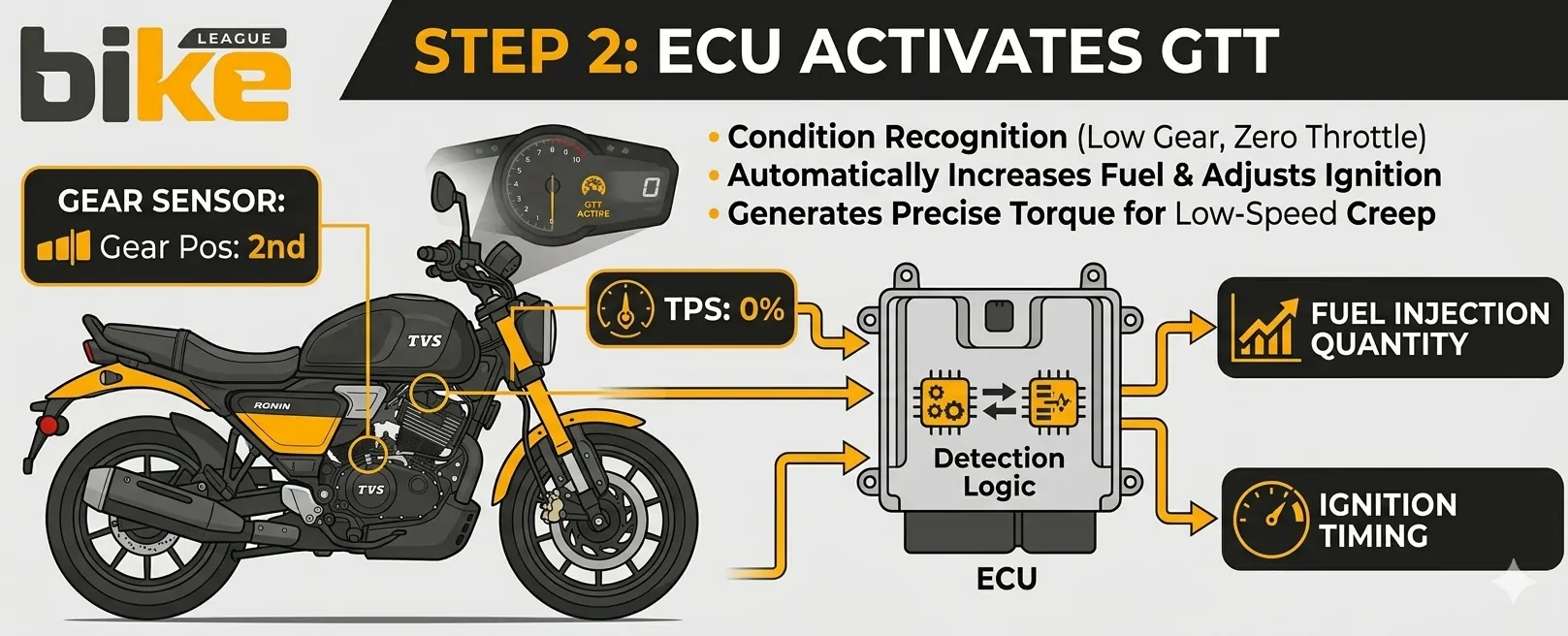
Step 2 — Ecu Activates Gtt Mode
When the ECU detects low gear, no throttle, and the clutch being released, it automatically adds more fuel and changes ignition timing to create just enough power to move the bike forward slowly. The engine doesn’t rev much; it just keeps enough power to let the bike creep ahead without stalling.
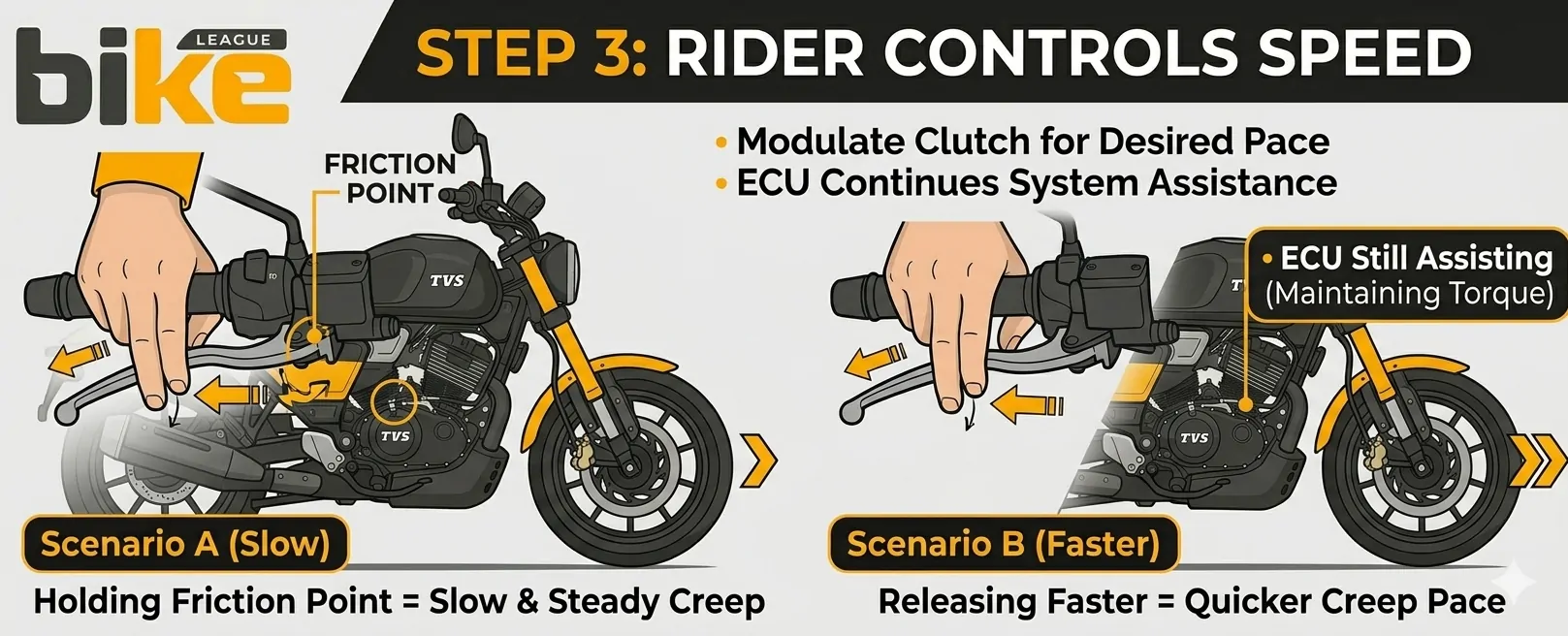
Step 3 — Rider Controls Speed Via Clutch Slip
You control how fast the bike creeps by how quickly you release the clutch lever. Letting it out faster makes the bike move a bit quicker, while holding it at the friction point keeps a slow, steady pace. The ECU continues to help the engine during this time.
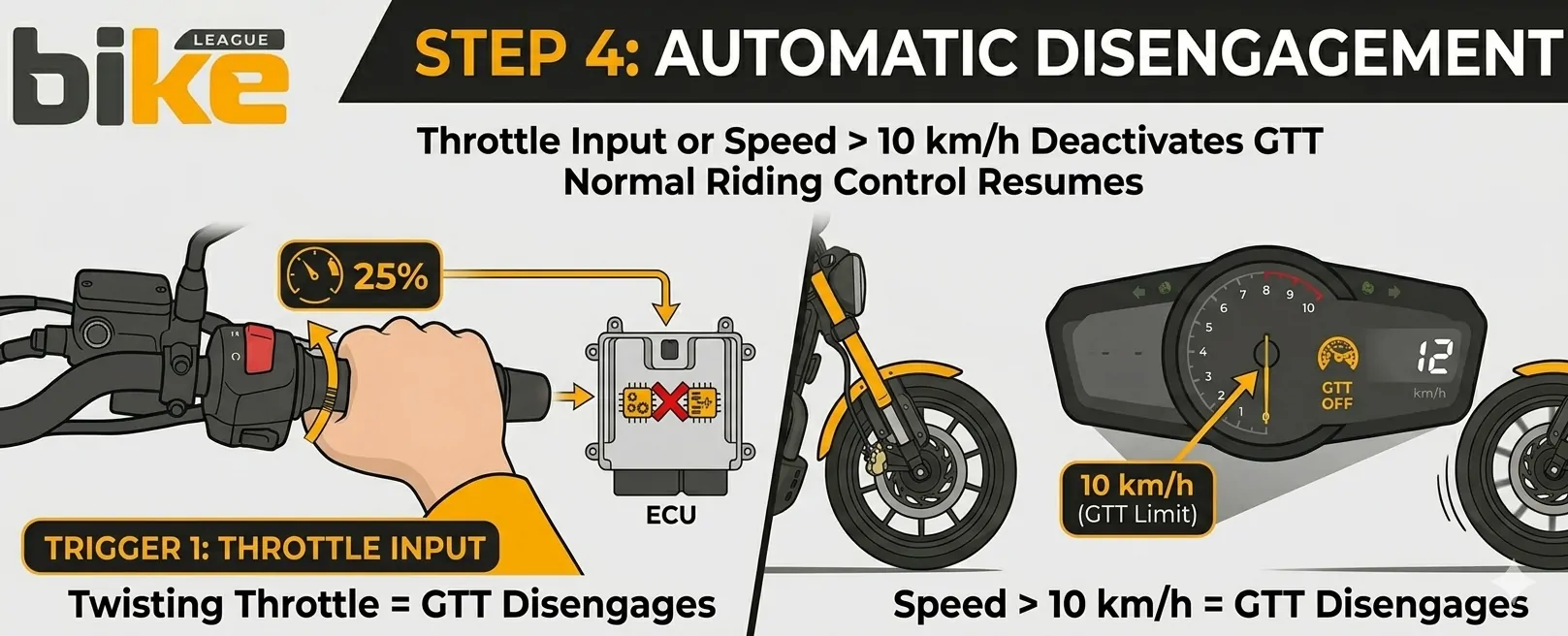
Step 4 — Gtt Disengages Automatically
When you twist the throttle, the ECU detects it and turns off GTT, giving you full control again. GTT also automatically turns off once the bike exceeds about 10 km/h, allowing you to ride normally.
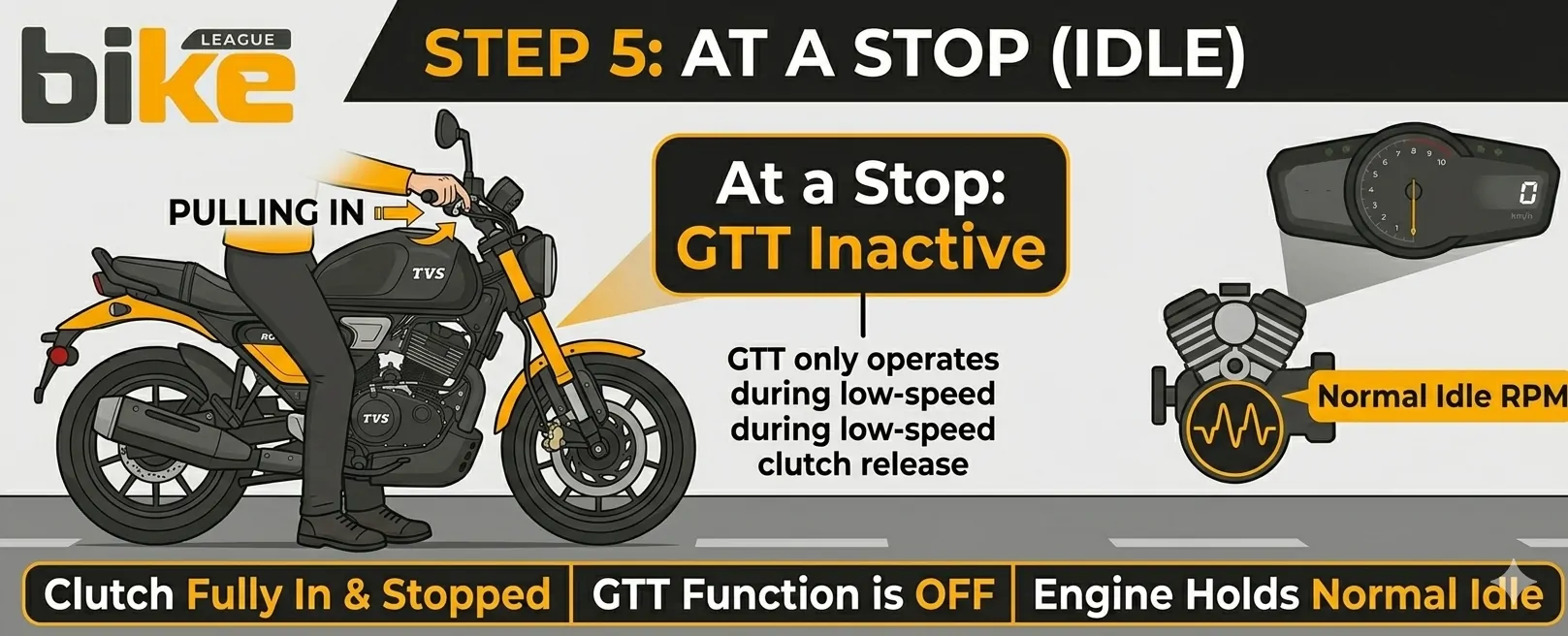
Step 5 — At A Stop
When you pull in the clutch and stop, the engine returns to its normal idle. GTT only works while you are letting out the clutch and moving slowly, not when you are stopped.
- Gear Engaged, Throttle Closed, Clutch Being Released
- Ecu Activates Gtt Mode
- Rider Controls Speed Via Clutch Slip
- Gtt Disengages Automatically
- At A Stop
Which Tvs Models Have Gtt?
GTT is not limited to the Ronin. It is available across multiple TVS motorcycles, including the Apache RTR 160 4V, Apache RTR 200 4V, Raider 125, and Apache RR 310. On all these models, GTT performs the same core function—enabling smooth low-speed movement without throttle input in city traffic.
On performance-oriented models like the Apache RTR series, GTT complements the engine’s tractability, making urban riding more manageable despite their sporty nature. The Raider 125 enhances ease of use for daily commuters and new riders.
On the flagship Apache RR 310, GTT works slightly differently—it is integrated with riding modes and is active in Urban and Rain modes across all gears, offering a more advanced implementation compared to the commuter-focused calibration seen on other models.
| Model | Variant(s) | GTT Availability | GTT Gears | Special Notes |
|---|---|---|---|---|
| TVS Ronin | Base (SS), Mid (DS), Top (TD) | Standard on all variants | 1st, 2nd, 3rd | Pairs with assist & slipper clutch |
| TVS Apache RTR 160 4V | All variants | Standard | 1st, 2nd, 3rd | Sporty engine, GTT aids city commuting |
| TVS Apache RTR 200 4V | All variants | Standard | 1st, 2nd, 3rd | Ride modes + GTT for urban comfort |
| TVS Raider 125 | All variants | Standard | 1st, 2nd, 3rd | Commuter-focused, GTT reduces fatigue |
| TVS Apache RR 310 | All variants | Standard | All gears (Urban & Rain modes) | Advanced GTT integrated with riding modes |
GTT is limited to gears 1–3 on most models to match its city-focused design, except on the RR 310, where it works in all gears when Urban or Rain mode is selected.
Pros Of Tvs Gtt
- Directly Targets Indian Urban Traffic Conditions: Indian city riding — with constant stop-and-go movement, traffic queues, and narrow filtering opportunities — demands exactly the kind of low-speed clutch management GTT removes from the equation. This is not a globally designed feature retrofitted for India; it is a feature built for how India actually rides.
- Reduces Left-Hand Fatigue Significantly: In heavy traffic, a rider can hold the clutch in, inch forward, engage, stop, repeat — hundreds of times on a long commute. GTT allows the rider to slip the clutch slowly without needing to apply throttle simultaneously, drastically reducing the cognitive and physical effort per gear engagement.
- Helps Beginners Avoid Stalling: New riders most often stall at intersections because they release the clutch too quickly without enough throttle. GTT’s ECU support provides a safety net during that vulnerable slip phase, making the bike far more forgiving to learn on.
- No Additional Hardware or Cost: GTT is a software feature. It costs nothing in terms of added mechanical complexity, weight, or dedicated components. It is already present in the ECU and adds no premium to any variant’s price.
- Slipper Clutch Works Alongside It: The assist and slipper clutch handles downshift drama, while GTT handles low-speed crawl. The two systems work in complementary ways, covering comfort and engagement, as well as disengagement, from both sides.
- Standard on All Variants: There is no need to pay for a higher trim to access GTT. The base Ronin buyer gets exactly the same GTT functionality as the top-spec buyer — a genuine value inclusion.
- Transparent and Predictable: GTT does not surprise the rider. It activates only when the conditions are clearly met (low gear, zero throttle, clutch releasing), and exits cleanly the moment throttle is given. There is no sudden mode change or unexpected behaviour to manage.
- No Engine Character Compromise: Because GTT is purely an ECU fuelling and ignition intervention at low speed, it has no effect on the engine character at normal riding speeds. The 225.9cc single-cylinder’s low-end torque character, mid-range pull, and top-end behaviour are entirely unchanged.
Cons Of Tvs Gtt
- Limited to Gears 1–3 Only: GTT does not operate in 4th or 5th gear. If a rider mistakenly filters slowly in high gear, there is no GTT support. The restriction is sensible from a safety standpoint, but it does cap the feature’s usefulness for riders who prefer to ride in higher gears at low speeds.
- Speed Ceiling of ~10 km/h: Once the bike crosses approximately 10 km/h, GTT exits, and the rider takes over completely. For most city scenarios this is fine, but in very slow-moving traffic that briefly crosses 10 km/h and drops back, there can be repeated GTT entries and exits that some riders find slightly inconsistent.
- Not a Substitute for Clutch Skill: GTT is a traffic aid, not a replacement for learning proper clutch technique. Riders who rely on it exclusively may find themselves at a disadvantage when GTT is inactive — such as in gears 4–5, on the highway, or during dynamic off-road manoeuvres.
- No Manual Toggle: There is no rider-controlled on/off switch for GTT in the interface. The system activates and deactivates automatically based on conditions. Some experienced riders might prefer the option to disable it for more direct control in certain riding situations.
- Invisible When It Works Best: GTT’s best quality is also its limitation in terms of rider awareness — it works silently and invisibly. Riders often do not notice it operating, which means they may not consciously learn when to rely on it and when not to.
- Software-Dependent: As an ECU feature, GTT’s behaviour is tied to TVS’s software calibration. If future service updates change the calibration, or if an ECU replacement is needed, GTT behaviour could technically vary. This is a minor concern but worth noting for long-term owners.
How Gtt Impacts Daily Commutes For Different Types Of Riders
GTT doesn’t make your bike faster or more powerful. Its main benefit is how it improves daily commuting, especially in India’s stop-and-go traffic. How much it helps depends on your riding experience and how often you ride in city traffic.
1. Beginners And New Riders
For someone learning to ride, especially in city traffic, GTT acts as a useful confidence-building aid.
- Fewer stalls at signals and junctions: Beginners often stall because they release the clutch too quickly without enough throttle. GTT helps the engine maintain just enough torque to keep the bike moving forward slowly, reducing the chances of abrupt stalls.
- Less stress in traffic: New riders can focus more on balance, road awareness, and traffic judgment instead of constantly worrying about clutch-throttle coordination. This makes crowded intersections and slow-moving traffic much easier to manage.
- Gentler learning curve: GTT does not replace clutch control, but it makes the bike more forgiving while a rider learns the friction point. Over time, this helps beginners build better clutch feel with less panic in real traffic situations.
If you’re new to riding, GTT makes the bike feel friendlier and easier to use every day.
2. Experienced City Commuters
For experienced riders, GTT is less about preventing stalls and more about reducing effort during repetitive urban riding.
- Lower fatigue in stop-go traffic: In daily commutes filled with signals, jams, and crawling traffic, GTT reduces the need to constantly balance clutch and throttle at very low speeds. That means less repetitive effort over long rides through the city.
- Smoother low-speed filtering: The bike can creep ahead more cleanly in 1st, 2nd, and 3rd gear without constant throttle blips. This helps experienced riders move through tight traffic gaps with less fuss.
- Predictable operation: Since GTT works only in clearly defined conditions and disengages when the throttle is applied or speed rises, it feels natural rather than intrusive. Riders who already have good clutch control will usually see it as a comfort feature, not a riding aid.
For daily commuters and regular city riders, GTT makes riding easier without changing how the bike feels.
3. Weekend Riders And Highway Users
For riders who primarily ride on open roads, GTT plays a smaller but still relevant role.
- Minimal impact on highways: Since GTT works only at low speeds and in the first three gears, it does not affect highway cruising, overtaking, or normal open-road performance.
- Useful in urban entry and exit points: Even riders who mostly tour or ride on highways still deal with city traffic at the start and end of a ride. In those situations, GTT makes the bike easier to manage and less tiring.
- No effect on performance character: GTT does not alter the bike’s mid-range pull or top-end feel during normal riding. Once you are out of traffic, the bike behaves exactly like a regular manual motorcycle.
For these riders, GTT isn’t the main feature, but it’s still a helpful everyday convenience.
Daily Commute Impact By Rider Type
| Rider Type | Main Benefit of GTT | Limitation |
|---|---|---|
| Beginners | Reduces stalls and builds confidence | Still need proper clutch control for slopes and higher gears |
| Experienced commuters | Reduces fatigue and smooths low-speed traffic riding | Does not change performance or replace skill |
| Weekend/highway riders | Makes city sections easier to handle | Limited usefulness once out on open roads |
In practice, GTT is most useful for people who ride often in city traffic. If you mostly ride on highways or for fun, it’s still helpful, but the benefits are less noticeable.
What Are The Performance And Maintenance Aspects Of Tvs Gtt?
Performance
For daily city riding, GTT makes things easier. It reduces stress in traffic, smooths out low-speed riding, and helps more people feel comfortable on the Ronin, while still letting experienced riders stay in control.
The Ronin’s 225.9cc engine produces 20.1 bhp at 7,750 rpm and 19.93 Nm of torque at 3,750 rpm. GTT operates well below the engine’s normal operating range, so there is no interaction with peak performance. Acceleration, top speed, and mid-range response are entirely unaffected.
The slipper clutch, on the other hand, interacts more directly with performance riding by preventing rear wheel skip during hard downshifts. GTT and the slipper clutch can be thought of as handling opposite ends of clutch use — GTT for soft, slow engagement; slipper clutch for aggressive, fast disengagement.
Maintenance
Since GTT is just a software feature, it doesn’t add any extra maintenance. There are no special GTT parts to check, replace, or service during regular maintenance.
The Ronin uses a standard assist-and-slipper clutch. GTT doesn’t cause extra clutch wear because you still control the clutch yourself. In fact, by making clutch use smoother in traffic, GTT might even help the clutch last longer if you ride often in the city.
The ECU and GTT sensors, like the throttle and gear position sensors, are standard parts checked during regular servicing. You don’t need any special tools or steps for GTT during maintenance.
Myths And Misconceptions About Tvs Glide Through Technology
Myth 1: Gtt Is An Automatic Clutch System
Reality: GTT does not automate the clutch in any way. The clutch hardware is completely standard, and the rider operates the clutch lever manually at all times. GTT only manages engine output (fuel injection and ignition timing) during the low-speed creep phase. The clutch is still the rider’s responsibility.
Myth 2: Gtt Works In All Gears
Reality: GTT is active only in 1st, 2nd, and 3rd gear on the TVS. Attempting to use it in 4th or 5th gear will yield no GTT support. The restriction is intentional and appropriate for the speeds those gears are intended for.
Myth 3: Gtt Prevents Stalling Completely
Reality: GTT reduces the likelihood of stalling during slow clutch release, but it is not a guarantee. If the rider releases the clutch very abruptly in a high-load situation (steep incline, fully loaded pillion), the engine can still stall. GTT helps; it does not eliminate the need for clutch feel.
Myth 4: Gtt Is Only Useful For Beginners
Reality: While GTT does help beginners avoid stalling, its primary benefit — reducing clutch-leg fatigue in urban stop-and-go traffic — applies equally to experienced daily commuters. A seasoned owner riding 50 km through city traffic every day will appreciate GTT as much as a first-time rider.
Myth 5: Gtt Is The Same As A Quickshifter
Reality: These are entirely different features. A quickshifter (or shift assistant) allows clutch-free gear changes by briefly cutting ignition during upshifts and blipping the throttle during downshifts. GTT only operates at near-standstill speeds and has nothing to do with gear-change mechanics.
Myth 6: Gtt Increases Fuel Consumption
Reality: GTT adjusts fuelling to maintain minimum torque at near-idle conditions. In city riding, where the alternative is the rider applying excessive throttle to avoid stalling, GTT can result in slightly leaner, more controlled fuel delivery. Real-world fuel economy with GTT is comparable to, or marginally better than, riding without it under equivalent traffic conditions.
Myth 7: Gtt Is Exclusive To The Top Variant
Reality: GTT is standard across all TVS Ronin variants — Base (SS), Mid (DS), and Top (TD). It is not a premium feature and requires no additional purchase or accessory installation.
Faq About Tvs Glide Through Technology
1. Does The Tvs Ronin’s Gtt Work Automatically, Or Do I Need To Activate It?
GTT activates automatically when the following conditions are met: the motorcycle is in 1st, 2nd, or 3rd gear, the clutch is released, and there is zero throttle input. No buttons, switches, or settings are required. It works passively in the background.
2. Can Gtt Help On Slopes And Flyovers During Traffic Jams?
Yes — and this is one of its most useful real-world applications in Indian cities. When inching up a slope in traffic, the GTT ensures the engine produces enough torque to hold and creep forward without stalling, even when the rider is balancing on the feet, down on the clutch at the friction point. It does not replace a hill-hold control, but it makes slope starts in traffic significantly less stressful.
3. Does Gtt Work When Riding Two-up (with A Pillion)?
Yes, GTT functions normally with a pillion. The ECU’s fuelling adjustment is sufficient for a two-person weight in first gear. However, on steep slopes with a pillion, the rider should still modulate the clutch carefully, as added weight increases drivetrain load.
4. Is Gtt Available On The Ronin’s Single-channel Abs Base Variant?
Yes. GTT is a feature of the engine management system, not the braking system. It is present on all Ronin variants regardless of ABS type.
5. Does Gtt Affect The Ronin’s Claimed Mileage Of 40–43 Km/l?
GTT operates only at near-idle, low-speed conditions in traffic. In that specific context, it may marginally improve fuel management compared to a rider who applies excessive throttle to avoid stalling. Under open-road conditions, GTT is inactive and has no influence on fuel economy.
6. Can Gtt Be Used While Filtering Through Traffic At Speeds Slightly Above 10 Km/h?
No. GTT disengages at approximately 10 km/h. Above that speed, the rider takes over normal throttle control. For filtering in slow-moving traffic that frequently crosses 10 km/h, riders will experience GTT cycling on and off, which is normal behaviour.
7. Is Gtt Covered Under The Standard Tvs Warranty?
Yes. As a factory-fitted ECU software feature, GTT is covered under TVS Motor Company’s standard warranty across all models. For warranty details, refer to the owner’s manual or contact your nearest TVS dealership.
8. Does Gtt Have Any Interaction With The Rain Or Urban Abs Modes On The Ronin?
The TVS Ronin’s ABS modes (Rain and Urban) govern braking intervention characteristics. GTT is an engine management feature and operates independently of ABS mode selection. Both can be active simultaneously without conflict.
9. What Happens If I Accidentally Give Throttle While Gtt Is Active?
GTT exits immediately upon the throttle position sensor detecting any input. Power delivery transitions smoothly back to rider-commanded throttle. There is no jerk or abrupt transition — the system hands over progressively.
10. Is There A Way To Know Gtt Is Active While Riding?
There is no dedicated GTT indicator on the Ronin’s instrument cluster. The system operates silently. Riders learn to recognise it through feel — the engine’s stability during slow clutch release in low gears without throttle is the clearest indicator that GTT is doing its job.
Other Related Links From Bikeleague India
- Motorcycle Gear Shift Patterns: Types, Pros & Cons
- Harley Davidson Road Glide
- TVS Ronin
- TVS X
- Ducati Scrambler Full Throttle
Conclusion
TVS Glide Through Technology (GTT) is a smart innovation made for Indian riding conditions. By using advanced engine management, GTT helps reduce city traffic fatigue and makes daily commutes smoother and less stressful. Unlike mechanical clutch automation, GTT keeps the natural feel of a manual motorcycle and doesn’t need extra hardware or maintenance. It’s included on all Ronin variants at no extra cost, adding even more value for riders.
GTT might not be the first thing you notice on a spec sheet, but its real value shows up after many hours in stop-and-go traffic. Whether you’re a new rider or an experienced commuter, GTT makes city rides easier without changing how your bike feels on the highway. Of course, GTT has its limits: it only works in the first three gears, turns off above 10 km/h, and can’t be switched off manually.
You still need to master clutch control, especially in different conditions. But within its intended use, GTT really helps you glide through traffic, reducing hand fatigue and making rides more comfortable. When combined with the Ronin’s assist and slipper clutch, the overall clutch experience is one of the best in its class.
If you have questions or feedback, you can email us at bikeleague2017@gmail.com or leave a comment below. Stay connected with Bikeleague India on social media for more updates and insights.