
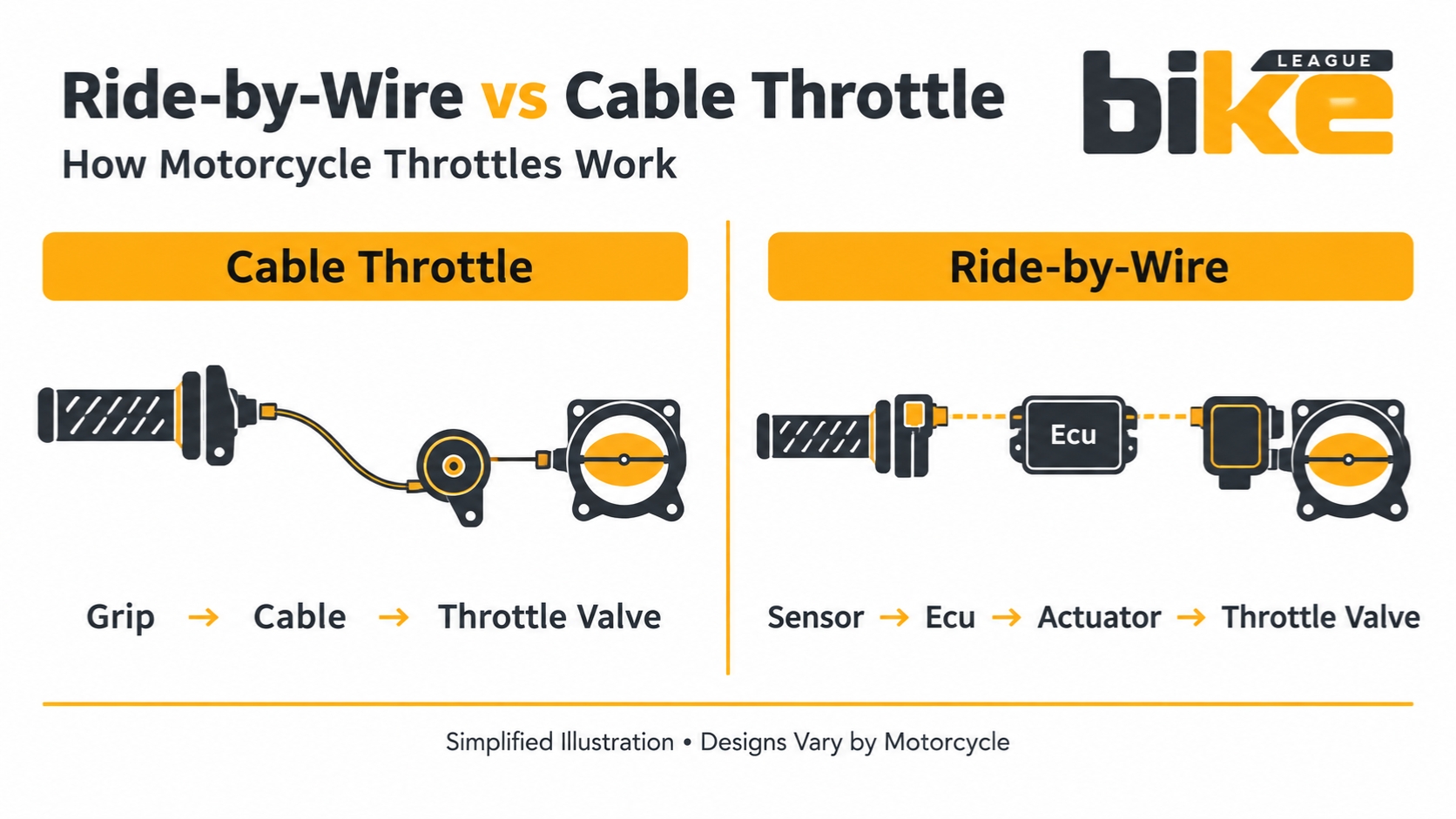
Long story short: A cable throttle links your right-hand grip directly to the engine’s throttle using a mechanical cable. Ride-by-wire, on the other hand, uses sensors, an electronic controller, and an electric actuator to control the throttle valve. The key difference is that a cable physically moves the throttle when you twist the grip, while ride-by-wire lets the bike’s electronics read your input and adjust the throttle for you.
This difference can be confusing for Indian motorcycle buyers. Terms like fuel injection, riding modes, and traction control often come up with ride-by-wire, but they don’t mean the same thing. A bike can have fuel injection and riding modes and still use a cable throttle. For example, the TVS Apache RTR 160 4V has riding modes but keeps a cable throttle.
This article explains how motorcycle throttles work, compares the pros and cons of ride-by-wire and cable throttles, and discusses what these technologies mean for daily commuting, touring, and performance riding in India.
Key Takeaways
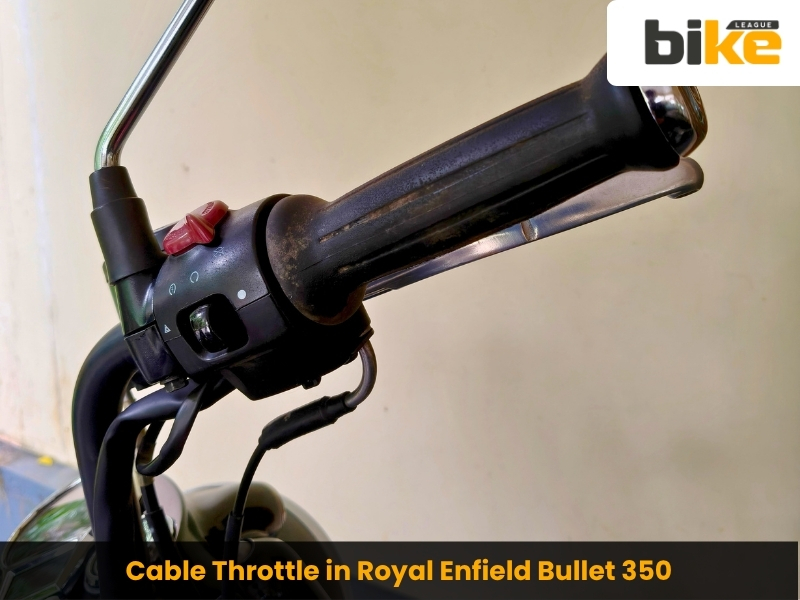
- A cable throttle uses a mechanical cable to operate the throttle mechanism, while ride-by-wire uses electronic sensing and an electrically operated throttle body.
- Fuel injection does not automatically mean ride-by-wire. A fuel-injected engine can use a mechanically operated throttle body.
- Riding modes do not prove that a motorcycle has ride-by-wire. The TVS Apache RTR 160 4V demonstrates that riding modes and a cable throttle can coexist.
- Ride-by-wire lets manufacturers program throttle response and integrate throttle control with electronic torque-management systems.
- No system is always better for every rider. What matters more is how well the throttle is set up, how it’s maintained, and the overall features of the motorcycle, not just the type of throttle it uses.
What Does The Throttle Do On A Motorcycle?
On a petrol motorcycle, the throttle regulates airflow into the engine. In a fuel-injected engine, the throttle body contains a valve that changes the size of the intake opening. The fuel-injection and ignition systems work alongside this airflow control to produce engine torque.
The valve is commonly a butterfly valve—a circular plate that rotates inside the intake passage. As it opens, it restricts less airflow. The engine-management system controls fuel delivery and ignition timing according to the engine’s operating conditions.
When you twist the throttle, it doesn’t simply send more petrol to the engine. Your action changes what the engine needs, and the bike adjusts airflow, fuel delivery, and ignition together to respond.
On a carburetted motorcycle, the throttle may operate a slide or butterfly valve, depending on the carburetor design. Cable throttles can work with both carburetors and fuel-injection throttle bodies, so “cable throttle” and “carburetor” are not the same thing.
What Is A Cable Throttle?
A cable throttle, also called a mechanical throttle or ride-by-cable throttle, uses a physical cable to transmit movement from the twist grip to the throttle mechanism.
The cable typically consists of an inner wire moving inside a protective outer housing. Turning the grip pulls the inner cable, which operates the engine’s throttle mechanism.
How Does A Cable Throttle Work?
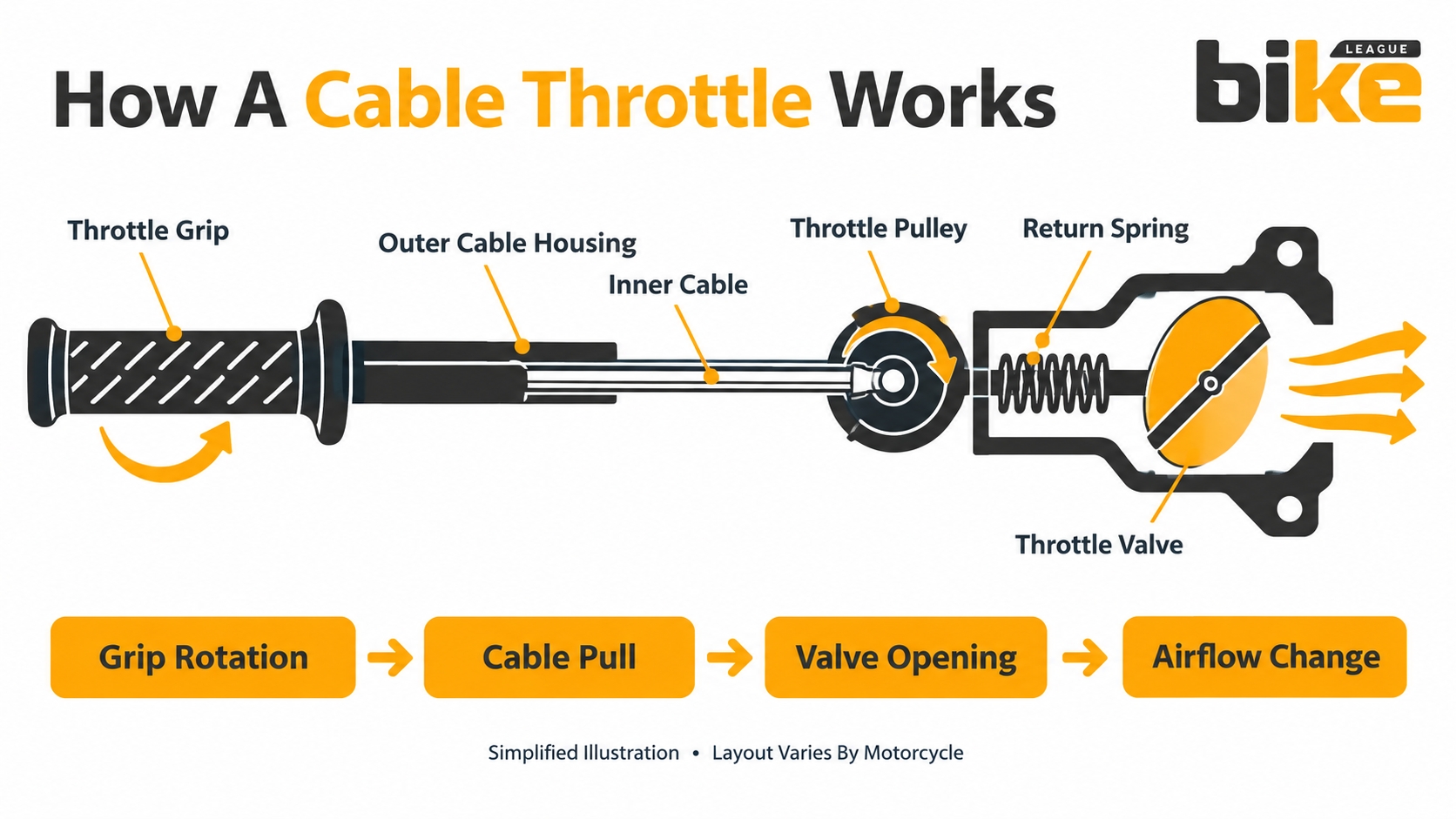
When you twist the throttle grip, the cable opens the throttle valve or moves the carburetor slide. Releasing the grip allows the return mechanism to bring the throttle back towards its closed position.
This setup gives you a direct mechanical link. However, the cable is not the only factor that affects how the engine responds. On fuel-injected bikes, the ECU still manages fuel delivery and ignition timing.
Single-cable Vs Dual-cable Throttles
A single-cable throttle generally uses one cable to open the throttle, with a spring providing the return action.
A common dual-cable arrangement uses an opening cable and a closing cable. The second cable lets the grip mechanism assist throttle closure rather than relying solely on the return spring. The exact arrangement depends on the motorcycle.
Having two throttle cables does not make the engine more powerful. It only describes how the throttle works mechanically, not how the engine performs.
What Is Ride-by-wire?
Ride-by-wire, also known as throttle-by-wire or electronic throttle control, uses electronics to control the throttle valve instead of a direct mechanical grip-to-valve connection.
The system detects the rider’s throttle input, processes it through an engine control unit, and uses an electric actuator to operate the throttle valve.
The engine control unit (ECU) is the electronic controller that manages functions such as fuel injection and ignition. With ride-by-wire, it also directly controls throttle-valve movement.
How Can You Tell Which Throttle System Your Motorcycle Uses?
Check the manufacturer’s specifications or owner’s manual for your exact motorcycle model, year, and variant. Look for a clear mention of ride-by-wire, throttle-by-wire, or electronic throttle control. If you are unsure, ask an authorised service centre to confirm the throttle arrangement.
Fuel injection, selectable riding modes and a throttle-position sensor do not automatically mean the motorcycle has ride-by-wire. A throttle-position sensor reports the throttle valve’s position to the ECU; it does not operate the valve. A cable-throttle motorcycle can therefore use this sensor while retaining a mechanical connection between the twist grip and the throttle mechanism.
The defining difference is how the throttle valve operates. With a cable throttle, the twist grip mechanically operates the throttle mechanism. With ride-by-wire, the rider’s input is interpreted electronically, and an ECU-controlled actuator positions the throttle valve.
Do not judge the throttle system just by looking at the cables or wires near the handlebar, and do not take apart the throttle to check. Always use the manufacturer’s information for your specific model to confirm the setup.
How Does Ride-by-wire Work?
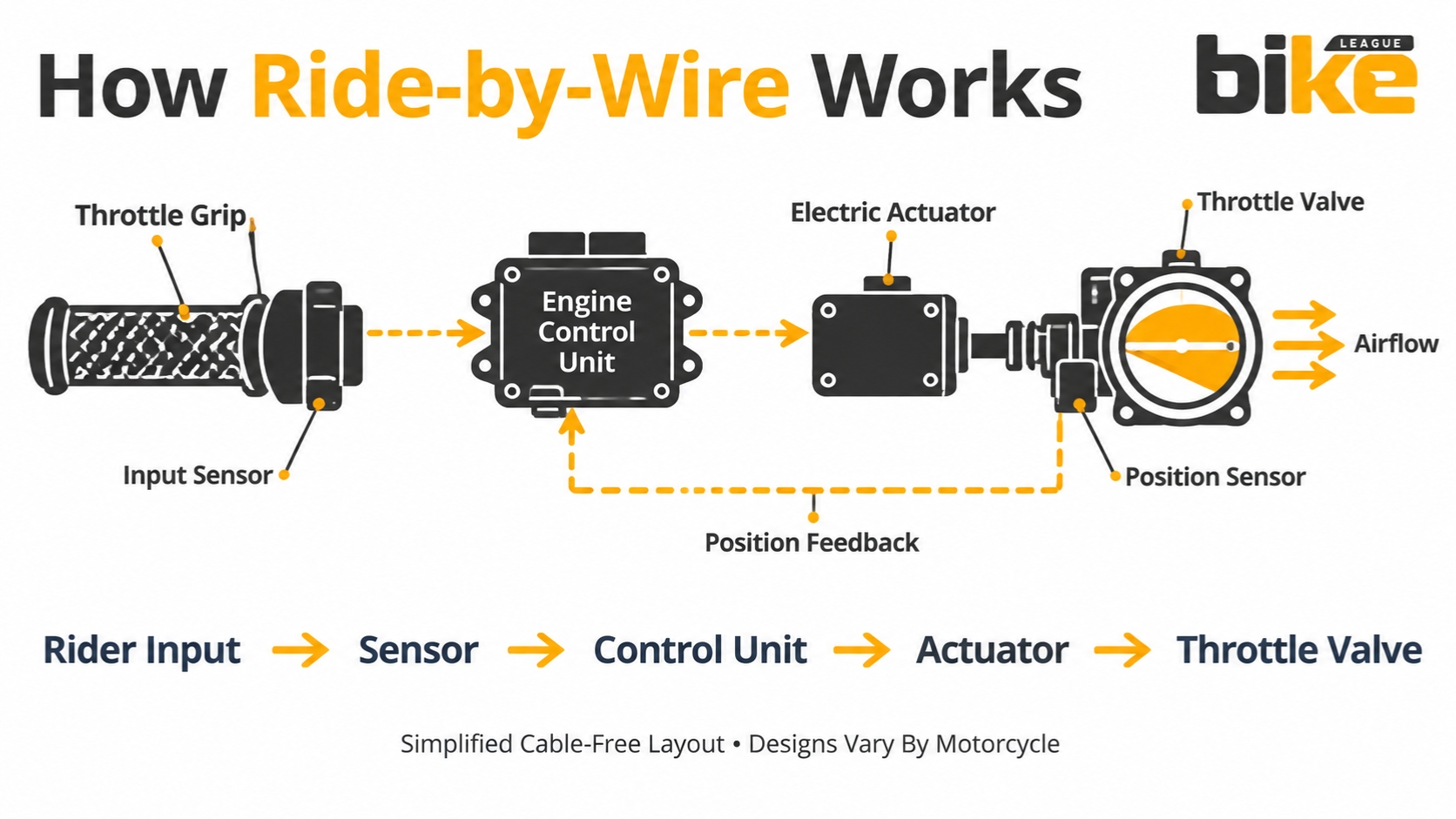
- The system detects your throttle request. Sensors detect how far you rotate the throttle grip. That input becomes an electrical signal instead of directly moving the throttle valve through a cable.
- The ECU processes the input. It evaluates the rider’s request alongside relevant operating information and control requirements, including requests from torque-influencing systems such as motorcycle stability control. Depending on the motorcycle, the selected riding mode can also change how the system responds to your wrist movement.
- An electric actuator moves the throttle valve. The ECU commands the electrically driven throttle body to open or close. A position sensor provides feedback on the valve’s actual position, letting the controller monitor its movement.
- Fuel injection and ignition work alongside it. The ECU coordinates throttle control with fuel injection and ignition. Ride-by-wire adds electronic airflow control to the wider engine-management process; it does not replace fuel injection.
Ride-by-wire Vs Cable Throttle: Comparison
| Aspect | Cable throttle | Ride-by-wire |
|---|---|---|
| Operating principle | A mechanical cable operates the throttle mechanism. | Sensors send the rider’s input to the ECU, which controls the throttle valve through an electric actuator. |
| Connection between grip and throttle valve | Wrist movement mechanically operates the throttle mechanism. | Wrist movement becomes an electronic request, and the ECU determines the throttle-valve response. |
| Throttle-response adjustment | The mechanical relationship remains, although fuel and ignition mapping can influence engine response. | Electronic mapping can change how throttle-valve movement relates to grip input. |
| Compatibility with fuel injection | Can be used with a fuel-injected engine. | Works as part of the electronic engine-management system. |
| Riding modes | Possible through changes to engine-management settings and other functions. | Can additionally provide different electronic throttle-response maps. |
| Electronic rider-aid integration | Fuel and ignition control can still influence engine torque. | Adds direct electronic control of the throttle valve for torque management. |
| Cruise control | A cable-operated throttle does not, by itself, establish whether the motorcycle has cruise control. Check the model’s equipment and control-system design. | Electronic throttle control supports cruise-control integration, but cruise control is included only when the manufacturer provides the necessary functionality and controls. |
| Routine maintenance and diagnosis | Focuses on cable condition, routing, specified free play and smooth operation. | Fault diagnosis can involve sensors, wiring, connectors, throttle-position feedback and the actuator. |
| System complexity | Comparatively simple mechanical throttle arrangement. | Uses additional electronic components and software. |
| Throttle feel | Mechanically direct, but overall response depends on adjustment and engine calibration. | Programmable, with riding quality depending on calibration. |
| Mileage and power | The throttle arrangement alone does not determine either result. | Does not automatically guarantee better mileage or higher peak power. |
Indian Motorcycle Examples
These examples concern motorcycles offered in India. Throttle arrangements and related features can differ by model year, production version, and variant. The Apache RTR 160 4V example refers to the ride-mode-equipped version, while the KTM example refers to the 2026 390 Duke. Check the specifications for the exact motorcycle you are considering rather than applying these details to every version carrying the same model name.
Tvs Apache Rtr 160 4v: Cable Throttle With Riding Modes
The TVS Apache RTR 160 4V challenges a common assumption: riding modes do not automatically mean ride-by-wire. The ride-mode-equipped version discussed here combines three riding modes with a cable-operated throttle.
For buyers, the main point is simple: a mode button means the bike has selectable settings, but it does not tell you how the throttle valve is controlled.
Tvs Apache Rtr 310: Ride-by-wire
The TVS Apache RTR 310 uses ride-by-wire to manage throttle response electronically instead of relying on a conventional cable connection.
Within the Apache family, the RTR 160 4V and RTR 310 illustrate two different approaches. Both can have electronic operating features, but their throttle-control arrangements should not be assumed to be identical.
Bajaj Dominar 400: Ride-by-wire On The 2025 Update
The 2025-updated Bajaj Dominar 400 introduced ride-by-wire through an electronic throttle body, along with four riding modes: Road, Rain, Sport and Off-Road.
This is a version-specific example. Do not assume that an older Dominar 400 has the same electronic throttle arrangement simply because it carries the same model name.
Tvs Apache Rr 310: Ride-by-wire On A Faired Sports Motorcycle
The TVS Apache RR 310 is another Indian-market example of ride-by-wire. Its electronically controlled throttle allows the manufacturer to programme throttle response as part of the motorcycle’s engine-management system.
The RR 310 also illustrates that ride-by-wire is not limited to naked motorcycles such as the Apache RTR 310. Check the exact model year and variant separately for its riding modes and other electronic features.
Triumph Speed 400: Ride-by-wire On A Modern-classic Roadster
The Triumph Speed 400 combines ride-by-wire with Bosch engine management. Triumph describes the intended rider connection as consistent and intuitive.
This shows ride-by-wire is not limited to aggressive sport bikes. It is also used on modern-classic roadsters, where the manufacturer can focus on making the throttle feel approachable instead of only aiming for sharp performance.
That’s what the manufacturer aims for, but you should still judge the throttle response yourself during a test ride.
Ktm 390 Duke: Ride-by-wire And Electronic Rider Aids
The 2026 KTM 390 Duke offered in India uses ride-by-wire and includes riding modes, motorcycle traction control, launch control, and cruise control. This combination illustrates how electronic throttle control can support a broader engine-control and rider-assistance package.
Do not apply this equipment list to every earlier 390 Duke. Features can change between model years, and ride-by-wire alone doesn’t guarantee a motorcycle includes all these functions.
However, you need to check each feature separately. Just because one motorcycle has these features does not mean every ride-by-wire model will.
Bmw G 310 Rr: Ride-by-wire On A Faired Sports Motorcycle
The BMW G 310 RR offered in India uses ride-by-wire, with an electronically controlled throttle valve responding to the rider’s input. It also offers four riding modes: Track, Sport, Urban and Rain.
This provides another Indian-market example of electronic throttle control on a faired sports motorcycle. As with the other examples, ride-by-wire should not be treated as proof that cruise control or traction control is included.
Indian Motorcycle Examples At A Glance
| Motorcycle sold in India | Throttle Type | What it Shows |
|---|---|---|
| TVS Apache RTR 160 4V — ride-mode-equipped version | Cable-operated throttle. | Selectable riding modes can coexist with a cable throttle. This example refers to the ride-mode-equipped version covered in the article, not an independently verified specification for every production version. |
| TVS Apache RTR 310 | Ride-by-wire. | Electronic throttle control is used within TVS’s performance motorcycle range. |
| Triumph Speed 400 | Ride-by-wire with Bosch engine management. | Ride-by-wire is also used on modern-classic roadsters, not only sports motorcycles. |
| 2026 KTM 390 Duke — India | Ride-by-wire. | Electronic throttle control can support a broader package of riding modes and rider aids. The equipment described here applies to the identified model year and should not be assumed for earlier versions. |
| Bajaj Dominar 400— 2025 update | Ride-by-wire through an electronic throttle body. | Ride-by-wire was introduced with the 2025 update. The feature should not be assumed for older Dominar 400 models. |
| TVS Apache RR 310 | Ride-by-wire. | Electronic throttle control is also used on faired sports motorcycles. Associated features should be checked for the exact model year and variant. |
| BMW G 310 RR | Ride-by-wire. | Electronic throttle control is available on this Indian-market faired sports motorcycle, alongside Track, Sport, Urban and Rain riding modes. |
Do Riding Modes Change Throttle Response Or Maximum Power?
Riding modes can change throttle response, maximum engine output, rider-aid settings or a combination of these. The exact changes depend on the motorcycle, so names like Rain, Road, and Sport don’t describe a universal set of settings.
Throttle Response And Maximum Power Are Different
Throttle response describes how the engine reacts to your wrist movement. On a ride-by-wire motorcycle, a gentler throttle map can make the same grip movement feel more gradual, while a sharper map can make it feel more immediate.
Maximum power is the engine’s highest available power output. A gentler throttle map does not necessarily reduce that output, and a sharper map does not automatically increase it. Some modes change how performance is delivered, while others also limit the available engine output.
Does Rain Mode Always Reduce Power?
No. Depending on the motorcycle, Rain mode may soften throttle response, reduce available engine output, change traction-control or ABS settings, or combine several adjustments. Check the manufacturer’s description of each mode rather than assuming that every motorcycle uses the same approach.
How Can A Cable-throttle Motorcycle Have Riding Modes?
A cable-throttle motorcycle can retain its mechanical grip-to-valve connection while changing fuel-injection, ignition or other electronically controlled settings. It therefore doesn’t need ride-by-wire to offer selectable riding modes.
The TVS Apache RTR 160 4V version discussed in this article illustrates this distinction: riding modes describe selectable operating settings, whereas ride-by-wire describes how the throttle valve is controlled.
What Is The Difference In Throttle Feel?
Cable Throttle: Mechanical Directness
With a cable throttle, your wrist movement goes directly to the throttle mechanism. This is why many riders say it feels direct or connected.
However, direct mechanical operation does not guarantee smooth engine response. The cable’s condition, adjustment and the motorcycle’s engine-management calibration still influence what the rider feels.
A well-maintained cable-throttle motorcycle can feel smooth and predictable. If the cable is not adjusted properly or the engine response is not suitable, small throttle changes can be harder to control.
Ride-by-wire: Programmable Response
Ride-by-wire allows manufacturers to change the relationship between grip movement and throttle-valve opening. The same wrist movement can produce a different response, depending on the selected mapping.
A gentler map can soften the response, while another can make the motorcycle feel more immediate. The exact result depends on the manufacturer’s programming.
Ride-by-wire is not always slow to respond, and it is not always smoother than a cable throttle. How natural and predictable it feels depends on how well it is set up.
Advantages Of Ride-by-wire
1. More Flexible Throttle Mapping
The ECU can control how throttle-valve movement relates to rider input. This gives manufacturers greater freedom to tune response for different operating conditions and riding modes.
This flexibility lets manufacturers shape throttle response without changing the mechanical hardware. With selectable riding modes, riders can choose from the manufacturer’s available responses.
2. Better Integration With Traction Control And Torque Management
Traction control helps manage rear-wheel slip during acceleration by adjusting the engine’s drive force. It doesn’t always require ride-by-wire: a system can adjust engine output through ignition timing or fuel-injection control, depending on the motorcycle’s design.
Ride-by-wire adds another method of intervention. Because the ECU can electronically position the throttle valve, it can adjust intake airflow as part of the engine’s torque-management strategy, alongside fuel injection and ignition.
The distinction is important: traction control describes a rider-assistance function, while ride-by-wire describes how the throttle valve is operated. Having traction control does not, by itself, prove that a motorcycle uses ride-by-wire.
Do not assume that traction control, cornering ABS and cruise control have the same technical requirements. These are separate functions, and their availability and operation must be checked for the exact motorcycle model and variant.
3. Support For Electronic Cruise Control
Electronic throttle control enables integration of engine-output adjustment with electronic cruise control, where the necessary equipment is fitted. The KTM 390 Duke discussed here offers cruise control as part of its broader electronic rider-aid package.
Ride-by-wire does not always come with cruise control.
4. Coordinated Engine Management
This gives manufacturers more control, but it doesn’t guarantee that a bike will have more power or better mileage than one with a cable throttle.
This is a control advantage, not proof that a particular motorcycle will produce more power or better mileage than a comparable cable-throttle model.
Limitations Of Ride-by-wire
1. More Electronic Complexity
Ride-by-wire involves sensors, wiring, an electronic controller, an actuator and software. A fault may require electronic diagnosis rather than a cable adjustment.
This does not mean ride-by-wire is unreliable. It simply has different operating and troubleshooting needs compared to a simple cable system.
2. Calibration Matters
The system’s flexibility also makes its calibration important. A rider may prefer one motorcycle’s response over another even when both use ride-by-wire.
The technology can change how the throttle responds, but the manufacturer must ensure it works well.
3. Features Are Not Guaranteed
Ride-by-wire does not guarantee cruise control, multiple riding modes, or any type of traction control. These are separate equipment choices that must be checked for the exact model and variant.
Advantages And Limitations Of A Cable Throttle
Advantages
- A cable throttle offers a comparatively simple mechanical operating arrangement. The grip directly operates the throttle mechanism, so it doesn’t require an electric actuator to position the main throttle valve.
- Its routine inspection requirements are also clear. Key checks include correct cable free play and smooth operation.
Limitations
- The cable needs correct adjustment and unrestricted movement. Cable condition and free play affect operation, making regular inspection important.
- The ECU cannot directly position the mechanically operated throttle valve, although it can still control fuel delivery and ignition on a fuel-injected motorcycle. Ride-by-wire adds electronic control over the throttle valve’s position.
Does Ride-by-wire Improve Mileage Or Performance?
Do not assume ride-by-wire will automatically give you better mileage or more power.
Electronic throttle control provides more scope to coordinate airflow with other engine-management functions. That can help manufacturers optimise operation, but the technology alone doesn’t create a fuel-economy advantage between two motorcycles.
Similarly, a sharper throttle map can make a motorcycle feel more responsive without increasing peak power. Throttle-response character and the engine’s maximum power are different aspects of performance.
When comparing Indian motorcycles, use actual specifications and reliable fuel-economy data. Do not assume either result just because the bike has ride-by-wire.
Is Ride-by-wire Safer Than A Cable Throttle?
Neither system is always safer just because it is mechanical or electronic. The design, condition, and correct operation are more important than the label.
Electronic throttle systems can incorporate position feedback, redundant sensing and safety monitoring. However, these are design capabilities, not confirmation that every motorcycle uses the same sensors, safeguards or fault response.
The component-level examples listed in the Sources section should not be treated as proof of the exact hardware fitted to the TVS, Triumph or KTM motorcycles discussed here. Model-specific safety claims require documentation for the particular motorcycle.
Cable throttles also require correct mechanical operation, adjustment and inspection. Follow the manufacturer’s requirements for throttle free play and smooth operation.
Do not assume that every electronic throttle fault produces the same warning, reduced-power mode or shutdown response. Follow the owner’s manual for the exact motorcycle if a warning or operating fault occurs.
Maintenance And Ownership Considerations
Maintaining A Cable Throttle
Follow the owner’s manual for the exact motorcycle. Check the specified free play and smooth operation, and follow its adjustment or lubrication instructions where provided.
Do not use a free-play setting from a different bike. What works for one model might not be right for yours.
Does Poor Throttle Response Mean The Throttle System Is Faulty?
Not necessarily. The throttle mechanism, fuel injection, and ignition work together to determine how the engine responds. Hesitation or an abrupt response alone does not establish that the throttle cable, grip sensor, or electronic throttle body is faulty.
On a cable-throttle motorcycle, the routine checks described here include correct cable free play and smooth throttle operation. Use the specifications and inspection procedure in the owner’s manual for your exact model rather than applying an adjustment figure from another motorcycle.
On a ride-by-wire motorcycle, diagnosis may involve the rider-input signal, wiring, connectors, actuator operation, and throttle-position feedback. Replacing a sensor or throttle body without identifying the fault may not address the underlying problem.
A warning light also does not identify the failed component by itself. Follow the motorcycle’s owner’s manual for the meaning of the warning and the required action, and use model-specific diagnosis rather than assuming that every warning indicates a throttle fault.
Do not use a generic throttle-reset procedure, bypass a sensor, or clear a warning as a substitute for diagnosing the problem. The checks and corrective procedures must match the motorcycle’s specific system.
Maintaining A Ride-by-wire System
Ride-by-wire changes the diagnostic focus. The system uses electronic input signals, wiring, and an actuator, so a fault may require checking those components and throttle-position feedback.
The absence of a conventional direct throttle cable does not make the system maintenance-free. It removes certain cable-related tasks while introducing different diagnostic requirements.
Comparing Ownership Costs
There is no like-for-like Indian repair-cost comparison presented here. It would be misleading to claim that ride-by-wire always costs a particular amount more to maintain.
For a purchase decision, compare model-specific service information and written parts quotations rather than a general assumption about the technology.
Which Throttle System Is Better For Indian Riders?
For Daily Commuting
Prioritise predictable response and smooth low-speed operation. A cable throttle does not, by itself, make a motorcycle less suitable for city use. Assess how the individual motorcycle responds rather than judging its commuting suitability solely by its throttle technology.
A ride-by-wire motorcycle may offer a useful gentler-response setting, but the benefit depends on the available mapping and how well it works.
For Highway Touring
Ride-by-wire matters most when it comes with useful touring equipment, such as electronic cruise control. The KTM 390 Duke discussed here illustrates this type of feature package.
Judge the included equipment rather than assuming that all ride-by-wire motorcycles provide the same touring benefits.
For Performance-oriented Riding
Ride-by-wire offers more flexibility for throttle mapping and integration with electronic torque management. This can be valuable on a motorcycle designed around sophisticated rider aids.
However, the throttle system does not independently determine the motorcycle’s handling, braking or overall performance.
For Riders Who Prefer Mechanical Simplicity
A cable throttle is simpler to operate, while ride-by-wire gives you more electronic control options. Both are good choices. The best one depends on what kind of response and features matter most to you.
Frequently Asked Questions About Ride-by-wire And Cable Throttles
1. Does Ride-by-wire Have A Throttle Cable?
Some ride-by-wire systems use cables to transmit the rider’s input to a sensor, while others are cable-free. The defining feature is that the ECU and an electric actuator control the throttle valves instead of a direct mechanical connection from the grip.
For example, the 2026 Yamaha YZF-R1 uses a cable-free Yamaha Chip Controlled Throttle (YCC-T) system. Its throttle-grip input is communicated electronically, removing the need for throttle cables between the grip and an input-sensing mechanism.
This is an overseas-market example and does not confirm the model’s current availability in India. A visible throttle cable alone doesn’t indicate whether a motorcycle uses conventional cable operation or ride-by-wire. Check the technical documentation for the exact model and production version.
2. What Is The Main Difference Between Ride-by-wire And A Cable Throttle?
A cable mechanically operates the throttle mechanism. Ride-by-wire uses electronic sensing and an ECU-controlled actuator to operate the throttle valve.
3. Can A Fuel-injected Motorcycle Have A Cable Throttle?
Yes. Fuel injection and throttle actuation are separate functions. A mechanically operated throttle body can be used with electronic fuel injection.
4. Does The Tvs Apache Rtr 160 4v Have Ride-by-wire?
The ride-mode-equipped RTR 160 4V version discussed here uses a cable-operated throttle. Verify the exact model and production version before applying this information to a purchase.
5. Does The Triumph Speed 400 Have Ride-by-wire?
Yes. The Triumph Speed 400 uses a ride-by-wire throttle with Bosch engine management.
6. Does Ride-by-wire Automatically Include Cruise Control?
No. Cruise control requires the manufacturer to provide the necessary functionality and controls. Check the equipment list separately.
7. Is A Cable Throttle More Responsive?
It is mechanically direct, but that does not guarantee better overall engine response. Calibration and system condition remain important.
8. Does Ride-by-wire Increase Engine Power?
Its defining benefit is electronic control of throttle operation. The technology alone does not mean higher peak power output.
9. Is Ride-by-wire Maintenance-free?
No. It uses sensors, electrical connections, a controller, and an actuator. These create different diagnostic considerations from a cable-operated throttle.
10. Can You Convert A Cable-throttle Motorcycle To Ride-by-wire?
It is not a simple throttle-grip replacement. A conversion requires compatible rider-input sensing, an electronically operated throttle body, a suitable ECU with wiring, and appropriate calibration and safety provisions.
Ride-by-wire is generally designed as an integrated factory system. Replacing the grip or adding a sensor alone does not give the ECU control over a mechanically operated throttle valve.
For most owners, this is not a straightforward accessory upgrade. Do not assume that components from another motorcycle will be compatible simply because both engines use fuel injection.
Other Related Articles From Bikeleague India
- Fuel Injection vs Carburetor: Motorcycle Comparison
- Motorcycle Traction Control: How It Works, Pros and Cons
- Motorcycle Cruise Control: All You Need to Know
- Ducati Scrambler full Throttle
- Bike Clutch- Diferent types explained with pros & cons
Final Thoughts
A cable throttle keeps things mechanically simple, while ride-by-wire lets manufacturers fine-tune throttle response and add electronic torque control. However, neither system alone determines how smooth, responsive, or suitable a motorcycle will be for you.
If you commute, look for a bike with predictable low-speed response. For touring or performance, check which riding modes and rider aids the motorcycle actually has. Do not just assume ride-by-wire means they are included. Choose the bike that matches your needs for response, features, and maintenance.
Sources
- Suzuki Motorcycle India — Ride-by-Wire: How It Works & Benefits
- Bosch Mobility — Two-wheeler engine management systems
- TVS Apache RTR 160 4V — TFT owner’s manual
- TVS Apache RTR 160 4V — Ride-mode owner’s manual
- Parts4Motorcycles — Ride-by-Wire vs Cable Throttle: What Riders Actually Feel
- Bosch Motorsport — Electronic Throttle Body
- TVS Motor — Ride By Wire: What It Is and How It Improves Motorcycle Performance
- Purpose Built Moto — Guide to Motorcycle Throttles
- TVS Apache RTR 310 — Owner’s manual
- Triumph Motorcycles India — Speed 400 high specification
- KTM — Ride By Wire technical guide
- KTM India — 390 Duke
- Yamaha Motorsports USA — 2026 YZF-R1: Cableless Yamaha Chip Controlled Throttle (YCC-T)
- Bajaj Auto — 2025 Dominar Update: Ride-by-Wire and Riding Modes
- BMW Motorrad India — G 310 RR: Ride-by-Wire and Four Riding Modes