

Long story short: Hero MotoCorp xSENS is a group of sensors and actuators connected to the bike’s ECU. It tracks inputs like throttle position, engine temperature, load, and lean angle. Using this data, the system adjusts fuel delivery and protects the engine. This article covers how xSENS works, which models have it, and the real-world pros and cons.
Hero MotoCorp xSENS technology helps improve mileage, keeps the engine running smoothly, and adds safety. It works in the background, so you likely won’t notice the electronics at work.
With more fuel-injected models, Hero now uses xSENS as the name for the sensors that make these engines smarter than older carbureted bikes. This guide shows how xSENS works, lists its sensors, and explains what it means for your daily rides.
Key Takeaways
- xSENS is a sensor-and-actuator network, not a single component. Hero bundles several sensors—throttle position, engine temperature, intake pressure, exhaust oxygen, crank position, and bank angle—under this name.
- xSENS is not a standalone fuel-saving gadget. It’s the sensing layer that feeds Hero’s ECU the real-time data needed to run the fuel injection system accurately, which is also what makes features like i3S possible.
- The system uses a two-way sensor-to-ECU-to-actuator loop. Sensors detect throttle angle, temperature, or lean angle. The ECU processes this data. Actuators such as the fuel injector or ignition coil respond within milliseconds.
- xSENS is present across almost all of Hero’s current fuel-injected models. It appears on entry-level bikes like the HF Deluxe and Splendor Plus, as well as on air-oil-cooled models like the Xtreme 160R 4V and Xoom scooter. Even the liquid-cooled Karizma XMR uses xSENS. As a result, it is one of the most widely fitted electronics packages in Hero’s lineup.
- One of the sensors under the xSENS umbrella, the bank angle sensor, is a safety feature: it cuts the engine if the bike falls beyond a certain lean angle, helping reduce fire risk and further damage after a fall.
What Is Hero Xsens Technology?
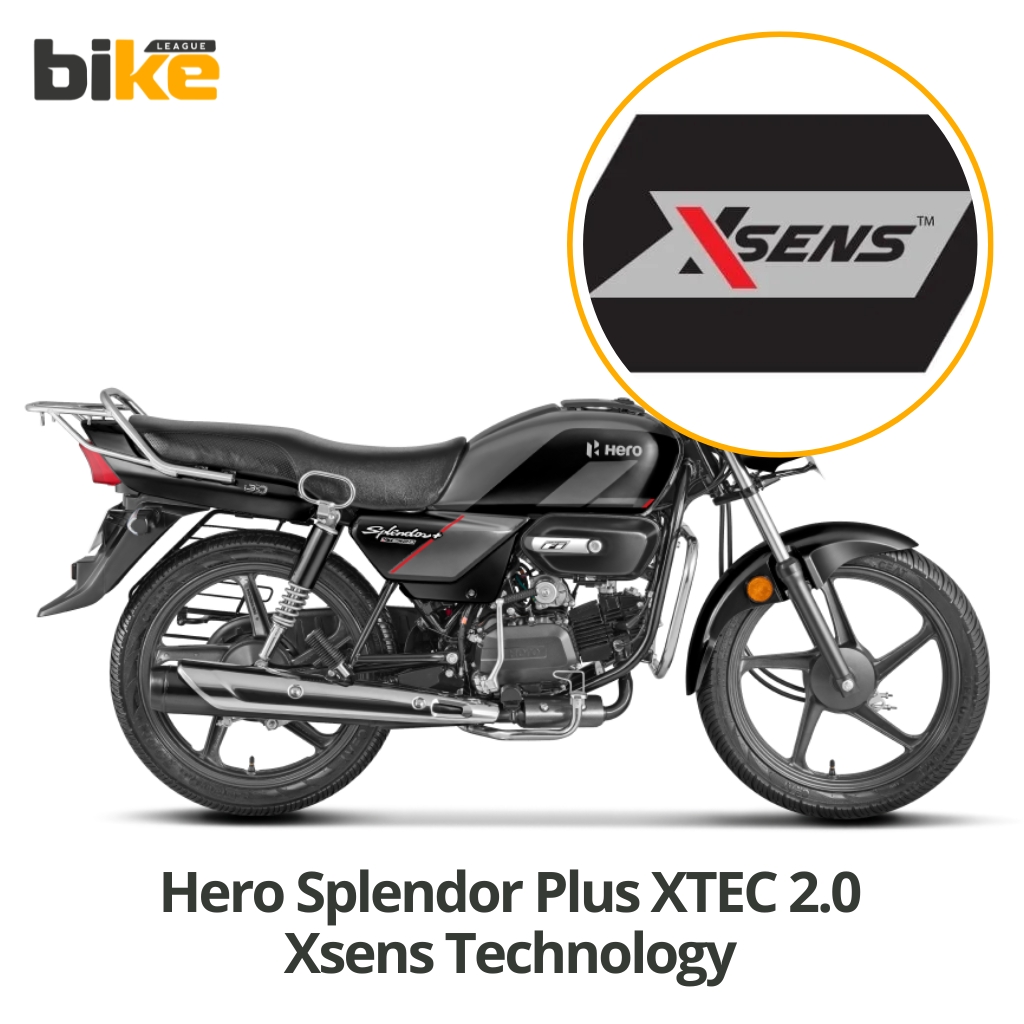
Hero MotoCorp uses the name xSENS for the group of electronic sensors and actuators on its fuel-injected motorcycles and scooters. Carbureted bikes mix air and fuel mechanically and don’t adjust much. Bikes with xSENS are always measuring things like throttle position, engine temperature, intake air pressure, and exhaust oxygen. The ECU uses this data to adjust the fuel-air mixture in real time.
According to Hero, the system uses 9 or 10 sensors, depending on the model. Most bikes have four main actuators: the fuel injector, ignition coil, idle air control valve, and fuel pump. Some i3S models also include the starter motor for idle stop-start. The number of actuators depends on the engine and its features. The process is straightforward: a sensor detects something, the ECU processes the information, and an actuator responds.
xSENS isn’t Hero’s only innovation—it’s just a brand name. Honda has a similar system called PGM-FI (Programmed Fuel Injection), which has been used since the early 1980s and is still found on current Indian models. TVS and Bajaj also use sensor-based fuel injection on their BS6 bikes, but they don’t give the sensor suite a special name. Most of their bikes are simply called “FI” or “EFI” variants. All these systems use sensors to manage fuel in real time. The different names are mostly for marketing, not technical reasons.
What Are The Key Sensors Under The Xsens Technology?

Not every model has all the sensors listed below. The exact combination depends on how the engine is cooled and the features of each model. That’s why Hero’s sensor count ranges from about 9 to 10 across different bikes (see the breakdown below).
- Throttle Position Sensor (TPS): Tracks exactly how far the throttle is twisted. This lets the ECU respond with the right amount of fuel for smoother, more predictable pickup.
- Manifold Absolute Pressure (MAP) Sensor: Reads intake air pressure to estimate engine load, which matters most when climbing gradients or riding two-up. Fitted across the entire FI lineup.
- Oxygen (O2) Sensor: Measures leftover oxygen in the exhaust so the ECU can correct the air-fuel ratio for cleaner, more complete combustion. Fitted across the entire FI lineup.
- Crank Position Sensor: Tracks the crankshaft’s position and speed, which the ECU uses to time fuel injection and ignition precisely. Fitted across the entire FI lineup.
- Engine Oil Temperature Sensor: Monitors oil temperature so the ECU can adjust the mixture during cold starts and help prevent overheating. This sensor is common on air-cooled and air-oil-cooled engines, including the Splendor, HF Deluxe, Glamour, and Xtreme 160R 4V.
- Coolant Temperature Sensor: Reads engine coolant temperature directly, giving the ECU a more precise thermal reading than an oil-temperature sensor. This sensor is specific to Hero’s liquid-cooled models, such as the Karizma XMR. It is not fitted on air-cooled or air-oil-cooled commuters.
- Intake Air Temperature Sensor: Denser cold air needs more fuel than warm air for the same mixture; this sensor lets the ECU compensate accordingly. Fitted across the entire FI lineup.
- Bank Angle Sensor: Detects when the bike has tipped beyond a safe lean angle and cuts the engine automatically, a safety measure in the event of a fall. Fitted across the entire FI lineup.
- Speed Sensor: Feeds real-time wheel speed data to the ECU and the instrument cluster’s digital speedometer. Fitted across the entire FI lineup.
Why Does The Sensor Count Vary By Model?
| Cooling Type | Example Models | Typical Sensor Count | Key Difference |
|---|---|---|---|
| Air-Cooled | Splendor Plus, HF Deluxe, Glamour, Passion XTEC | ~9 sensors | Uses an oil temperature sensor; no coolant temperature sensor needed |
| Air-Oil-Cooled | Xtreme 160R 4V | ~9 to 10 sensors | Same core sensor set as air-cooled models, with oil-cooler-related monitoring added |
| Liquid-Cooled | Karizma XMR | 10 sensors | Adds a dedicated coolant temperature sensor in place of, or alongside, oil temperature monitoring |
What Are The Key Actuators Under The Xsens ?
Sensors collect information, and actuators follow the ECU’s instructions. Most fuel-injected Hero bikes have four main actuators. Models with i3S include a fifth: the starter motor. When a sensor detects something, an actuator makes a physical change in the engine. This teamwork makes xSENS an active, closed-loop system instead of just a monitoring setup.
- Fuel Injector: Sprays a precise amount of fuel into the intake tract. Timing and quantity are based on the ECU’s calculation from throttle, load, and temperature data.
- Ignition Coil: Fires the spark plug at the moment the ECU calculates for optimal combustion. It uses crank position data to time the spark.
- Idle Air Control (IAC) Valve: Adjusts the air bypassing the throttle body at idle. This keeps idle RPM stable regardless of engine temperature or electrical load.
- Fuel Pump: Maintains the fuel rail at the pressure the injector needs. The ECU switches it on and regulates it, rather than running it mechanically off engine rotation.
- Starter Motor (i3S Models): On bikes with both xSENS and i3S, the ECU commands the starter motor to restart it. This happens as soon as the clutch is pulled after an idle shut-off.
Pros Of Hero Xsens Technology
- More Consistent Fuel Efficiency: The ECU adjusts the mixture based on real conditions, not fixed carburetor jetting. Riders typically see steadier mileage across different loads, gradients, and temperatures.
- Smoother, More Predictable Throttle Response: Accurate throttle position and load data help the engine respond cleanly to inputs instead of surging or hesitating. This matters most in stop-go traffic.
- Easier Cold Starts: Temperature sensors let the ECU richen the mixture automatically on cold mornings, removing the need for a manual choke.
- Built-In Safety Layer: The bank angle sensor’s automatic engine cut-off after a fall is a genuine safety benefit that a carbureted bike simply doesn’t have.
- Foundation for Other Features: xSENS enables i3S, real-time mileage indicators, and BS6 emissions compliance on the same platform. Its benefits go beyond fuel economy.
- Fitted Across Affordable Models: Like i3S, xSENS isn’t reserved for premium bikes. It’s standard on Hero’s entry-level commuters too, since BS6 fuel injection requires this sensor suite anyway.
Cons Of Hero Xsens Technology
- More Components That Can Fail: More Components That Can Fail: A carburetor has almost nothing to go wrong electronically. A sensor-driven FI system has several parts—sensors, wiring, connectors—that can fail and trigger a limp mode or warning light.
- Diagnosis Needs Hero’s Tools: A local mechanic can strip and clean a carburetor with basic tools. But xSENS-related faults usually need Hero’s diagnostic scanner at an authorised service centre. BS6 Phase 2 norms require OBD-II (On-Board Diagnostics II) on all new two-wheelers. This standardises how the ECU logs and reports sensor faults.
- Sensor Replacement Costs: Individual sensors, such as the oxygen sensor or bank angle sensor, are specialised parts. They cost more to replace than carburettor jets or float valves.
- Not a Standalone Marketing Feature: xSENS is really just the sensing layer for fuel injection. Riders sometimes expect a dedicated benefit from it beyond what the FI system already delivers.
- Limited Rider-Facing Feedback: Most of what xSENS does happens invisibly. The exceptions are the bank angle cut-off and the occasional warning light. Riders can’t easily verify that xSENS is “working” like they can with i3S switching the engine off.
- Battery Dependency: Like any FI system, xSENS-equipped bikes need a healthy battery for the ECU and sensors to function correctly. A weak battery can cause erratic fuelling or hard starts.
How Does Hero Xsens Technology Work?
The Foundation: Continuous Sensor Monitoring
Each sensor in the xSENS suite reports its reading to the ECU several times per second. The throttle position sensor tells how far the throttle is open. The MAP sensor reports intake pressure. The oxygen sensor reports exhaust composition. None of these sensors acts alone. The ECU combines all inputs to decide how much fuel to inject and when to fire the spark.
Step-by-step Operation
- Step 1: Rider Inputs Throttle The throttle position sensor detects the twist and reports the angle to the ECU instantly.
- Step 2: ECU Reads Supporting Data The ECU checks intake pressure (MAP), engine temperature, and crank position at the same time. This lets it understand current load and engine state.
- Step 3: ECU Calculates the Mixture The ECU uses pre-programmed maps together with live sensor data. From this it decides how much fuel to inject and the ideal ignition timing.
- Step 4: Actuators Respond The fuel injector delivers the calculated fuel quantity. The ignition coil fires at the right time, all within milliseconds of the throttle input.
- Step 5: Oxygen Sensor Closes the Loop After combustion, the oxygen sensor measures how much oxygen is left in the exhaust. It reports back to the ECU, which fine-tunes the next cycle’s mixture for cleaner burning.
- Step 6: Handoff to i3S (Idle Stop-Start) On models with both xSENS and i3S, the throttle position and speed sensors tell the ECU when the bike has stopped. They also confirm the throttle is closed. Once the ECU confirms this, it cuts ignition and fuel injection to shut down the engine. When the rider pulls the clutch to move off again, the ECU commands the starter motor to restart. The crank position sensor ensures the engine runs smoothly right away.
- Step 7: Safety Monitoring Runs in Parallel Independently of the fuelling loop, the bank angle sensor watches for an unsafe lean angle at all times. It can cut the engine immediately if the bike tips over.
Which Hero Models Have Xsens Technology?
xSENS is fitted across effectively all of Hero’s current fuel-injected two-wheelers. BS6 emission norms require this kind of sensor-based fuelling. Notable models include:
| Model | Engine | Segment | Cooling Type | System |
|---|---|---|---|---|
| Hero Splendor Plus XTEC 2.0 | 97.2cc | Commuter Motorcycle | Air-Cooled | xSENS FI |
| Hero Super Splendor XTEC 2.0 | 125cc | Commuter Motorcycle | Air-Cooled | xSENS FI |
| Hero HF Deluxe | 97.2cc | Commuter Motorcycle | Air-Cooled | xSENS FI |
| Hero Glamour | 124.7cc | Commuter Motorcycle | Air-Cooled | xSENS FI |
| Hero Passion XTEC | 113.2cc | Commuter Motorcycle | Air-Cooled | xSENS FI |
| Hero Xtreme 160R 4V | 163.2cc | Street Motorcycle | Air-Oil-Cooled | xSENS |
| Hero Karizma XMR | 210cc | Sport Touring Motorcycle | Liquid-Cooled | xSENS |
| Hero Xoom 160 | 156.7cc | Scooter | Liquid-Cooled | xSENS |
| Hero Pleasure Plus XTEC | 110cc | Scooter | Air-Cooled | xSENS |
Almost every current Hero fuel-injected model uses this sensor suite to meet BS6 norms. xSENS comes standard on the brand’s motorcycles and scooters, not just on select variants.
What Are The Performance And Maintenance Aspects Of Hero Xsens Technology?
Performance
xSENS doesn’t increase horsepower or torque. Instead, it helps the engine use power and fuel more efficiently. Most riders notice smoother throttle response, easier cold starts, and steadier mileage. These benefits show up when riding with a passenger, going uphill, or in extreme weather. Riders notice these improvements, but not a big increase in power.
Maintenance
Routine maintenance for bikes with xSENS is the same as for other Hero fuel-injected models. The main difference is in diagnosing problems. If a sensor fails or a connector is loose, you’ll usually see a warning light or notice rough running. These issues should be checked at an authorised service centre. Hero’s diagnostic tools are more reliable than guessing.
Myths And Misconceptions About Hero Xsens Technology
1. Myth: Xsens Is A Single Sensor Or A Single Feature.
Reality: xSENS is an umbrella term for a group of sensors and actuators working together, not one specific part.
2. Myth: Xsens And I3s Are The Same Thing.
Reality: They’re related but different. xSENS is the broader sensor network that supports fuel injection. i3S is a specific idle stop-start feature that relies on some of that same sensor and ECU infrastructure.
3. Myth: Xsens Boosts Horsepower Or Top Speed.
Reality: xSENS improves how efficiently and cleanly the engine uses fuel; it doesn’t add mechanical power on its own.
4. Myth: A Carbureted Bike With An Oxygen Sensor Added Would Work The Same Way.
Reality: xSENS depends on the whole sensor-ECU-actuator loop working together with fuel injection. Bolting on a single sensor to a carbureted engine doesn’t replicate this closed-loop system.
5. Myth: Sensor Faults Always Mean An Expensive Repair.
Reality: Reality: Many xSENS faults trace back to a loose connector or wiring issue rather than a failed sensor. A proper diagnostic check at a service centre can confirm this before any part is replaced.
6. Myth: Xsens Is Only Found On Premium Or Newer Hero Models.
Reality: BS6 fuel injection requires this kind of sensor suite. That’s why xSENS is present on entry-level commuters like the HF Deluxe, just as much as on the Xtreme 160R 4V.
Frequently Asked Questions About Hero Xsens Technology
1. What Does Xsens Stand For?
xSENS isn’t an acronym like i3S. It’s Hero’s brand name for the sensor-and-actuator network that supports its fuel injection system.
2. How Many Sensors Does Xsens Use?
Hero has described the system as using 9-10 sensors and around 5 actuators, depending on the specific model and variant.
3. Does Xsens Improve Mileage On Its Own?
xSENS is the sensing layer that enables the fuel injection system to deliver an accurate air-fuel mixture. The mileage benefit comes from this accurate fuelling, not from any single sensor.
4. Is Xsens The Same As I3s?
No. xSENS is the broader sensor suite supporting fuel injection. i3S is a specific idle stop-start feature that uses some of the same underlying ECU and sensor infrastructure.
5. What Happens If A Sensor In The Xsens System Fails?
Depending on which sensor fails, riders may notice rough idling, hesitant throttle response, or a dashboard warning light. The fix typically requires a diagnostic check at an authorised Hero service centre.
6. Does Xsens Need Any Extra Maintenance?
No, xSENS-equipped bikes follow the same service schedule as other Hero FI models. There’s no separate maintenance routine specific to the sensor suite.
7. Which Hero Models Come With Xsens?
Nearly all current Hero fuel-injected motorcycles and scooters carry some version of the xSENS sensor suite. This includes the HF Deluxe, Splendor Plus, Glamour, Passion XTEC, Xtreme 160R 4V, and the Xoom 160 scooter.
Glossary Of Technical Terms Used In This Article
- xSENS: Hero MotoCorp’s name for the network of sensors and actuators that feed real-time data to the ECU to manage fuel injection and related functions.
- ECU (Engine Control Unit): The electronic system that processes sensor data and controls fuel injection, ignition timing, and related engine functions.
- Throttle Position Sensor (TPS): Measures how far the throttle is opened, so the ECU can respond with an appropriate fuel quantity.
- MAP Sensor (Manifold Absolute Pressure): Measures intake air pressure to help the ECU estimate engine load.
- Oxygen (O2) Sensor: Measures leftover oxygen in the exhaust gas so the ECU can fine-tune the air-fuel mixture for cleaner combustion.
- Crank Position Sensor: Tracks the crankshaft’s position and rotational speed, used to time fuel injection and ignition precisely.
- Bank Angle Sensor: A safety sensor that cuts the engine when the motorcycle leans beyond a safe angle, such as during a fall.
- Fuel Injection (FI): A system that delivers a precisely metered amount of fuel directly into the engine, managed electronically by the ECU.
- Limp Mode: A protective ECU state triggered by a detected sensor or system fault, which restricts engine performance (reduced power, capped RPM, or rough running) to prevent further damage until the fault is diagnosed and fixed.
- Closed-Loop Fuelling: A fuelling strategy where the oxygen sensor’s exhaust reading is fed back to the ECU to continuously correct the air-fuel mixture.
- OBD-II (On-Board Diagnostics II): A BS6 Phase 2-mandated diagnostic standard that lets the ECU log and report sensor and emissions faults in a standardised format, readable via a compatible diagnostic scanner.
Sources
- How HF Deluxe’s xSENS FI Technology Transforms Your Daily Rides
- Smarter Rides, Better Mileage: How xSENS FI Tech Makes Splendor Plus Fuel-Efficient
- Maximise Every Drop: How i3S and xSENS FI Make the Splendor Plus a True Mileage King
Other Related Links From Bikeleague India
- Hero MotoCorp i3S Technology: How It Works, Pros & Cons
- Why do Fi bikes rev high on cold start
- Push start vs Jump start in Fi motorcycle: What works
- Hero Motocorp
- Hero Xtreme 160R 4V
Conclusion
Hero’s xSENS technology is the electronic system behind modern fuel injection and cleaner emissions. It also supports safety features like automatic engine cut-off if the bike falls. You won’t see it as a power figure or a flashy dashboard display. It works quietly in the background on almost every current Hero model.
With BS6 and future emission rules coming in, more Hero bikes will use electronic controls. This means systems like xSENS will become even more important for tuning and maintaining Hero’s engines.
If you have any questions, email us at bikeleagueindia@gmail.com. We’re here to help. You can also follow us on social media for more updates from Bikeleague India.