
Long story short: Ensure a smooth journey with our guide to bike documents for travel in India required by traffic police from RC,DL to fitness certificate. Riding a bike in India requires adherence to specific legal requirements, including carrying certain documents. Riding a motorcycle in India is fun and convenient, but you need to follow some rules to keep things easy. Always carrying the right documents helps you avoid fines and makes your trips less stressful.
Since rules keep changing and digital documents are now accepted, it’s important to know which papers you need, whether physical or digital. This guide covers the latest requirements and helps you get ready for any traffic police check, so you can travel confidently across India.
Key Takeaways
- It is mandatory to carry valid bike documents—including Driving Licence, Registration Certificate, Insurance, Pollution Under Control Certificate, and Road Tax Certificate—while riding in India.
- Digital documents stored in DigiLocker or the mParivahan app are legally valid for police checks and can be used instead of physical copies.
- Failing to produce any required document can result in spot fines, e-challans, or even vehicle impoundment, with penalties increasing for repeat offences.
- Special rules apply to older vehicles (a fitness certificate after 15 years) and to riders over 40 (a medical certificate), so check your eligibility and keep all paperwork up to date.
- In case of lost or stolen documents, file a police FIR immediately and use digital copies as interim proof while applying for duplicates online.
What Are The Must-have Bike Documents For Travel In India?
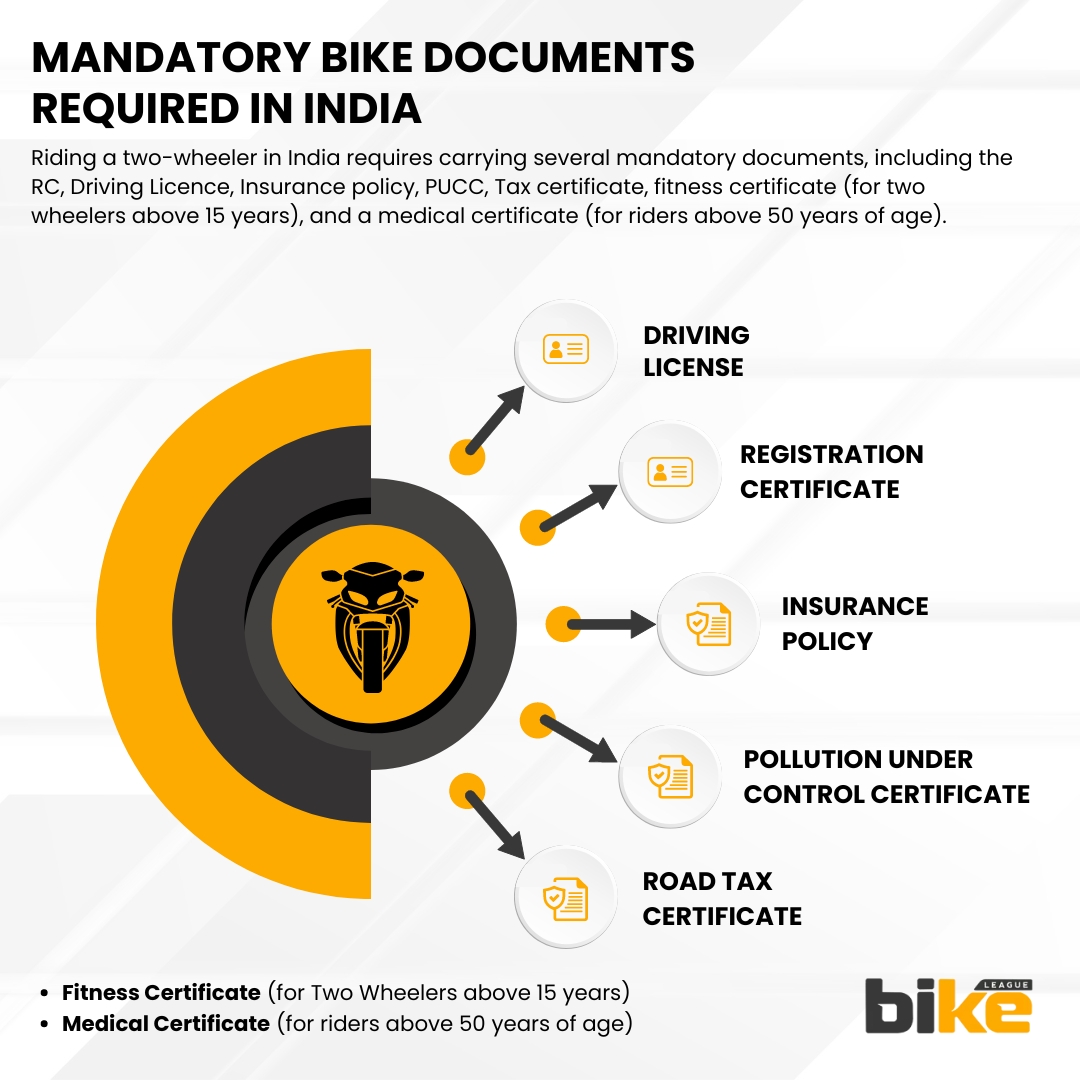
1. Driving Licence
You need a valid driving licence to ride a bike legally in India. It’s your proof to the police that you know the basics and are authorised to operate your two-wheeler.
Want to know more about the types of licences and the full process? Check out our detailed guide from the team below: https://www.bikeleague.in/motorcycle-articles/motorcycle-faq-articles/two-wheeler-license-in-india-full-guide-to-types-process/
2. Registration Certificate (rc)
The Registration Certificate (RC) is proof that your bike is officially registered with the RTO. Always keep it with you when riding—if you’re stopped by the police and don’t have it, you could get fined on the spot.
Want to dig deeper into what an RC is, why it matters, and how to get or renew one? Check out our team’s detailed guide below: https://www.bikeleague.in/motorcycle-articles/motorcycle-faq-articles/motorcycle-rc-book-in-india-exploring-book-vs-digital/
3. Bike Insurance Policy
You need at least third-party insurance to ride legally in India. This is what covers you if your bike causes an accident and someone else is hurt or their property is damaged. It’s not just a formality—it saves you from big expenses and legal trouble if something goes wrong.
If you want practical tips for picking the right insurance or want to know what’s really covered, check out our team’s guide below: https://www.bikeleague.in/motorcycle-articles/motorcycle-technical-articles/how-to-buy-and-select-two-wheeler-insurance/
4. Road Tax Certificate
You’ll need a road tax certificate when riding your bike in India. This proves you’ve paid the required tax and are following the rules—skip it, and you might get fined if the police stop you.
Curious how road tax works or what the certificate looks like? Our team’s guide below explains all the details: https://www.bikeleague.in/motorcycle-articles/motorcycle-faq-articles/two-wheeler-road-tax-in-india-a-detailed-explanation/
5. Pollution Under Control Certificate (pucc)
A Pollution Under Control Certificate (PUCC) proves that your bike isn’t polluting more than the allowed limit. You should always keep it with you when riding—if you’re stopped and can’t show a valid PUCC, you could face a fine for breaking environmental rules.
Want to know more about PUC rules or how to get your certificate? Our team’s article below covers everything you need: https://www.bikeleague.in/motorcycle-articles/motorcycle-faq-articles/bike-pollution-certificate-all-you-need-to-know-in-india/
6. Fitness Certificate
If your bike has crossed the 15-year mark, you’ll need a fitness certificate from the RTO to prove it’s still safe for Indian roads. Make sure you renew this on time—if you’re caught without it, you could face fines or be stopped from riding.
Want more details about what a fitness certificate is, how to get one, or what happens if yours expires? Our team’s article below explains it all: https://www.bikeleague.in/motorcycle-articles/motorcycle-faq-articles/bike-fitness-certificate-guide-all-you-need-to-know/
7. Medical Certificate
If you’re over 40, you’ll need to carry a medical certificate to prove you’re fit to ride. Make sure it’s up to date before heading out—if it’s expired, you could run into trouble during a police check.
Need more details about who needs a medical certificate, how to get one, or what happens if you forget it? Our team’s article below has you covered: https://www.bikeleague.in/motorcycle-articles/motorcycle-faq-articles/medical-certificate-for-bike-riders-in-india-essential-guide/
| Document | Is it Mandatory? | Who must carry it? | Physical / Digital | Key Validity / Notes |
|---|---|---|---|---|
| Driving Licence (DL) | Yes | All riders operating a motorised two-wheeler on public roads | Physical card or digital copy in DigiLocker / mParivahan (legally valid) | Mandatory under Motor Vehicles Act; must be valid for the class of vehicle you ride |
| Registration Certificate (RC) | Yes | Owner or rider of the motorcycle | Physical smart card or digital RC in approved apps | Valid for 15 years for private bikes, then renewed periodically |
| Bike Insurance Policy | Yes (at least Third-party) | All bikes used on public roads | Policy document or digital copy in DigiLocker / insurer app | Third-party cover is compulsory; comprehensive is optional but recommended |
| Pollution Under Control Certificate (PUCC) | Yes | All BS-compliant petrol bikes after initial exemption period | Printed slip or validated digital record | Validity depends on fuel type and emission norms; must be renewed regularly |
| Road Tax Certificate | Yes | All registered two-wheelers | Receipt/certificate or digital record in RTO systems | Generally paid one-time at purchase; proof may be required during checks or NOC/transfer |
| Fitness Certificate | Yes, for older vehicles | Private bikes older than 15 years | RTO-issued fitness certificate (paper or electronic record) | Required after RC’s initial 15-year period to confirm roadworthiness |
| Medical Certificate | Yes, for a specific age group | Riders typically above 40 years (as per state/RTO norms) | RTO-accepted medical form, usually physical | Used to certify physical and mental fitness to ride; often needed at licence issuance/renewal |
| Digital Copies in DigiLocker / mParivahan | Not mandatory, but legally valid | Any rider choosing paperless mode | Digital only (apps linked to government databases) | Recognised under amended Motor Vehicle Rules; physical copies generally not needed if digital version is validated |
What Are The Penalties For Each Missing Document Mentioned Above In India?
The Motor Vehicles Act 2019 requires you to carry certain bike documents to avoid heavy fines during traffic checks in India. Fines have stayed about the same through 2026. First-time offences usually mean a spot fine, but repeat offences can lead to jail or higher penalties.
| Document | MV Act Section | First Offence Penalty | Subsequent Offence Penalty | Notes |
|---|---|---|---|---|
| Driving Licence (DL) | 181 | ₹5,000 | ₹5,000 (may include jail up to 3 months) | Applies to unlicensed driving or mismatch with vehicle class; licence may be seized |
| Registration Certificate (RC) | 192 | ₹2,000 – ₹5,000 | Up to ₹10,000 + imprisonment up to 1 year | Vehicle impoundment possible; exceptions for emergencies with reporting |
| Bike Insurance Policy | 196 | ₹2,000 (+/- jail up to 3 months) | ₹4,000 (+/- jail up to 3 months) | Third-party mandatory; common e-challan via ANPR cameras |
| Pollution Under Control (PUC/PUCC) | 190(2) | ₹1,000 | ₹10,000 (+/- jail up to 6 months + community service) | Strict enforcement in polluted cities; validity tied to BS norms |
| Road Tax Certificate | Varies (state-specific, linked to RC) | ₹500 – ₹2,000 | Up to ₹5,000 | Proof via RC or tax receipt; penalties escalate with non-payment duration |
| Fitness Certificate (vehicles >15 years) | 62 (linked to 192) | ₹5,000 | ₹5,000 – ₹10,000 | For older private bikes; confirms roadworthiness post-RC expiry |
| Medical Certificate (riders >40) | Linked to DL renewal (182) | ₹500 – ₹1,000 (via DL violation) | Varies by state | Required for DL issuance/renewal; rarely checked standalone but ties to DL fines |
Points To Note
- Digital Validity: Fines apply equally if digital copies (DigiLocker/mParivahan) fail verification; always ensure apps are up to date.
- Payment: Spot fines or e-challans payable online; present documents within 7 days in some cases to reduce the administrative fee to ₹ 100.
- Variations: Some states tweak amounts (e.g., Delhi is higher for PUC); check Parivahan.gov.in for local rules.
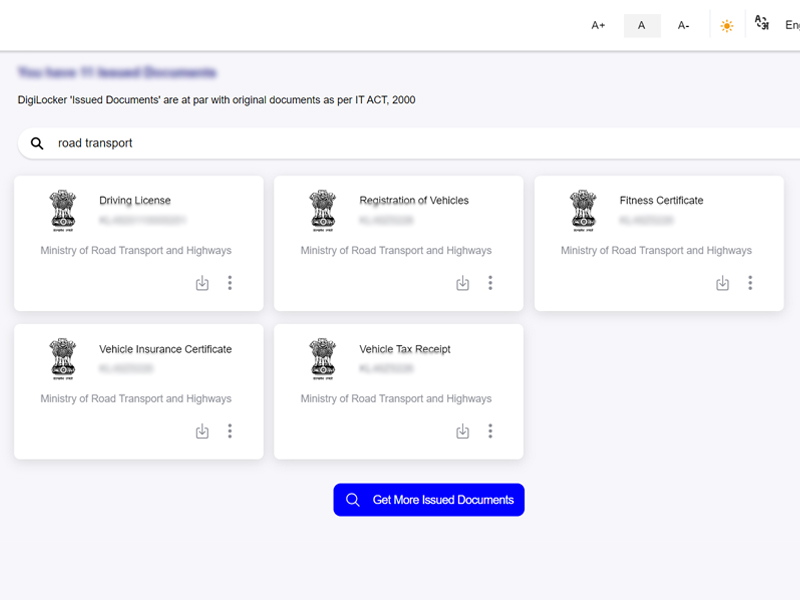
Which Are The Approved Digital Platforms For Storage Of Two-wheeler Documents In India ?
The government has specified that digital copies of vehicle documents must be stored in the
- DigiLocker – https://www.digilocker.gov.in/
- mParivahan – https://parivahan.gov.in/
- mParivahan Android app- https://play.google.com/store/apps/details?id=com.nic.mparivahan&hl=en_IN
- mParivahan IOS app – https://apps.apple.com/in/app/nextgen-mparivahan/id1450914131
- Digilocker Android app – https://play.google.com/store/apps/details?id=com.digilocker.android&hl=en_IN
- Digilocker IOS app – https://apps.apple.com/in/app/digilocker/id1320618078
apps. These platforms are officially recognised for storing and presenting digital documents during traffic police inspections. This ensures that the documents are easily accessible and verifiable by authorities.
Physical Vs Digital Bike Documents: What’s Accepted Where?
Physical documents are no longer mandatory for routine bike checks in India since the 2020 amendments, as digital versions in DigiLocker or mParivahan have full legal validity under the Motor Vehicles Act and the IT Act 2000. However, practical issues like no internet or officer discretion can favour physical copies, especially in remote or inter-state scenarios.
Physical Vs Digital Guide
| Scenario | Physical Accepted? | Digital Accepted? | Recommendation | Notes |
|---|---|---|---|---|
| Routine urban traffic stops | Yes | Yes (preferred) | Digital sufficient | Officers scan QR or verify app; legally equivalent |
| Inter-state highway travel | Yes | Yes | Carry both or digital + offline screenshot | mParivahan/DigiLocker work offline after fetch; valid nationwide |
| Remote/rural areas (no signal) | Yes | Yes (if pre-fetched offline) | Physical backup essential | Apps store locally; screenshots invalid if tampered-look |
| Court/legal proceedings | Yes (originals) | Sometimes (printed/certified) | Physical originals | Digital proof via govt portal, but courts prefer hard copies |
| Vehicle seizure/impoundment | Yes (surrender originals) | Digital impound via portal | Digital for verification | Physical may still be demanded post-offence |
| No smartphone/battery dead | Yes | No | Always carry physical | Basic precaution for edge cases |
Best Practices
- Fetch docs in mParivahan/DigiLocker for tamper-proof QR verification; avoid gallery photos.
- If the officer refuses digital (rare, actionable), show the MoRTH advisory and note the details for the grievance.
What Are The Exemptions For Specific Categories For Bike Documents In India?
While there are no broad exemptions from mandatory motorcycle documentation for specific categories of riders, some accommodations and unique processes are in place to assist particular groups.
1. Disabled Persons
- Bike modifications and licensing process accommodations are more common.
- The government has been working towards making transportation more accessible for disabled individuals, which may include:
- Possibility of modified vehicles
- Special driving licenses catering to their needs
- Potentially easier access to services or assistance in obtaining necessary documents
2. Older People (above 60 Years)
- Priority service when applying for driving licenses or vehicle registrations
- Reduced fees in some states for motorcycle document processing
- Easier access to services or assistance in obtaining necessary bike documents
3. Military Personnel
- Ability to use military identification instead of some civilian documents in certain situations
- Streamlined procedures for obtaining or renewing documents due to service commitments
What About Documents Should Foreigners Or Nris Carry While Riding Bikes In India
Under the Motor Vehicles Act, foreigners and NRIs can legally ride bikes (rented or owned) in India with an International Driving Permit (IDP) alongside their valid home-country licence, provided it is valid for up to 1 year or for the duration of their visa. No Indian DL is required for short-term stays, but rentals strictly require IDP, passport, and visa; imported bikes need a temporary RC via customs/FRRO.
1. Key Documents Required
| Category | Requirements | Validity/Notes |
|---|---|---|
| Driving Licence | Home DL + IDP (1949 Convention, issued by home country) | IDP valid 1 year max; English translation if non-English DL. No IDP from India for foreigners—get from home AAA equivalent |
| Vehicle Documents (Rental) | Rental firm’s RC, insurance, PUC; show passport/visa | Rentals provide these; deposit passport copies common but risky—use photocopies |
| Own/Imported Bike | Temporary import permit (Customs/FRRO), temp RC, third-party insurance | 6-month max stay; Carnet de Passage for overland; NRIs easier with Indian address |
| Insurance | Third-party min (buy Indian policy for coverage) | Foreign insurance often insufficient; get via rental or online (e.g., PolicyBazaar) |
| Registration (Long Stay) | FRRO registration if >180 days; possible Indian RC | NRIs: Use OCI/PIO card + Indian address for easier RTO process |
2. Lost Documents Handling
- DL/IDP: Report to local police to file an FIR, and apply for a replacement via the home embassy/consulate.
- Passport/Visa: Police FIR + report to FRRO/e-FRRO (indianfrro.gov.in) + nearest Indian embassy of your country for reissue; Police Clearance Certificate needed.
- Bike Docs: Rental firm handles RC/insurance; own bike—RTO duplicate with FIR + embassy ID proof.
- NRIs: Contact the High Commission of India abroad or the MEA helpline; faster with Aadhaar/Indian mobile.
3. Practical Tips
- Carry both physical and digital (DigiLocker if Indian-linked); IDP must accompany the original DL at all times.
- Kerala tours: Local rentals (e.g., Kochi) accept IDP; check BS-VI compliance for PUC.
- Embassy Contacts: List via mea.gov.in.
What To Do If Bike Documents Are Lost Or Stolen?
If bike documents are lost or stolen in India, immediately file a First Information Report (FIR) at the nearest police station (or online via state portals like delhipolice.gov.in/lostfound) to start the duplicate process—this is mandatory for RC, DL, and insurance claims. Use digital copies from mParivahan/DigiLocker as interim proof during checks, then apply for duplicates via Parivahan portal (parivahan.gov.in).
Step-by-step Process
- File FIR/Police Report: Visit the station within 24 hours or use online lost/found (e.g., state police sites); note chassis/engine numbers. Get a copy immediately.
- Gather Supporting Docs: Valid insurance, PUC, ID/address proof (Aadhaar/passport), chassis pencil print/photo, notarised affidavit (₹20 stamp paper).
- Apply Online (Preferred): Go to parivahan.gov.in > Vahan > Vehicle Related Services > Duplicate RC/DL. Fill Form 26/LLD, upload docs, pay fee (₹200-500 for RC), track via SMS/app. Smart card RC delivered in 15-30 days.
- Offline Fallback: Submit at zonal RTO with prints; verification/biometrics may be needed (1-2 weeks).
- Insurance Claim (if Theft): Submit FIR + policy to insurer for reimbursement (comprehensive policy required).
Document-specific Breakdown
| Document | Duplicate Fee (approx.) | Processing Time | Key Extra Steps |
|---|---|---|---|
| RC Book/Smart Card | ₹200-500 | 15-30 days | Form 26 + FIR + affidavit + PUC/insurance; NOC if financed |
| Driving Licence (DL) | ₹200-400 | 7-15 days | Form LLD + FIR + biometrics at RTO; use Sarathi portal |
| PUC | ₹100-200 | Same day | Re-test at emission center; no FIR needed |
| Insurance Policy | Free (digital reprint) | Instant-3 days | Contact insurer with FIR/policy number; app download |
Foreigners/nris Special Notes
- FIR + report to FRRO (indianfrro.gov.in) + home embassy for passport/DL reissue.
- Rentals: Inform the company—they handle RC/insurance duplicates.
Myths & Misconceptions About Bike Documents
1. Digital Documents/digilocker Screenshots Are Not Accepted By The Traffic Police.
Digital documents have been fully legal since 2020, thanks to government-approved apps like mParivahan and DigiLocker. If you’ve ever worried about whether your digital copy is valid, rest assured. As long as you use the official QR code in these apps, you’re covered. However, avoid using screenshots or PDFs, as they may be considered tampered with and may not be accepted. If you ever face an issue—say, an officer refuses your digital document—simply call the MoRTH helpline at 1033. The good news is that today, almost all traffic police officers recognise and accept digital documents without any trouble.
2. No Bike Insurance Needed If Parked Or Garaged.
Even if you think your bike is safe just because it’s parked or stored away, you still need to have third-party insurance. This rule applies at all times—whether your bike is on a busy road or just sitting quietly in your parking space. Automatic cameras can scan number plates around the clock, so you could get an e-challan of ₹2,000 or more if you’re not insured. This rule applies to electric vehicles and scooters too, so no one gets left out.
3. Physical Original Documents Mandatory—no Exceptions.
If you prefer carrying digital copies of your bike documents, you’re in luck! For regular police checks, digital versions are just as good as the originals. You’ll only need to show physical documents if you’re going to court, visiting the RTO, or selling your bike. Laminated copies and phone gallery photos won’t work—so stick to the official apps for peace of mind.
4. Rc Book Valid For Lifetime.
Many people assume their RC book is valid forever, but that’s not the case. For private bikes in India, your RC is valid for 15 years. After that, you’ll need to get a fitness certificate every five years to keep riding legally. Commercial bikes have an even shorter validity period, so always double-check your paperwork if you use your bike for work.
5. Can’t Legally Ride A Friend’s/family Bike.
Wondering if you can ride a friend’s or family member’s bike? As long as you have your own valid driving licence and the bike’s RC and insurance (digital copies are fine), you’re good to go. No rule says only the owner can ride the bike for private use.
6. Puc Or Insurance Rarely Checked—skip If Expired.
It might be tempting to skip renewing your PUC or insurance, especially if you think no one checks them. But traffic police can and do issue spot fines ranging from ₹1,000 to ₹10,000 for expired PUCs. Plus, your insurance details are stored in the RC database, and validity is automatically shown in the Parivahan app. So, it’s always safer (and cheaper) to keep everything up to date.
Faqs About Bike Documents In India
1. What Are The Essential Documents Needed To Ride A Bike In India?
You must carry a valid Driving Licence (DL), Registration Certificate (RC), at least third-party Bike Insurance, Pollution Under Control Certificate (PUCC), Road Tax Certificate, and, for bikes older than 15 years, a Fitness Certificate. Riders aged 40 or older may also need a Medical Certificate.
2. Are Digital Copies Of Bike Documents Valid During Police Checks?
Yes. Digital copies in government-approved apps like DigiLocker and mParivahan are legally valid across India for routine traffic checks. Always use the official app (not screenshots) for verification.
3. What Is The Penalty For Not Carrying A Valid Driving Licence?
The penalty for the first offence is ₹ 5,000, and repeat offences may carry a maximum of 3 months in jail, as per the Motor Vehicles Act.
4. Can I Ride Someone Else’s Bike With My Own Licence?
Yes. As long as you have a valid DL and the bike’s RC, insurance, and PUCC, you can legally ride a friend’s or family member’s bike for private use.
5. Is It Mandatory To Carry The Original Documents Or Are Photocopies Accepted?
Digital copies in approved apps are accepted as originals for checks. Photocopies, including laminated copies or phone gallery photos, are not valid.
6. What Should I Do If My Bike Documents Are Lost Or Stolen?
File a police FIR immediately, use digital copies temporarily, and apply for duplicates via the Parivahan portal or your insurer.
7. Do I Need Insurance If My Bike Is Parked And Not In Use?
Yes. Third-party insurance is mandatory even for parked or garaged bikes on public roads. ANPR cameras can issue e-challans for uninsured vehicles.
8. Is The Puc Certificate Required For All Bikes?
Yes. All petrol bikes must have a valid PUCC after the initial exemption period. Fines range from ₹1,000 to ₹10,000 for non-compliance.
9. Are There Exemptions For Older People, Disabled Riders, Or Military Personnel?
There are some accommodations, such as priority service, reduced fees, or special licence options, but all must carry the mandatory documents. Military personnel may use alternative IDs in certain cases.
10. What Platforms Are Approved For Digital Storage Of Bike Documents In India?
DigiLocker and mParivahan (Android/iOS) are officially recognised apps for storing and presenting digital documents during traffic stops.
Other Related Articles From Bikeleague India
- Bike fitness certificate guide – All you need to know
- Motorcycle RC book in India: Exploring Book vs Digital
- Bike ownership transfer in India – step by step guide
- KTM RC 390
- KTM RC 200
Conclusion
Following India’s bike registration rules is not just about following the law—it also helps you ride safely and responsibly. As rules change and digital checks become more common, keeping your documents organised and easy to find is more important than ever.
This bike documents guide gives you all the details you need, from required documents and penalties to common myths and digital tips, so you can handle any traffic check with confidence. When you stay informed and prepared, your rides are smoother, you avoid big fines, and you help keep the roads safe for everyone.
If you have any questions about bike documents for riding in India, feel free to email us at bikeleague2017@gmail.com or leave a comment below. We’re happy to help. You can also contact us on social media.