Overview
Performance And Engine
The Bonneville T40 has a liquid-cooled, four-stroke, single-cylinder engine with double overhead camshafts and four valves. It comes with an 89 mm bore, a 56.1 mm stroke, and a 12.1:1 compression ratio. Fuel is delivered through electronic fuel injection with throttle control.
| Engine specification |
Bonneville T40 |
| Published engine capacity |
350cc |
| Configuration |
Single-cylinder, four-stroke |
| Cooling |
Liquid-cooled |
| Valve arrangement |
DOHC, four valves |
| Bore × stroke |
89 × 56.1 mm |
| Compression ratio |
12.1:1 |
| Fuel delivery |
Bosch electronic fuel injection |
| Throttle control |
Electronic, ride-by-wire |
| Maximum power |
29 PS at 7,000 rpm |
| Maximum torque |
31.2 Nm at 5,500 rpm |
The engine displacement is listed as either 349cc or the rounded figure of 350cc. These are just different ways of describing the engine size.
Peak torque comes at 5,500 rpm, and peak power is reached at 7,000 rpm. The T40’s torque is due to its updated cylinder head, camshafts, and specific engine tuning. The engine is set up for strong low- and mid-range performance.
The engine is tuned for good low- and mid-range performance. However, there are no published figures for roll-on acceleration, overtaking times, or detailed gear-by-gear performance.
The T40 uses a ride-by-wire throttle as part of its electronic fuel-injection system. It offers five riding modes: Road, Rain, Eco, and two customizable options called Rider A and Rider B. These modes let you adjust throttle response and rider aids to suit different conditions and preferences.
Eco mode does not have a separate certified mileage figure. There is also no published comparison of fuel consumption for each mode in the Indian market.
The exhaust has a stainless-steel twin-skin header and a peashooter-style silencer. The engine is set to run at a lower idle speed, but the exact number isn’t given. While these details describe the sound and character, there are no measured noise levels or vibration figures at specific speeds.
Triumph does not provide 0–60 km/h or 0–100 km/h acceleration times. There are no official acceleration test results for the T40, so these numbers can’t be confirmed.
The Bonneville T40 comes with a six-speed manual gearbox and a wet, multi-plate slip-and-assist clutch. The rider operates the clutch and shifts gears manually, as there is no automatic transmission.
Power goes to the rear wheel through an X-ring chain, and the Indian T40 does not offer belt-drive or shaft-drive options.
The Bonneville T40 is listed with a claimed top speed of 132 km/h. This number appears for different variants, but there is no official top-speed figure for the Indian T40. The correct way to state it is “132 km/h claimed top speed.” There are no GPS test results or official top-speed measurements.
Mileage And Fuel Efficiency
There is no official fuel-economy figure in km/l for the T40. The “Fuel Consumption” section only mentions the service interval, not actual fuel use. An estimated mileage is given, but it is not ARAI-certified. So, there is no ARAI-certified mileage for the India-spec Bonneville T40.
An estimated mileage of 27.02 km/l is mentioned. The listing groups the T4, T40 Standard, and T40 Black together, so the specification is not specific to the T40 Standard. This number is not an official claim, an ARAI result, or an owner average.
Owners report an average mileage of 32 km/l, with another source mentioning 32.5 km/l. The main owner-reported figure is 32 km/l, while 32.5 km/l is not independently verified. There is also a single report of 24 km/l, which is different from the average. These numbers are for the combined T4, Standard, and Black versions, and there are no separate averages for each. The number of owners or city and highway breakdowns are not given.
Features And Technology
The Triumph Bonneville T40 combines classic looks with modern technology for the Indian market. It comes standard with a circular TFT display, full-map navigation, smartphone connectivity, five riding modes, cruise control, and lean-sensitive ABS and traction control. LED lighting, USB-C charging, and a centre stand are also included. You can choose from optional seats, protection, and luggage accessories.
- Circular Colour TFT Display: The India-spec Bonneville T40 has a 4-inch circular, full-colour TFT display. It shows gear position, fuel level, ambient temperature, and indicator info, while the center area is used for connectivity and menus. This TFT display is different from the LCD on the Bonneville T4.
- Heritage Display Theme: You can choose a Heritage mode that changes the display to an analogue-style look. This is just a display theme, not a riding mode, so the TFT keeps its digital functions while looking traditional.
- Customisable Display Widgets: The TFT lets you set up five custom widgets using the handlebar switch. You can assign functions like media controls to these widgets for quicker access, so you don’t have to go through the main menus each time.
- Standard Full-Map Navigation: Full-map navigation comes standard and works through the navigation app. The map appears right on the TFT display, where you can also see favourite destinations, points of interest, and recent searches.
- Route Planning Through the navigation app: The app lets you discover routes, add waypoints, and plan your ride before you leave. These features depend on the connected app, so the display itself is not a fully independent navigation device.
- Standard Phone and Music Controls: With smartphone connectivity, you can answer calls, access contacts, and control music through the TFT and left-hand switch. These are standard features, but there are no built-in speakers or included communication headset.
- Backlit Handlebar Switchgear: The backlit switch cubes make it easier to use the controls in low light. The left-hand controls let you access the instrument display, connected features, and cruise control right from the handlebar.
- Five Riding Modes: The T40 has Road, Rain, Eco, Rider A, and Rider B modes. Road, Rain, and Eco are set up in advance, while Rider A and Rider B can be customized. These modes change throttle response, traction control, and ABS settings. You can also add your favorite modes to a quick-access menu on the TFT.
- Electronic Throttle Control: The T40 uses Bosch electronic fuel injection with a ride-by-wire throttle. This setup is part of the powertrain and allows for adjustable throttle response in different riding modes.
- Optimised Cornering ABS: The T40 features lean-sensitive Optimised Cornering ABS on both the front and rear brakes.
- Optimised Cornering Traction Control: The T40 includes lean-sensitive Optimised Cornering Traction Control, with settings that change based on the selected riding mode.
- 12. Standard Cruise Control: Cruise control comes standard and is operated with the left-hand switch. You can adjust the set speed using the controls. Triumph does not offer adaptive cruise control or automatic distance management on this model.
- USB-C Charging Port: There is a discreet USB-C charger for charging your devices while riding. Triumph confirms the connector type but does not share details on power output or fast charging on the Indian website.
- Full LED Lighting: The T40 uses LED lighting throughout, including the round headlamp with its signature daytime running lights. The circular headlight keeps the classic Bonneville look while using modern lighting.
- Automatic Low-Light Headlight Switching: Triumph says the lights automatically switch from daytime running to dipped beam when it gets darker. This applies only to low-light switching, not automatic high-beam or adaptive cornering lights.
- Self-Cancelling Indicators: The T40 comes with self-cancelling indicators
- Emergency Deceleration Warning: When you brake hard, the emergency deceleration warning flashes the rear light to alert drivers behind you. Triumph does not specify exactly when this feature activates.
- Slip-and-Assist Clutch: The T40 comes standard with a wet, multi-plate slip-and-assist clutch. It offers assist and slipper functions in the manual clutch. No automatic clutch or quickshifter is listed.
- Front and Rear Disc Brakes: The front brake has a single 310 mm fixed disc with a twin-piston axial caliper, while the rear uses a 255 mm fixed disc with a single-piston floating caliper. Both brakes work with Optimised Cornering ABS.
- Braided Brake Lines: Triumph includes braided brake lines in the braking package. The company says these help with consistent performance and lever feel. This description is separate from any independent stopping-distance tests.
- Forty-Three-Millimetre Front Forks: The front suspension uses 43 mm forks with 130 mm of wheel travel. Triumph does not mention front preload or damping adjustment in the technical details.
- Preload-Adjustable Twin Rear Shock Absorbers: The twin rear shocks offer 130 mm of wheel travel and spring-preload adjustment. Triumph confirms this adjustment, but does not list separate compression or rebound damping adjustments.
- Aluminium-Rimmed Spoked Wheels: The T40 comes with an 18-inch front wheel and a 17-inch rear wheel, both with aluminium rims and steel spokes. The official specs say both wheels use tubes, so they should not be described as tubeless.
- Standard Centre Stand: The bike comes with a centre stand as standard. Triumph lists upright storage, cleaning, and chain maintenance as its main uses, so it is a built-in convenience feature, not an extra accessory.
- Ribbed Bench Seat: The standard bench seat features a ribbed finish, black upholstery, and Triumph lettering at the back. Triumph says there is foam padding for both the rider and passenger. The standard seat height is 790 mm.
- Fuel Tank Knee Pads: The teardrop-shaped fuel tank has rubber knee pads and a metal three-bar Triumph badge. These features are specifically listed in the T40’s official equipment details.
- Optional Low and Comfort Seats: An optional low seat lowers the seat height by 20 mm to 770 mm and comes in black or brown. A comfort seat and pillion backrest are also available. These are accessories, not standard features.
- Optional Protection Accessories: Triumph offers a radiator cover, aluminium sump guard, and engine bars as accessories. These are not included with the standard bike.
- Optional Luggage and Indicator Accessories: Classic panniers, extra luggage options, and bullet LED indicators are available for customization. The bullet indicators are accessories and do not replace the standard self-cancelling indicators.
Build Quality
The Bonneville T40 uses a hybrid spine/perimeter tubular-steel frame and a twin-sided steel swingarm. The chassis is identified as a new frame developed for the T40 with tubular-steel construction. These are the documented structural foundations of the motorcycle.
Steel construction alone does not indicate weld quality, assembly consistency, or long-term resistance to rattles. There has been no detailed inspection of these areas, so it is not possible to claim perfect assembly.
The fuel tank has a two-tone finish with hand-painted coachlining. Triumph says every Bonneville T40 is hand-finished, with the coachlining as a clear example. The tank also features rubber knee pads and a metal three-bar Triumph badge, giving specific material and finish details instead of just a general premium label.
Triumph calls the paint deep and rich and says the finishes are durable. These are the company’s claims, as there is no data on paint thickness, abrasion tests, or long-term exposure to Indian weather.
The T40 features chrome-finished mirrors, a chrome grab hoop, and brushed-aluminium heel guards. The clutch and alternator covers also have a brushed-aluminium finish. Machined cooling fins and finned exhaust-header roses add detail. The exhaust uses a stainless-steel twin-skin header and silencer.
These details show the materials and finishes used on the motorcycle. However, they do not prove how well the chrome, brushed surfaces, or fasteners will resist corrosion after rep
eated exposure to monsoon or coastal conditions.
Triumph says cables and hoses are hidden to keep the engine area tidy. Branding appears on parts like the handlebar clamp, front mudguard, engine covers, and lights. This shows careful attention to how components look and are arranged.
However, hiding cables and hoses does not show how easy they are to service, how well connectors are protected, or if there is wear where they touch other parts. These issues need direct inspection.
The spoked wheels use aluminium rims and steel spokes. Triumph says this setup gives strength and durability while keeping weight down. Both wheels are clearly listed as tubed.
There is no data on how well the rims resist damage from severe potholes or how often the spokes need adjustment in Indian conditions. There is also no proof of long-term resistance to corrosion, paint fading, or loose fittings. These are gaps in the information, not confirmed problems.
Handling
Triumph lists a 1,418 mm wheelbase, a 25.4-degree rake angle, and a 195 kg wet weight. The handlebar width is 818 mm. These numbers describe the T40’s size and layout.
Triumph calls the motorcycle lightweight and agile, but these are the company’s own descriptions. Weight and geometry do not show how much effort is needed to steer, balance at low speeds, or back the bike out of a sloped parking spot.
Triumph says the chassis and ergonomics are made to work together for city and open-road handling. The company credits the aluminium-rimmed spoked wheels for a responsive feel. These are claims about intended handling, not results from Indian road tests.
There is no published turning circle, steering-lock angle, or controlled test of quick direction changes. There is also no evidence that the T40 is especially easy to handle in traffic or very nimble in tight spaces.
The T40 has an 18-inch front wheel and a 17-inch rear wheel. Triumph lists a 100/90-18 front tyre and a 150/70 R17 rear tyre. These sizes are confirmed, but the official page does not name the tyre brand or model.
As a result, you cannot make specific claims about wet-road grip, cornering feedback, or tyre performance on dusty Indian roads based only on the sizes. Triumph says the tyres are grippy, but does not give braking or cornering test results.
The front suspension uses 43 mm forks with 130 mm of wheel travel. The twin rear shocks also have 130 mm of travel and include spring-preload adjustment. The telescopic fork and twin-shock setup are confirmed.
Triumph’s specs only mention rear preload as an adjustment. There is no listing for separate compression or rebound adjustments. The travel figures do not show how well the suspension handles pitching, repeated bumps, or sharp impacts on Indian roads.
The front brake has a 310 mm fixed disc and a twin-piston axial caliper. The rear brake uses a 255 mm fixed disc and a single-piston floating caliper. Braided brake lines and Optimised Cornering ABS are also included.
Triumph says this setup gives consistent response and a reassuring lever feel. There are no published stopping distances, repeated-braking results, or independent tests of lever control. The braking hardware is confirmed, but its actual performance compared to others is not.
Optimised Cornering ABS and Optimised Cornering Traction Control come as standard. Triumph says both are lean-sensitive systems meant to help control in different riding conditions. These features are important for the T40’s handling, especially compared to bikes with simpler electronics.
These systems do not prove the motorcycle’s maximum cornering grip or guarantee safety on loose, dirty, or damaged roads. The official page provides no test results or comparisons.
Comfort
Triumph says the T40 has an upright riding position, with handlebars and footpegs set for relaxed ergonomics. This is the official description of the seating posture.
Triumph has not published handlebar reach, seat-to-footpeg distance, or rider-triangle measurements. The available specifications therefore do not establish the exact knee bend or wrist loading experienced by riders of different heights.
The standard black bench seat has a ribbed finish and Triumph lettering at the back. Triumph says there is plenty of foam padding for both the rider and passenger, showing the seat is meant for two people, not just one.
However, no published measurements exist for seat length, pillion width, or foam density. There is also no data on comfort after several hours. It is fair to say the seat is designed for everyday comfort, but not to promise all-day comfort.
The standard seat height is 790 mm. Triumph also describes a slim standover area, which supports its accessibility claims. The standard seat height is consistent across specifications.
An optional low seat lowers the height by 20 mm to 770 mm and comes in black or brown. This is an accessory, not the standard seat. No published data guarantees that every rider can put both feet flat on the ground, since there are no rider-specific reach measurements.
The T40 has 130 mm of suspension travel at both ends and rear preload adjustment. While the specs are clear, it’s not confirmed if the standard setup feels firm or soft over potholes, rough roads, or joints.
There isn’t a detailed ride-comfort test that looks at solo versus pillion riding or different preload settings. There’s also no proof that the T40 handles every pothole smoothly or stays steady on all Indian roads.
The padded bench seat comes with a rear grab hoop. Triumph also offers a pillion backrest as an accessory to improve passenger comfort. This backrest is separate from the standard seat.
There’s no information on pillion knee angle, seat support for long rides, or comfort with luggage. The bike offers standard two-person seating and an optional backrest, but long-distance comfort isn’t confirmed.
The standard cruise control lets you adjust speed using the left-hand switch. Triumph says it keeps your chosen speed without needing to hold the throttle.
Cruise control alone doesn’t guarantee comfort on long rides. There’s no measured data on wind pressure, seat fatigue, or vibration at highway speeds in India.
Besides the low seat, Triumph offers a comfort seat for longer trips. The official page doesn’t list its foam type, size, or compare it to the standard seat. It’s simply an extra comfort accessory.
A 4.9-out-of-5 comfort rating is shown, but this isn’t a separate, controlled test for the T40 Standard. It’s helpful as user feedback, but doesn’t replace a detailed road test for seat fatigue, suspension, heat, or vibration.
The T40 is built for an upright riding position, with a padded bench seat and optional seat adjustments. However, there’s no independent data on how comfortable it is on Indian roads.
Styling
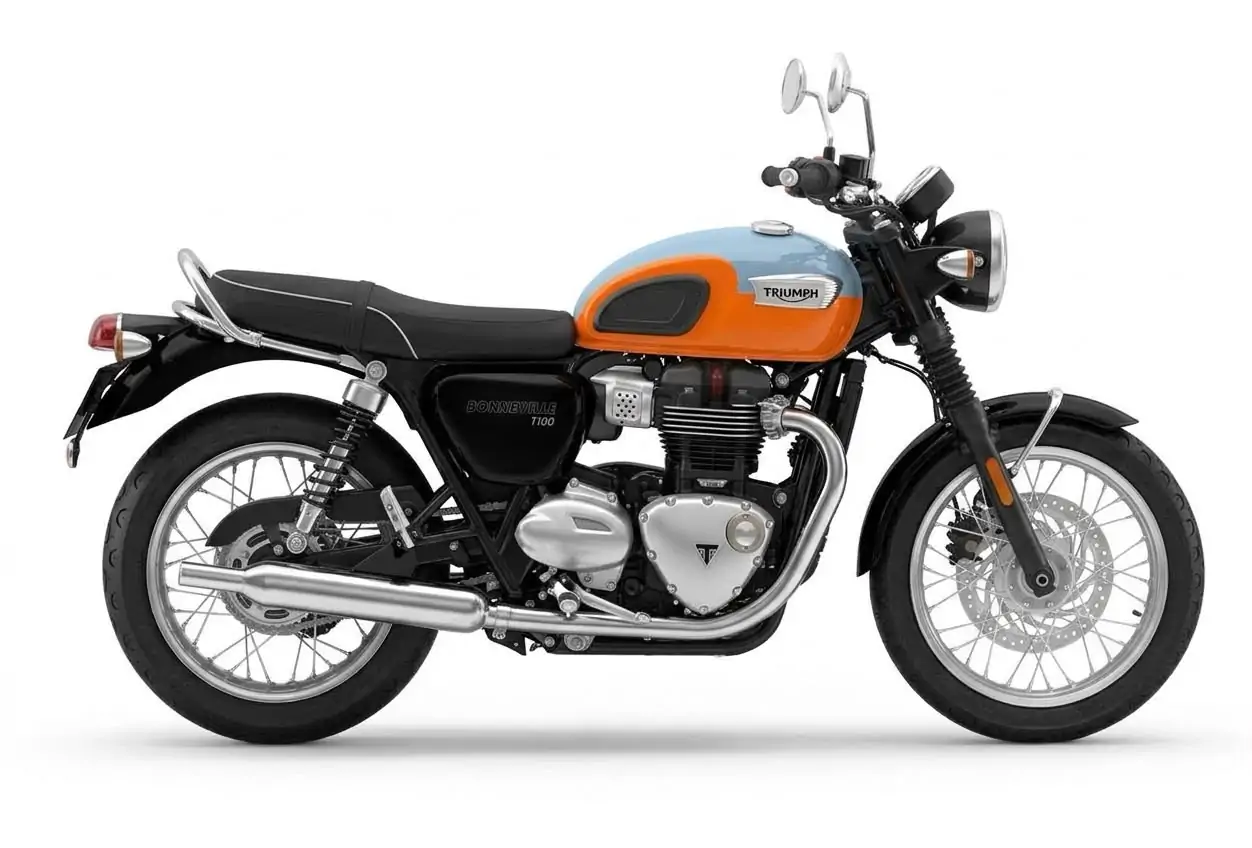
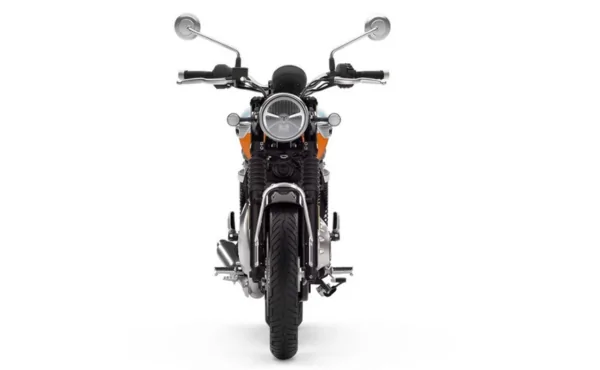
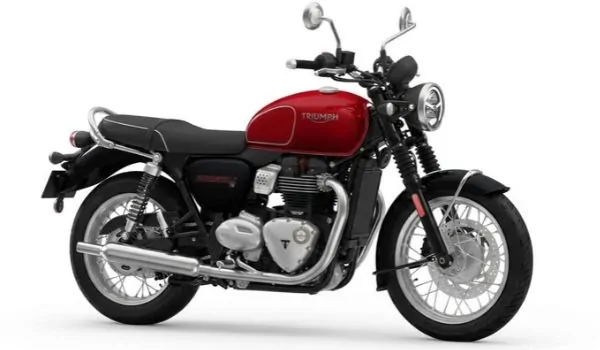
Triumph clearly links the T40’s look to its 1960s bikes. The design features flowing tank lines, longer mudguards, and a classic exhaust shape, keeping the proportions of the bigger Bonneville models. Classic front forks and exposed twin rear shocks finish the roadster style.
The styling isn’t just about the fuel tank. The round headlight, bench seat, spoked wheels, and clean engine area all work together for a classic look. This mix is key to the T40’s traditional design.
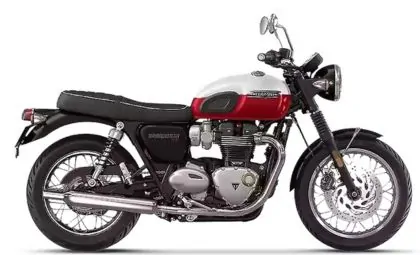
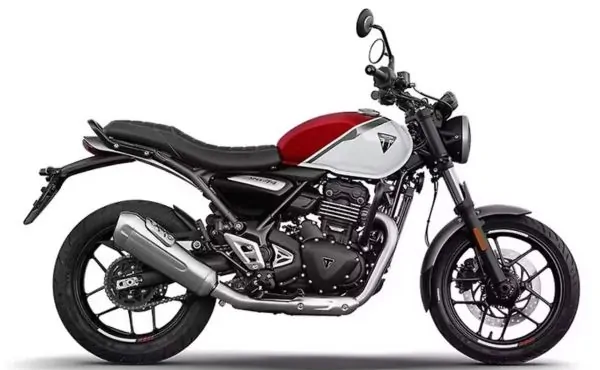
The teardrop-shaped fuel tank is the main visual feature of the T40. All three standard colours have two-tone paint and hand-painted coachlining that follows the tank’s shape. Triumph confirms this lining is painted by hand, not printed.
Rubber knee pads and a metal three-bar Triumph badge add contrast to the painted tank. These touches keep the traditional look and are part of the standard T40’s official design.
The T40 has a round LED headlight with a unique daytime-running-light pattern. Its circular housing keeps the traditional front look instead of switching to an angular design.
The instrument display is also round. Triumph says this keeps the Bonneville’s classic look, and the Heritage display theme gives an analogue-style layout. These features add modern touches without changing the bike’s mostly circular style.
The engine features bright machined cooling fins, large finned exhaust-header roses, and brushed-aluminium clutch and alternator covers. Triumph also highlights the triangular engine badge as part of the clean, recognizable Modern Classic look.
Cables and hoses are hidden to keep the engine area tidy. This styling choice lets modern parts blend in without taking over the engine’s look.
The standard T40’s wheels have aluminium rims and traditional steel spokes. The open-spoke look matches the exposed twin rear shocks and classic front forks. Triumph says these parts are key to keeping the Bonneville style.
The standard model’s bright wheels and engine details stand out against the darker parts on the T40 Black.
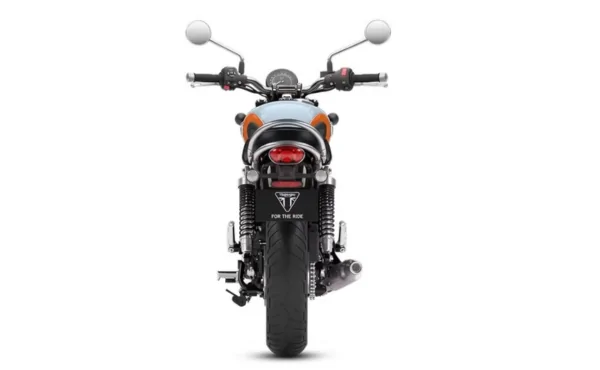
The standard T40 has a black ribbed bench seat with Triumph lettering at the rear. A chrome-finished grab hoop and mirrors add bright accents, while brushed-aluminium heel guards introduce another contrasting surface treatment.
The long peashooter-style silencer finishes the classic side profile. The silencer, chrome parts, and brushed finishes all add to the bike’s retro look.
der system.
Color Options And Variants
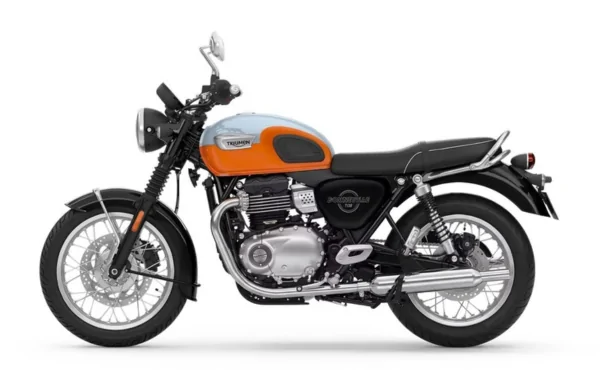
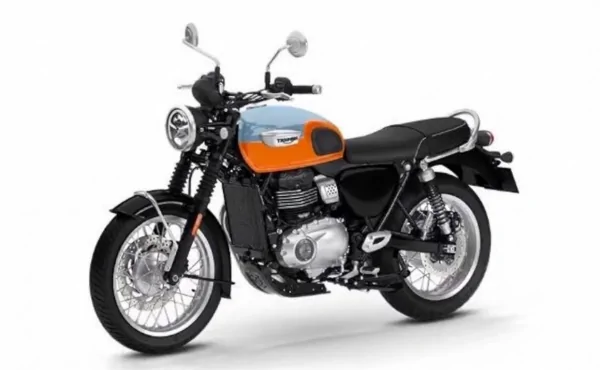
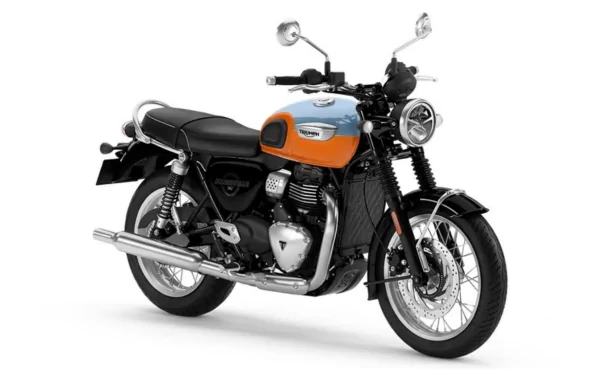
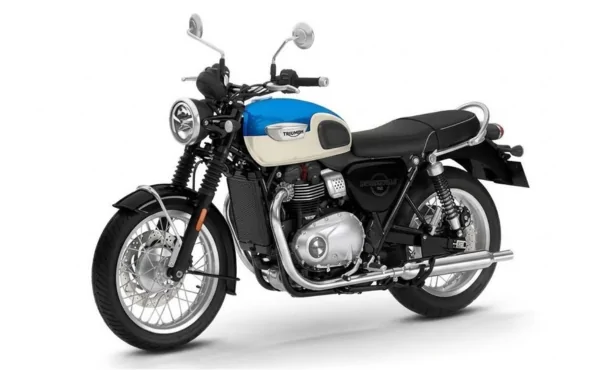
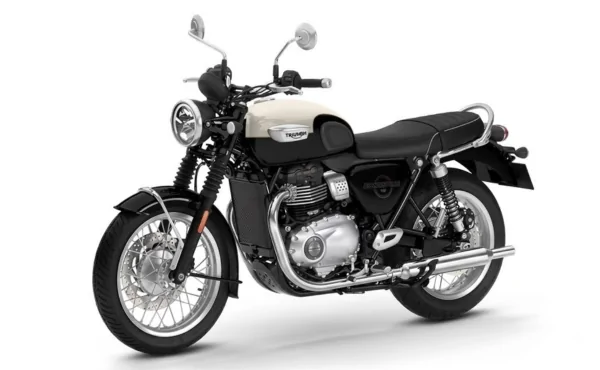
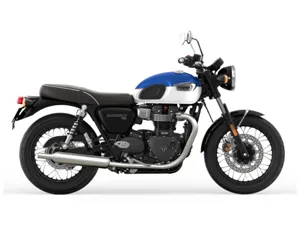
Triumph’s official Indian page lists three standard T40 colour combinations: Meriden Blue and Tangerine Orange, Aegean Blue and Fusion White, and New England White and Jet Black. Every scheme receives hand-painted coachlining, rubber tank knee pads and the metal Triumph tank badge.
| T40 colour scheme |
Colour combination |
| Meriden Blue and Tangerine Orange |
Blue and orange two-tone treatment |
| Aegean Blue and Fusion White |
Blue and white two-tone treatment |
| New England White and Jet Black |
White and black two-tone treatment |
Meriden Blue and Tangerine Orange offer the boldest colour contrast among the standard T40 options. The orange highlights the tank’s shape, and the hand-painted pinstripe adds detail. This is one of three heritage-inspired schemes.
Aegean Blue and Fusion White combines blue with a white section on the tank. It has the same coachlining, knee pads, and metal badge as the other standard T40 colours. This is just a colour choice, not a separate trim.
New England White and Jet Black mix white and black in the standard model’s two-tone tank. Triumph uses these exact names on its Indian page, and they should be the main reference for this scheme.
Some listings call the white-and-black option “Fusion white and Phantom black.” This is different from the official T40 colour name, which is New England White and Jet Black.
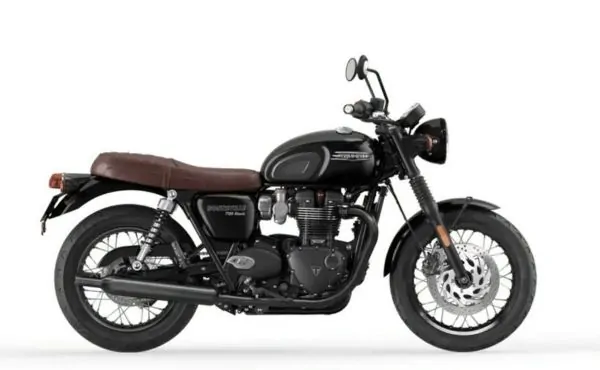
Matt Pewter Grey and Matt Phantom Black are the colours for the Bonneville T40 Black. This makes a fourth look when you count both the standard T40 and T40 Black, but it’s not a fourth colour for the standard T40 alone.
The T40 Black also gets gloss-black aluminium spoke rims, black engine cases, and other black parts. So, its unique look goes beyond just the tank paint.
The standard Bonneville T40 is the model shown on the Triumph India page. It comes with three heritage-inspired two-tone colours, hand-painted coachlining, chrome mirrors and grab hoop, and brushed-aluminium engine cover details.
This model comes in Meriden Blue and Tangerine Orange, Aegean Blue and Fusion White, and New England White and Jet Black. These are colour options, not different mechanical or equipment versions.
The Bonneville T40 Black is a separate version with a darker look. It has Matt Pewter Grey and Matt Phantom Black paint, gloss-black wheel rims, black engine cases, and other black parts. It’s different from the standard model and is the fourth colour option in the T40 range.
| Version |
India colour selection |
Main visual distinction |
| Bonneville T40 Standard |
Three two-tone schemes |
Heritage tank colours, hand-painted coachlining and bright chrome/brushed detailing |
| Bonneville T40 Black |
Matt Pewter Grey and Matt Phantom Black treatment |
Darker body treatment, gloss-black spoke rims and black engine casings |
Value For Money And Pricing
The Bonneville T40 starts at ₹ 2,79,999 ex-showroom in Delhi. This is the starting price for this model and shouldn’t be swapped with lower prices shown for other Bonneville versions in combined listings.
The starting price isn’t the final amount in every Indian city. Registration and insurance add to the total, and city-specific listings show these charges separately. On-road prices usually include ex-showroom price, RTO fees, and insurance.
A nationwide on-road price would be misleading. The right reference is a quote for the T40 in the buyer’s registration city, not a “Bonneville T40 onwards” price that might actually be for the cheaper T4 in broader listings.
Triumph lists low seats, comfort seats, a pillion backrest, engine bars, an aluminium sump guard, a radiator cover, and luggage as accessories. These are not included in the standard bike’s price. The official page doesn’t show their individual prices or a total for all accessories.
The T40’s main value is its standard tech package. It comes with a circular colour TFT display, full-map navigation, phone and music controls, five riding modes, and cruise control. It also has Optimised Cornering ABS and Traction Control.
These features give buyers a clear reason to consider the price. The bike isn’t just about the Bonneville name—it has navigation, connectivity, cruise control, and lean-sensitive features as standard. Still, it’s not proven to have the best equipment-to-price ratio without comparing all variants.
A USB-C charger and centre stand come standard. In contrast, comfort seats, the pillion backrest, and luggage are accessories. This difference is important when comparing the T40 to bikes that come with accessory bundles.A fair value comparison should use the final quoted price of each motorcycle with the equipment the buyer actually needs. Comparing a fully accessorised competitor with a standard T40, or the other way around, would not give an accurate purchase-cost comparison.
Triumph recommends servicing every 16,000 km or 12 months, whichever comes first. The kilometre interval is helpful for riders who cover a lot of distance each year, but the annual limit still applies to those who ride less than 16,000 km.
The service interval is meant to reduce workshop visits and running costs. However, there is no detailed Indian servicing schedule with prices for labour, consumables, and replacement parts. The interval by itself does not prove that the T40 is cheaper to maintain than other motorcycles.
There is no full ownership-cost calculation, guaranteed resale value, or specific fuel-consumption number. The “Fuel Consumption” section shows service-interval details instead of a km/l result. Because of these missing details, it is not possible to fully compare long-term costs.
The most reliable conclusion is that the T40 comes with a clearly listed standard equipment package at its published starting price. Claims about the lowest running costs, best resale value, or highest financial return would need more proof.
Competitor models in India are
- Harley-Davidson X440
- Harley-Davidson X440 T
- Royal Enfield Classic 350
- Royal Enfield Guerrilla 450
The Bonneville T40’s price matches its Bonneville identity and standard technology package. It is priced close to the Harley-Davidson X440 T and costs more than the X440 versions and the less expensive Triumph options listed above.
You can compare purchase value by looking at the included connectivity, cruise control, and rider aids. There is no full Indian maintenance-cost schedule or fuel-economy number. The asking price and standard equipment can be directly compared, but there is no proven claim of lowest ownership cost.