Overview
Performance And Engine
The RTR 310 runs on a 312.12 cc single-cylinder, four-stroke, fuel-injected, liquid-cooled engine. It features closed-loop electronic fuel injection, electronic throttle control, a 23-row radiator, and a reverse-inclined engine design to help centralize weight. TVS also says it uses forged aluminium pistons that are 5% lighter.
| Engine item |
Specification |
| Engine type |
Single-cylinder, four-stroke, fuel-injected, liquid-cooled, spark-ignition engine |
| Displacement |
312.12 cc |
| Valve train |
DOHC |
| Fuel system |
Closed-loop EFI |
| Maximum power — Sport, Track, SuperMoto |
35.6 PS at 9,700 rpm |
| Maximum torque — Sport, Track, SuperMoto |
28.7 Nm at 6,650 rpm |
| Maximum power — Urban, Rain |
27.1 PS at 7,500 rpm |
| Maximum torque — Urban, Rain |
27.3 Nm at 6,600 rpm |
| Claimed 0–60 km/h |
2.81 seconds |
| Claimed 0–100 km/h |
7.19 seconds |
TVS says the RTR 310 can go from 0 to 60 km/h in 2.81 seconds and 0 to 100 km/h in 7.19 seconds. Actual results will depend on things like rider weight, road and tyre condition, weather, altitude, fuel quality, riding mode, how you launch, and traffic.
The motorcycle also has Glide Through Technology, which TVS says enables low-speed movement through a gradual clutch release without throttle input. This is intended to make low-speed riding and traffic manoeuvres easier while reducing the likelihood of stalling.
The RTR 310 comes with Glide Through Technology, which, according to TVS, lets you move at low speeds by slowly releasing the clutch without using the throttle. This helps make riding in traffic easier and lowers the chance of stalling.
| Transmission item |
Specification |
| Gearbox |
Six-speed manual |
| Shift pattern |
One down, five up |
| Clutch |
Wet multi-plate, seven-plate RT slipper clutch |
| Final drive |
Chain |
| Quickshifter |
Bi-directional quickshifter on Top and BTO variants, according to HT Auto |
The RT slipper clutch helps with aggressive downshifts by reducing rear-wheel hop and making the clutch lever easier to use. The bi-directional quickshifter lets you shift up or down without using the clutch, but not all versions have it. Check with the dealer and get a written quote for your chosen model.
TVS claims the Apache RTR 310 can reach a top speed of 150 km/h. This is the maximum under ideal conditions, not a speed you should ride at all the time. Actual top speed will change based on rider weight, wind, road slope, tyre condition, temperature, road surface, and riding mode. Always follow speed limits and ride safely.
Mileage And Fuel Efficiency
TVS’s official FAQ states ARAI-claimed mileage of 30 km/l in Urban and Rain modes and 28 km/l in Sport, Track, and SuperMoto modes. This mode-specific claim is the most detailed official mileage reference for the RTR 310.
| Mileage reference |
Reported mileage |
| TVS ARAI claim — Urban/Rain |
30 km/l |
| TVS ARAI claim — Sport/Track/SuperMoto |
28 km/l |
With its 11-litre fuel tank, TVS’s numbers suggest you could get about 330 km at 30 km/l or 308 km at 28 km/l. These are just estimates based on the official figures and a full tank, not guaranteed real-world results.
Owners and road tests usually report mileage in the low 30s, with most people seeing between 32 and 34 kmpl.
| User or test reference |
Reported mileage |
| Owners’ average |
30-33 kmpl |
For planning, expect real-world mileage to be around 30–33 kmpl, based on user reports. Your actual mileage will depend on things like riding mode, engine speed, throttle use, traffic, hills, load, tyre pressure, maintenance, and weather. Sport, Track, and SuperMoto modes, especially with fast acceleration and high revs, will use more fuel than Urban or Rain modes.
The TVS Apache RTR 310 is a well-equipped naked sport motorcycle in India, offering connected tech, five riding modes, advanced rider aids, and Built To Order options. Some features, especially BTO and dynamic-control hardware, depend on the variant or kit you choose, so check the final feature list with your dealer.
Features And Technology
The TVS Apache RTR 310 comes loaded with features, including connected tech, five riding modes, advanced rider aids, and Built To Order customization. Some equipment, like BTO and dynamic-control hardware, depends on which variant or kit you pick.
- 5-inch horizontal TFT race computer: The Apache RTR 310 uses a 5-inch horizontal TFT instrument cluster as its central rider interface. TVS says the display lets riders control functions such as traction control, cruise control, headlamp brightness, and Bluetooth music.
- TVS SmartXonnect connectivity: The motorcycle supports TVS SmartXonnect smartphone pairing for connected ride information and app-linked functions. TVS states that the platform provides ride telemetry and connected functions through the TVS Connect ecosystem.
- Five ride modes: The RTR 310 provides Urban, Rain, Sport, Track, and SuperMoto riding modes. These change the motorcycle’s engine response and selected braking or rider-aid settings for differing conditions and riding purposes.
- Urban mode: Urban mode is calibrated for city riding, with power delivery intended to provide quick acceleration bursts. TVS states that dual-channel ABS is set for quick response with mild lever pulsation.
- Rain mode: Rain mode provides linear acceleration and limits the motorcycle to 120 km/h, according to TVS. The ABS setting is intended to offer stronger lever pulsation and rear-lift protection for lower-grip wet-road conditions.
- Sport mode: Sport mode is designed to provide maximum acceleration across normal operating conditions, with race-mapped fuel injection and engine braking calibrated for smooth deceleration.
- Track mode: Track mode gives access to the engine’s full performance calibration, with immediate ride-by-wire throttle response and reduced ABS intervention. It is intended for closed-course or track use, not public-road riding.
- SuperMoto mode: SuperMoto mode maximises power and disengages rear ABS. Because rear-wheel ABS is disabled, it should only be used by appropriately trained riders in controlled environments where such use is lawful and safe.
- Ride-by-wire throttle: The RTR 310 uses an electronic throttle-control system. TVS describes an intelligent throttle body with a turbulence system, sharper throttle grip, and a reverse-blip function
- Glide Through Technology: GTT lets you move at low speed by gradually releasing the clutch without throttle input. TVS says this helps smooth, stall-free low-speed riding.
- Six-speed gearbox: The motorcycle has a six-speed manual transmission. TVS describes its bottom-mounted shift lever and negative back-rake angle as features intended to support precise shifts.
- Bi-directional quickshifter: The RTR 310 has a bi-directional quickshifter, allowing clutchless upshifts and downshifts. TVS describes it as helping reduce shift time; confirm availability on the exact selected variant or BTO configuration.
- RT slipper clutch: The wet multi-plate, seven-plate Race Tuned slipper clutch helps manage aggressive downshifts and reduce rear-wheel hop. TVS also states that its assist function reduces clutch effort.
- Cruise control: Race Tuned Linear Stability Control includes cruise control. TVS says it lets the rider maintain a selected speed without throttle or clutch input; use it only on open, predictable roads and never as a substitute for rider attention.
- Race-tuned linear traction control: TVS lists linear traction control as a segment-first feature. It manages engine torque to support rear-wheel grip and reduce wheelspin during acceleration on slippery surfaces.
- Adaptive Bi-LED cyborg headlamp: The RTR 310 features an adaptive Bi-LED headlamp with intelligent beam control. TVS says it adjusts to speed and ambient light to optimise visibility.
- Sequential turn-signal lamps: The motorcycle has five-LED sequential turn-signal lamps, which TVS calls TSL. These form part of the newer visual and lighting package.
- Knuckle guards: The styling package includes sculpted knuckle guards. TVS states they are intended to deflect wind while contributing to the motorcycle’s aggressive appearance.
- Transparent anti-fog clutch cover: The motorcycle features a transparent anti-fog clutch cover. It is primarily a styling feature that exposes the clutch area.
- SmartXonnect ride telemetry: TVS says SmartXonnect provides post-ride analytics, including gear-shift points and ride-pattern analysis. This lets riders review selected ride data after the journey.
- Race telemetry: The SmartXonnect application can record race-related parameters and provide a summary after a track session. It is intended for reviewing performance data in controlled riding environments.
- Voice Assist: Voice Assist enables hands-free control of selected cluster and basic vehicle functions. Check the owner’s manual or consult the dealer for exact commands and supported functions.
- what3words navigation: The connected system supports what3words navigation, allowing riders to search, share, and navigate using three-word location identifiers.
- Telephony functions: When paired with a compatible phone, the control cubes can accept or reject calls, set Do Not Disturb, provide SMS notifications, and send auto-reply SMS messages. Riders should use these functions only when safely stopped.
- Digi Docs: Digi Docs can store and transfer up to three documents, such as a registration certificate or driving licence, from the TVS Connect app to the TFT cluster.
- Crash alert: The system can enter Crash Alert mode when it detects a fall and send the crash location to the rider’s emergency contacts within 180 seconds, according to TVS. This feature depends on appropriate app setup, phone connectivity, and emergency-contact configuration.
- Music playback control: Riders can cycle through Bluetooth-connected music tracks using the handlebar toggle switches, with track information shown on the TFT display.
- GoPro control: The RTR 310 can pair with a GoPro camera, allowing selected camera control through the motorcycle’s toggle switches.
- Hybrid trellis-and-cast split chassis: The RTR 310 uses a hybrid structure with a trellis frame and cast-frame elements in a split-chassis layout. TVS pairs it with a lightweight aluminium sub-frame.
- 43 mm USD fork and adjustable monoshock: Standard hardware includes a 43 mm USD front fork and a preload-adjustable rear monoshock mounted directly to a solid die-cast aluminium swingarm.
- Built-to-Order customisation: TVS offers the RTR 310 through its Built-to-Order programme. Customers can choose configurations, performance kits, styling options, and colour choices using TVS’s online configurator or TVS ARIVE app, subject to availability.
- Fully adjustable suspension with BTO kit: The relevant BTO configuration adds front adjustment for preload, compression damping, and rebound damping, along with rear preload and rebound adjustment.
- Tyre Pressure Monitoring System: The BTO kit can include TPMS, which continuously monitors front and rear tyre pressures and shows real-time data on the TFT display. It alerts the rider if pressure moves outside the recommended range.
- Brass-coated chain: The BTO package includes a brass-coated chain, which TVS describes as rust-resistant and visually distinctive.
- Race Tuned Dynamic Stability Control: Applicable BTO equipment can include RT-DSC, which uses a six-dimensional IMU to support cornering-related braking and torque-control functions.
- Cornering ABS: As part of RT-DSC, cornering ABS assists braking while leaned over. It remains a rider aid and cannot overcome excessive speed, poor tyre condition, low-grip surfaces, or abrupt rider input.
- Cornering traction control: This RT-DSC function regulates engine torque while accelerating out of a corner to help reduce wheelspin.
- Launch control: The BTO dynamic package can include launch control, which TVS describes as providing maximum-power starts while managing wheelspin.
- Drag torque control: Drag torque control helps reduce rear-wheel lock during aggressive downshifts, supporting smoother deceleration and motorcycle control.
- Wheelie control: Wheelie control uses pitch rate, pitch angle, and wheel-acceleration inputs to help manage front-wheel lift under strong acceleration.
- Slope-dependent control: This system estimates slope angle and axle-load changes to help determine suitable brake-force distribution.
- Rear-wheel lift-off protection: This function helps keep the rear wheel grounded during intense braking and reduces the risk of a rollover.
- Cornering cruise control: When the motorcycle is cornering, the system can reduce speed to support a comfortable lean angle and then increase it toward the original cruise setting after the corner, according to TVS.
- Keyless Ride System: The updated RTR 310 offers a keyless ride system. With the fob detected, the rider can start the motorcycle and electronically lock or unlock the handlebar.
- LED lighting: The RTR 310 uses an LED headlamp and LED tail lamp. The adaptive Bi-LED headlamp and sequential signals add to its lighting and visibility package.
- TVS ARIVE support: TVS ARIVE supports online configuration, Built-to-Order selection, accessory viewing, and booking-related functions. It supports the personalised ownership approach for the RTR 310.
Build Quality
The Apache RTR 310 uses a hybrid split-chassis layout combining a trellis frame with cast-frame elements, plus a lightweight aluminium sub-frame and a solid die-cast aluminium swingarm. TVS calls this structure the “Freestyler Frame,” developed to deliver dynamic response at higher speeds and agile handling. Its visible mechanical components—including the aluminium swingarm, exposed frame sections, 5-inch TFT console, adaptive Bi-LED headlamp, knuckle guards, and transparent anti-fog clutch cover—give the motorcycle a premium naked-sport appearance.
Road tests usually praise the RTR 310’s fit and finish, with good quality and no panel gaps or rattles on the bikes tested. Still, build quality can vary, so it’s a good idea to check the exact motorcycle you get at delivery.
Before accepting delivery, inspect the paint finish, tank shrouds, headlamp surround, TFT display, switchgear, knuckle guards, transparent clutch cover, chain alignment, rear-swingarm finish, brake-lever and clutch-lever action, panel fasteners, tyre manufacturing dates, wheel rims, and visible wiring. Also confirm the exact specification of the motorcycle because items such as adjustable suspension, TPMS, RT-DSC, and certain dynamic-control functions can be linked to a Built To Order configuration.
Handling
The RTR 310 is designed for quick direction changes without giving up highway stability. Its standard hardware includes a 43 mm USD fork, preload-adjustable rear monoshock, 17-inch wheels, 110/70-R17 front and 150/60-R17 rear tyres, a 1,358 mm wheelbase, and a 169 kg kerb weight. TVS pairs this with a wide, tapered steel handlebar intended to provide precise control and rider feedback.
Road testers say the RTR 310 feels light, agile, quick to turn, and stable on the track. Owners also mention that the Michelin Road 5 tyres help the bike lean quickly and grip well. The RTR 310 is often called flickable and easy to change direction, thanks to its chassis and tyres.
The standard suspension is set up for both sporty riding and daily comfort. Reviews say the non-adjustable suspension offers a good mix of comfort and control, and it’s a bit softer than the Apache RR 310 but still smooth over bumps. The rear monoshock’s direct mount and KYB tuning help with stable damping and cornering.
For riders who want to tailor the motorcycle more closely, the Built To Order configuration offers fully adjustable suspension: front preload, compression, and rebound adjustment, plus rear preload and rebound adjustment. This can help with track riding, different rider weights, frequent pillion use, or particular road conditions, but proper setup matters; poorly adjusted suspension can reduce, rather than improve, control and comfort.
The RTR 310 also offers rider aids that can support handling on equipped configurations. These include linear traction control as standard in TVS’s description, along with RT-DSC-related features such as cornering ABS, cornering traction control, drag-torque control, wheelie control, slope-dependent control, and rear-wheel lift-off protection where the relevant BTO kit is selected. These features assist the rider but do not compensate for unsafe speed, poor tyres, low grip, abrupt control inputs, or inadequate riding skill.
Comfort
The RTR 310 has an upright riding position, unlike the forward-leaning stance of a fully faired sportbike. Its wide handlebar, rear-set footpegs, clear view ahead, and 800 mm seat height make it easy to use in the city. The seat is set up for comfort, with a slight sporty lean, and the 800 mm height works for both shorter and taller riders.
Reviews say the RTR 310’s ergonomics are relaxed, with an upright position and a high, flat handlebar. This setup is comfortable for both city and highway riding, making it good for daily commutes and longer trips, with a nice balance of comfort and agility.
The suspension handles most roads well. Riders describe the ride as smooth, soaking up bumps, bridge joints, and dips without making the rider uncomfortable. The non-adjustable suspension is well balanced for everyday use.
There are some comfort limits. You’ll still feel sharp potholes, and some owners say the suspension is a bit firm for sporty riding. The RTR 310 is comfortable on normal rough roads and speed bumps, but you should slow down for deep potholes and sharp bumps.
TVS has updated the seat after earlier complaints about comfort. Since seat comfort depends on your height, weight, how long you ride, and local weather, it’s best to take a proper test ride. Check the seat shape, handlebar reach, knee angle, wrist comfort, low-speed balance, and suspension on the roads you use most.
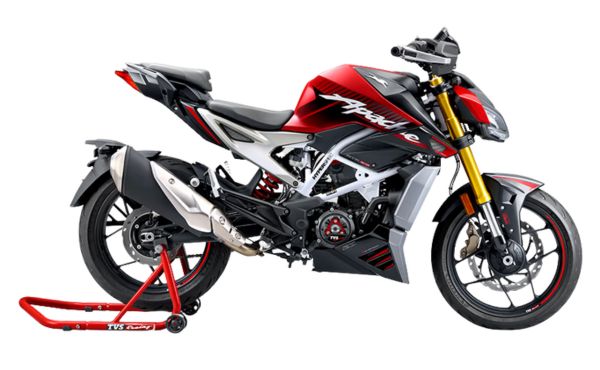
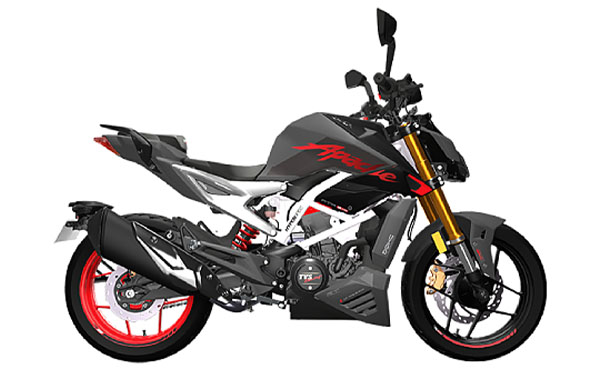
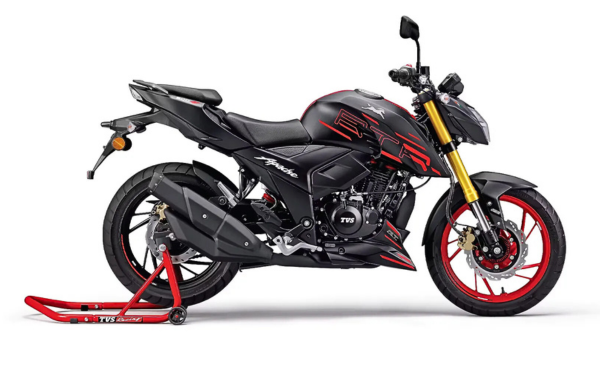
The TVS Apache RTR 310 is styled as an aggressive naked streetfighter, and its India lineup now spans regular, BTO, special-edition, and anniversary versions.
Key visual changes in the latest range include refreshed graphics, the Black Diamond Edition’s all-black finish, and colour-specific treatments across trims.
Styling
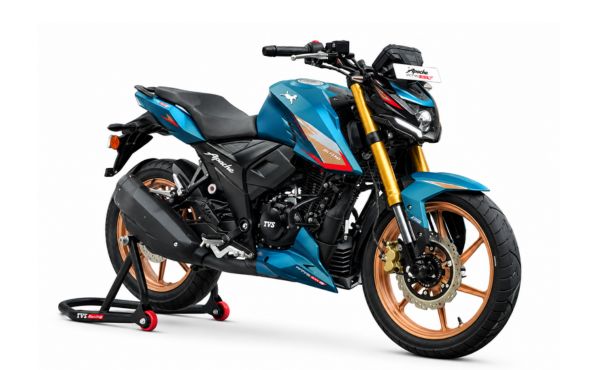
TVS calls the Apache RTR 310 a “Freestyler,” positioning it as a naked performance motorcycle rather than a fully faired sportbike. Its design uses fluid body lines alongside angular surfaces, with a forward-biased stance, raked tail, sculpted tank extensions, exposed mechanical hardware, and a compact naked-bike silhouette. TVS describes the visual theme as cyborg-inspired, and the motorcycle’s split headlamp, muscular front profile, short rear section, and visible aluminium swingarm reinforce that identity.
The front end is one of the RTR 310’s strongest visual elements. It uses an adaptive Bi-LED cyborg headlamp with intelligent beam control, paired with five-LED sequential turn-signal lamps. Sculpted knuckle guards sit ahead of the handlebar and contribute to both the motorcycle’s wind deflection and its aggressive streetfighter appearance.
The transparent anti-fog clutch cover is another distinctive styling component. It exposes the clutch area and sets the RTR 310 apart from conventional naked motorcycles with a standard opaque engine cover. Other design details include the 5-inch horizontal TFT display, steel tapered handlebar, exposed hybrid trellis-and-cast frame sections, aluminium sub-frame, die-cast aluminium swingarm, and side-mounted exhaust layout.
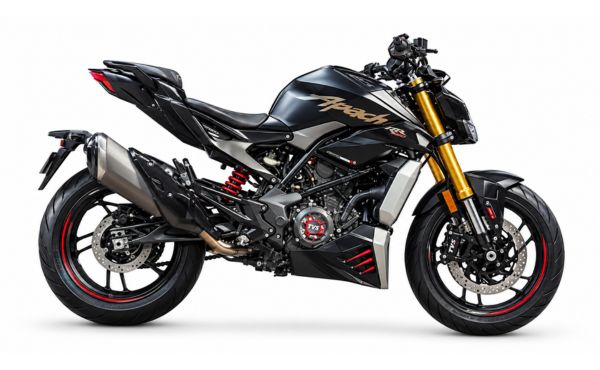
The September 2026 Black Diamond Edition introduces a more understated alternative to the brighter regular colours. It features an all-black body finish and new livery, and is a top-spec, quickshifter-equipped version.
Colour Options And Variants
There are six colours or livery treatments available for the current Apache RTR 310 range.
- Arsenal Black
- Fury Yellow
- Fiery Red
- Sepang Blue
- Black Diamond Edition
- Black and Champagne Gold
Availability depends on the selected variant, and dealers may not stock every colour in every city.
Arsenal Black gives the RTR 310 a more discreet appearance and suits riders who prefer the naked-bike design without bright graphics. Fury Yellow and Fiery Red create a more attention-grabbing streetfighter appearance, while Sepang Blue uses blue, white, and red decals inspired by racing colours.
The Black Diamond Edition uses a fully black finish and is the most understated-looking special version in the range. The Black and Champagne Gold treatment is associated with the Limited Anniversary Edition, providing a more celebratory livery for buyers seeking a distinct special-edition appearance.
The Apache RTR 310 comes in eight variants, including base versions, BTO configurations, the Black Diamond Edition, and the Limited Anniversary Edition.
- Arsenal Black Base without Quickshifter
- Arsenal Black Base
- Fury Yellow Base
- Black Diamond Edition
- Fiery Red Base
- BTO 1
- BTO 2
- Limited Anniversary Edition
Equipment levels, colour availability, and prices differ by variant, so the final dealer quotation should identify the exact trim and features included.
The Arsenal Black Base without Quickshifter is the entry point to the RTR 310 range. It gives buyers the core streetfighter design and standard hardware, but omits the bi-directional quickshifter.
The Black Diamond Edition is a newly introduced high-spec model. It combines the all-black livery with the top-spec configuration, including a quickshifter.
Unlike the RR 310 Black Diamond Edition, the retrieved reports do not explicitly confirm a keyless-ride feature for the RTR version, so buyers should not assume it is included without dealer confirmation.
The BTO 1 and BTO 2 configurations are intended for buyers who want the Built To Order route. TVS’s configurator lets you select available performance kits, styling options, and colours; the performance-oriented package can include fully adjustable suspension, TPMS, a brass-coated chain, RT-DSC, cornering rider aids, launch control, wheelie control, and related functions. As BTO equipment can change based on current availability, buyers should request a detailed written feature sheet before placing an order.
The Limited Anniversary Edition sits at the top of the listed range and is identified by its Black and Champagne Gold colour scheme. It is intended primarily for buyers who value special-edition styling and positioning, so confirm its complete feature list rather than assuming it includes every BTO or Black Diamond component.
The TVS Apache RTR 310 is priced between budget performance nakeds and pricier premium streetfighters. Its main value isn’t just the 312 cc engine, but also the mix of riding modes, TFT display, quickshifter option, and advanced BTO electronics at different price points.
Value For Money And Pricing
The Apache RTR 310 range has eight variants in India. The entry Arsenal Black Base without Quickshifter is listed at ₹ 2,29,990 ex-showroom. The prices below are ex-showroom Delhi figures, so that on-road prices will vary by state, insurance selection, road tax, registration, accessories, finance charges, and dealer-level offers.
The Black Diamond Edition is notable because it’s only ₹2,000 more than the Arsenal Black Base and Fury Yellow Base in Delhi. It comes with special all-black styling and is based on the top variant with a quickshifter. Still, get a written feature list, as the special-edition name doesn’t guarantee all BTO features or accessories.
The entry-level RTR 310 is a good way to get a 312 cc liquid-cooled naked bike with a five-inch TFT display, TVS SmartXonnect, five riding modes, ride-by-wire throttle, traction control, adaptive Bi-LED lights, and a 43 mm USD fork. If you want the basic streetfighter look and standard electronics without a quickshifter or lots of custom options, this version offers the best value.
The mid-range versions are a good choice if you care about certain features. The Black Diamond Edition stands out visually and comes with a quickshifter. It’s a good pick if you want clutchless shifting and the all-black look without going for the BTO models.
The BTO 1 and BTO 2 versions are for buyers who want to pay extra for features like adjustable suspension, tyre-pressure monitoring, a brass-coated chain, and, in the dynamic package, RT-DSC with cornering ABS, traction control, launch control, wheelie control, drag-torque control, rear-wheel lift-off protection, slope-dependent control, and cornering cruise control. These extras make sense if you’ll actually use the adjustability and rider aids, not just if you want the cheapest option.
The Limited Anniversary Edition is mainly for those who want a special-edition bike. Its Black and Champagne Gold look is its main highlight, so it’s best for buyers who care about unique styling and top-tier status. Don’t assume it has all BTO features—check the equipment list carefully before booking.
The RTR 310 competes most directly with performance-oriented naked motorcycles in India, although rivals vary substantially in engine capacity, output, equipment, price, and riding character. The closest cross-shopping options include:
- KTM 250 Duke
- Bajaj Pulsar NS400Z
- KTM 390 Duke
- Triumph Speed 400
- BMW G 310 Rr
The Apache RTR 310 gives the best value in two versions: the Base without Quickshifter for those who want the core bike at the lowest price, and the Black Diamond Edition for those who want the quickshifter and special styling without paying for the pricier BTO models. The BTO versions are worth it only if you really want features like adjustable suspension, TPMS, and advanced rider aids—not just for a higher-spec badge.
Before you decide, compare the on-road price of the RTR 310 variant you want with its rivals in your city. Ask the dealer for a detailed quote that lists the colour, quickshifter, BTO kit, rider aids, TPMS, adjustable suspension, warranty, accessories, insurance, and any finance charges. This is important because the price difference between the entry model and the Anniversary Edition is almost ₹67,000 ex-showroom, and the features can vary a lot.