Overview
Performance & Engine
The Ntorq 150 has a 149.7 cc, single-cylinder engine with three valves and fuel injection. It uses O3C, or Oil-Cooled Combustion Chamber technology, which is different from a typical liquid-cooled engine.
Maximum power is 9.7 kW (13.2 PS) at 7,000 rpm. Peak torque is 14.2 Nm at 5,500 rpm. These are the official engine-output figures and should be retained rather than replacing the 149.7 cc displacement with a rounded 150 cc technical specification.
The engine specifications above use O3C, which stands for Oil-Cooled Combustion Chamber technology. Bore, stroke, compression ratio, or individual transmission ratios are not specified.
| Engine item |
Specification |
| Engine configuration |
Single-cylinder, three-valve |
| Displacement |
149.7 cc |
| Engine technology |
O3C—Oil-Cooled Combustion Chamber |
| Fuel system |
Fuel injection |
| Maximum power |
9.7 kW (13.2 PS) at 7,000 rpm/td>
|
| Maximum torque |
14.2 Nm at 5,500 rpm |
| Starting system |
Self-start with ISG |
| Fuel-tank capacity |
5.8 litres |
The 0–60 km/h acceleration is claimed to be 6.3 seconds. This is a manufacturer-stated figure. Rider weight, road gradient, or test procedure for this claim are not disclosed.
Independent measurements should remain separate from that claim. Some comparison data lists 0–60 km/h times of 6.43 seconds in Street mode and 5.41 seconds in Race mode, and 0–80 km/h in 12.23 seconds and 10.12 seconds, respectively. These are mode-specific results and not replacements for the official 6.3-second figure.
The official acceleration figure is what the manufacturer advertises, while independent tests show how the scooter performs in different modes. These numbers may vary depending on the scooter and conditions.
The Ntorq 150 has an automatic continuously variable transmission, or CVT. A separate gearbox entry and explicit detail for the CVT specification are not provided.
Unlike a manual motorcycle gearbox, the CVT does not require the rider to select first, second, or subsequent gears. Its ratio changes automatically as the scooter accelerates, providing the twist-and-go operation associated with this scooter layout. No fixed gear count should be assigned to the Ntorq 150.
Self-start with ISG is the listed starting method. ISG concerns engine starting and should not be described as an automatic gear-selection feature or a separate transmission. Available specifications do not establish a different CVT ratio set for the standard and TFT versions.
The Ntorq 150 has a claimed top speed of 104 km/h, according to the manufacturer. This is a manufacturer-stated maximum, not a recommended sustained cruising speed.
Factors like rider weight, wind, and road slope are not specified, and it is not clear if the speed is from the speedometer or independent testing. The scooter may not always reach this speed, especially with extra weight or in different conditions.
Mileage And Fuel Efficiency
The Ntorq 150 is said to have a claimed mileage of 40 km/l for both variants, but there is no official certification number or detailed data published. The appropriate wording is “40 km/l claimed mileage.”
The claimed figure and owner-submitted averages have different bases, even when their displayed numbers happen to match.
Owners usually report mileage between 37 km/l and 40 km/l for the Ntorq 150, depending on the variant. These are just reported numbers, not guaranteed minimums or proof that one version is more fuel-efficient than the other. The small differences do not show a clear advantage.
A test result for the Ntorq 150 is 45.84 km/l when ridden at a leisurely pace. Other estimates suggest approximately 35–38 km/l for a mixture of spirited and sedate riding, and note that aggressive Race-mode use reduces fuel economy.
The 45.84 km/l number is a measured test result; the 35–38 km/l range is based on usage expectations, not the same kind of evidence.
Tested city consumption is 46.9 km/l and highway consumption is 49.92 km/l. These figures are from independent testing and should not be presented as owner averages or official mileage specifications.
It’s important to keep the numbers separate: 40 km/l is the claimed mileage, about 37–40 km/l is what owners report, and higher numbers come from independent tests. These figures are not guaranteed for every rider or trip.
Features And Technology
The TVS Ntorq 150 offers LED lighting, Bluetooth connectivity, single-channel ABS, riding modes, and practical storage as part of its features for the Indian market. There are two versions: Ntorq 150 and Ntorq 150 TFT. The main difference is in the display and some connected features. The basic equipment is the same, but not all details are listed for each variant.
- Projector LED headlamps: Multipoint projector headlamps with projector LED lighting are used. This is a projector-LED arrangement rather than a conventional halogen headlamp with an LED daytime running light. Illumination distance or brightness figures are not provided.
- LED tail lamp and indicators: The specifications identify LED tail lighting and LED turn-signal lamps. A T-shaped rear-lamp design and a distinctive front combination lamp are part of the lighting package.
- Variant-specific instrument displays: The standard Ntorq 150 has an LCD console, and the Ntorq 150 TFT has a 5-inch TFT console. The TFT display is therefore not standard across the range, even though both versions offer digital instrumentation. Brightness control is also listed in the secondary specifications.
- Bluetooth connectivity: Bluetooth connectivity is included, allowing for smartphone-pairing capability, but not every connected function is identical between the LCD and TFT versions.
- Voice Assist on TFT: Voice Assist is available specifically with the TFT variant. It should not be presented as a standard feature of the LCD-equipped Ntorq 150 without variant-specific confirmation.
- Street and Race riding modes: The Ntorq 150 offers selectable Street and Race riding modes. These are selectable riding modes, not manually selected transmission gears; the mode names should be retained rather than replaced with an assumed Eco or Power mode.
- Single-channel ABS: The Ntorq 150 is equipped with single-channel ABS. This should not be described as dual-channel ABS or confused with the Synchronized Braking Technology used on some other TVS scooters.
- Front-disc and rear-drum brakes: The Ntorq 150 has a 220 mm front disc and a 130 mm rear drum. The scooter therefore does not have a dual-disc braking setup, despite its ABS-equipped specification.
- Traction control: Both the standard and TFT variants include traction control. It is an electronic rider aid and should not be described as a guarantee against loss of grip. Details such as intervention logic, operating thresholds, or whether it can be switched off are not specified.
- Adjustable brake levers on TFT: Adjustable brake levers are included in the TFT variant. This allows the lever arrangement to be tailored, but the number of adjustment positions or identical fitment on the standard version is not confirmed.
- Self-start with ISG: The starting method is “Self – ISG,” identifying an electric-start arrangement using an Integrated Starter Generator; it does not, by itself, establish an automatic idle-stop system or a kick-start backup.
- Underseat storage: Under the seat, the Ntorq 150 has 22 litres of storage space. The total capacity is 22 litres, but helmet size and the shape of the compartment matter for fitment.
- Fuel-filling access through the front keyhole: The Ntorq 150 has rear fuel filling operated through the front keyhole. This is a convenience feature distinct from keyless operation—the TFT variant still uses a physical key.
- Multifunction lock and key shutter: The Ntorq 150 includes a multifunction lock and key-shutter lock. These are physical-key convenience and protection features rather than remote keyless unlocking or a smart-key system.
- Tubeless tyres: The Ntorq 150 uses a 100/80-12 front tyre and a 110/80-12 rear tyre, both tubeless. These are the India-market tyre sizes; no alternative tyre size should be assigned to the TFT variant without additional information.
- Conventional hydraulic suspension: The front uses telescopic suspension with hydraulic dampers, while the rear uses a coil spring with hydraulic dampers. Electronically adjustable suspension or a rear-preload adjustment range is not specified.
- Maintenance-free battery: The electrical specification includes a 12 V, 5 Ah maintenance-free battery. “Maintenance-free” describes the battery type, not the servicing requirements of the entire scooter.
- Aerodynamic winglets: Aircraft-inspired winglets are intended to support high-speed stability. This is the stated design purpose; downforce measurements or a quantified stability improvement are not published.
- Naked handlebar: The exposed handlebar is another listed design feature. TVS associates it with control and a distinctive stance, but it should not be interpreted as an adjustable handlebar or a separate steering-assistance system.
- Coloured alloy wheels and sporty exterior detailing: TVS highlights coloured alloy wheels, a sporty muffler, and stealth-aircraft-inspired bodywork. These are appearance-related features and do not establish different engine specifications or mechanical equipment for each colour.
Build Quality
The TVS Ntorq 150 has a reinforced scooter chassis, telescopic front suspension with hydraulic dampers, and a rear coil spring with hydraulic damping. It weighs 115 kg. Its dimensions are 1,861 mm long, 740 mm wide, and 1,120 mm tall, with a 1,285 mm wheelbase. TVS publishes one set of these specifications rather than separate dimensions and weights for the standard and TFT versions.
The Ntorq 150 uses the Ntorq 125’s main-frame foundation with strengthening and reinforcement. This describes an evolution of the existing platform, not a completely new structure in every respect. The official product page does not explain the location or construction of each reinforcement.
Owners usually praise the scooter’s build quality. They mention good paint, solid-feeling switches, and tidy panel gaps. These comments give a good first impression, but they do not guarantee that every scooter will have the same finish or last as long.
Some owners noticed that the plastics around the handlebar creaked a bit. So, even with good paint and well-aligned panels, there can be some minor trim noise. This was just seen on the tested scooter and does not mean every Ntorq 150 will have this issue.
The available official information does not provide a material-by-material durability assessment or measured corrosion resistance. It is therefore more accurate to describe the finish as generally well reviewed than to claim that the scooter is completely rattle-free or that every exterior component has proven long-term durability.
Handling
A key strength of the Ntorq 150 is its balanced handling. It is easy to steer in traffic, feels smooth when cornering, and holds its line well. Road tests also say the chassis feels stable and composed during daily rides.
The exposed handlebar gives useful leverage when steering. Owners report little effort when changing direction and no handlebar-to-knee contact during tight U-turns. This supports its urban manoeuvrability, but does not guarantee the same knee clearance for every rider.
The scooter uses 12-inch tubeless tyres, sized 100/80 at the front and 110/80 at the rear. This wheel arrangement helps it balance agility and comfort.
The suspension strikes a balance between comfort and control. It is not very soft, but it does not hit hard over rough roads. The ride is fairly comfortable, and carrying a passenger makes the suspension feel smoother and more stable.
Longer-term feedback is positive. Some long-term reports describe the scooter as planted at speed, confidence-inspiring through corners, and pliant over bad roads. These findings reflect tested scooters and should not be treated as proof of identical behaviour on every surface or with every load.
The braking setup uses a 220 mm front disc and a 130 mm rear drum, with single-channel ABS. The front brake’s bite and lever feel are well regarded. This is not a dual-disc or dual-channel ABS arrangement.
TVS lists 155 mm ground clearance. This is relevant to speed breakers and uneven roads, but the company does not publish clearance under different passenger or luggage loads. It does not guarantee that the scooter will avoid grounding in every situation.
Comfort
The Ntorq 150 has a spacious riding position, a long seat, and a practical floorboard. TVS lists the seat as 765 mm long and 770 mm high. These numbers are helpful, but comfort and reach will still depend on the rider.
Multiple owners find the scooter spacious, with a neutral seating position and enough seat space for two full-sized adults on tested scooters. This supports regular rider-pillion use, although comfort still depends on the people using it. A tall owner fitted comfortably and experienced no handlebar-to-knee contact during lock-to-lock U-turns.
The seat is described as wide and long enough for two adults, with cushioning that balances support and comfort while retaining some firmness. During hour-long rides with a pillion, the test scooter did not feel cramped. Road tests also praise the wide, well-cushioned seat and find that comfort remains broadly unchanged with a passenger.
The suspension is generally comfortable for daily use, but it is not consistently described as soft. Ordinary broken roads are absorbed reasonably well, while very rough surfaces and sharp bumps can still feel uncomfortable. Some owners report a bumpier response on demanding roads despite otherwise positive comments about the seat and ride.
Overall, the Ntorq 150 feels sporty but still comfortable for daily use. The seat, floorboard, and riding position get good reviews.
Styling
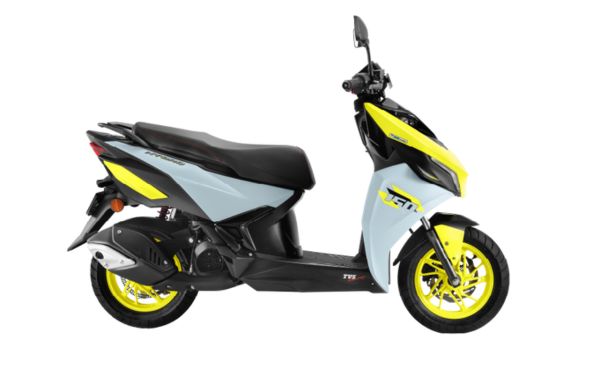
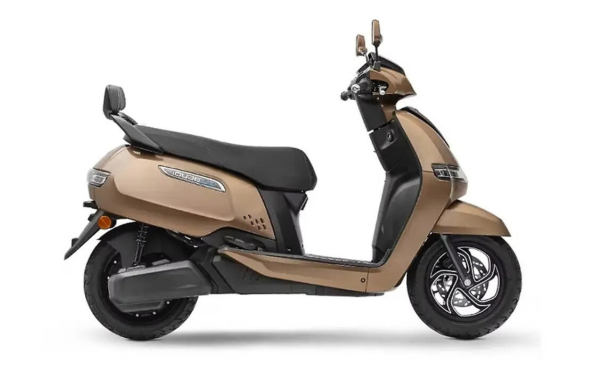
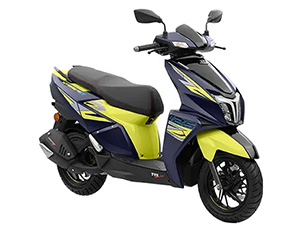
The TVS Ntorq 150 in India has an angular, aircraft-inspired design built around sculpted bodywork, aerodynamic winglets, an exposed handlebar, projector LED headlamps, and coloured alloy wheels.
TVS offers two variants—Ntorq 150 and Ntorq 150 TFT—with four distinct colours across the range: Nitro Green, Racing Red, Stealth Silver, and Turbo Blue. Each variant has three listed colour choices rather than access to all four.
TVS says the scooter’s look is inspired by stealth aircraft, with winglets that stand out at the front. These are meant to help with high-speed stability, though there are no published aerodynamic test results. Mainly, the winglets add to the Ntorq 150’s sharp, sporty style.
The front combines multipoint projector LED headlamps with a separate front combination-lamp arrangement. The shaped lighting and angular body panels create a more aggressive presentation than a conventional rounded commuter scooter.
TVS’s technical specifications confirm LED headlamps and LED turn signals, so the lighting description is not simply a reference to LED daytime running lights around a halogen lamp.
The exposed, or “naked,” handlebar is another defining detail. It gives the upper section a less enclosed appearance than a fully covered scooter handlebar assembly. TVS lists it as a design feature, but does not establish an adjustable handlebar mechanism or a different handlebar arrangement between the two variants.
Coloured alloy wheels and a sporty muffler continue the visual theme along the sides. TVS advertises alloy wheels in four colours, but the retrieved text does not map every wheel finish to each body colour.
At the rear, the Ntorq 150 uses a T-shaped LED tail-lamp design. This provides a recognisable rear lighting signature, while the angular bodywork maintains the aircraft-inspired theme. The official page does not identify separate body panels or a different rear-lamp design for the TFT variant.
Colour Options And Variants
TVS NTorq 150 is available in four colours and they are:
- Nitro Green
- Racing Red
- Stealth Silver
- Turbo Blue
All four colour names are used for the Ntorq 150, but each variant is not available in every colour.
The variant pairing below is drawn from available product information. The official product-page FAQ confirms the overall palette but does not specify the pairing details.
| Colour |
Ntorq 150 standard |
Ntorq 150 TFT |
| Racing Red |
Listed |
Listed |
| Turbo Blue |
Listed |
Listed |
| Stealth Silver |
Listed |
Not Listed |
| Nitro Green |
Not Listed |
Listed |
Both variants therefore share Racing Red and Turbo Blue. Stealth Silver is listed for the standard version, while Nitro Green is listed for TFT.
TVS officially identifies two India-market variants:
- Ntorq 150
- Ntorq 150 TFT
The first version is also called “Standard.” There are differences in instrument presentation and colour availability, but no major exterior shape changes between them are established.
| Variant |
Instrument presentation |
Listed colours |
Styling distinction |
| Ntorq 150, also called Standard |
LCD console |
Stealth Silver, Racing Red, Turbo Blue |
Standard-specific Stealth Silver option |
| Ntorq 150 TFT |
5-inch TFT console |
Nitro Green, Racing Red, Turbo Blue |
TFT console and TFT-specific Nitro Green option |
Ntorq 150 Standard
The standard Ntorq 150 retains the model’s aircraft-inspired bodywork, winglets, exposed handlebar, projector LED lighting, coloured alloy-wheel presentation, and T-shaped rear lamp. Its instrument display is an LCD rather than the TFT screen fitted to the higher version.
Its colours are Stealth Silver, Racing Red, and Turbo Blue. Stealth Silver is the supported variant-specific option, while the other two are shared with TFT.
Ntorq 150 Tft
The Ntorq 150 TFT replaces the standard LCD presentation with a 5-inch TFT console. This changes the rider-facing dashboard appearance, while the official page continues to present both versions within the same Ntorq 150 design family.
Its colours are Nitro Green, Racing Red, and Turbo Blue. Nitro Green distinguishes its colour selection from the standard version, but the TFT name should not be interpreted as confirmation of exclusive body panels, different winglets, or a separate lighting design. Those exterior differences are not established in the cited official information.
Value For Money And Pricing
The TVS Ntorq 150 is offered in two India-market versions: Ntorq 150, commonly called Standard, and Ntorq 150 TFT. Currently, Delhi places the Standard at ₹ 1,12,900 ex-showroom and the TFT at ₹ 1,22,100. On-road price for the standard version is ₹ 1,31,248 and ₹ 1,41,360 for the TFT variant.
The Ntorq 150’s value proposition is a performance-oriented scooter package available below several larger-capacity sporty alternatives. TVS publishes the same model-level engine specification—149.7 cc, 13.2 PS, and 14.2 Nm—and identifies both Standard and TFT versions. Indian variant analysis reports that the two share the engine and chassis.
The Standard version is a better choice for buyers who want the main features of the Ntorq 150 without needing the bigger display. It has the same engine and chassis, includes connected-console features, and costs less than the TFT. This makes it a good value if you care more about the scooter than the advanced dashboard.
The published variant analysis gives both versions identical power, torque, acceleration claims, and top-speed claims. Paying more for TFT does not establish faster acceleration or a higher manufacturer-stated maximum speed.
The TFT version adds a 5-inch full-colour display and a four-way navigation switch, according to Indian motorcycle variant analysis. The same analysis describes a broader connected-function package, including additional telematics and over-the-air support. These are the principal reasons to consider paying more, rather than expecting an engine upgrade.
Equipment attribution needs qualification. Buyers should therefore confirm traction-control fitment on the exact Standard or TFT scooter rather than treating an uncertain feature assignment as a settled value advantage.
The TFT premium is most defensible for someone who will regularly use its display and confirmed additional connected functions. Conversely, a buyer who primarily wants the shared engine and chassis may find Standard more economical.
Purchase price alone does not establish total ownership value. The official range page does not publish a fixed annual servicing cost, guaranteed maintenance expenditure, or a rupee-per-kilometre ownership figure. Claims that the Ntorq 150 is definitively the cheapest sporty scooter to maintain would therefore exceed the available evidence.
The Ntorq 150’s principal sporty-scooter competitors include
- Yamaha Aerox 155
- Hero Xoom 160
- Aprilia SR 175
All three are recognised as rivals, with variant analysis directly placing Aerox 155 and Xoom 160 against the Ntorq 150. These are relevant India-market alternatives, not overseas models added solely due to engine capacity similarities.
The Standard version is the more affordable way to get the Ntorq 150’s main features. The TFT version adds a bigger display and more connected features, but not a different engine. This is the main difference to consider when comparing price and equipment.
Before comparing it with Aerox 155, Xoom 160, or SR 175, obtain a written quotation separating ex-showroom price, registration-related charges, insurance, accessories, and any finance fees. Given the conflicting published prices and incomplete official variant matrix, the final assessment should use the actual scooter’s confirmed equipment and invoice.