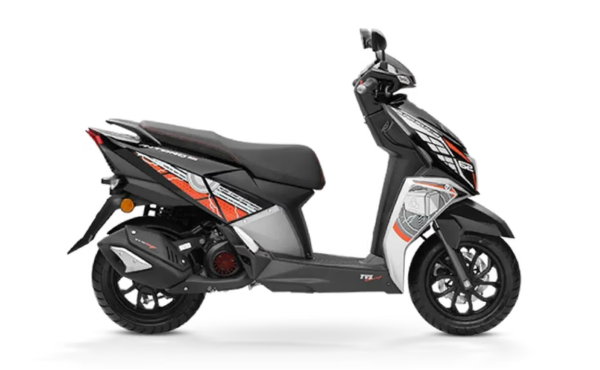
Overview
Performance And Engine
All versions use the same basic engine: a 124.8 cc, single-cylinder, four-stroke, air-cooled, fuel-injected engine with three valves. The technical displacement is 124.8 cc.
The scooter uses a dry paper-and-foam air filter and an automatic centrifugal clutch. Bore, stroke, and compression ratio details are not listed in the available technical information.
| Engine item |
Specification |
| Displacement |
124.8 cc |
| Configuration |
Single-cylinder, four-stroke, spark ignition |
| Number of valves |
Three |
| Cooling |
Air-cooled |
| Fuel system |
Fuel injection |
| Clutch |
Automatic centrifugal clutch |
| Air filter |
Dry paper and foam |
| Fuel-tank capacity |
5.8 litres |
These engine and fuel system details are the same for all versions.
The Disc, Race Edition, XT and Super Squad have identical maximum engine outputs: 7 kW at 7,000 rpm and 10.6 Nm at 5,500 rpm. There is no power or torque advantage for one of these four versions over the others.
Some specifications describe the power as 9.4 PS, while others use 7 kW. The most consistent specification is 7 kW at 7,000 rpm.
Some sources list the power as 9.4 PS, while others use 7 kW. The most consistent figure is 7 kW at 7,000 rpm.
Street mode is meant for efficient, smooth commuting, while Race mode is for higher performance. The technical output numbers are shown with slashes, not labeled by mode, so they are reported as published.
| Variant |
Power |
Torque |
| Disc |
7 kW at 7,000 rpm |
10.6 Nm at 5,500 rpm |
| Race Edition |
7 kW at 7,000 rpm |
10.6 Nm at 5,500 rpm |
| XT |
7 kW at 7,000 rpm |
10.6 Nm at 5,500 rpm |
| Super Squad |
7 kW at 7,000 rpm |
10.6 Nm at 5,500 rpm |
| Race XP |
6.6 kW / 7.5 kW at 7,000 rpm |
10.0 Nm / 11.5 Nm at 5,500 rpm |
The technical details differ by variant. Race XP alone has the higher 7.5 kW and 11.5 Nm output figures.
The Disc, Race Edition, XT, and Super Squad reach 0–60 km/h in 8.9 seconds. Race XP is quicker, at 7.9 seconds.
There is some disagreement about Race XP’s 0–60 km/h time, with both 7.9 and 8.3 seconds reported. The 7.9-second figure is more common, but both are mentioned.
These acceleration numbers do not specify rider weight, road slope, or how the tests were done.
The Ntorq 125 uses an automatic continuously variable transmission (CVT). An automatic centrifugal clutch is also confirmed, but there are no separately labelled CVT specifications or individual transmission ratios in the technical information.
The technical information describes the system as an automatic CVT with an automatic centrifugal clutch. Riding-mode labels are listed separately from the transmission specification.
There are no established different CVT ratios for Disc, Race Edition, XT, Super Squad, and Race XP.
The top speed is 94 km/h for Disc, Race Edition, XT, and Super Squad.
Race XP’s technical information lists a top speed of 98 km/h in Race mode. There is no published separate Street-mode maximum.
| Variant |
0–60 km/h figure |
Top Speed |
| Disc |
8.9 seconds |
94 km/h |
| Race Edition |
8.9 seconds |
94 km/h |
| XT |
8.9 seconds |
94 km/h |
| Super Squad |
8.9 seconds |
94 km/h |
| Race XP |
7.9 seconds |
98 km/h in Race mode |
These performance numbers do not say if the top speed is from the speedometer or measured by other means.
Mileage And Fuel Efficiency
The Ntorq 125 has an ARAI-certified fuel efficiency of 48.5 km/l, but this is a general model figure, not specific to each variant. There is no separate ARAI mileage for each version.
Owners report an average fuel efficiency of 43 km/l. There is no controlled, up-to-date mileage comparison for all five versions, so this is a general reference.
There is no mileage breakdown by variant. Owners report a wide range, from about 35–37 km/l to as high as 51 km/l on some trips, showing that fuel efficiency varies.
Features And Technology
The TVS Ntorq 125 in India comes with connected technology, digital displays, LED lighting, and practical features. Equipment differs by version, especially in display type and smartphone features. Race XP adds Street and Race modes, while XT features a hybrid TFT-and-LCD console and extra connected info. The following features are listed by which variant they come with, not as standard for all.
- SmartXonnect smartphone connectivity: The Ntorq 125 offers a SmartXonnect-enabled console with more than 60 connected features. Smartphone connectivity is available on the Disc, Race Edition, Race XP, and XT variants, but the available functions differ by version. SmartXonnect is a connected-feature platform, with functions and display features varying depending on the variant.
- Digital instrumentation on the regular versions: The LCD console displays a speedometer, odometer, fuel gauge, trip information, clock, engine-temperature information, and a lap timer. The regular console has Street and Sports display modes. These are dashboard presentation modes and should not be interpreted as selectable engine-output settings.
- Hybrid TFT and LCD console on XT: The XT’s instrument cluster is a hybrid console combining a coloured TFT screen with a negative LCD. This distinguishes XT from the conventional LCD-equipped versions. It should not be described as a touchscreen or as two TFT screens.
- Turn-by-turn navigation assistance: Some models offer turn-by-turn navigation on the console through smartphone pairing. You need a compatible phone for this feature.
- Incoming call and SMS alerts: Race Edition, Race XP, and XT show call and SMS alerts on the console after pairing with your phone.
- Voice assistance on Race XP and XT: Race XP offers voice assistance as part of its SmartXonnect features. On XT, you can use a switch to give voice commands for navigation and screen brightness, with audio feedback. These features are not available on every version.
- Additional connected information on XT: The XT version shows live cricket scores, weather, news, and social media notifications on its display. These features are only on XT, not all versions.
- Last-parked-location assistance: Race XP and XT have a last-parked-location feature, helping you find where you parked using the connected system.
- Ride statistics and lap-timer functions: Race Edition offers ride statistics. Race XP adds a lap timer and mode-based analytics through the TVS Connect app. XT also has a lap-time recorder, ride analytics, and a top-speed recorder. These features show riding data but do not change how the scooter performs.
- TVS Connect app integration: The scooter can connect to your smartphone using the TVS Connect app, which works with most major mobile platforms.
- Street and Race riding modes on Race XP: Race XP has two riding modes: Street for efficient, smooth commuting, and Race for full performance. These modes are selectable and do not change the transmission gears manually.
- LED headlamps: All five versions have an LED headlamp and signature LED lighting. Race Edition has a special headlamp design. There is no information about projector headlamps, brightness ratings, or measured illumination distance.
- Signature T-shaped rear lamp: All versions have a signature ‘T’-shaped rear lamp. This is a confirmed feature, but there is no mention of LED turn indicators in the technical details.
- Front-disc and rear-drum braking: All five versions have a 220 mm front disc and a 130 mm rear drum. Disc, Race Edition, Race XP, and Super Squad use a Roto-Petal front disc, while XT has a 220 mm disc. None of the versions have dual-disc brakes.
- Synchronized Braking Technology: Disc and Super Squad have Synchronized Braking Technology (SBT), which balances braking between the front and rear wheels. ABS and traction control are not included.
- Tubeless tyres: All versions come with tubeless tyres: 100/80-12 at the front and 110/80-12 at the rear. There are no different tyre sizes for XT or Race XP. Tubeless tyres are not puncture-proof.
- Underseat storage, boot light and charging provision: The scooter has underseat storage with a boot light and a USB charger inside the compartment. The exact charging capacity is not confirmed.
- Conventional hydraulic suspension: All versions have telescopic front suspension with hydraulic dampers and a rear coil spring with hydraulic damping. There is no electronic suspension adjustment or selectable rear preload. These are standard, not electronic, suspension parts.
- Maintenance-free battery with variant-specific capacity: Disc, Race Edition, and Super Squad use a 12 V, 3 Ah maintenance-free battery. XT has a 12 V, 4 Ah battery, and Race XP uses a 12 V, 5 Ah battery. ‘Maintenance-free’ refers to the battery, not the whole scooter.
Build Quality
The TVS Ntorq 125 uses a “High Rigidity Under Bone Tubular Type” frame across the Disc, Race Edition, XT, Race XP and Super Squad versions. TVS lists the same overall dimensions and wheelbase for all five, establishing a shared published chassis layout rather than five separately specified structures. However, the manufacturer does not provide numerical frame-rigidity measurements or a material-by-material assessment of the exterior panels.
TVS specifies dimensions of 1,861 mm in length, 710 mm in width and 1,164 mm in height, with a 1,285 mm wheelbase and 155 mm ground clearance. The official kerb weight is 111 kg for Disc, Race Edition, Race XP and Super Squad, while XT is listed at 109 kg. These current variant-specific figures should take precedence over weights quoted in older road tests.
The scooter feels well put together, with no rattling noises noticed during test rides. This suggests good build quality. The Ntorq 125 is seen as solidly built, with no extra rattles during use. This is based on owner feedback, not formal tests of durability or finish.
Handling
The Ntorq 125 is known for its agile handling. It corners easily and feels stable on good roads, which adds to its reputation for fun handling. However, this does not guarantee the same grip on wet or rough roads.
All five variants have telescopic front suspension with hydraulic dampers and a rear coil spring with hydraulic damping. They also use 12-inch tubeless tyres, sized 100/80-12 at the front and 110/80-12 at the rear. The published specifications do not establish a different suspension type or tyre size for Race XP or XT.
Race XP shares its underpinnings with the other disc-brake-equipped Ntorq versions, apart from the weight reduction described at that time. This observation helps explain the common handling foundation, but older weight comparisons should not replace the current official kerb weights.
The scooter is easy to maneuver in tight parking spots and has a short turning radius. The handlebar does not hit the knees during sharp U-turns. These points are based on one test ride, not official measurements.
Official information does not supply steering-effort measurements or a turning-radius figure. Urban manoeuvrability has received positive reviews, but there are no precise measurements or confirmation of identical experience for riders of different sizes.
The sporty suspension helps with handling but can affect comfort. It makes the scooter feel confident in corners, but lighter riders may find the rear suspension stiff and feel bumps more.
These points show that good handling and comfort over bumps are separate. A scooter can feel stable in corners but still be firm on rough roads, so good cornering does not mean the suspension is always soft.
TVS’s 155 mm ground-clearance figure is published for the scooter, but there is no information about clearance with a rider, pillion, or luggage aboard. The information does not confirm that the scooter will avoid ground contact on all obstacles.
Comfort
Comfort reviews for the Ntorq 125 are mixed. Owners like the riding position and knee room, but mention the small footboard and firm suspension as drawbacks. Some find it more comfortable than others, so opinions vary.
The scooter has comfortable ergonomics and enough space around the knees. The handlebar clears the knees during tight U-turns, making it suitable for daily use.
A 5-foot-10-inch rider can place both feet flat on the ground with a comfortable bend at the knees. The available technical information does not list seat height or seat length.
The footboard is small, so there is not much room to move your feet. Carrying a bag there makes it even tighter and pushes your feet to the edges. This can be a problem for riders who need to change leg positions often or carry things on the floorboard.
The official overall width of 710 mm is not a floorboard-width measurement. TVS does not publish the usable footboard dimensions, so exact comparisons of foot space cannot be made from those specifications.
Some owners say the seat is well-padded and comfortable for daily rides and short trips. Both rider and passenger comfort are mentioned, but these are personal opinions, not results from formal tests.
TVS lists split grab rails across the five variants, providing a designated passenger handhold. However, the available information does not include seat dimensions, a grab-rail load rating or detailed pillion-comfort measurements.
One rider weighing 55 kg found the rear shock stiff and uncomfortable, while others thought the suspension was comfortable. This shows that ride quality feels different to different people.
The ride can feel firm, and bumps may cause discomfort after a while. Some owners praise the suspension for absorbing bumps, while others complain it is too stiff. So, the suspension may feel firm to some riders.
Comfort on longer rides depends on the rider. Some owners find it comfortable for daily and longer trips, but some tests say the firm suspension can cause discomfort over time. Seat comfort, footboard space, and suspension all play a role.
Styling
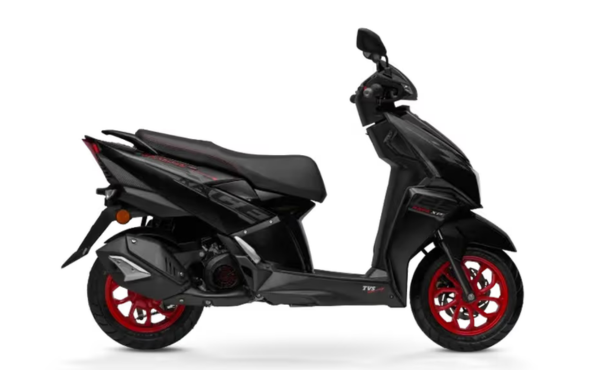
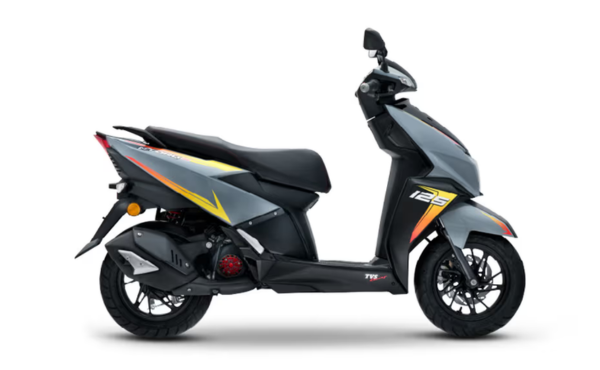
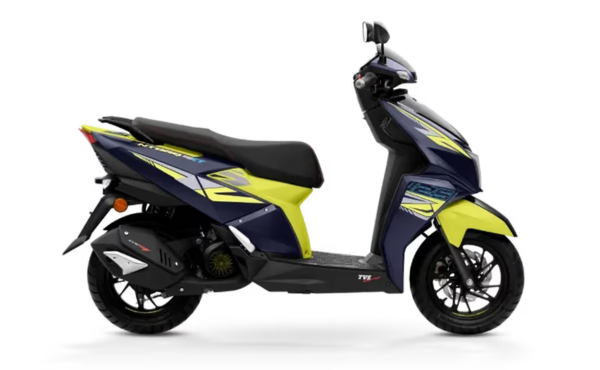
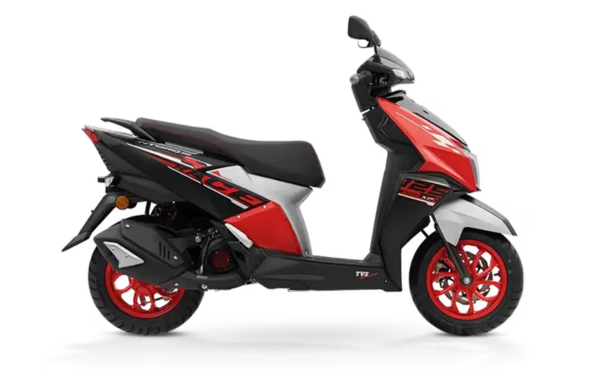
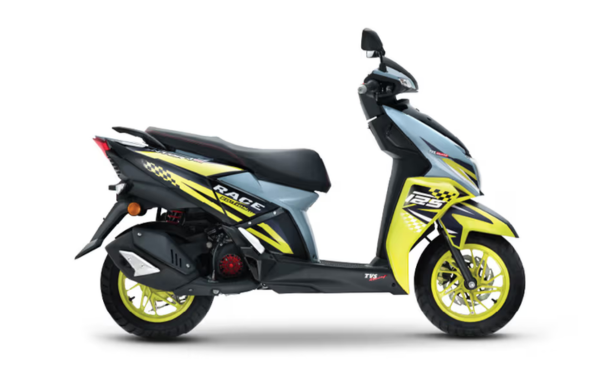
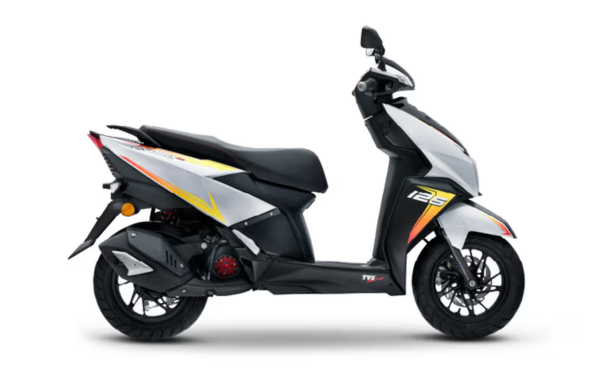
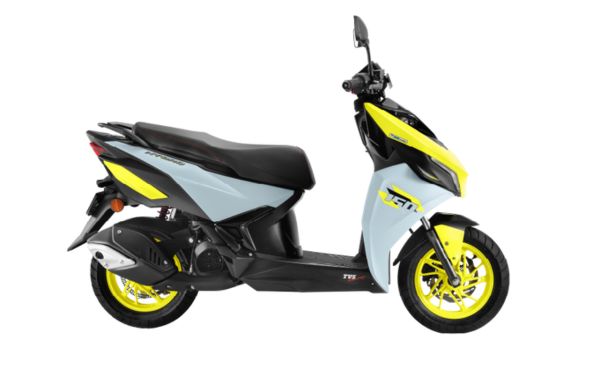
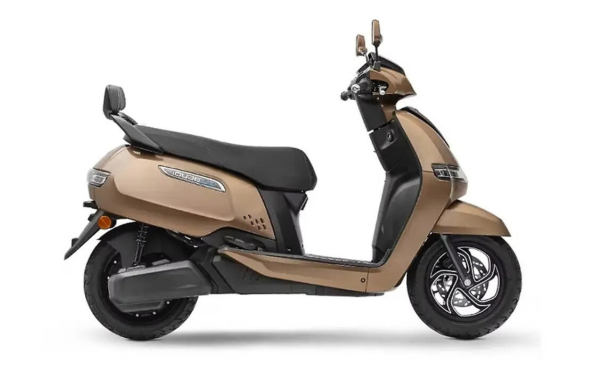
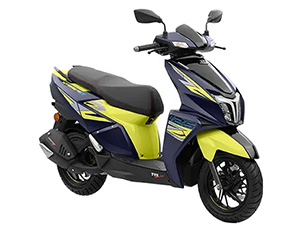
The TVS Ntorq 125 in India has a sporty, aircraft-inspired design in all versions. TVS highlights stealth styling, a signature LED headlamp, T-shaped rear lamp, split grab rails, and a short muffler on every variant. The main visual differences are in colors, graphics, wheel finishes, and details, not in the body shape.
TVS says the Ntorq 125’s body is inspired by stealth aircraft and designed to look aerodynamic. There are no published aerodynamic measurements, so the styling is mainly for appearance, not proven aerodynamic benefits.
The split grab rails at the back and the short muffler add to the sporty, aircraft-inspired look. These features are on all five versions, not just Race Edition or Race XP.
Every version features a signature LED headlamp and T-shaped rear lamp, giving the Ntorq a recognizable look. There is no information about different headlamp assemblies or projector headlamps.
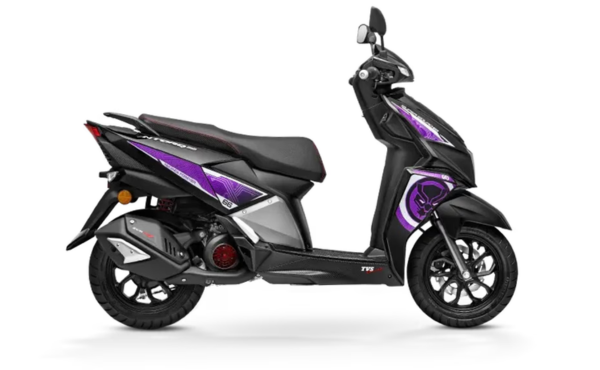
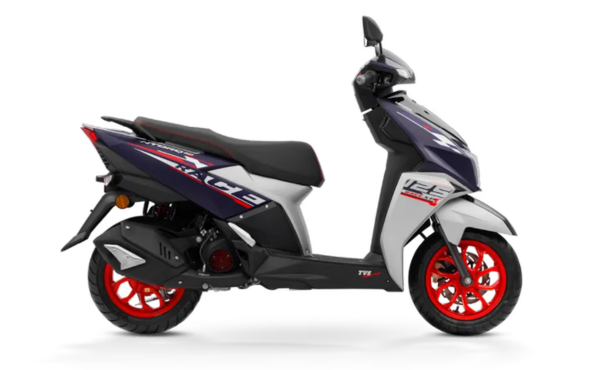
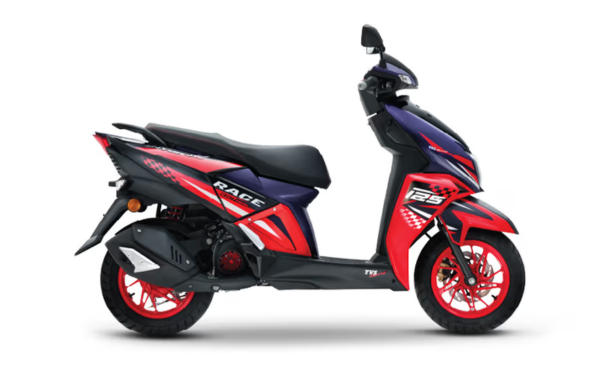
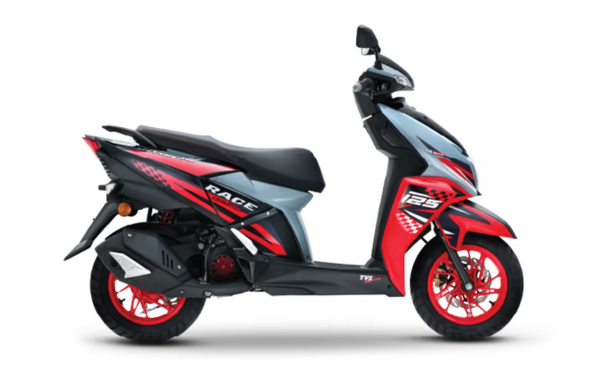
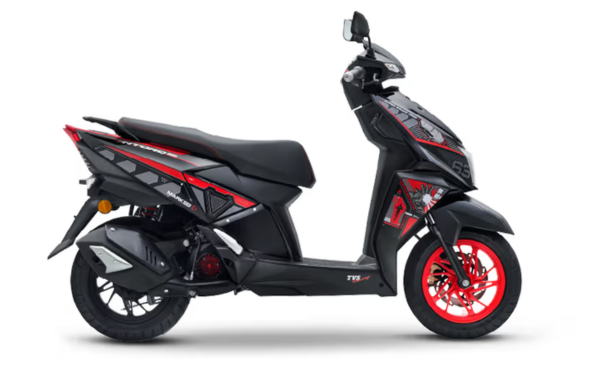
Race Edition and Race XP have race-inspired decals, while Super Squad features Marvel-themed graphics, giving each a unique look within the Ntorq family.
Colour Options And Variants
Colour availability is variant-specific. The Disc and Race Edition selectors provide clear named choices, while some Race XP and XT listings do not expose colour names. The colour guide fills those gaps, and multiple listings support the names.
| Variant |
Colour choices |
| Disc |
Midnight Black, Spiti White, Nardo Grey |
| Race Edition |
Inferno Red, Drift Blue, Rush Green |
| Race XP |
Blaze Blue, Race Red, Dark Black |
| XT |
Neon |
| Super Squad |
Black Panther, Thor, Iron Man |
There are 13 named colour or themed choices supported by these current references. Broader counts should not be treated as a confirmed current official selection without resolving the differences.
The five variants covered in this overview are:
- DISC
- RACE EDITION
- XT
- RACE XP
- SUPER SQUARD
In terms of styling, the versions differ in paint, decals, themed graphics, and some visible details, not in body design.
Value For Money And Pricing
The TVS Ntorq 125 range comprises Disc, Race Edition, Super Squad, Race XP and XT. The variant-specific price panels currently display ex-showroom figures from ₹ 91,056 for the Disc base variant in Delhi to ₹1,02,000 for the XT variant.
The value of the Ntorq 125 depends on the version and its features. The base model offers the core package, while higher-priced versions add features or cosmetic changes. XT is the most expensive, and Race XP has the highest engine output.
Disc is the cheapest version. It has a SmartXonnect console with over 60 connected features and the same engine output as Race Edition, Super Squad, and XT. Disc gives you the core features without the special editions or XT’s advanced console.
Disc’s lower price does not mean less engine power compared to the three more expensive versions.
Race Edition’s panel price is ₹5,450 above Disc. TVS publishes the same maximum power, torque, acceleration, and top-speed figures for both versions, while highlighting Race Edition’s race-inspired graphics and connected functions. Its premium should therefore not be described as payment for a more powerful engine.
Race Edition costs more than Disc and adds race-inspired graphics and features. There is no official performance advantage over Disc.
Super Squad costs ₹9,550 more than Disc and ₹4,100 more than Race Edition. It features Marvel-inspired themes but has the same engine and performance as those versions. The extra cost is mainly for the special edition look.
Super Squad’s higher price is for its character-themed design. Engine output and performance are the same as Disc and Race Edition. The technical details do not explain the extra cost.
Race XP’s displayed ₹95,000 ex-showroom price is ₹1,600 above Super Squad and ₹5,700 above Race Edition. Unlike those versions, it has a higher maximum published engine output and explicitly confirmed Street and Race riding modes. TVS also confirms voice assistance and additional connected analytics on its page. These are substantive reasons to consider its premium rather than relying only on edition branding.
Race XP offers more engine power and selectable Street and Race modes. Its price and features may attract buyers looking for extra performance and tech, but total ownership cost is not covered here.
XT costs ₹7,000 more than Race XP and ₹18,150 more than Disc. Its main difference is the hybrid colored-TFT and negative-LCD console, plus extra connected info like weather, news, cricket scores, and social media updates. The engine output is the same as Disc, Race Edition, and Super Squad.
XT is the tech-focused version, with a hybrid colored-TFT and negative-LCD console and more connected info. Its higher price does not mean better performance than Race XP.
Relevant India-market alternatives include
- Yamaha RayZR 125 Fi Hybrid
- Suzuki Avenis 125
- Honda Dio 125
- Hero Xoom 125
These scooters are compared to the Ntorq 125, but prices vary by version, location, and time. So, a single price ranking would not be accurate without matching up-to-date quotes.