Overview
Performance And Engine
The Apache RTR 160 4V runs on a 159.7 cc, single-cylinder, four-stroke, four-valve, oil-cooled, fuel-injected engine. Its Oil-Cooled Combustion Chamber (O3C) design and RT-Fi fuel injection help keep the engine temperature steady, improve throttle response, and make combustion more efficient.
| Engine item |
Specification |
| Engine type |
Single-cylinder, four-stroke, four-valve, oil-cooled, fuel-injected |
| Displacement |
159.7 cc |
| Fuel system |
Race Tuned Fuel Injection |
| Cooling system |
Oil-Cooled Combustion Chamber |
| Maximum power — Sport |
17.55 PS at 9,250 rpm |
| Maximum torque — Sport |
14.73 Nm at 7,500 rpm |
| Maximum power — Urban/Rain |
13.32 PS at 7,500 rpm |
| Maximum torque — Urban/Rain |
12.7 Nm at 6,500 rpm |
| Riding modes |
Sport, Urban and Rain |
In Sport mode, the engine produces its maximum power of 17.55 PS and 14.73 Nm of torque. Urban and Rain modes lower the output to 13.32 PS and 12.7 Nm, making the bike easier to handle in traffic or on slippery roads.
TVS has added Glide Through Technology, which allows the bike to move slowly by easing out the clutch, even without using the throttle. This helps prevent stalling in slow-moving traffic.
The Apache RTR 160 4V comes with a five-speed manual gearbox, chain drive, and a wet multi-plate assist-and-slipper clutch. The gear shift pattern is one down and four up.
| Transmission item |
Specification |
| Gearbox |
Five-speed manual |
| Shift pattern |
One down, four up |
| Clutch |
Wet multi-plate assist-and-slipper clutch |
| Final drive |
Chain |
The assist-and-slipper clutch smooths downshifts, helps prevent the rear wheel from hopping during hard braking, and reduces the effort needed to use the clutch. This feature comes standard on all current RTR 160 4V models.
The Apache RTR 160 4V can reach a top speed of 114 km/h in Sport mode. In Urban and Rain modes, the top speed is 103 km/h.
| Riding mode |
Listed maximum speed |
| Sport |
114 km/h |
| Urban |
103 km/h |
| Rain |
103 km/h |
These are the claimed top speeds, not the recommended cruising speeds. Real-world performance will vary depending on rider weight, traffic, road slope, wind, tyre condition and pressure, fuel quality, weather, maintenance, and the chosen mode. Always follow speed limits and ride safely for the conditions.
Mileage And Fuel Efficiency
The most reliable ARAI mileage figure is 41–41.4 kmpl. Some sources mention 45 kmpl, but this higher number is not consistent across all reports.
For practical planning, use about 41 kmpl rather than assuming the higher 45 kmpl figure. With its 12-litre fuel tank, 41–41.4 kmpl translates to a calculated theoretical range of around 492–497 km before reserve. This is a mathematical estimate, not a guaranteed ride distance.
Actual fuel economy depends on many factors like traffic, engine speed, riding mode, how you accelerate, the weight of rider and passenger, tyre pressure, maintenance, route, fuel quality, and weather. Reported figures range from 37–42 kmpl. Some riders mention 45 kmpl, but in heavy traffic it can drop to 36 kmpl, while steady highway riding can give 44–46 kmpl.
For daily use, it’s safer to expect about 37–42 kmpl, especially if you ride in mixed city conditions. You might get better mileage on smooth highways at moderate speeds, but heavy traffic, using Sport mode, quick acceleration, high revs, low tyre pressure, carrying a passenger, or riding on hilly roads can lower your fuel efficiency.
Features And Technology
The TVS Apache RTR 160 4V offers a 159.7 cc four-valve engine along with many safety, connectivity, comfort, and sporty features. The features you get depend on the variant. The top TFT Map version includes Google Maps mirroring, Panic Brake Alert, Type-C charging, Champagne Gold alloy wheels, traction control, a 37 mm USD fork, and dual-channel ABS. Lower variants keep the main engine, ride modes, lighting, chassis, and Glide Through Technology.
- 159.7 cc O3C four-valve engine: The RTR 160 4V uses a 159.7 cc, oil-cooled, four-valve, fuel-injected engine. TVS quotes 17.55 PS and states that its Oil-Cooled Combustion Chamber and RT-Fi technology support sharper throttle response, efficient combustion, and consistent performance.
- Race-tuned fuel injection: RT-Fi electronically manages fuel delivery. TVS presents it as a system that supports throttle response and combustion efficiency across riding conditions.
- Three riding modes: The motorcycle offers Sport, Urban, and Rain modes. These adjust engine output and ABS response for performance riding, ordinary traffic, or wet, low-grip surfaces.
- Sport mode: Sport mode provides the full engine calibration, with a listed output of 17.55 PS and 14.73 Nm.
- Urban mode: Urban mode reduces the output setting and is intended to provide a smoother, more manageable response for city traffic.
- Rain mode: Rain mode also uses the lower output calibration and adjusts ABS response for wet or low-grip conditions.
- Glide Through Technology: GTT enables low-speed movement using gradual clutch release without throttle input. It reduces the risk of stalling and makes stop-start traffic easier to manage.
- Assist-and-slipper clutch: The wet multi-plate assist-and-slipper clutch provides smoother downshifts, reduces rear-wheel hop under aggressive braking, lowers clutch effort, and improves control while cornering.
- Advanced traction control: TVS lists a traction-control system that regulates engine torque to help reduce rear-wheel spin. It is available on the USD with TFT and TFT Map variants, not across the complete range.
- Dual-channel ABS: Dual-channel ABS is available on the DC ABS with USD, TFT, and TFT Map variants. It monitors both wheels to help reduce wheel lock under heavy braking.
- Rear-wheel lift-off protection: The applicable dual-channel ABS variants include rear-wheel lift-off protection, designed to help maintain stability during hard braking.
- 37 mm USD front fork: The 37 mm upside-down front suspension is available on the DC ABS with USD, TFT, and TFT Map variants. TVS says it is designed for sharper cornering and greater straight-line stability.
- Three-step adjustable levers: The brake and clutch levers on the relevant higher variants can be adjusted in three steps without tools, helping riders tailor reach to their hand size.
- Five-inch TFT cluster: The 5-inch TFT cluster is available on the USD with TFT and TFT Map variants. It provides race telemetry, turn-by-turn navigation, ride analytics, smartphone connectivity, and customisation functions.
- TVS SmartXonnect: SmartXonnect supports Bluetooth-based smartphone pairing with the TFT console, enabling connected ride information and compatible app-linked functions.
- Turn-by-turn navigation: The TFT cluster supports route guidance. Riders should set their destination before moving and avoid interacting with the display while riding.
- Google Maps mirroring: Google Maps mirroring displays compatible smartphone navigation on the TFT screen. TVS lists it only for the top TFT Map variant.
- Race telemetry: The TFT-equipped variants provide race telemetry, allowing riders to review selected performance-related ride information.
- Ride analytics: The connected TFT package includes ride analytics for reviewing ride-related data.
- Panic Brake Alert: On the top TFT Map variant, the motorcycle automatically flashes the rear brake lamp during sudden braking to warn following traffic.
- Type-C charging port: The top TFT Map variant has a Type-C port for charging compatible devices while riding. Ensure the cable is secure, and avoid handling the device while the motorcycle is moving.
- Class-D projector headlamp: The RTR 160 4V uses a Class-D projector headlamp designed for a wider, brighter beam.
- Signature LED light blades: LED light blades flank the headlamp and form part of the motorcycle’s front-lighting signature.
- LED turn indicators: The motorcycle uses LED turn indicators, designed to improve signal visibility while complementing the Apache’s styling.
- Gold-finished forks and coloured alloy wheels: The motorcycle uses race-inspired graphics, gold-finished front forks, and coloured alloy wheels. These details vary by chosen colour and variant.
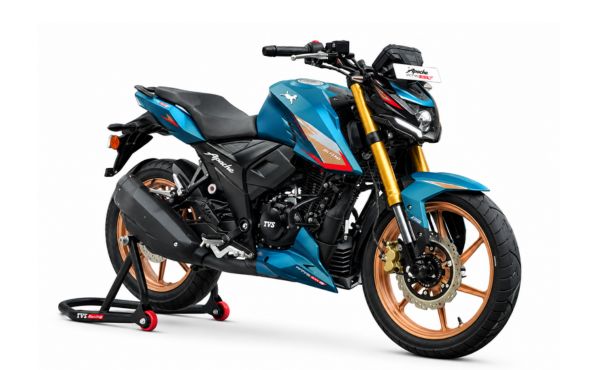
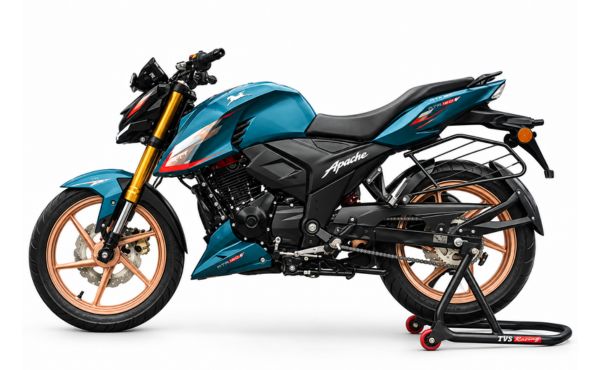
- Champagne Gold alloy wheels: The top variant in Arctic Teal receives Champagne Gold alloy wheels, which TVS lists as exclusive to that variant and colour combination.
- Hydroformed handlebar: TVS says the hydroformed handlebar supports rider control, reduces fatigue, and improves confidence through corners.
- Patented double-cradle chassis: The Double Cradle chassis is developed using Multi-Body Dynamics. TVS claims it increases stability by 25 per cent and supports sharp handling.
- Racing bullpup exhaust: The bullpup exhaust reduces weight and delivers the characteristic Apache exhaust note.
- Rear MIG suspension: The RTR 160 4V’s rear suspension uses a Monotube, Inverted, Gas-Filled shock absorber with spring aid. TVS says it supports riding comfort and cornering performance.
- Theft-resistant key: The motorcycle includes a theft-resistant key as part of its security equipment.
- Complimentary TVS XPOD helmet: The RTR series includes an XPOD helmet in Tamil Nadu, Kerala, Karnataka, Gujarat, Puducherry, Rajasthan, Uttar Pradesh, Haryana, the North East, and Odisha. This location-specific offer may change, so confirm eligibility with the dealer.
Build Quality
The Apache RTR 160 4V uses TVS’s patented Double Cradle chassis, developed with Multi-Body Dynamics Analysis. TVS says this design improves stability by 25 percent and gives the bike a sporty handling base. Visible features include a hydroformed handlebar, bullpup exhaust, rear MIG shock absorber, projector headlamp, LED light blades, LED indicators, race graphics, coloured alloy wheels, and gold-finished USD forks on higher variants.
The current higher-spec version receives a five-inch TFT display, Google Maps mirroring, Panic Brake Alert, Type-C charging, and Champagne Gold alloy wheels on the Arctic Teal top variant. These items give the top model a more premium appearance and user interface, but they are variant-specific; buyers should not assume that they are fitted to every RTR 160 4V.
Most feedback about the bike’s fit, finish, and quality is positive. Many owners mention its smooth finish and low maintenance as strong points. However, these are general opinions, not results from long-term studies, so it’s important to carefully inspect your bike when you take delivery.
At delivery, check paint consistency, decal alignment, tank-panel fit, headlamp and indicator operation, TFT or digital-console response, switchgear quality, clutch and brake-lever movement, handlebar alignment, chain adjustment, wheel-rim finish, tyre manufacturing dates, front-fork seals, rear-shock mounting, visible cables, wiring, fasteners, and panel rattles over uneven roads. Also verify the exact variant, as USD suspension, traction control, dual-channel ABS, adjustable levers, and TFT features aren’t fitted to every version.
Handling
The RTR 160 4V’s handling character comes from its double-cradle chassis, compact naked-bike geometry, hydroformed handlebar, and a relatively low kerb weight for the class. TVS says the chassis is engineered for sharp handling, while the 37 mm USD fork on higher variants is intended to improve cornering precision and straight-line stability.
The higher-spec models use a 37 mm upside-down fork and dual-channel ABS with rear-wheel lift-off protection. These additions should matter most to riders who frequently ride wet roads, hard-brake, hit uneven city surfaces, or corner spiritedly. TVS also provides three-step, tool-free adjustment of the brake and clutch levers on these versions, letting riders fine-tune lever reach and control.
Riders say the RTR 160 4V is quick to steer and handles well on the road. Many find the steering sharp, the throttle response accurate, and the weight balanced, which gives them confidence in corners. The bike feels stable and agile on smooth roads and at higher speeds, but remember these are general opinions, not a guarantee of performance.
The rear Monotube Inverted Gas-filled suspension balances comfort with cornering support. On the higher variants, traction control, dual-channel ABS, and rear-wheel lift-off protection provide additional electronic support under acceleration and braking. These aids cannot overcome poor tyre condition, unsuitable speeds, rough surfaces, abrupt inputs, or unsafe riding.
Comfort
The RTR 160 4V uses a relatively upright sport-naked posture. Its wide hydroformed handlebar, rider triangle, and seat layout are designed to reduce fatigue without removing the motorcycle’s sporty character. The handlebar supports rider control and comfort, and the upright posture is easy on the wrists and back for regular city and highway riding.
Seat comfort is generally suitable for everyday use, but it isn’t ideal for every rider. The seat is wide and well padded, though taller riders may find the motorcycle slightly cramped. The rider triangle is comfortable for most, but a wider rider’s seat and better padding would improve longer rides.
The ride quality is a typical mix for a sporty commuter. The RTR 160 4V feels stable and agile on smooth roads, but the rear suspension can feel stiff over bumps and potholes. Overall, the ride is good, but you may notice more vibration at speeds above 80–85 km/h. It’s best to take a personal test ride, especially on your usual routes and over speed breakers or rough roads.
With a 12-litre fuel tank, 180 mm ground clearance, and a kerb weight of 143–146 kg, the bike is practical for daily use. The 800 mm seat height should fit most riders. Shorter riders should try out low-speed turns, reversing, and stopping on uneven roads, while taller riders should check the knee angle, seat-to-footpeg distance, and handlebar reach before buying.
For pillion use, test the rear seat, footpeg position, suspension response, and braking behaviour with the usual passenger. The RTR 160 4V is primarily a sporty commuter, so frequent two-up touring or persistently poor roads may make comfort more dependent on rider weight, passenger load, tyre pressure, and rear-suspension condition.
Styling
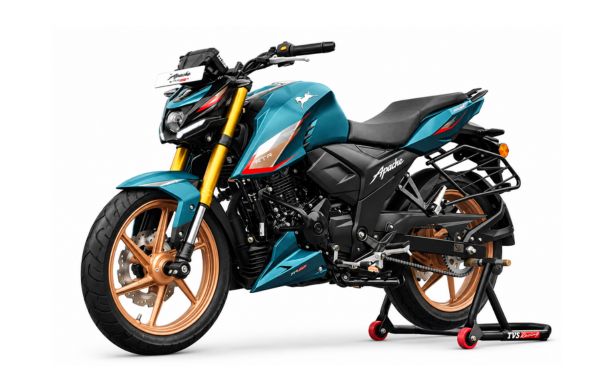
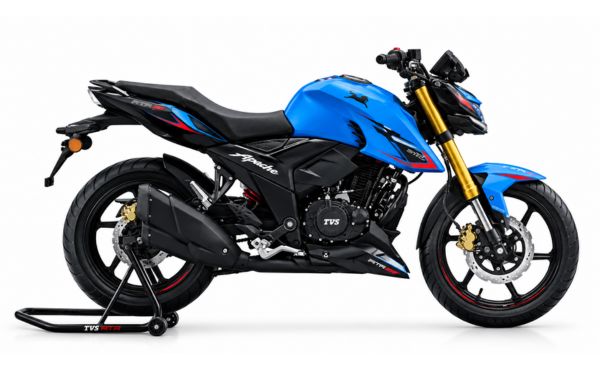
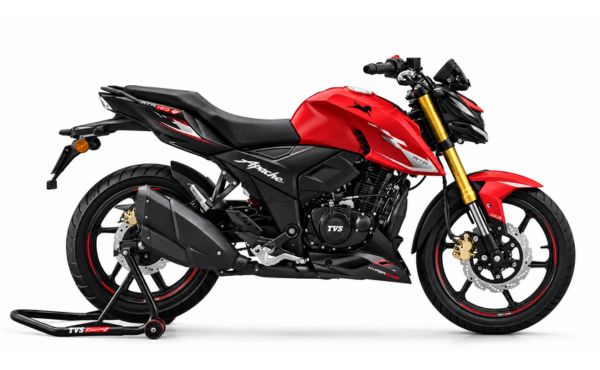
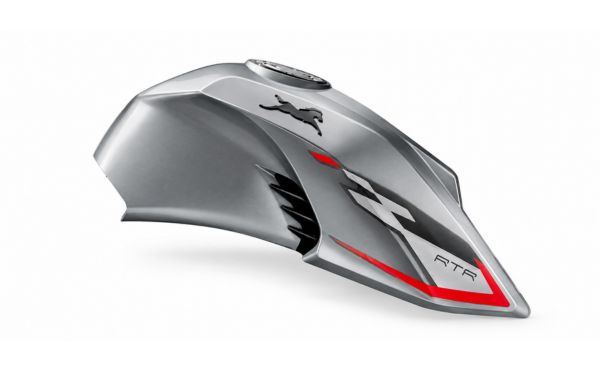
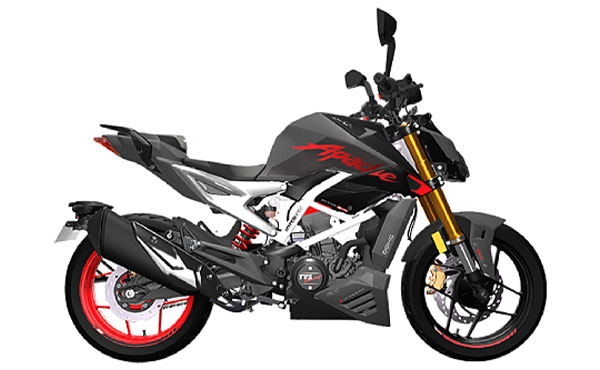
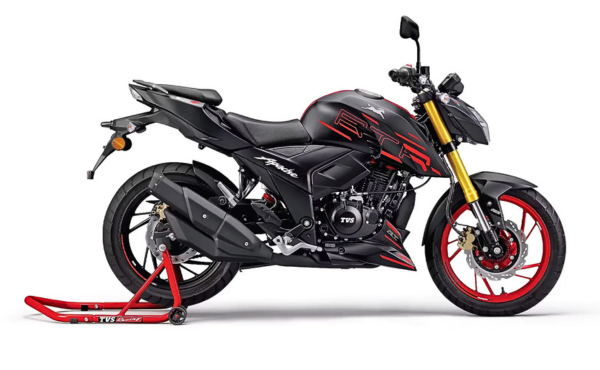
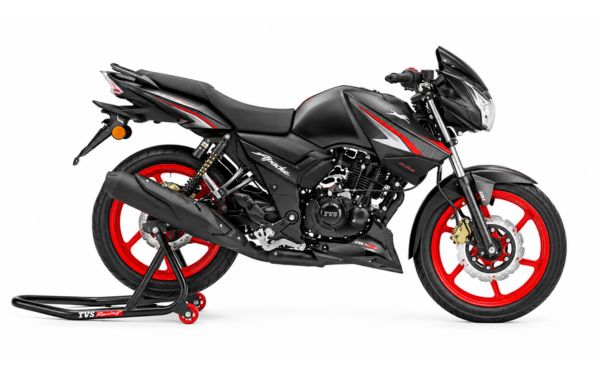
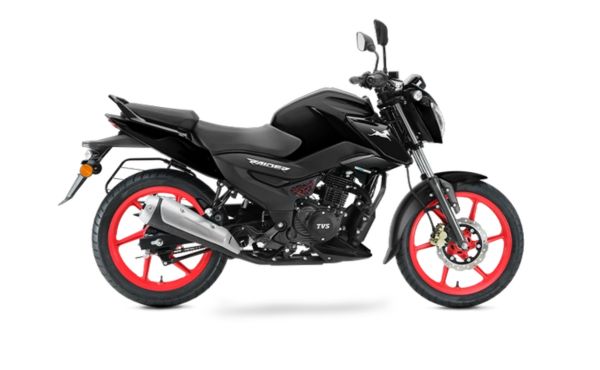
The Apache RTR 160 4V has a race-inspired naked-bike look. It features a compact front cowl, large tank extensions, visible mechanical parts, sculpted side panels, a short tail, and a compact racing bullpup exhaust. All these design elements give it a sporty, forward-leaning stance, making it stand out from regular commuter bikes.
At the front, the 2026 model uses an all-new Class-D projector headlamp. TVS says it delivers a wider, brighter beam, with signature LED light blades flanking the projector unit. Slim LED turn indicators complete the front-end styling and align with the bike’s sharper, more aggressive visual theme.
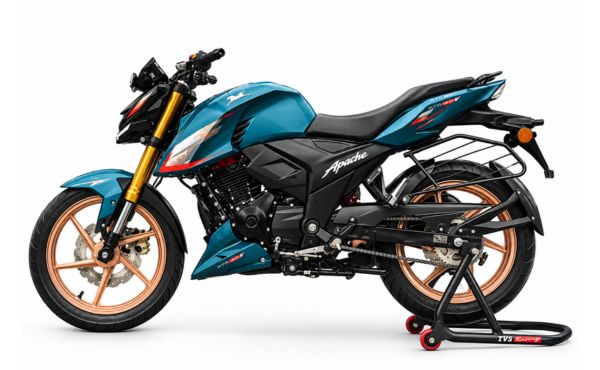
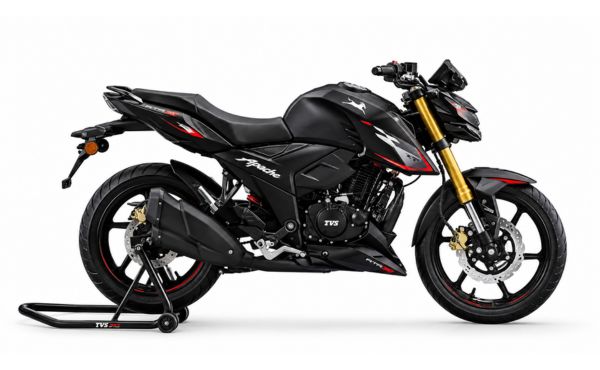
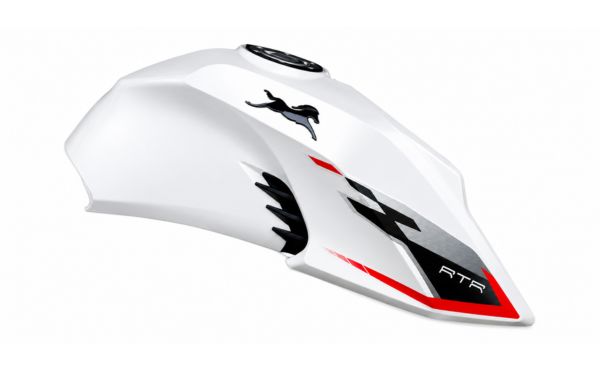
The side view is shaped by the tank shrouds, hydroformed handlebar, double-cradle frame layout, engine area, and short bullpup exhaust. TVS also highlights aggressive race graphics, gold-finished front forks, and coloured alloy wheels as styling details that contribute to the motorcycle’s dynamic appearance. The 37 mm gold-finished USD fork is fitted only on the Dual Channel ABS with USD, USD with TFT, and TFT with Map Mirroring variants.
The range-topping TFT with Map Mirroring version receives the most visually distinctive treatment. In Arctic Teal, it comes with exclusive Champagne Gold alloy wheels, a combination TVS explicitly reserves for the top variant in that colour.
Colour Options And Variants
The Apache RTR 160 4V is available in the following colour options:
- Matte Black
- Pearl White
- Granite Grey
- Marine Blue
- Racing Red
- Arctic Teal
However, the colours you can choose depend on the variant and what the dealer has in stock. Champagne Gold alloy wheels are only offered on the top Arctic Teal version.
The Apache RTR 160 4V is offered in five core variants, starting with the RM Disc (Black Edition) and ending with TFT with Map Mirroring. Each version has a different set of features.
| Variant |
Variant identity |
| RM Disc (Black Edition) |
Entry-level listed version with an LCD console |
| Single Channel ABS |
LCD-console version with single-channel ABS. |
| Dual Channel ABS with USD |
Adds dual-channel ABS, 37 mm USD fork, rear-wheel lift-off protection, and adjustable brake and clutch levers |
| USD with TFT |
Adds the 5-inch TFT console, SmartXonnect, traction control, dual-channel ABS, and USD fork |
| TFT with Map Mirroring |
Top version with TFT, Google Maps mirroring, Panic Brake Alert, Type-C charging, traction control, dual-channel ABS, and USD fork |
The differences between versions are clear. The RM Disc (Black Edition) and Single Channel ABS models have an LCD console. The Dual Channel ABS with USD adds a premium USD front fork. The USD with TFT version brings in a 5-inch TFT display. The TFT with Map Mirroring stands out the most, thanks to its navigation mirroring, Type-C port, Panic Brake Alert, and the Arctic Teal with Champagne Gold wheels.
Value For Money And Pricing
The TVS Apache RTR 160 4V starts at ₹ 1,19,890 ex-showroom in India for the base model. It’s a good value for buyers looking for a 160 cc street-naked bike with features like ride modes, an assist-and-slipper clutch, and projector lighting. Higher variants add USD forks, dual-channel ABS, traction control, and TFT connectivity. Whether a version is worth the price depends on which features you’ll actually use. In New Delhi, the on-road price ranges from about ₹1.23 lakh to ₹1.43 lakh, but this is just a city-specific estimate, not the price for all of India.
Don’t judge the Apache RTR 160 4V only by its base price. The price and features change a lot between versions. The RM Disc (Black Edition) is the cheapest, while the single-channel ABS model costs more.
For buyers prioritising safety and hardware, the Dual Channel ABS with USD is the clearest value step in the published price ladder. Above the Single Channel ABS version, it adds a 37 mm USD fork, dual-channel ABS with rear-wheel lift-off protection, and adjustable levers. This is a tangible change to the motorcycle’s hardware specification, not a cosmetic or display-only upgrade.
The USD with TFT adds the 5-inch TFT cluster and advanced connectivity package, including race telemetry, turn-by-turn navigation, ride analytics, smartphone connectivity, customisation, and traction control. It costs more than the USD/dual-channel ABS version. It offers better value for riders who will use the display and connected functions regularly; those who do not may find the preceding variant more financially rational.
The TFT with Map Mirroring version costs a very low premium over the USD variant with TFT. For this increment, TVS adds Google Maps mirroring, Panic Brake Alert, and Type-C charging, alongside the exclusive Arctic Teal with Champagne Gold alloy-wheel treatment. Within the top end of the range, this is the most equipment-rich step for the smallest price increase.
The Apache RTR 160 4V operates in India’s sporty 150–160 cc commuter/naked-motorcycle segment. The closest regularly compared rivals include:
- Bajaj Pulsar N160
- Hero Xtreme 160R 4V
- Yamaha FZ-S FI
The Apache is often compared against these models and is identified as a competing option in the category.
The Bajaj Pulsar N160 and Hero Xtreme 160R 4V are the closest alternatives for a buyer cross-shopping sporty 160 cc naked motorcycles. The Yamaha FZ-S FI is relevant for buyers willing to consider a 150 cc rival, particularly if the purchase decision is driven by different pricing or usage preferences.
The Apache RTR 160 4V has a broad pricing structure: lower variants focus on access to the core Apache package, the Dual Channel ABS with USD version introduces the most important braking and front-suspension upgrades, and the top two variants focus on connectivity and electronic functions. The top TFT with Map Mirroring model’s premium over the USD with TFT is modest for the features TVS lists, while the Dual Channel ABS with USD model is a more hardware-focused upgrade over the Single Channel ABS version.
Verdict
The TVS Apache RTR 160 4V is a strong choice for Indian riders who want more than just a basic 160 cc bike. It offers a 159.7 cc four-valve engine, ride modes, RT-Fi fuel injection, an assist-and-slipper clutch, sporty chassis parts, and unique LED-projector styling. Each variant adds more features, with the top TFT with Map Mirroring model including dual-channel ABS, USD forks, traction control, a 5-inch TFT display, Google Maps mirroring, Panic Brake Alert, and Type-C charging. The Dual Channel ABS with USD version is best for those who care most about braking and suspension, while the top model is ideal for riders who want extra connectivity for a small price increase.
Choosing the right Apache RTR 160 4V means picking the variant that fits your needs, not just looking at the starting price. Key features like dual-channel ABS, USD forks, traction control, TFT display, and Google Maps mirroring are only on certain versions. Riders should also check seat comfort, rear suspension on rough roads, footpeg position, and high-speed vibrations with a local test ride. By getting a written list of features, a city-specific price quote, and comparing it to the Bajaj Pulsar N160, Hero Xtreme 160R 4V, and Yamaha FZ-S FI, you can see if the Apache RTR 160 4V is the right sporty, tech-focused 160 cc bike for you.
Pros
- Feature-rich 160 cc package: The RTR 160 4V includes a 159.7 cc four-valve engine, Sport/Urban/Rain ride modes, Glide Through Technology, and an assist-and-slipper clutch.
- Strong safety equipment on upper variants: The Dual Channel ABS with USD, USD with TFT, and TFT with Map Mirroring variants receive dual-channel ABS, rear-wheel lift-off protection, and a 37 mm USD front fork.
- Advanced electronics available: Traction control is offered on the TFT-equipped variants, while the top version adds Google Maps mirroring, Panic Brake Alert, and Type-C charging.
- Sporty and agile character: The bike is quick, easy to manage in traffic, agile through corners, and sufficiently stable at faster road speeds.
- Premium lighting and design details: The Class-D projector headlamp, LED light blades, LED indicators, race graphics, and coloured alloy wheels give the motorcycle a distinctive sporty appearance.
- Good TFT upgrade value at the top end: The TFT with Map Mirroring variant costs only ₹2,000 more than the USD with TFT variant in the supplied price list, while adding Google Maps mirroring, Panic Brake Alert, and Type-C charging.
Cons
- Important equipment is not standard on all variants: Dual-channel ABS, USD forks, traction control, TFT instrumentation, and map mirroring are limited to specific, higher-priced versions.
- Sporty ergonomics may not suit every rider: The slightly rear-set footpegs may require adjustment for riders coming from conventional commuter motorcycles.
- Long-distance comfort should be checked personally: The motorcycle suits daily use, but its sporty seating position and ride setup may not suit every rider on frequent long-distance journeys.
- Possible high-speed vibrations: Secondary user feedback mentions vibrations at higher speeds; riders should evaluate handlebar, footpeg, and seat vibration during a test ride.
- Variant selection needs care: The range has five listed variants with meaningful differences in braking, suspension, electronics, and display equipment. Buyers should confirm the exact specification in writing before booking.
Frequently Asked Questions About Tvs Apache Rtr 160 4v
1. What Is The Mileage Of The Tvs Apache Rtr 160 4v?
The ARAI-certified figure is about 41-41.4 kmpl. In real-world use, most riders report 37-42 kmpl in mixed city conditions. Steady highway riding can give 44-46 kmpl, while heavy traffic can drop it to around 36 kmpl. With the 12-litre tank, the theoretical range is roughly 492-497 km before reserve.
2. How Much Power Does The Apache Rtr 160 4v Make, And What Is Its Top Speed?
The 159.7 cc, oil-cooled, four-valve, fuel-injected engine makes 17.55 PS and 14.73 Nm in Sport mode. In Urban and Rain modes, output drops to 13.32 PS and 12.7 Nm. The claimed top speed is 114 km/h in Sport mode and 103 km/h in Urban and Rain modes.
3. What Are The Variants Of The Tvs Apache Rtr 160 4v?
There are five core variants:
• RM Disc (Black Edition)
• Single Channel ABS
• Dual Channel ABS with USD
• USD with TFT
• TFT with Map Mirroring
The base variants have an LCD console. Dual-channel ABS, the 37 mm USD fork and adjustable levers start from the Dual Channel ABS with USD variant. The TFT display and traction control start with the USD variant. Google Maps mirroring, Panic Brake Alert and Type-C charging are only on the top variant.
4. What Is The Price Of The Tvs Apache Rtr 160 4v In India?
The base model starts at ₹1,19,890 (ex-showroom). In New Delhi, the on-road price ranges from about ₹1.23 lakh to ₹1.43 lakh, depending on the variant. Prices vary by city and variant, so confirm a written quote with your local dealer before booking.
5. Which Bikes Compete With The Apache Rtr 160 4v?
The closest rivals are the Bajaj Pulsar N160 and the Hero Xtreme 160R 4V. The Yamaha FZ-S FI is also worth considering if you are open to a 150 cc option. Compare variants and features, not just base prices, since equipment differs a lot between trims.
Other Related Links From Bikeleague India
About Tvs Bikes
TVS Motor Company, a prominent player in the Indian two-wheeler industry, has a rich innovation and strategic growth history. TVS Motor manufactures a wide range of two-wheelers, including mopeds, scooters, commuter motorcycles, and racing-inspired bikes like the TVS Apache series and the TVS Apache RR310. The company’s diverse product portfolio caters to various segments, ensuring options for different customer preferences and needs.
History
TVS Motor Company, part of the TVS Group, was founded in 1911 by T.V. Sundaram Iyengar, starting with Madurai’s first bus service. In the 1970s, the group entered the automotive sector, launching Sundaram Clayton and opening a moped manufacturing facility in Hosur in 1976.
In 1980, they released TVS 50, India’s first two-seater moped, revolutionising the two-wheeler market. The company rapidly expanded, introducing motorcycles and scooters, and formed a joint venture with Suzuki before becoming independent again in 2001.
Timeline & Milestones
- 980: Launch of TVS 50, the first Indian moped.
- 1987: Collaboration with Suzuki, introducing advanced products and manufacturing expertise.
- 2001: JV with Suzuki ends; TVS becomes an independent entity.
- 2005: Introduction of the Apache series, marking entry into high-performance bikes.
- 2013: Alliance with BMW Motorrad for co-development of high-end motorcycles.
- 2020: Launch of TVS iQube Electric, signalling robust entry into electric mobility.
- 2024: Over 50 million vehicles on the road; TVS reaches record revenue and expands its EV portfolio.
Manufacturing Facilities
TVS Motor Company operates three state-of-the-art factories in India:
- Hosur, Tamil Nadu: The primary and oldest plant, central to TVS’s manufacturing capacity.
- Mysuru, Karnataka: Supports production for southern and western markets.
- Nalagarh, Himachal Pradesh: Caters to northern and eastern India.
The company has also entered into contract manufacturing partnerships to optimise logistics and expand service in eastern India.
Market Position
- TVS is India’s third-largest two-wheeler manufacturer.
- In the first half of 2025, TVS grew its market share to 18.71%, up from 17.08% in 2024, outpacing competitors like Hero, Honda, and Bajaj. This was driven by robust performance in the electric scooter segment and premium motorcycles.
- The company continues to innovate, leading with connected vehicles, advanced safety features, and a wide product portfolio from commuter mopeds to high-end racing bikes.
Achievements
- Financial Strength: In FY2023-24, TVS posted record revenue of ₹31,776 crore and Profit Before Tax of ₹2,781 crore, with EBITDA margins exceeding 11%.
- Global Presence: TVS exports to over 80 countries and is strengthening its position in international markets with partnerships and homologated products for Europe and other regions.
- Innovation: Pioneer of several firsts, including India’s first catalytic converter in a 100cc bike and connected scooters.
- Recognition: Consistently awarded for quality, performance, and customer satisfaction, reflecting industry trust in the brand.
Future Outlook
- Growth Forecasts: Analysts expect TVS’s earnings to grow at 20.2% annually, with revenue growth projected at 5.8% per annum and return on equity at 26.3% over the next three years.
- EV & Sustainability: TVS is intensifying its EV push, aiming for leadership in sustainable urban mobility. The company is investing in R&D and roping in partnerships to strengthen its EV lineup.
- Premiumisation & Expansion: Continued focus on premium models, expansion of the dealer network, customer-centric campaigns, and a strategic push into Europe, Africa, Latin America, and ASEAN regions.
- Innovation Commitment: TVS will keep innovating, both in product offerings and technology, to match evolving consumer preferences and to remain a trendsetter in the Indian mobility space.
TVS Motor Company embodies Indian manufacturing excellence and adaptability. Starting from modest beginnings, it has become a global leader, driving India’s mobility revolution with a focus on quality, sustainability, and innovation.
Other Related Links From Bikeleague India
- TVS Apache RTR 160
- TVS Apache RTR 200 4V
- TVS Apache RTR 310
- TVS Apache RTR 180
- TVS Apache RTR 160 4V