Overview
Performance And Engine
The RTR 200 4V is equipped with a 197.75cc single-cylinder oil-cooled engine, The RTR 200 4V runs on a 197.75 cc, single-cylinder, four-stroke, four-valve, oil-cooled, fuel-injected engine. According to TVS, the engine uses ram-air assist to boost performance and manage temperature.
| Engine item |
Specification |
| Engine type |
Single-cylinder, four-stroke, four-valve, oil-cooled |
| Displacement |
197.75 cc |
| Fuel system |
Electronic fuel injection |
| Cooling system |
Oil-cooled combustion chamber with ram-air assist |
| Maximum power |
20.82 PS at 9,000 rpm |
| Maximum torque |
17.25 Nm at 7,250 rpm |
| Riding modes |
Sport, Urban and Rain |
With 20.82 PS and 17.25 Nm, the RTR 200 4V is a strong performer among 200 cc naked motorcycles in India. Sport mode gives you full power, while Urban and Rain modes adjust the engine and ABS for city traffic or wet roads. TVS also includes Glide Through Technology, which lets the bike move slowly by just releasing the clutch, making it easier to ride in heavy traffic without stalling.
The Apache RTR 200 4V has a five-speed manual gearbox, chain drive, and a wet multi-plate slipper clutch. The standard shift pattern is one down and four up.
| Transmission item |
Specification |
| Gearbox |
Five-speed manual |
| Shift pattern |
One down, four up |
| Clutch |
Wet multi-plate slipper clutch |
| Final drive |
Chain |
The slipper clutch helps prevent rear-wheel hop during fast or hard downshifts, making cornering smoother. TVS describes it as a race-tuned system that gives you better control when shifting down.
TVS says the top speed is 127 km/h in Sport mode. In Urban and Rain modes, the top speed is limited to 105 km/h.
| Riding mode |
Listed maximum speed |
| Sport |
127 km/h |
| Urban |
105 km/h |
| Rain |
105 km/h |
These are claimed top speeds, not recommended cruising speeds. Actual top speed can vary based on rider weight, road slope, wind, fuel quality, traffic, tyre condition, maintenance, and weather. Always follow speed limits and ride safely for the conditions.
Mileage And Fuel Efficiency
ARAI fuel efficiency figures for the RTR 200 4V are reported as 41.9 kmpl and 37 kmpl. Since the exact number is uncertain, you can expect a claimed range of 37–42 kmpl. With a 12-litre fuel tank, this gives a theoretical range of about 444–504 km before reserve, though real-world mileage may differ.
Most riders report lower fuel economy than the official numbers, usually between 37.6 and 38.45 kmpl. Actual mileage depends a lot on city traffic, speed, load, riding mode, engine rpm, tyre pressure, maintenance, and weather.
| Real-world source |
Reported mileage |
Context |
| City estimate |
33–35 kmpl |
Reported typical city-use range. |
| Highway estimate |
38–40 kmpl |
Reported steady-speed highway range. |
For daily riding, you can expect about 35–40 kmpl. If you ride in heavy traffic, accelerate quickly, use Sport mode, ride at high rpm on highways, or carry a passenger, your mileage may be lower. Riding gently in the city or at steady speeds on the highway usually gives better fuel economy.
Features And Technology
The TVS Apache RTR 200 4V is a well-equipped sub-200 cc naked motorcycle in India. It offers ride modes, dual-channel ABS, traction control, a 5-inch TFT screen, smartphone connectivity, and a race-inspired chassis. These features support performance riding, daily traffic use, safety, and easy access to information.
-
197.75 cc oil-cooled four-valve engine: The RTR 200 4V uses a 197.75 cc, oil-cooled, four-valve engine with ram-air assist. TVS states that the engine produces 20.82 PS and is designed for reduced heat and quicker throttle response.
-
Ram-air assist: The engine includes a ram-air assist system. TVS presents it as part of the motor’s airflow and heat-management package.
-
Electronic fuel injection: Electronic fuel injection manages fuel delivery for the oil-cooled 197.75 cc engine
-
Sport, Urban, and Rain riding modes: The rider can select Sport, Urban, or Rain mode. TVS states that each mode changes engine and ABS response for different riding conditions.
-
Advanced traction control: The traction-control system regulates engine torque to help reduce rear-wheel spin. It is intended to support stability when traction is limited, but it does not replace correct tyre pressure, safe speed, rider judgment, or controlled throttle use.
-
Dual-channel ABS: The motorcycle has dual-channel ABS, which monitors both wheels to help reduce the chance of wheel lock during hard braking.
-
Rear-wheel lift-off protection: TVS includes rear-wheel lift-off protection with the braking package. It is designed to improve stability under hard braking by helping limit rear-wheel lift.
-
37 mm USD front fork: The RTR 200 4V uses a 37 mm upside-down front suspension. TVS says it is intended to provide sharper cornering behaviour and greater stability on straights.
-
Rear radial tyre: The motorcycle uses a radial rear tyre, which TVS says provides grip, stability, and durability.
-
Double Cradle Split Synchro Stiff chassis: TVS uses its patented Double Cradle Split Synchro Stiff chassis, developed with Multi-Body Dynamics Analysis. TVS claims this layout increases stability by 25%.
-
Hydroformed handlebar: The RTR 200 4V has a hydroformed handlebar. TVS says the design is intended to support rider control and reduce fatigue.
-
Three-step adjustable brake and clutch levers: Both brake and clutch levers have three adjustment positions. The levers adjust tool-free to suit different hand sizes and reach preferences.
-
Race-tuned slipper clutch: The wet multi-plate slipper clutch supports smoother downshifts, reduces rear-wheel hop during aggressive braking, and improves control while cornering.
-
Glide Through Technology: GTT lets the motorcycle start moving through a gradual clutch release without using the throttle. TVS presents it as a low-speed traffic feature that makes clutch-throttle coordination easier and reduces the risk of stalling
-
Five-inch TFT instrument cluster: The motorcycle uses an intuitive five-inch TFT display. It serves as the main rider-information interface.
-
TVS SmartXonnect connectivity: SmartXonnect provides Bluetooth-based phone connectivity through the TFT cluster.
-
Turn-by-turn navigation: The TFT cluster supports turn-by-turn navigation. Set the route before riding and do not operate the display while the motorcycle is moving.
-
Race telemetry: The TFT cluster supports turn-by-turn navigation. Set the route before riding and do not operate the display while the motorcycle is moving.
-
Ride analytics: Ride analytics are included with the connected TFT package. It provides ride-related data through the display and smartphone-connected system.
-
Call and SMS alerts: The SmartXonnect system can provide call and SMS notifications. Riders should review or respond to notifications only after safely stopping.
-
Class-D projector headlamp: The updated RTR 200 4V uses a Class-D projector headlamp designed to provide a wider and brighter beam for night visibility.
-
Signature LED light blades: LED light blades flank the projector headlamp and form part of the motorcycle’s front lighting and visual signature.
-
LED turn indicators: The motorcycle has LED turn indicators.
-
Double-barrel exhaust:The RTR 200 4V has a double-barrel exhaust. TVS states that it is tuned for rapid exhaust outflow and the model’s characteristic exhaust note.
-
Aggressive race graphics:The motorcycle uses race-inspired graphics and a muscular tank cowl as part of its styling package.
-
Coloured alloy wheels: Coloured alloy wheels are part of the motorcycle’s styling.
-
Theft-resistant key: The Apache RTR 200 4V includes a theft-resistant key as part of its security-related equipment.
-
Complimentary TVS XPOD helmet: A complimentary TVS XPOD helmet is included. This may be promotional or offer-specific, so confirm availability and terms with the authorised dealer before booking.
Build Quality
The Apache RTR 200 4V uses TVS’s patented Double Cradle Split Synchro Stiff chassis, developed using Multi-Body Dynamics Analysis. TVS claims that this structural layout improves stability by 25 percent and provides an optimised vehicle layout for riding dynamics. The motorcycle also features a 37 mm USD front fork, rear radial tyre, hydroformed handlebar, double-barrel exhaust, LED lighting, and a five-inch TFT display.
The latest top variant gets adjustable front USD suspension, marking the return of adjustability on the RTR 200 4V after it was removed in an earlier version. The updated equipment includes a TFT display with navigation, Panic Brake Alert, and a Type-C charging port. These additions increase the feature density, but buyers should confirm which equipment belongs to the exact variant they are buying because the lineup includes more than one price and specification level.
The Class-D projector headlamp, signature LED light blades, LED indicators, race graphics, gold-finished forks, coloured alloy wheels, muscular tank cowl, and double-barrel exhaust all give the motorcycle a more premium look than a basic commuter. Still, it’s important to check the paint quality, tank-panel fit, wiring, switchgear, TFT operation, lever adjustment, wheel finish, tyre manufacturing dates, chain alignment, brake action, fork seals, and visible fasteners before you take delivery.
Handling
The RTR 200 4V is built with sporty handling as a central priority. TVS says the 37 mm USD fork delivers sharper cornering and better straight-line stability, while the rear radial tire is intended to provide grip, stability, and durability. The hydroformed handlebar is designed to give the rider direct control, and the slipper clutch supports smoother downshifts and reduced rear-wheel hop when entering corners.
The KYB front fork and Showa monoshock are said to offer a comfortable but controlled ride. The RTR 200 4V feels light, changes direction quickly, stays stable at speed, and handles corners well. While some of these comments come from earlier models, the same chassis design and road focus still apply to the 2026 version.
The updated top variant’s adjustable front USD suspension offers more scope to tune the front end for rider weight, riding style, road conditions, or a more sport-focused setup. Some riders describe the handling as very sharp after stiffening the adjustable front suspension for corners. This is a subjective observation, not a guaranteed outcome: incorrect settings can harm comfort, grip, or predictability, so riders should begin with the recommended settings and adjust in small increments.
The dual-channel ABS, traction control, rear-wheel lift-off protection, three riding modes, and radial rear tyre further support confidence under braking and acceleration. They are useful rider aids, but they do not replace correct tyre pressure, safe speed, smooth inputs, or awareness of wet roads, loose gravel, potholes, diesel spills, and other Indian-road hazards.
Comfort
The Apache RTR 200 4V has a relatively upright and compact riding posture for a sporty naked motorcycle. Its high-set clip-on handlebars, well-positioned footpegs, adjustable levers, and seat layout are intended to distribute rider weight without placing excessive pressure on the wrists, tailbone, or feet. Road tests found the position comfortable for city use and manageable over longer distances.
The TVS Glide Through Technology is useful in traffic because it lets the motorcycle move at very low speed through a gradual clutch release without throttle input. This can make crawling through congested roads easier and reduce the risk of stalling, particularly for newer riders.
Ride quality is generally reported as a good balance of firmness and usability. Older BS6 models were described as slightly firm but capable of tackling bad roads and speed breakers without disturbing the motorcycle’s stability. The suspension is also described as supple and comfortable. These observations suggest that the RTR 200 4V should feel controlled in ordinary urban riding while retaining the firmness needed for sporty handling.
Comfort depends a lot on how the suspension is set up and what the rider prefers. One owner said the front felt soft and the rear hard, especially on rough roads, but the bike felt much better after a service and suspension adjustment. This shows why it’s important to check rear preload, front-fork adjustment if available, tyre pressures, and the bike’s condition before finishing your test ride.
For frequent pillion use or long-distance travel, evaluate the rear-seat space, suspension response, braking feel, and low-speed balance with the typical passenger during a test ride. The RTR 200 4V is primarily a sporty naked motorcycle, so comfort depends on body size, road quality, trip duration, luggage, and the selected suspension setting.
Styling
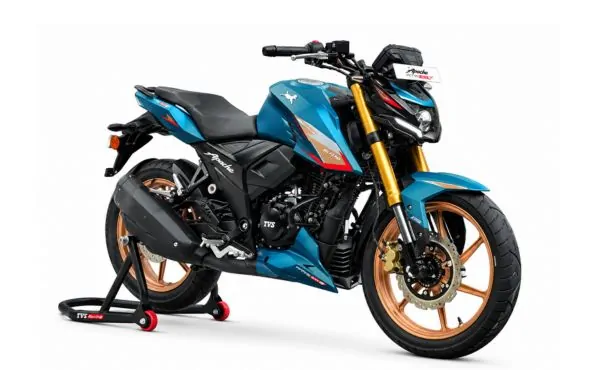
The Apache RTR 200 4V is styled as a compact naked performance motorcycle rather than a conventional commuter. A Class-D projector headlamp with a signature dominates its front end, with LED light blades, flanked by LED turn indicators. TVS says the projector unit delivers a wider, brighter beam, while the lighting arrangement creates the motorcycle’s recognizable aggressive face.
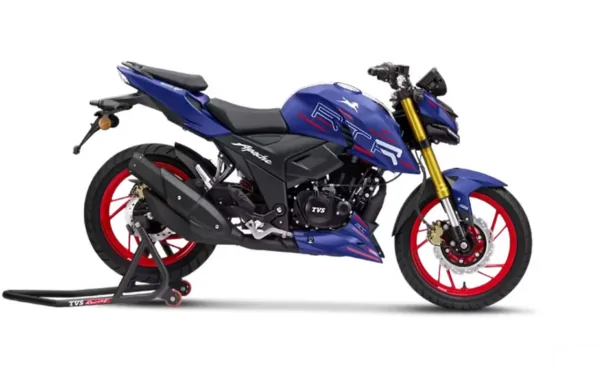
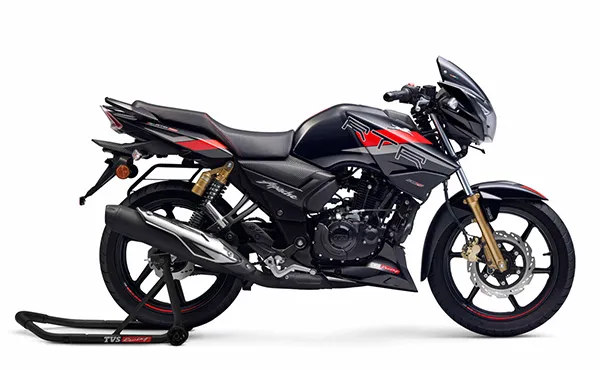
The side profile combines a muscular tank cowl, high-set handlebar, exposed engine, gold-finished 37 mm USD fork, side panels, and a short tail section. The RTR 200 4V also retains its double-barrel exhaust, a major visual identifier that reinforces its performance-oriented look.
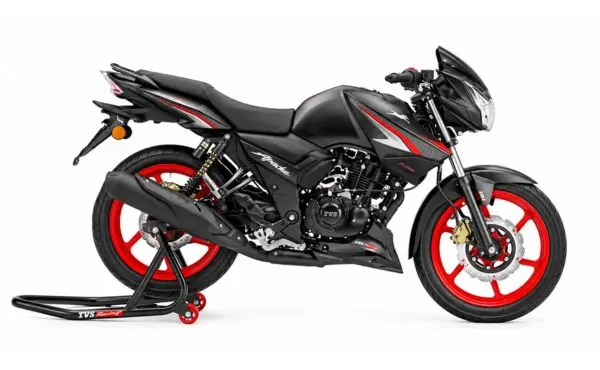
TVS uses race-inspired graphics and coloured alloy wheels to give the RTR 200 4V more visual presence. The 2026 colour update includes special mismatched-alloy treatments on certain versions, such as a red front wheel paired with a black rear wheel. TVS Racing’s pit-lane appearance inspired this detail, making those versions visually distinct from conventional single-colour commuter motorcycles.
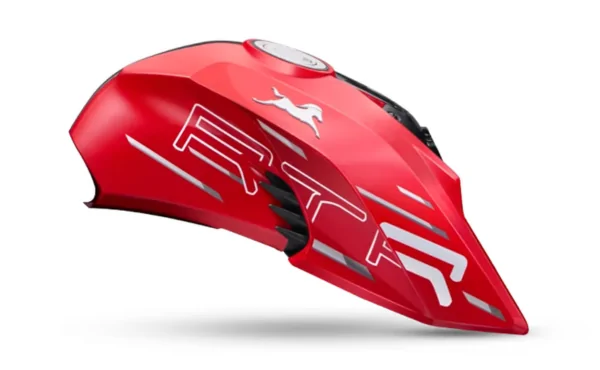
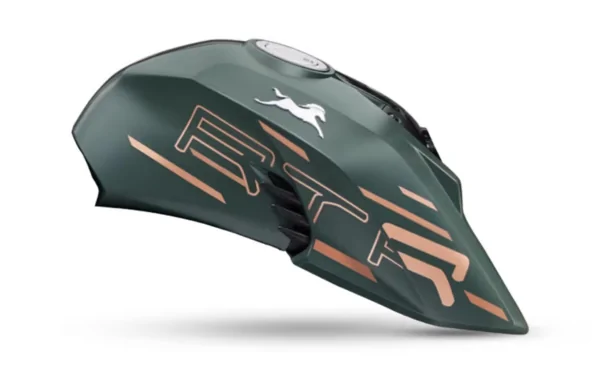
The new top variant does not redesign the body panels or headlamp but adds new paint options and a revised equipment package. The primary styling changes are the introduction of Sepang Blue with red alloy wheels, Armoury Green, and Racing Red, while Matte Black continues in the range.
Colour Options And Variants
Colour availability is variant-specific, and there are a total of 5 colours, 4 of which were recently introduced in 2026, and they are
| Colour / livery |
Visual character |
| Sepang Blue with red alloy wheels |
Sepang Blue with red alloy wheels Racing-inspired blue finish with a contrasting red front alloy wheel |
| Armoury Green |
Darker, military-inspired green treatment |
| Racing Red |
Bright, traditional performance-bike colour |
| Matte Black |
Understated matte finish |
| Granite Grey |
Technical-looking matte grey finish |
Sepang Blue is the most distinctive new treatment because it is paired with red alloy wheels. TVS’s own 2026 colour material describes the mismatched alloy approach as a racing-inspired visual detail, with a red front wheel and black rear wheel.
Matte Black is the most understated option, while Armoury Green offers a darker alternative without the bright wheel contrast of Sepang Blue. Racing Red provides a conventional, high-visibility sports-naked look.
Two variants are available, and the top variant was introduced in late 2026. They are
| Variant reference |
Key identity |
| Apache RTR 200 4V new top variant |
Latest higher-spec model with adjustable front suspension, TFT display, map mirroring, Panic Brake Alert, Type-C charging, and new colours. |
| Apache RTR 200 4V TFT |
TFT-equipped mid variant |
The new top variant is the clearest choice for buyers who want the latest styling, adjustable front suspension, five-inch TFT display, Google Maps mirroring, Panic Brake Alert, and Type-C charging. The TFT-labelled version is described as a mid variant.
Value For Money And Pricing
The TVS Apache RTR 200 4V is priced from ₹ 1,48,240 ex-showroom in India for the base TFT variant. Its value proposition centres on its 20.82 PS oil-cooled engine, riding modes, traction control, dual-channel ABS, USD fork, slipper clutch, and five-inch TFT connectivity—equipment that makes it one of the more feature-rich options in the 200 cc naked-motorcycle category. The latest top variant’s price reflects the addition of adjustable front suspension, TFT navigation and connectivity functions, map mirroring, Panic Brake Alert, Type-C charging, and updated colour options.
At its entry price, the RTR 200 4V provides a substantial performance-and-safety package: a 197.75 cc oil-cooled four-valve fuel-injected engine producing 20.82 PS and 17.25 Nm, Sport/Urban/Rain modes, traction control, dual-channel ABS with rear-wheel lift-off protection, a 37 mm USD fork, radial rear tyre, slipper clutch, adjustable levers, Glide Through Technology, and a double-cradle chassis.
This combination gives the Apache a strong equipment advantage over basic commuter-oriented motorcycles. The official 5-inch TFT system adds smartphone connectivity, turn-by-turn navigation, ride analytics, race telemetry, and call/SMS alerts. The Class-D projector headlamp, LED light blades, LED indicators, gold-finished forks, coloured alloys, and double-barrel exhaust reinforce its premium, sporty position.
The top variant makes the strongest case for buyers who specifically value the additional technology and adjustability. Adjustable front suspension can matter for riders who want to tailor fork response to their weight or road conditions, while map mirroring and Type-C charging improve everyday usability. If these features are not important, the lower-priced version may offer better value because it retains the same core engine, chassis, riding modes, traction control, and braking hardware.
The Apache RTR 200 4V competes with a range of Indian motorcycles that differ in price, engine output, design, and intended use. The most relevant alternatives include:
- Bajaj Pulsar NS200
- Honda Hornet 2.0
- KTM 200 Duke
- Yamaha MT-15 V2
- Suzuki Gixxer 250
- Hero Xpulse 210
They are not identical rivals in every respect, but they are common cross-shopping choices for buyers considering a sporty 160–250 cc motorcycle.
The RTR 200 4V is a strong option for a rider who wants a technology-rich sporty commuter rather than merely the cheapest 200 cc motorcycle. Its engine output, three modes, traction control, dual-channel ABS, USD fork, slipper clutch, and modern lighting already create a compelling core package. The top variant is worth the additional spend only if you will use the adjustable fork, TFT-based navigation and map mirroring, Panic Brake Alert, Type-C port, and newer colour choices.