Overview
Performance And Engine
The Jupiter 125 uses a 124.8cc air-cooled, single-cylinder, four-stroke engine with a two-valve head. It features TVS’s ETFi (Eco-thrust Fuel Injection) technology. The bore is 53.5 mm, and the stroke is 55.5 mm. All four variants have an unassisted maximum output of about 8.16 PS at 6,500 rpm and peak torque of 10.5 Nm at 4,500 rpm.
| Engine item |
Specification |
| Displacement |
124.8cc |
| Configuration |
Single-cylinder, four-stroke |
| Cooling |
Air-cooled |
| Fuel system |
ET-Fi Fuel Injection |
| Number of valves |
Two |
| Bore × stroke |
53.5 × 55.5 mm |
| Maximum power without assistance |
8.16 PS at 6,500 rpm |
| Maximum torque without assistance |
10.5 Nm at 4,500 rpm |
The power figures above are rounded conversions for ease of reference. The same basic engine dimensions and unassisted outputs apply across all four variants.
The DT SXC and SmartXonnect come with iGO Assist, which raises maximum power to about 8.57 PS at 6,500 rpm and peak torque to 11.1 Nm at 4,500 rpm. The Drum Alloy and Disc only show the unassisted outputs and do not have iGO Assist.
| Variant |
Maximum power without assist |
aximum power with assist |
Maximum torque without assist |
Maximum torque with assist |
| Drum Alloy |
8.16 PS at 6,500 rpm |
Not listed |
10.5 Nm at 4,500 rpm |
Not listed |
| Disc |
8.16 PS at 6,500 rpm |
Not listed |
10.5 Nm at 4,500 rpm |
Not listed |
| DT SXC |
8.16 PS at 6,500 rpm |
8.57 PS at 6,500 rpm |
10.5 Nm at 4,500 rpm |
11.1 Nm at 4,500 rpm |
| SmartXonnect |
8.16 PS at 6,500 rpm |
8.57 PS at 6,500 rpm |
10.5 Nm at 4,500 rpm |
11.1 Nm at 4,500 rpm |
These are the outputs for each Jupiter 125 variant, with power converted to PS. The additional assisted output applies when the assist function operates; it should not replace the unassisted rating when describing the engine itself. iGO Assist improves pickup and mileage.
The Jupiter 125 responds well in daily traffic. It accelerates best between about 30 and 60 km/h, and speed increases steadily up to around 70 km/h before slowing down. Throttle and fuel response are quick to rider input.
Peak torque comes in early, and the CVT is tuned for quick acceleration in traffic. Acceleration drops off after about 60 km/h. The Jupiter 125 performs best in city and moderate-speed riding, not at high speeds.
Earlier versions of the Jupiter 125 were available prior to the current assisted-output specifications. Acceleration measurements for the present iGO Assist-equipped DT SXC and SmartXonnect are not established.
The engine runs smoothly and feels refined in most situations, though you might notice a slight buzz through the floorboard and handlebar when accelerating. Overall, it’s smooth with only minor vibration, showing good refinement even if it’s not totally vibration-free.
Every Jupiter 125 variant uses a CVT automatic transmission. This type of transmission changes gears automatically, so the rider doesn’t need to shift or use a manual clutch. The Drum Alloy, Disc, DT SXC, and SmartXonnect all have this system.
The transmission helps the scooter respond smoothly in traffic. The Drum Alloy’s engine and CVT work together for steady, jerk-free acceleration. The CVT’s tuning is key to its quick response at low and medium speeds.
The top speed shows about 90 km/h on the speedometer, which is around 80 km/h when measured with equipment.
The Jupiter 125 has reportedly reached about 95 km/h, but this hasn’t been confirmed with official measuring equipment.
Mileage And Fuel Efficiency
The TVS Jupiter 125 has an ARAI-rated mileage of 50 km/l, but this number is only an estimate.
The 50 km/l listing is a model-level figure. No separate ARAI figures are established for the current Drum Alloy, Disc, DT SXC and SmartXonnect, nor is the mileage of each 2026 variant specifically certified. It should not be used to claim that the assisted and non-assisted versions have identical fuel economy.
The Drum Alloy and Disc feature IntelliGo automatic start-stop technology and ETFi fuel injection. A 15% mileage improvement is advertised, but there is no clear comparison baseline or absolute km/l result. That percentage should not be converted into a claimed mileage figure.
The DT SXC and SmartXonnect include iGO Assist and automatic start-stop, presented as measures to improve pickup and fuel efficiency. There is no numerical mileage increase for the assisted variants. Load, riding habits, traffic, road conditions and maintenance affect fuel economy.
The Jupiter 125 is reported to average about 48 km/l, but this number isn’t broken down by model year or variant.
Mileage reports differ from the average. Some riders get about 45–50 km/l in city traffic, and others see similar numbers after 1,500 km of riding. These are personal experiences, not official tests.
Some riders report lower mileage, like about 32 km/l in the city or 25 km/l for short trips after limited use. These examples show that the 48 km/l average doesn’t cover every case and isn’t a guaranteed minimum or city mileage.
Some have also reported 50 km/l, which matches the ARAI figure. The 48 km/l average is a separate number.
Features And Technology
The TVS Jupiter 125 comes with useful features for daily riding in India, like 33-litre underseat storage, external front fuel filling, mobile charging, and an all-in-one lock. All variants share these basics, while some versions also offer smartphone connectivity, navigation, a pillion backrest, and iGO Assist.
- LED Headlamp and Front Light Guides: All four Jupiter 125 variants—Drum Alloy, Disc, DT SXC and SmartXonnect—have an LED headlamp with a clear lens and multi-focal reflector. Signature LED front light guides are present on the Drum Alloy, Disc and SmartXonnect. The DT SXC features the headlamp and visor, but the front light guides are not separately listed in its feature set.
- Tail Lamp with LED Light Guide: All four variants have a bulb-type tail lamp with an LED light guide. This is not an all-LED tail lamp. There is also a grabrail reflector and a tail-lamp reflector as part of the rear visibility equipment.
- Semi-Digital Instrument Console: The Drum Alloy and Disc feature a semi-digital speedometer combining analogue and digital information. These variants do not include the connected feature package offered on the DT SXC and SmartXonnect.
- Bluetooth Connectivity: The DT SXC and SmartXonnect support smartphone connectivity through a connected platform, offering more than 60 features including navigation, phone notifications, fuel information and ride statistics. This connected package is specific to these two variants within the range covered here.
- Turn-by-Turn Navigation: The DT SXC includes turn-by-turn navigation, and the SmartXonnect offers navigation with voice assistance. This provides route guidance through the connected system rather than requiring the rider to rely solely on a phone’s map screen.
- Call, SMS and Social-Media Alerts: The DT SXC offers call, SMS, and social-media alerts as part of its connected features. The SmartXonnect also provides call, SMS, and social-media alerts. These functions bring supported phone notifications to the connected display.
- Connected Updates and Ride Statistics: The DT SXC and SmartXonnect provide news and traffic updates, weather information, rain alerts, and ride statistics. The SmartXonnect also offers live sports updates. These are connected information services for the DT SXC and SmartXonnect.
- Fuel-Economy and Range Displays: Average fuel economy and distance-to-empty information are available across the range. Average fuel economy helps the rider monitor consumption, while distance to empty provides an estimated remaining riding range before refuelling.
- Underseat Storage: Every variant has a 33-litre underseat storage compartment. This is marketed as space for two helmets, with the DT SXC and SmartXonnect described as accommodating two full-face helmets. Actual compatibility may vary depending on helmet size and shell dimensions.
- Front Glove Box: All four variants have a 2-litre open-type front glove box. This provides a separate compartment for small belongings without opening the seat. Its open design distinguishes it from an enclosed or lockable storage box.
- Front Mobile Charging Facility: A front mobile charger is available across the range. The Disc features a USB port in the front glove box and the DT SXC has a USB mobile charging port. The Drum Alloy includes a charger in the utility box, and the SmartXonnect features a front mobile charger.
- External Front Fuel Filling: All four variants feature an external fuel-filling point at the front. This allows refuelling without opening the seat and keeps the fuel-filler access separate from the underseat storage compartment.
- All-in-One Lock: The Jupiter 125’s single lock operates the ignition, steering lock, seat lock and fuel-filler access. This arrangement is present across all four variants, reducing the need for separate access points for these functions.
- One-Touch Collapsible Bag Hook: Every variant includes a one-touch collapsible bag hook. It provides an additional carrying point in the front area and folds away when not required.
- Long Seat and Front Leg Space: All four variants have a 790 mm seat and 380 mm of front leg space. These shared dimensions mean the higher versions do not gain a longer seat or a larger published front footwell than the Drum Alloy and Disc. Ground reach is 765 mm across the range.
- Cushioned Pillion Backrest: The DT SXC and SmartXonnect include a cushioned pillion backrest. The Drum Alloy and Disc do not include this feature.
- Adjustable Rear Suspension: Every variant uses telescopic hydraulic front suspension and a twin-tube emulsion-type rear shock absorber with three-step adjustment. The adjustable rear unit is part of the shared equipment rather than an upgrade reserved for connected variants.
- Body Balance Technology: Body Balance Technology is present across all four variants as a weight-distribution arrangement intended to support balance and stability. The floorboard-mounted fuel tank lowers the centre of gravity and frees space beneath the seat.
- Alloy Wheels and Tubeless Tyres: Alloy wheels are standard on the Jupiter 125 range, with diamond-cut alloy wheels on the Disc and SmartXonnect and 12-inch alloy wheels on the DT SXC. All versions have 90/90-12 tubeless tyres at both ends.
- Disc and Drum Brake Options: The Drum Alloy has 130 mm drum brakes at the front and rear. The Disc, DT SXC and SmartXonnect feature a 220 mm front disc brake and 130 mm rear drum brake.
- Synchronized Braking Technology: Synchronized Braking Technology, or SBT, is present across the range. It distributes braking action between the two wheels. The other three variants pair their front disc brake with SBT.
- Side-Stand Indicator and Engine Inhibitor: Every variant includes a side-stand indicator and engine inhibitor. This combination alerts the rider to the side-stand position and prevents starting with the stand down.
- Follow-Me Headlamp: The DT SXC and SmartXonnect feature a follow-me headlamp function, which illuminates the rider’s path when walking away from the scooter. This feature is not available on the Drum Alloy or Disc.
- Hazard Lamps: Hazard lamps are included on the SmartXonnect as part of its safety equipment. This feature is not confirmed for the other three variants.
- Pass Switch: A pass switch is included on all four variants. It allows the rider to flash the headlamp for signalling without changing the regular lighting setting.
- Silent Electric Start: All four variants have an electric silent-start system, shared across the range.
- Automatic Start-Stop: The Drum Alloy and Disc use IntelliGo automatic start-stop technology. The DT SXC and SmartXonnect also feature automatic start-stop. This system stops the engine during suitable stationary periods to reduce unnecessary idling.
- iGO Assist Technology: The DT SXC and SmartXonnect include iGO Assist, a system for improving pickup and fuel efficiency. This feature is not present on the Drum Alloy and Disc, making it an important distinction between the regular and connected versions.
- E-Z Centre Stand: Every variant features a patented E-Z centre stand. It is designed to simplify placing the scooter on its centre stand during parking.
- MetalMAXX Body Construction: MetalMAXX metal-body construction is present across all four variants. This is shared equipment, not an addition exclusive to the DT SXC or SmartXonnect.
- Exterior Detailing: A headlamp visor, raised 3D emblem, body-coloured grabrails and a grabrail reflector appear across the range. The Disc, DT SXC and SmartXonnect also include chrome highlights and dual-coloured inner panels.
Build Quality
TVS lists MetalMAXX metal-body construction on all four Jupiter 125 variants. The Drum Alloy’s official description further identifies ultra-high-strength sheet-metal exterior panels and a stiff chassis intended to provide structural rigidity. Metal bodywork is therefore part of the shared construction package rather than an addition reserved for the connected variants.
The metal-body description does not mean that every exterior component is metal.
The scooter combines metal panels with plastic trim, and the quality of those individual components needs to be assessed separately.
The Jupiter 125 has good paint quality and a finish that feels premium. However, the plastics around the headlamp might not fit perfectly, and the underseat light can sometimes come loose.
The plastic quality and paint finish are generally good, but there may be uneven gaps and loose fit around the handlebar cowl and instrument cluster. The switchgear works well, and no strange noises were noticed during long-term use.
Handling
Handling is a highlight for the Jupiter 125. It feels light to ride even though it weighs 108 kg. Its balanced weight and low centre of gravity make it easy to move through traffic and change lanes.
The scooter’s weight is well balanced and doesn’t feel heavy in city riding. Steering is very light, though there’s a slight top-heavy feel. Overall, it’s easy to handle in urban areas, even if you sometimes notice the weight.
TVS lists Body Balance Technology across all four variants. Its Disc page explains that the floorboard-mounted fuel tank lowers the centre of gravity. All four versions have a published wheelbase of 1,275 mm, confirming that these basic handling dimensions are shared across the range.
On the road, the Jupiter 125 feels stable and confident, even at higher speeds and through corners. Its main strength is reliable everyday handling, not top-level sporty performance.
The Jupiter 125 uses 12-inch wheels with 90/90-12 tubeless tyres at both ends. TVS also lists 163 mm of ground clearance across the four variants. The shared tyre dimensions and clearance mean that the higher variants do not gain a larger wheel diameter or additional published clearance.
The official information doesn’t list ground clearance with a rider, passenger, and luggage. So, the 163 mm figure isn’t a guarantee that the scooter will clear every speed bump with any load.
The Drum Alloy has 130 mm drum brakes at both ends. The Disc, DT SXC and SmartXonnect have a front disc and rear drum arrangement, with Synchronized Braking Technology listed across the range.
These are meaningful differences in braking hardware even though the basic chassis dimensions remain shared.
The front disc brake offers strong stopping power and good lever feel, while the rear brake feels softer. Braking is a strong point for disc-equipped versions, but these comments don’t apply to the Drum Alloy’s front drum brake.
Comfort
TVS says all variants have 380 mm of front leg space and are designed for relaxed riding. The footboard is roomy, fitting both the rider’s feet and extra items. This makes the Jupiter 125 comfortable for upright, daily riding.
Taller riders may find that the handlebar touches their knees when turning fully, especially during tight turns or parking. Even with a spacious footboard, this issue can still happen.
All four variants have a published seat length of 790 mm. The Drum Alloy and Disc therefore retain the same listed seating length as the DT SXC and SmartXonnect. A higher variant does not buy a longer seat within this range.
The seat stands out for its comfort, with good cushioning and no discomfort even on long rides. It’s long and roomy, offering comfort that goes beyond just the measurements.
TVS publishes a ground-reach figure of 765 mm for all four variants and highlights easy ground access in its comfort sections. This shared dimension means the connected versions do not have a different published ground reach from the Drum Alloy or Disc.
TVS labels this measurement “ground reach.” It should not be treated as proof that every rider can place both feet flat on the road, because the supplied pages do not provide rider-inseam measurements or a universal fit assessment.
The current official specification for every variant is telescopic hydraulic front suspension and a twin-tube emulsion-type rear shock absorber with three-step adjustment. The rear adjustment is standard across the range rather than an upgrade exclusive to the DT SXC or SmartXonnect.
The suspension handles small bumps, stones, and road joints well. It’s not the softest out there, and you might feel some bounce over bigger bumps, but it still gives a comfortable ride for daily use. It doesn’t completely smooth out large obstacles.
The scooter absorbs bigger bumps without harsh jolts and stays steady after hitting them. Most agree it’s comfortable to ride, though opinions on bigger bumps vary. These comments are based on earlier reviews, not a new test of all current variants.
All variants have a 790 mm seat, giving both rider and passenger plenty of space. The seat is comfortable even for two larger people, thanks to its good cushioning. This roomy seating is a key feature of the Jupiter 125, not just the higher-end versions.
The DT SXC and SmartXonnect add a cushioned pillion backrest, providing an additional passenger support point. The Drum Alloy and Disc do not list this backrest in their individual comfort packages. Apart from that addition, all four retain the same published seat length and suspension configuration.
Styling
TThe Jupiter 125 has a classic look, with a headlamp on the handlebar, a small visor above it, and a wide front apron. TVS calls this style “Progressive Neo Masculine Styling” for the Drum Alloy, Disc, and SmartXonnect. The Drum Alloy is also described as straightforward, with chrome details on the body.
All four variants feature a raised 3D emblem and body-coloured grabrails. At the back, the tail lamp comes with a grabrail reflector. These shared touches give all versions a similar look, even though their colours differ.
All four variants use an LED headlamp with a clear lens and multi-focal reflector. TVS explicitly lists signature front LED light guides on the Drum Alloy, Disc and SmartXonnect pages. The DT SXC page confirms the headlamp and visor but does not separately identify front light guides in its styling section.
The rear lamp uses a bulb with an LED light guide on all variants, so it’s not a full LED tail lamp. The light guide and grabrail reflector are part of the rear styling.
The Disc, DT SXC and SmartXonnect explicitly list chrome highlights and dual-coloured inner panels. These finishes add contrast around the rider-facing surfaces and exterior trim. The Drum Alloy’s description also mentions chrome, but its individual styling section does not list dual-coloured inner panels.
TVS lists diamond-cut alloy wheels for the Disc and SmartXonnect. The DT SXC has 12-inch alloy wheels but isn’t specifically called diamond-cut. This keeps the wheel descriptions accurate for each variant.
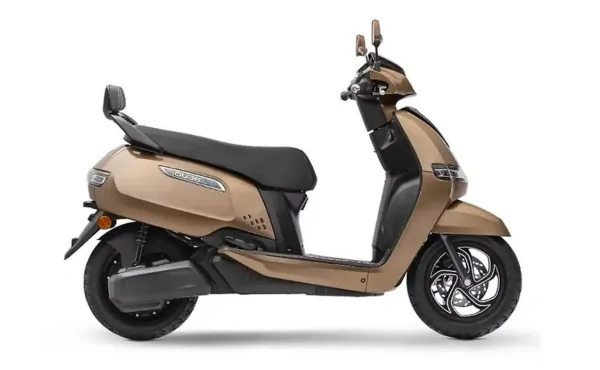
The DT SXC uses ivory-based dual-tone combinations rather than the single-colour names offered on the other variants. Its palette pairs ivory with brown, grey, matte copper bronze or elite green. The contrasting body colours are complemented by dual-coloured inner panels, chrome highlights and body-coloured grabrails.
A cushioned pillion backrest also distinguishes its rear profile from the Drum Alloy and Disc.
The SmartXonnect includes a backrest too, so this exterior addition is shared by the two connected variants rather than being exclusive to the DT SXC.
Colour Options And Variants
TVS lists different colour selections for each variant. Indiblue, Titanium Grey and White are shared by the Drum Alloy and Disc, while Sparkling Black is additionally listed for the Disc. The DT SXC and SmartXonnect have separate palettes.
| Variant |
Colours |
| Drum Alloy |
Indiblue, Titanium Grey, White |
| Disc |
Indiblue, Titanium Grey, White, Sparkling Black |
| DT SXC |
Ivory Matte Copper Bronze, Ivory Elite Green, Ivory Brown, Ivory Grey |
| SmartXonnect |
Elite Green, Elegant Red, Matte Copper Bronze |
The Drum Alloy offers three colours: Indiblue, Titanium Grey and White. The Disc retains those three choices and adds Sparkling Black. Buyers seeking that particular black finish therefore need to distinguish the Disc’s colour selection from the Drum Alloy’s rather than treating their palettes as identical.
TVS does not attach “gloss” or “matte” labels to Indiblue, Titanium Grey, White or Sparkling Black in the supplied colour selectors. Those finish descriptions should not be added to the official names without separate confirmation.
The DT SXC has four listed combinations: Ivory Matte Copper Bronze, Ivory Elite Green, Ivory Brown and Ivory Grey. Both its colour selector and FAQ identify these options, with TVS describing Ivory Matte Copper Bronze and Ivory Elite Green as newly added choices.
These names identify dual-tone combinations. Ivory Elite Green is therefore a separate listed scheme from the SmartXonnect’s Elite Green, just as Ivory Matte Copper Bronze differs from the SmartXonnect’s Matte Copper Bronze.
The SmartXonnect is available in Elite Green, Elegant Red and Matte Copper Bronze. Its colour selector and FAQ consistently list these three names. Elegant Red is not listed on the other three supplied variant pages.
Across the four official selectors, there are 11 distinct colour names or combinations. This count includes a shared colour only once and treats the ivory-based DT SXC combinations as separate schemes from the similarly named SmartXonnect colours.
The Drum Alloy is the entry version in TVS’s four-variant listing. Its exterior includes the headlamp visor, signature front light guides, raised 3D emblem, body-coloured grabrails and rear grabrail reflector. It uses a semi-digital instrument console and is offered in Indiblue, Titanium Grey and White.
Its design retains the range’s conventional appearance without the pillion backrest listed on the connected versions. TVS also describes chrome detailing as part of its exterior treatment.
The Disc adds a front disc-brake configuration and explicitly listed diamond-cut alloy wheels. Its styling package includes chrome highlights, dual-coloured inner panels, front light guides, body-coloured grabrails and a raised 3D emblem. It retains a semi-digital instrument console.
Its four-colour palette comprises Indiblue, Titanium Grey, White and Sparkling Black. The extra black choice and the specified wheel finish are useful visual distinctions when comparing it with the Drum Alloy.
DT SXC is TVS’s Dual Tone SmartXonnect version. Its defining visual distinction is the ivory-based dual-tone colour treatment, supported by chrome highlights, dual-coloured inner panels and a cushioned pillion backrest. The official page also confirms alloy wheels and a front disc brake.
The four combinations—Ivory Matte Copper Bronze, Ivory Elite Green, Ivory Brown and Ivory Grey—give it a separate identity from the regular Drum Alloy, Disc and SmartXonnect palettes. It is not simply another colour name within the standard SmartXonnect selection.
The SmartXonnect combines its connected instrument display with diamond-cut alloy wheels, chrome highlights, dual-coloured inner panels, signature front light guides and a cushioned pillion backrest.
It also retains the headlamp visor, raised emblem and body-coloured grabrails found elsewhere in the range.
Its Elite Green, Elegant Red and Matte Copper Bronze options distinguish it from the ivory-based DT SXC. Although both versions carry connected equipment and a backrest, TVS lists them as separate variants with separate colour selections.
Value For Money And Pricing
The TVS Jupiter 125’s base Drum Alloy variant starts at ₹82,100. The Disc and DT SXC are priced in between, with all four variants covering a price range of ₹8,235. These are ex-showroom Delhi prices, not the final on-road cost.
TVS notes that ex-showroom and on-road prices change depending on the city. The final price includes registration, road tax, and insurance, on top of the ex-showroom price. Accessories and optional packages can also affect the total cost.
In Delhi, the starting on-road price for the Jupiter 125 is about ₹94,337. This is just an estimate and can change based on the city, dealership, or variant.
It’s important to note that the ₹4,010 ex-showroom price gap between the Drum Alloy and Disc doesn’t always match their on-road price difference. Registration and insurance costs in your area also affect the final price.
The Drum Alloy’s strongest value argument is that the entry version retains the Jupiter 125’s principal everyday conveniences. Its 33-litre underseat compartment, 790 mm seat, external front fuel filling and adjustable rear suspension are also listed on the higher variants. Buyers do not need to pay for connectivity to obtain those shared provisions.
It is therefore the clearest price-led choice for buyers who do not require a front disc brake, smartphone connectivity or iGO Assist. The compromise is specific: those additions are absent from its published equipment package, rather than the entry version losing the range’s basic storage and seating dimensions.
The Disc suits buyers who want a front disc brake but do not need the connected package. Its ₹4,010 premium over the Drum Alloy buys a tangible braking-hardware change, accompanied by the listed wheel and interior-trim differences.
Its position becomes less straightforward when compared with the DT SXC. Another ₹3,240 adds connectivity, iGO Assist and a pillion backrest. The Disc remains the less expensive option, but buyers who want those additions receive a substantially broader package by taking the next step.
The DT SXC makes a particularly strong equipment-per-rupee case at the published prices.
It combines a front disc brake, iGO Assist, connected functions and a pillion backrest ₹985 below the SmartXonnect. Those shared major additions mean it should not be treated as a less-equipped basic version merely because it costs less than the highest-listed variant.
This assessment concerns the manufacturer’s published prices and equipment, not a claim that every connected function will be useful to every owner. For buyers who want the assist system, navigation and backrest, the DT SXC offers those items without requiring the range’s highest expenditure.
The SmartXonnect’s ₹985 premium over the DT SXC is modest within the overall range. Its page explicitly lists hazard lamps, diamond-cut alloy wheels and navigation with voice assistance. The DT SXC page also offers navigation and extensive connected functions, but does not separately list hazard lamps or describe its wheels as diamond-cut.
These are differences in the published equipment descriptions; an omission from one page alone does not prove that a component is unavailable. The strongest reason to choose the SmartXonnect over the DT SXC is therefore the buyer’s preference for its confirmed specification and colour selection, rather than an assumption that it alone provides connectivity or iGO Assist.
Competitor Models in India for the Jupiter 125 are
- Suzuki Access 125
- Honda Activa 125
- Hero Destini 125
- Hero Destini Prime
- Yamaha Fascino 125