Overview
Performance And Engine
The Raider has a 124.8 cc, air-and-oil-cooled, single-cylinder SI engine with three valves. It has a 53.5 mm bore, 55.5 mm stroke, and produces a maximum power of 8.37 kW at 7,500 rpm, which is about 11.38 PS. The iGO Assist feature is included with the engine on the TFT DD, SXC DD, SSE, iGO, and Split Seat versions.
| Engine item |
Specification |
| Engine type |
Air- and oil-cooled, single-cylinder SI |
| Displacement |
124.8 cc |
| Valves |
3 |
| Bore × stroke |
53.5 mm × 55.5 mm |
| Maximum power |
8.37 kW at 7,500 rpm, approximately 11.38 PS |
| Peak torque — TFT DD / SXC DD / SSE / iGO / Split Seat |
11.75 Nm at 6,000 rpm |
| Peak torque — Single Seat / Drum |
11.2 Nm at 6,000 rpm |
| Fuel-tank capacity |
10 litres |
| Electrical system |
MF battery, 12 V 5 Ah; iGO Assist listed |
TVS says iGO Assist uses an intelligent ECU controller to give extra torque when needed. The company claims the iGO Assist versions can accelerate from 0 to 60 km/h in 5.8 seconds. This figure only applies to the iGO Assist models, not the Single Seat or Drum versions.
iGO Assist models also come with Boost Mode, but Single Seat and Drum versions do not. TVS says Boost Mode is designed for better acceleration. Power Mode gives faster acceleration and a higher top speed, while Eco Mode is meant for better mileage and efficient power. Actual performance depends on factors like rider and passenger weight, road slope, wind, gear and mode selection, throttle use, fuel quality, tyre pressure and condition, maintenance, traffic, and weather.
The TVS Raider has a five-speed manual gearbox with a 1-N-2-3-4-5 shift pattern. The technical details mention iGO Assist as part of the electrical system, but there is no separate gearbox setting or automatic transmission for any Raider model.
| Transmission Item |
Specification |
| Gearbox |
Five-speed manual |
| Shift pattern |
1-N-2-3-4-5 |
| Final drive |
Chain drive |
| Low-speed traffic feature |
Glide Through Traffic |
| Start-assistance system |
iGO Assist-equipped versions list MF battery, 12 V 5 Ah with iGO Assist |
TVS describes Glide Through Traffic as a feature that helps with low-speed riding in heavy traffic. The company does not provide a specific speed range for this function, so it is not possible to state an exact speed.
TVS says Power Mode allows for a higher top speed, but does not give an exact number. So, it is not accurate to quote a specific top speed as an official TVS figure.
Estimates suggest the Raider’s top speed is around 95 to 99 km/h, but TVS does not officially confirm these numbers.
Top speed depends on things like rider position and weight, passenger or luggage, road surface and slope, wind, tyre pressure, traffic, fuel, weather, and how well the bike is maintained. It is not meant to be a recommended cruising speed.
Mileage And Fuel Efficiency
There is no official ARAI mileage figure for the Raider. Reported mileage ranges from 56.7 kmpl to 71.94 kmpl, based on independent tests. These are not official TVS numbers.
Mileage claims for the Raider range from 56 kmpl to 71.94 kmpl. These numbers are for reference and do not guarantee what each rider will get in real use.
If you use the official 10-litre fuel tank and the 56–57 kmpl mileage range, the Raider could theoretically go about 560–570 km on a full tank, or about 719 km if you use the 71.94 kmpl figure. These are only estimates and do not include factors like fuel reserve, traffic, speed, load, or how you refuel. Average fuel efficiency is usually between 55 kmpl and 71.94 kmpl, depending on whether you ride in the city or on the highway.
In mixed riding, a safe estimate for mileage is about 55–60 kmpl. You can get better mileage with steady, moderate riding and less traffic. On the other hand, frequent hard acceleration, using Power or Boost Mode often, carrying a passenger, rough or uphill roads, low tyre pressure, or overdue servicing can lower fuel efficiency. The best way to know your Raider’s mileage is to track it over several refills on your usual route.
Features And Technology
The TVS Raider in India comes with features that range from a basic reverse-LCD commuter setup to advanced TFT-connected models with dual-disc ABS and traction control. The TFT DD and SXC DD versions have the most features. The iGO, SSE, and Split Seat models add iGO Assist and SmartXonnect, while the Single Seat and Drum versions keep things simple with basic technology and brakes.
- 124.8 cc, three-valve engine: The Raider uses a 124.8 cc, air-and-oil-cooled, single-cylinder SI engine with three valves. The official specification table lists 8.37 kW at 7,500 rpm, equivalent to about 11.38 PS.
- iGO Assist: TFT DD, SXC DD, SSE, iGO, and Split Seat versions receive iGO Assist. TVS says it uses an intelligent ECU controller to provide torque on demand.
- Variant-specific torque output: The iGO Assist versions are listed with 11.75 Nm at 6,000 rpm, while Single Seat and Drum versions are listed with 11.2 Nm at 6,000 rpm.
- Boost Mode: TFT DD, SXC DD, SSE, iGO, and Split Seat variants have Boost Mode. TVS describes this as the acceleration-focused riding mode.
- Power Mode: TVS describes Power Mode as providing faster acceleration and a higher top-speed setting. It is part of the Raider riding-mode package on applicable versions.
- Eco Mode: Eco Mode is designed for high mileage with optimised power, according to TVS.
- Integrated Starter Generator: The Raider uses iGO Assist / ISG technology for silent, hassle-free starting.
- Glide Through Traffic: GTT is designed for effortless low-speed riding in congested traffic. TVS does not state a numerical operating-speed range in the published Raider material.
- TFT display: The TFT DD variant receives a TFT display and SmartXonnect with more than 99 connected features.
- Reverse-LCD display: SXC DD, SSE, iGO, Split Seat, Single Seat, and Drum versions use a reverse-LCD display. SXC DD, SSE, iGO, and Split Seat models receive a reverse multicolour LCD display with more than 85 connected features.
- SmartXonnect connectivity: TFT DD, SXC DD, SSE, iGO, and Split Seat variants have SmartXonnect. It supports compatible smartphone-connected functions; it is not listed for Single Seat or Drum models.
- Turn-by-turn navigation: SmartXonnect provides real-time turn-by-turn navigation on the applicable display.
- Phone, message, and app notifications: Connected variants can show calls, messages, and app notifications on the display.
- Call management: TFT DD, SXC DD, SSE, iGO, and Split Seat models include call-management functionality through a single-touch control.
- Voice Assist: Voice Assist is available on TFT DD, SXC DD, SSE, iGO, and Split Seat variants. TVS says it can be used for navigation and other functions.
- Low-fuel alert: SmartXonnect includes a low-fuel alert on the compatible connected variants.
- Ambient sensor: TFT DD, SXC DD, SSE, iGO, and Split Seat versions include an ambient sensor, according to the variant matrix.
- Dual-disc brakes with ABS: TFT DD and SXC DD versions have 240 mm front and 200 mm rear disc brakes with ABS. TVS describes this as a first-in-segment dual-disc ABS configuration.
- Traction Control System: TVS lists a Traction Control System with the TFT DD and SXC DD dual-disc ABS configurations, describing it as supporting grip, stability, and control.
- Front disc and rear drum setup: SSE, iGO, Split Seat, and Single Seat versions use a 240 mm front disc and a 130 mm rear drum .
- Sync Braking Technology: The disc-and-drum Raider versions use SBT, which TVS describes as supporting improved control and shorter braking distance.
- Drum-brake configuration: The Drum variant uses 130 mm drum brakes at the front and rear and is listed with SBT.
- LED headlamp: The Raider uses an “animalistic” LED headlamp as part of its sporty naked-street styling.
- LED tail lamp: The specification sheet lists an LED tail lamp.
- Side-stand engine cut-off: The Raider has a side-stand indicator with engine cut-off functionality.
- Five-step-adjustable gas-charged rear monoshock: The rear suspension is a five-step-adjustable, gas-charged monoshock. TVS describes it as intended to provide a stable and comfortable ride.
- Variant-specific tyre sizes: TFT DD and SXC DD versions use 90/90–17 front and 110/80–17 rear tubeless tyres. Other configurations listed in the official specification use 80/100–17 front and 100/90–17 rear tubeless tyres.
- Variant-specific kerb weight: SSE, iGO, and Split Seat versions are listed at 123 kg; Single Seat and Drum versions at 124 kg; and TFT DD and SXC DD versions at 125 kg.
- 10-litre fuel tank: The Raider has a 10-litre fuel tank.
- Special Super Squad Edition styling: The SSE version is offered with Deadpool, Wolverine, Iron Man, and Black Panther themes.
Build Quality
The Raider has a sporty naked-street design built around a muscular fuel tank, LED headlamp, LED tail lamp, telescopic front fork, gas-charged monoshock, and tubeless tyres. The supplied official technical information lists an overall length of 2,070 mm, width of 785 mm, height of 1,028 mm, wheelbase of 1,326 mm, and unladen ground clearance of 180 mm.
Kerb weight differs by variant. The SSE, iGO, and Split Seat models are listed at 123 kg, the Single Seat and Drum models at 124 kg, and the TFT DD and SXC DD versions at 125 kg. These small weight changes reflect the differing brakes and equipment rather than indicating a completely different chassis.
The front and rear hardware also changes with the selected variant. TFT DD and SXC DD models use 240 mm front and 200 mm rear disc brakes with ABS, while SSE, iGO, Split Seat, and Single Seat variants use a 240 mm front disc with a 130 mm rear drum. The Drum version uses 130 mm drums at both ends. Buyers should inspect the exact motorcycle because the Raider’s braking equipment cannot be generalised across the entire range.
Owners have mixed opinions about the Raider’s fit and finish. Some like its display, styling, and daily practicality, while others mention issues like chain noise, vibration, or worries about paint and panel quality after some time. These are personal experiences and do not mean every Raider will have these problems. It’s a good idea to inspect the bike carefully before taking delivery.
Check paint consistency, decal alignment, tank-panel fit, headlamp and tail-lamp operation, switchgear movement, screen readability, handlebar alignment, wheel-rim finish, tyre manufacturing dates, chain lubrication and tension, front-fork seals, rear-shock mounting and adjustment, brake-lever feel, disc condition, fasteners, and visible wiring. For SmartXonnect-equipped versions, pair a smartphone and test navigation, notifications, call management, and Voice Assist before taking delivery.
Handling
The Raider’s handling fundamentals include a 1,326 mm wheelbase, 180 mm unladen ground clearance, telescopic front suspension, and five-step-adjustable gas-charged rear monoshock. TVS says the rear suspension is intended to offer a stable and comfortable ride, while the low 123–125 kg kerb-weight range should support manoeuvrability in traffic.
Tyre specification varies by version. TFT DD and SXC DD models are listed with 90/90–17 front and 110/80–17 rear tubeless tyres, while other listed configurations use 80/100–17 front and 100/90–17 rear tubeless tyres. The dual-disc ABS variants therefore differ not only in braking equipment but also in tyre sizing, which can affect their road feel.
The TFT DD and SXC DD versions are the highest safety-specification Raider configurations. TVS lists dual-disc brakes with ABS and traction control for these versions and describes the package as supporting grip, stability, and control. The other disc-brake variants use Sync Braking Technology, which TVS says provides better control and shorter braking distance. These systems are rider aids, not substitutes for appropriate speed, tyre condition, braking technique, or caution on wet, sandy, broken, or uneven roads.
The official Raider page identifies Glide Through Traffic as a low-speed riding aid for traffic conditions. It may be particularly useful in stop-start conditions, but TVS does not publish a numerical operating-speed range in the available product material.
Many people say the Raider feels light and easy to handle in city traffic, but views on its high-speed stability and suspension differ. When you test ride, try it in real local conditions like slow traffic, U-turns, speed bumps, rough roads, hard braking, and a bit of open road. This will help you judge the steering, suspension, brakes, and how confident you feel at your usual speeds.
Comfort
The Raider is designed as a sporty commuter rather than a long-distance touring motorcycle. Its comfort-related equipment includes the five-step-adjustable gas-charged rear monoshock, Glide Through Traffic, and iGO Assist or Integrated Starter Generator functions on applicable variants. TVS says the monoshock is intended to provide a stable and comfortable ride, while GTT is intended to make low-speed traffic riding easier.
The Raider’s weight range of 123–125 kg and its 180 mm ground clearance may help with everyday manoeuvring and negotiating speed breakers or uneven urban roads. However, TVS’s available technical specifications do not list a seat-height figure in the supplied material, so it would be inappropriate to make a specific accessibility claim for shorter or taller riders.
Seating layout differs by variant. The lineup explicitly includes Split Seat and Single Seat versions, but it does not state that one is definitively more comfortable for every rider or pillion. Comfort will depend on rider height, passenger weight, seat shape and padding, road quality, tyre pressure, suspension preload, journey length, and riding speed.
People often praise the Raider for being light, easy to handle in the city, having a clear display, and being practical for daily commuting. Some, however, mention vibration, a stiff ride on rough roads, or seat discomfort on long trips. These are personal opinions, so it’s best to test the version you want instead of assuming all Raiders are the same.
For a meaningful comfort assessment, test the chosen Raider over stop-start traffic, speed breakers, broken tarmac, and a longer open-road stretch. Evaluate seat support, handlebar reach, knee angle, footpeg position, clutch effort, engine vibration, heat in traffic, rear-suspension reaction to potholes, and the ability to place both feet securely at a stop. If regular pillion use is expected, test the intended Single Seat or Split Seat version with the usual passenger.
Styling
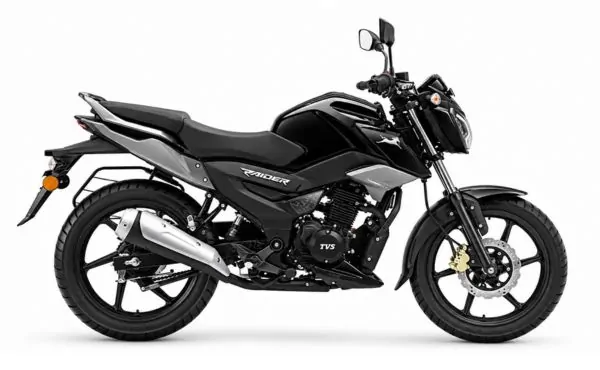
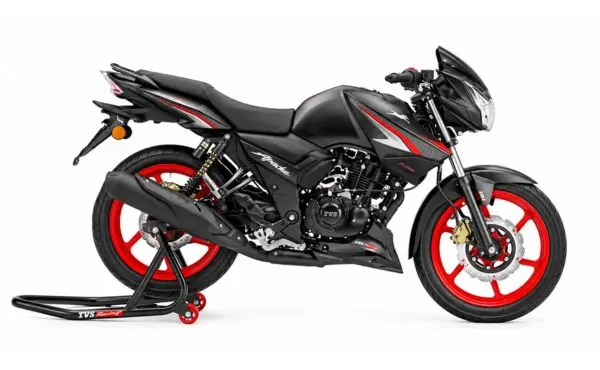
The Raider has a sharp naked-street design rather than the flat-tank, conservative appearance of a conventional commuter motorcycle. TVS highlights its animalistic LED headlamp, muscular fuel tank, compact tail section, exposed engine area, and sporty bodywork. The range also uses an LED tail lamp, alloy-wheel stance, and either single-seat or split-seat layouts depending on the chosen model.
The top-end TFT DD and SXC DD versions are visually differentiated by their dual-disc ABS layout. They use a 240 mm front disc and 200 mm rear disc, along with wider 90/90–17 front and 110/80–17 rear tubeless tyres. This gives them a more substantial wheel-and-brake appearance than the disc-and-drum Raider versions.
The SSE, iGO, Split Seat, and Single Seat variants use a 240 mm front disc paired with a 130 mm rear drum, while the Drum version uses 130 mm drum brakes at both ends. These hardware differences matter visually as well as functionally, particularly around the rear wheel.
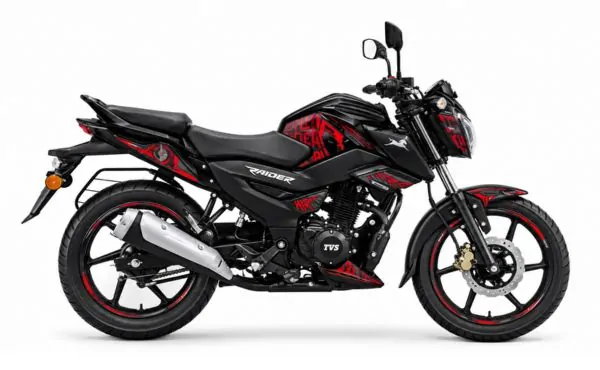
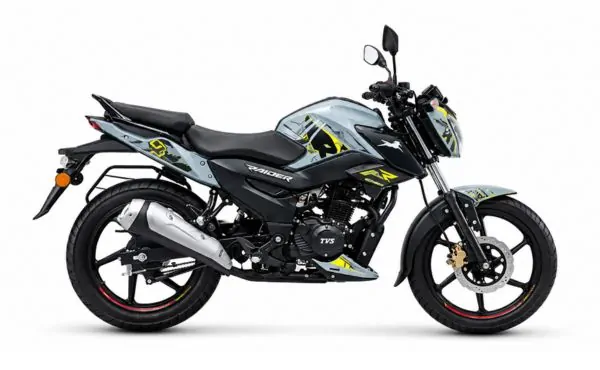
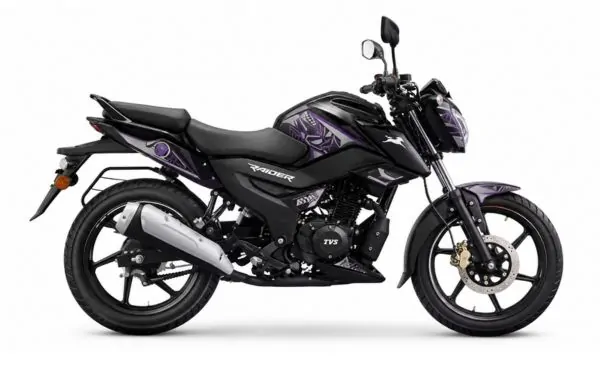
The Super Squad Edition is the most distinctive Raider from a styling perspective. TVS offers factory Marvel-themed versions with Deadpool, Wolverine, Iron Man, and Black Panther graphics; its colour-image entries also include a Doomsday-labelled theme. These themes are visual treatments and should not be treated as proof of different engine or chassis specifications.
Colour Options And Variants
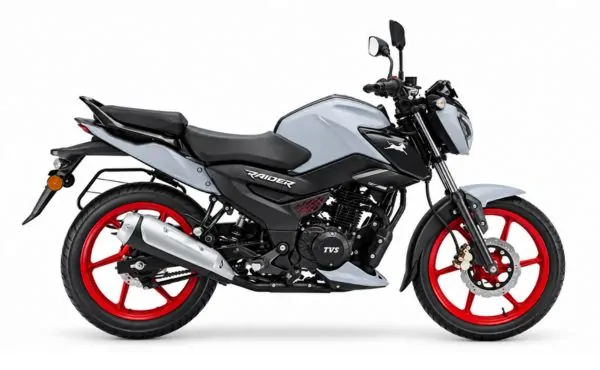
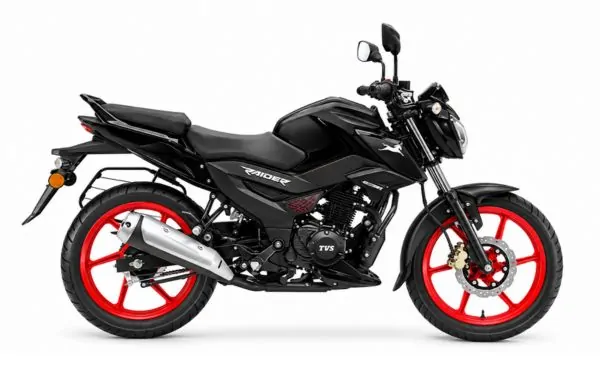
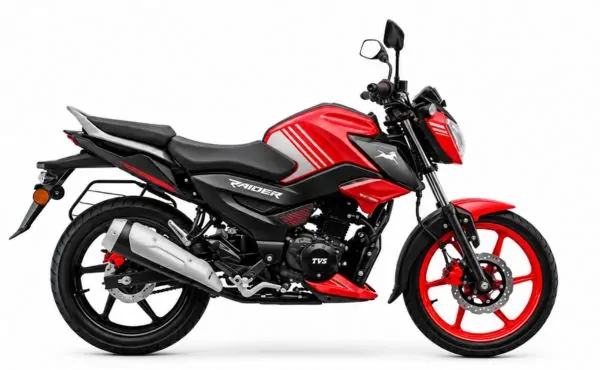
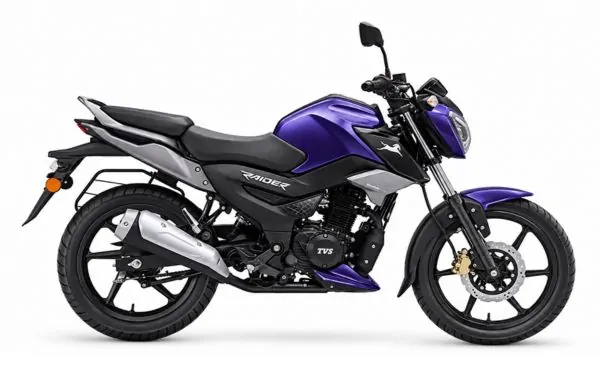
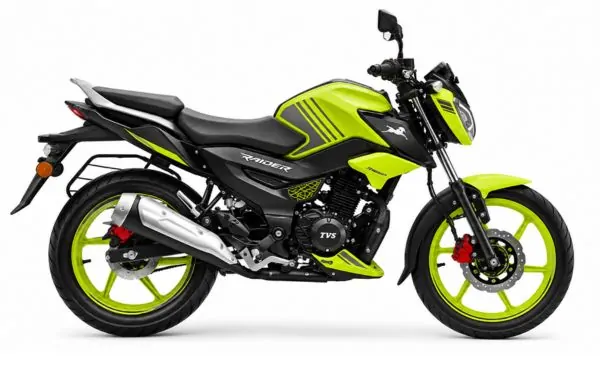
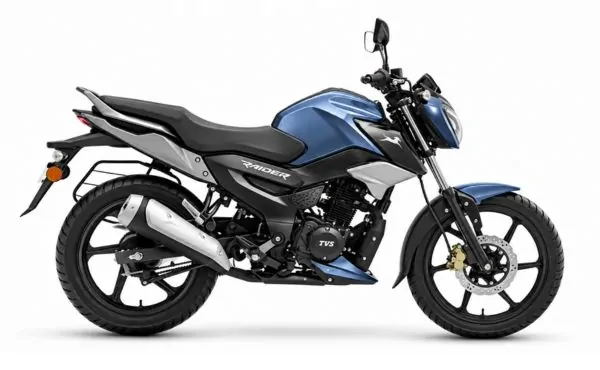
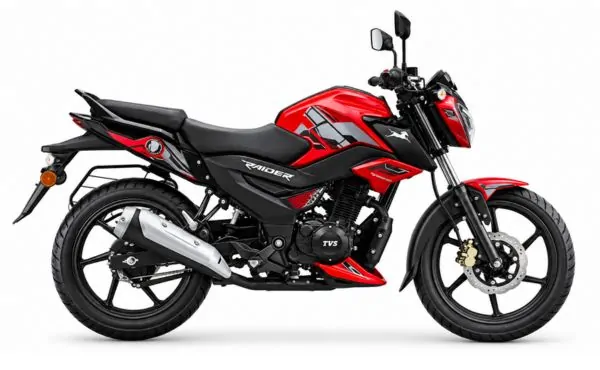
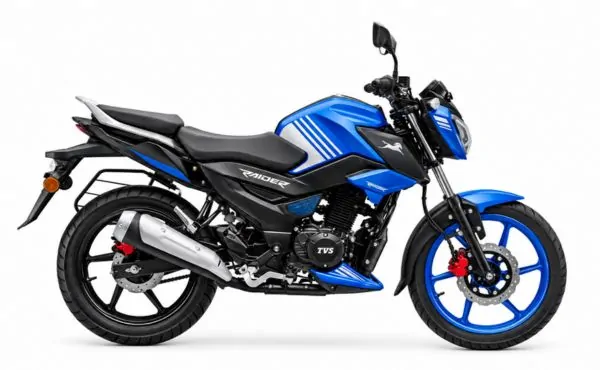
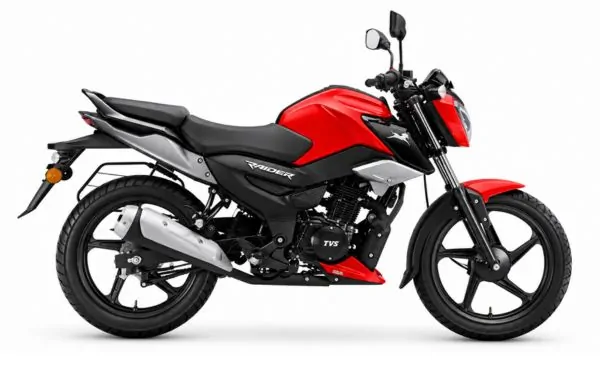
The Raider is shown in a broad selection of standard colours, wheel-finish pairings, and Marvel-themed Super Squad Edition liveries. TVS’s colour presentation groups several finishes by Red Alloys and Black Alloys, which indicate the wheel-finish presentation rather than separate paint colours. The exact colour available depends on the chosen variant and local dealer stock.
Red-alloy group
- Nardo Grey
- Wicked Black
- Striking Red
Black-alloy group
- Forza Blue
- Striking Red
- Blazing Blue
- Fiery Yellow
Super Squad Edition themes
- Black Panther
- Iron Man
- Deadpool
- Wolverine
Other colours shown
- Mercury Grey
- Nitro Green
- Metallic Blue
- Metallic Grey
- Black
- Red
The Raider range consists of TFT DD, SXC DD, SSE, iGO, Split Seat, Single Seat, and Drum. Each version combines a different mix of display, connectivity, iGO Assist availability, seat treatment, and braking hardware.
| Variant |
Key visual or layout identity |
Display and connected functions |
Brake configuration |
| TFT DD |
TFT-equipped, dual-disc model |
TFT console; SmartXonnect; 99+ connected features |
Dual disc with ABS |
| SXC DD |
Reverse-LCD, dual-disc model |
Reverse-LCD console; SmartXonnect; 85+ connected features |
Dual disc with ABS |
| SSE |
Marvel-themed Super Squad Edition |
Reverse-LCD console; SmartXonnect; 85+ connected features |
Front disc and rear drum |
| iGO |
iGO Assist version |
Reverse-LCD console; SmartXonnect; 85+ connected features |
Front disc and rear drum |
| Split Seat |
Two-piece seat layout |
Reverse-LCD console; SmartXonnect; 85+ connected features |
Front disc and rear drum |
| Single Seat |
One-piece seat layout |
Reverse-LCD console; SmartXonnect is not listed |
Front disc and rear drum |
| Drum |
Drum-brake entry model |
Reverse-LCD console; SmartXonnect is not listed |
Front and rear drum |
TFT DD
The TFT DD is the Raider’s most screen-focused option. It has a TFT display, SmartXonnect with more than 99 connected features, call management, Voice Assist, iGO Assist, and dual-disc brakes with ABS. TVS displays it in Nitro Green, Striking Red, and Metallic Blue.
SXC DD
The SXC DD retains the dual-disc ABS arrangement but uses a reverse-LCD display instead of the TFT unit. It receives SmartXonnect with more than 85 connected features, call management, Voice Assist, and iGO Assist. TVS displays Nitro Green, Striking Red, and Metallic Blue for this variant.
SSE
The Super Squad Edition is the themed Raider option. It uses a reverse-LCD console, SmartXonnect with more than 85 connected features, iGO Assist, Boost Mode, and front-disc/rear-drum brakes. Its visual identity comes from the Marvel-themed graphics rather than a unique mechanical specification.
iGO and Split Seat
The iGO and Split Seat variants have iGO Assist, Boost Mode, ambient sensor, Voice Assist, call management, and SmartXonnect with more than 85 connected features. Both use a reverse-LCD display and front-disc/rear-drum brakes. The visible difference is the Split Seat model’s two-piece seat arrangement; TVS displays it in Black, Red, and Blazing Blue.
Single Seat and Drum
The Single Seat and Drum variants use Intelligent technology rather than iGO Assist. They are not listed with SmartXonnect, Boost Mode, ambient sensor, Voice Assist, or call management. Both use a reverse-LCD console, but Single Seat uses front-disc/rear-drum brakes, and Drum uses drum brakes at both ends.
The TFT DD is the most premium-looking Raider for buyers who want a TFT console and dual-disc ABS hardware. The SXC DD offers the same brake layout with a reverse-LCD connected console. SSE is the themed graphics option, while iGO and Split Seat combine iGO Assist and connected functionality with a conventional front-disc/rear-drum layout. Single Seat and Drum provide the simpler end of the range.
Before you book, check the exact variant name, colour, wheel finish, display type, seat style, brake setup, and whether SmartXonnect is available at the dealership. Raider colours and features depend on the version, so do not assume you can mix and match them without checking first.
Value For Money And Pricing
The TVS Raider range in India starts at ₹ 84,460 ex-showroom Delhi for the base Drum variant. The entry Raider Drum’s stated Delhi on-road price is ₹1,00,035; use this as a city-specific reference, because registration, insurance, accessories, and related charges can change the final on-road amount.
TVS offers the Raider in seven principal trims: Drum, Single Seat, Split Seat, iGO, Super Squad Edition, SXC Dual Disc, and TFT Dual Disc. The range gives buyers an entry point at the Drum variant, then progressively adds a front disc brake, connected features, iGO Assist, themed graphics, and eventually dual-disc braking with ABS at the top end. TVS’s price page labels its figures as ex-showroom Delhi and notes that mandatory and other accessories are excluded.
The Raider’s value for money depends a lot on which version you choose. All models are in the 125 cc commuter class, but the higher trims offer features you usually do not get at this price, not just different looks. It’s best to pick the version with the features you actually need, instead of just going by the Raider name.
The Drum variant is the least-expensive way into the range. It includes a reverse-LCD digital cluster, riding modes, Sync Braking Technology, and a drum-brake configuration. It is the value-led option for a buyer who wants Raider styling and the basic digital package while keeping the initial outlay as low as possible.
The Single Seat version is the more logical upgrade for a rider who wants a front disc brake. TVS lists a 240 mm front disc with Sync Braking Technology, along with its reverse-LCD cluster and riding modes. It costs more than the Drum version.
The Split Seat and iGO variants bring the Raider’s richer digital proposition into play. TVS lists SmartXonnect with more than 85 connected features, call management, voice assist, a reverse multicolour LCD display, and Glide Through Traffic. These versions also use the iGO Assist configuration, which TVS quotes at 11.75 Nm at 6,000 rpm and a claimed 0–60 km/h time of 5.8 seconds.
The price gap between the cited Split Seat price and iGO price is small. Buyers should compare their local quotations and the exact equipment displayed on the selected motorcycle, rather than assuming every feature shown on the Raider webpage applies identically to both trims.
The Super Squad Edition has a similar feature basis to the connected iGO versions but is aimed at buyers who specifically value the themed exterior. TVS identifies Deadpool, Wolverine, Iron Man, and Black Panther themes on its Raider page; the current Indian pricing list also identifies a Doctor Doom Super Squad Edition. It represents value only if the buyer genuinely wants the official themed styling, since the ₹700 difference over iGO is primarily a design-led decision.
The SXC Dual Disc begins the premium end of the range. It combines dual-disc brakes with ABS, traction control, iGO Assist, and SmartXonnect with more than 85 connected features. This is the most targeted option for a buyer who sees stronger braking hardware and electronic safety support as the priority but does not require the TFT console.
The TFT Dual Disc is the flagship Raider. It carries dual-disc brakes with ABS and traction control, iGO Assist, and a TFT display with more than 99 connected features, plus call management and voice assist. The extra over the SXC Dual Disc should be evaluated as a premium for the TFT/expanded connected interface rather than a separate performance class, because TVS presents both variants with the 11.75 Nm iGO Assist torque figure and 5.8-second 0–60 km/h claim.
| Buying priority |
Raider version to examine first |
Value rationale |
| Lowest initial purchase price |
Drum |
Lowest listed entry price; reverse-LCD cluster, riding modes, and SBT. |
| Front-disc braking without moving to the connected trims |
Single Seat |
Adds a 240 mm front disc and SBT at a moderate step above Drum. |
| Connected functions and iGO Assist |
iGO or Split Seat |
85+ connected features, voice assist, call management, GTT, and iGO Assist. |
| Factory-themed appearance |
Super Squad Edition |
Marvel-inspired visual themes with the connected-feature package. |
| Dual-disc ABS at a lower price than the TFT model |
SXC Dual Disc |
Dual discs, ABS, traction control, and 85+ connected features. [1965] |
| Largest digital interface and complete Raider equipment suite |
TFT Dual Disc |
TFT cluster, 99+ connected features, dual-disc ABS, and traction control. |
The Raider competes in India’s premium 125 cc commuter and sporty-naked space. The closest comparisons are the
- Hero Xtreme 125R
- Bajaj Pulsar N125
- Bajaj Pulsar NS125
- Honda SP125
- Honda CB125 Hornet
Their relevance varies: the Xtreme 125R, Pulsar N125, Pulsar NS125, and CB125 Hornet are sportier alternatives, while the SP125 is a traditional commuter-oriented comparison.
The Raider Drum is the budget entry point. The Single Seat is the front-disc upgrade, iGO and Split Seat form the connected-feature middle ground, SXC Dual Disc targets buyers who prioritise dual-disc ABS and traction control, and TFT Dual Disc is the fully equipped flagship.
For the most balanced equipment-to-price proposition, iGO, Split Seat, and SXC Dual Disc deserve the closest scrutiny: the first two introduce SmartXonnect and iGO Assist, while SXC Dual Disc adds the headline safety hardware without the additional TFT premium. The final choice should be made from a same-day dealer quotation that separately shows ex-showroom price, insurance, registration, accessories, offers, and the final on-road total.