Overview
Performance And Motor
The iQube has a hub-mounted electric motor, meaning the motor is built into the wheel instead of using an engine and CVT like petrol scooters. The 2.3 kWh version uses a BLDC (brushless DC) hub motor. Most versions have a 4.4 kW peak output, but the 2.3 kWh model has a lower peak output of 3.68 kW.
The 2.3 kWh version should not be given the general 4.4 kW figure from the main page. Its specific technical specification is more accurate for this model.
| Motor specification |
iQube 2.3 kWh |
| Motor type |
BLDC hub-mounted traction motor |
| Rated power |
3 kW, approximately 4.08 PS |
| Peak power |
3.68 kW, approximately 5.00 PS |
| Rated torque |
33 Nm |
| Peak torque |
140 Nm |
The PS numbers are rounded from the kW ratings. Rated output and peak output are different and should not be swapped.
The 4.4 kW peak output is about 5.98 PS. This general motor info doesn’t provide a full power table for each version, so don’t use it to ignore the specific difference for the 2.3 kWh model.
The iQube 2.3 kWh has a 0–40 km/h acceleration time of 4.7 seconds. There is also a 4.2-second time published, but the comparison table does not show this for every version. So, the 4.2-second figure should not be used for all models.
This difference is important because the entry version has less peak power and a lower top speed. Its specific acceleration number gives a clearer picture than a general promotional claim.
The iQube is said to perform smoothly and quietly, with quick acceleration for city use. Power mode gives stronger pickup and faster acceleration. It offers both Eco and Power modes, and the hub motor is quiet and refined.
Older speed limits for each mode should not be assumed for every version. The current table gives the most accurate top speeds for each model.
The iQube has an automatic, twist-and-go setup with its hub-mounted electric drive. It does not use the belt-and-pulley CVT from petrol TVS scooters, and there is no clutch or gear shifting for the rider. Indian automotive rules call its transmission automatic.
The hub setup is said to reduce transmission losses compared to a separate drivetrain. This does not mean the whole electrical system is 100% efficient; it only refers to the direct hub-drive design.
Regenerative braking is part of the scooter. It lets the scooter recover energy when slowing down, but no fixed percentage has been published for how much it increases riding range.
The current official comparison table gives the iQube 2.3 kWh a maximum speed of 68 km/h. The 3.1 kWh, 3.5 kWh, MillionR Edition, S 4.7 kWh and ST 5.3 kWh are each listed at 82 km/h. These are published specifications, not independently measured GPS results.
| Variant |
Official top speed |
| iQube 2.3 kWh |
68 km/h |
| iQube 3.1 kWh |
82 km/h |
| iQube 3.5 kWh |
82 km/h |
| iQube MillionR Edition |
82 km/h |
| iQube S 4.7 kWh |
82 km/h |
| iQube ST 5.3 kWh |
82 km/h |
The numbers above are from the current comparison table. Some other sources show lower speeds for certain versions, but the main figures should be used when describing the range.
Charging Time
The current variant cards and comparison table show charging times from 10% to 80% battery. It takes 2 hours 25 minutes for the 2.3 kWh version and up to 4 hours for the ST 5.3 kWh. These are not full-charge times.
| Variant |
Installed battery capacity |
Official charging time: 10–80% |
| iQube 2.3 kWh |
2.3 kWh |
2 hours 25 minutes |
| iQube 3.1 kWh |
3.1 kWh |
3 hours 30 minutes |
| iQube 3.5 kWh |
3.5 kWh |
3 hours 45 minutes |
| iQube MillionR Edition |
3.5 kWh |
3 hours 45 minutes |
| iQube S 4.7 kWh |
4.7 kWh |
3 hours 15 minutes |
| iQube ST 5.3 kWh |
5.3 kWh |
4 hours |
Do not estimate 0–100% charging times by assuming the rate stays the same, since the full charging profile is not given.
A portable 950W charger and charging through a 15A plug point are available. The 2.3 kWh version includes a portable offboard charger, but the technical table does not state the charger’s output wattage independently.
There is also a general claim of 0–80% charging in 4 hours 18 minutes. This uses a different starting point than the 10–80% figures and is not clearly linked to every version. It should not be used as the standard iQube charging time.
Charging cuts off automatically after reaching 100%. That confirms the charging-control function, not the time required to reach a full charge.
Range
The range numbers are IDC range per charge. The 2.3 kWh version is listed at 114 km, and the ST 5.3 kWh goes up to 212 km. The regular 3.5 kWh and MillionR Edition both have a published range of 145 km.
| Variant |
Official IDC range per charge |
| iQube 2.3 kWh |
114 km |
| iQube 3.1 kWh |
123 km |
| iQube 3.5 kWh |
145 km |
| iQube MillionR Edition |
145 km |
| iQube S 4.7 kWh |
175 km |
| iQube ST 5.3 kWh |
212 km |
Features And Technology
The TVS iQube offers a range of features for everyday electric-scooter use in India, combining digital displays, connected functions, parking assistance and practical storage provisions. Equipment varies by version, from the 2.3 kWh model’s LCD to the ST 5.3 kWh’s touchscreen, while supported variants provide navigation, phone alerts, remote charge information and security notifications. USB charging, a portable charger, and automatic charging cut-off add convenience, making variant-specific equipment a key differentiator in the iQube range.
- Variant-Specific Digital Displays: The iQube 2.3 kWh has a 5-inch LCD, while the 3.1 kWh, 3.5 kWh and MillionR Edition use 5-inch TFT displays. The S 4.7 kWh has a larger 7-inch TFT display, and the ST 5.3 kWh adds touchscreen functionality to its 7-inch TFT unit. A touchscreen should therefore not be described as standard across the range.
- Touchscreen Controls on ST: The ST 5.3 kWh provides an interactive touchscreen dashboard with incoming-call alerts and music play/pause controls. These functions distinguish its display from the non-touch units listed on the other variants.
- SmartXonnect Connectivity: SmartXonnect is the iQube’s connected platform, linking supported scooter functions with the smartphone app. More than 100 connected features are advertised, and access to every connected service should not be assumed to be permanently included without a subscription.
- Turn-by-Turn Navigation: Supported connected variants provide turn-by-turn navigation through the SmartXonnect system. Navigation is available on the S 4.7 kWh, providing route guidance through the scooter’s display.
- Call and SMS Alerts: The connected system provides incoming-call and SMS notifications on supported displays. The S 4.7 kWh and ST 5.3 kWh include incoming-call alerts through their respective interfaces.
- Voice Assistance: The S 4.7 kWh variant includes voice assistance and an Alexa skill. These functions form part of that variant’s connected technology package; voice-control availability is not established for all six versions.
- Music Controls: The S 4.7 kWh includes music controls, while the ST 5.3 kWh touchscreen provides play/pause functionality. These controls should not be interpreted as confirmation that the scooter has built-in speakers or independently streams music without a connected device.
- Distance-to-Empty Display: TVS highlights a distance-to-empty indicator that displays the estimated remaining riding distance. It is a dashboard estimate, not a guarantee, of the distance available under every combination of speed, load, and road conditions.
- Remote Charge Status: The connected system allows supported vehicle charge information to be checked remotely. Remote charge status is included on the S 4.7 kWh, and the app provides remote battery status.
- Trip Telemetry and Ride Information: The iQube app provides trip telemetry, allowing owners to review supported ride information through the connected platform. This is available alongside navigation, battery status and other app-linked functions. The precise information available depends on the applicable connected package.
- Geofencing: Geofencing is available through the telematics unit on the 3.5 kWh, S 4.7 kWh and ST 5.3 kWh. This allows you to set a virtual boundary and triggers an alert when the vehicle crosses the configured limit.
- Anti-Theft Alerts: The 3.5 kWh, S 4.7 kWh and ST 5.3 kWh include telematics-based anti-theft alerts. This is a notification function and should not be presented as proof that theft is impossible or that the scooter can always be remotely immobilised.
- Crash and Fall Alerts: Crash and fall alerts are included on the 3.5 kWh, S 4.7 kWh and ST 5.3 kWh. These functions use the connected system to notify the owner when a qualifying event is detected. They supplement the information available to the owner but are not a substitute for emergency assistance.
- Live Indicator Status: The 3.5 kWh, S 4.7 kWh, and ST 5.3 kWh include live indicator status through the telematics unit. This is distinct from an automatically cancelling indicator function, which those listings do not establish.
- Q-Park Assist: Q-Park Assist provides powered assistance for reversing the scooter. You activate it via a button, and it supports reversing over minor obstacles, inclines, and uneven surfaces. This is a parking aid, not an autonomous parking system.
- Eco and Power Riding Modes: The iQube offers Eco and Power modes. Power mode provides stronger pickup, while Eco offers an alternative operating setting. Do not apply mode-specific speed limits uniformly across the current range because the variants have different published performance specifications.
- Regenerative Braking: Regenerative braking is included in the iQube’s published equipment. It enables energy recovery during suitable deceleration conditions, but the cited sources do not establish a fixed percentage increase in range attributable to regeneration.
- Hill-Hold Assistance: Hill-hold functionality is included within the iQube equipment, with specific assignment to the 3.1 kWh variant. It should therefore not be described as standard across all six current versions.
- Underseat Storage on Higher Variants: There is 32-litre underseat storage on the 3.5 kWh, S 4.7 kWh and ST 5.3 kWh. These compartments can accommodate two helmets, but there is no specification of universal compatibility with every helmet size and shell shape.
- MillionR Edition Front Storage Box: The MillionR Edition adds a front storage box, increasing its combined storage capacity from 32 litres to 35.5 litres. This additional compartment is an edition-specific provision and should not be attributed to every iQube.
- Mobile Charging Port: The underseat storage on the 3.5 kWh, S 4.7 kWh, and ST 5.3 kWh includes a USB charging port. The MillionR Edition also gets a USB Type-C charging port.
- Portable Plug-and-Play Charger: A portable offboard charging setup connects to a suitable 15A plug point. This lets you charge at a compatible electrical outlet, so the scooter doesn’t rely solely on a dedicated public charging station.
- Automatic Charging Cut-Off: The charger automatically cuts power when the battery reaches 100%. This is a charging-control function; it does not establish that every household socket or extension cable is suitable for charging the scooter.
- Battery Management System: The iQube’s battery package includes an indigenously developed Battery Management System. It also includes a high-strength aluminium battery casing. These are battery-system provisions rather than user-selectable riding functions.
- Water- and Dust-Resistance Rating: The battery is IP67-rated for water and dust resistance on the 3.5 kWh and S 4.7 kWh variants. This is a defined protection rating, not a claim that the entire scooter can be ridden through water of unlimited depth.
- AIS 156 Battery-Safety Compliance: The 3.5 kWh and S 4.7 kWh variants have AIS 156 certification. This is a stated safety-compliance provision and should not be interpreted as a guarantee against every possible battery fault or accident.
- Front Disc and Rear Drum Brakes: The current S 4.7 kWh includes a front disc brake and rear drum brake. Disc brakes are also included on the 3.5 kWh and S variants. A disc brake should not be confused with ABS, which is not available for these equipment descriptions.
- Telescopic Fork and Twin Rear Shock Absorbers: The current S 4.7 kWh uses telescopic front forks and twin rear shock absorbers. It also has 12-inch wheels. These details identify its chassis equipment but do not imply electronically adjustable or semi-active suspension.
Build Quality
The iQube S is praised for its paint quality and robust switchgear. The controls offer a tactile feel, contributing to a positive impression of the surfaces and components used regularly by the rider.
Overall quality is good, but the finish is not consistently excellent. Well-finished paint and solid controls don’t translate into equally precise fitment across every body panel.
Some fit-and-finish issues include the visor area, uneven panel gaps near the front apron, and a roughly finished plastic cover beneath the rider’s seat. These were specific to a tested vehicle and are not confirmed faults of every current iQube
.
TVS promotes the build quality, but no published measurements exist for panel gaps, long-term plastic ageing, or resistance to rattles. The available evidence supports a qualified assessment: the iQube S has good overall quality, with room for improvement in individual trim and panel details.
TVS describes high-strength aluminium extrusion casing around the battery packs and iden
tifies IP67-rated battery protection against water and dust. These are confirmed construction details for the battery assembly, not a description of the exterior body panels
.
The protection rating should not be extended into a claim that the entire scooter is waterproof or suitable for unrestricted travel through flooded roads. The manufacturer’s cited description specifically concerns the battery protection system.
Handling
The scooter changes direction easily and is sufficiently agile for traffic. Its sure-footed feel comes from good chassis balance, and it stays composed through longer bends.
The older 2.2 kWh version is manageable in urban conditions and feels light on its feet without feeling nervous at higher speeds. This result applies to the tested scooter and should not be used as proof that every current battery version has identical steering effort or weight distribution.
Not all iQube evaluations describe the same steering sensation. Some tests found the steering heavier than many petrol scooters and some electric rivals, requiring more handlebar effort, though this was not considered problematic.
The later positive agility assessments and the earlier heavier-steering observation should remain separate. They concern different test vehicles and generations. Describing the entire 2026 range as either exceptionally light-steering or uniformly heavy-steering would go beyond the available evidence.
The iQube’s planted cornering behaviour is noted. Its low centre of gravity helps disguise much of the scooter’s weight, and the chassis does not feel nervous or twitchy through bends.
The scooter offers confident cornering and holds its line well. It’s less composed in fast corners than some rivals with tighter suspension control. Its documented strength is reassuring everyday handling rather than class-leading sporting ability.
The iQube models use telescopic front suspension, twin rear shock absorbers, and 12-inch wheels. This arrangement keeps the scooter planted and provides good overall chassis balance.
the present battery range. The main TVS comparison table distinguishes the current versions but doesn’t provide a complete variant-by-variant comparison of suspension tuning or steering behaviour.
Comfort
The iQube’s ergonomics are a strength, combining a reasonably high handlebar, wide seat, and spacious floorboard for a comfortable riding position. The floorboard accommodates riding boots, with extra room to spare.
The 2.2 kWh version offers a riding position manageable for smaller riders while still providing enough room for taller riders. This supports a broad range of rider accommodation, rather than a universal guarantee of fit for every individual.
Both the iQube S and the older 2.2 kWh version have a seat height of 770 mm, which is considered accessible, with the 2.2 kWh model particularly manageable for smaller riders.
Those measurements belong to the reviewed versions. The current main TVS page does not provide a complete seat-height table for every battery variant, so the reviews should not be used to assert an independently verified identical fit throughout the current lineup.
The iQube S seat is supportive enough for one to two hours of riding without requiring a break. Its soft, spacious seat accommodates riders of different sizes.
There is a rider-dependent limitation: heavier riders may begin sinking through the soft padding toward the hard seat base after approximately an hour. A soft initial feel therefore does not guarantee sustained support for every rider.
The 2.2 kWh scooter’s seat is sufficiently roomy for two full-size adults. The seat’s width is notable for the rider, but space is more restricted with a pillion aboard.
These observations should not be combined into a single unconditional claim about passenger space. They show that later and earlier test vehicles received different assessments, so the specific version and occupants matter for any comfort judgement.
The iQube performs well over bridge joints and uneven surfaces, isolating occupants from most bumps on urban roads.
Suspension descriptions differ: some tests considered it relatively firm but pliant, while others described it as softer. The common finding is good everyday comfort, though not a uniform damping character across every version.
Larger obstacles expose some limits. Substantial potholes and closely spaced rumble strips can make the rear suspension kick around, and hitting bumps at higher speeds may bottom out the front fork.
The iQube is comfortable over typical urban irregularities, but offers less isolation from severe potholes and sharp impacts. It is not established whether these earlier suspension limitations have persisted unchanged or been eliminated across all current variants.
TVS’s Q-Park Assist provides powered reverse assistance. The manufacturer describes it as supporting reversing manoeuvres, including over minor obstacles and inclines. It reduces reliance on leg power to push the scooter backwards, but it is a parking aid rather than an autonomous parking system.
Styling
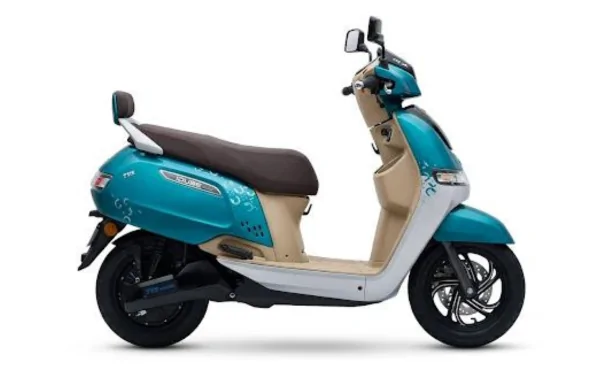
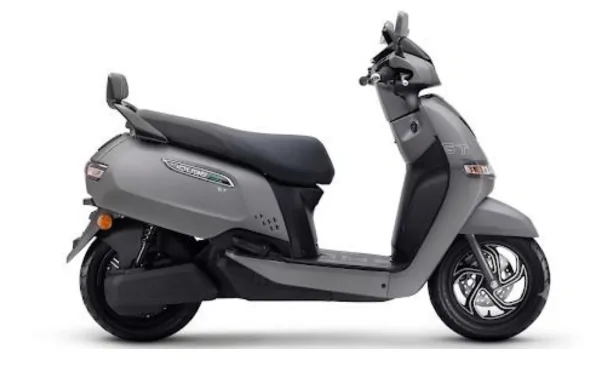
TVS describes the iQube’s design as a blend of smart styling and a practical layout. The regular versions, S and ST, belong to the same design family rather than being presented as completely different scooter designs. Their visual distinctions are principally the colour selection, trim treatment and dashboard presentation.
The main product page groups the range under iQube, iQube S and iQube ST. Battery-capacity suffixes identify the individual versions within those groups; they should not be treated as names for separate body styles.
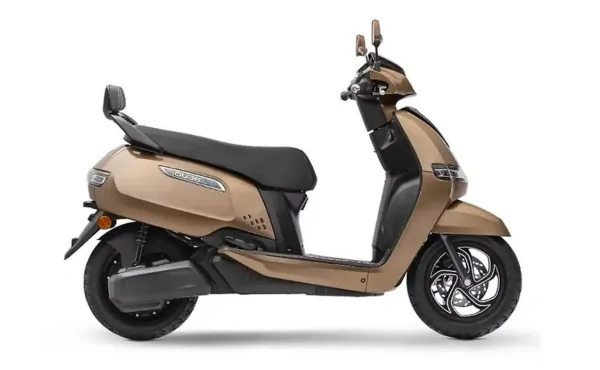
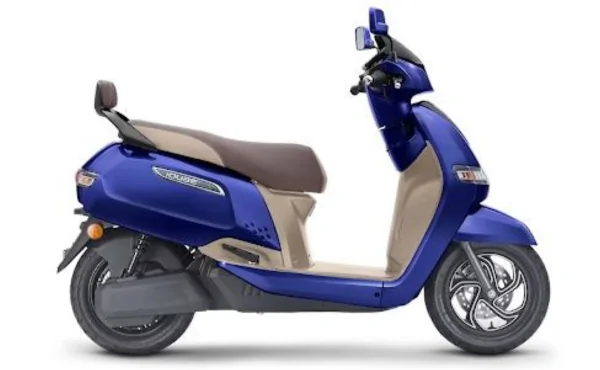
The standard iQube palette includes Pearl White, Titanium Grey, and Walnut Brown, plus Starlight Blue-Beige and Copper Bronze-Beige combinations on selected versions. The beige combinations offer a different visual treatment from the range’s single-colour names. Availability is variant-specific rather than common to all six versions.
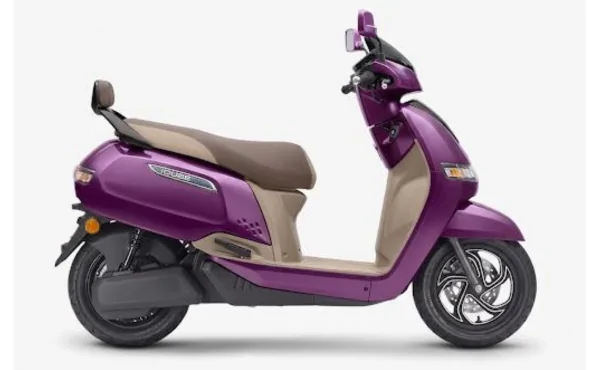
The S and ST have their own colour selections. The S introduces purple-beige and blue-beige combinations, while the ST offers Starlight Blue-Beige, Copper Bronze-Beige and Titanium Grey Matte. A colour listed for one version should not automatically be attributed to another.
The instrument display is another visible distinction within the range. The 2.3 kWh version uses a 5-inch LCD, while the 3.1 kWh, 3.5 kWh and MillionR Edition have 5-inch TFT displays. The S 4.7 kWh moves to a 7-inch TFT display, and the ST 5.3 kWh uses a 7-inch TFT touchscreen.
The touchscreen is therefore specific to the ST in TVS’s current comparison table. The larger screen fitted to the S does not, by itself, establish touchscreen operation.
The MillionR Edition commemorates the iQube reaching one million customers. It is based on the 3.5 kWh version and adds Aurora Green dual-tone paint, MillionR badging and dedicated graphics. An apron-mounted front storage box also changes the front panel’s presentation.
TVS’s booking page lists Aurora Green as the edition’s colour. It is a separate special-edition treatment, not an additional colour shown across the regular 2.3 kWh, 3.1 kWh and 3.5 kWh selections.
Colour Options And Variants
The following table combines TVS’s current booking-page colour selections with the TVS specification leaflet hosted by BikeDekho. The leaflet supplies explicit colour allocations for the 2.3 kWh and 3.1 kWh versions, whose colour names are not exposed in the retrieved booking-page text.
| Variant |
Listed colour options |
| iQube 2.3 kWh |
Pearl White, Walnut Brown, Titanium Grey. |
| iQube 3.1 kWh |
Titanium Grey, Pearl White, Starlight Blue-Beige, Copper Bronze-Beige. |
| iQube 3.5 kWh |
Copper Bronze-Beige, Starlight Blue-Beige, Walnut Brown, Pearl White, Titanium Grey. |
| iQube MillionR Edition |
Aurora Green |
| iQube S 4.7 kWh |
Titanium Grey Matte, Magnificence Purple-Beige, Harlequin Blue-Beige |
| iQube ST 5.3 kWh |
Starlight Blue-Beige, Titanium Grey Matte, Copper Bronze-Beige |
The 2.3 kWh has three listed colours: Pearl White, Walnut Brown and Titanium Grey. The 3.1 kWh has four, retaining Pearl White and Titanium Grey while adding Starlight Blue-Beige and Copper Bronze-Beige. The leaflet’s 3.1 kWh allocation excludes Walnut Brown.
The 3.5 kWh has the broadest listed palette of the six versions, with five choices: Pearl White, Titanium Grey, Walnut Brown, Starlight Blue-Beige and Copper Bronze-Beige. This includes both the standard single-colour names and two contrasting beige combinations.
The S 4.7 kWh is listed in Titanium Grey Matte, Magnificence Purple-Beige and Harlequin Blue-Beige in TVS’s specification leaflet. The purple and blue combinations distinguish its palette from that of the regular iQube versions.
TVS’s booking page contains spelling variations for the purple-beige and blue-beige names and shortens the grey entry to “Titanium Grey.” The table above follows the specification leaflet’s names, including the Matte designation, rather than treating those website variations as additional colours.
The ST 5.3 kWh has three listed choices: Starlight Blue-Beige, Titanium Grey Matte and Copper Bronze-Beige. Unlike the S, its current selection does not include the purple-beige or blue-beige combinations.
Titanium Grey Matte should remain distinct from the Titanium Grey listed on the regular versions. Similarly, Copper Bronze-Beige is the manufacturer’s name used here; do not replace it with “Copper Brown Beige” just because some secondary listings use that wording.
The cited variant lists contain nine distinct colour names or combinations when shared shades are counted once, and Titanium Grey Matte is kept separate from Titanium Grey. This is a count derived from the cited selections, not a claim that every colour is available on every version.
The iQube 2.3 kWh is the entry version in TVS’s current six-version listing. Its three-colour selection comprises Pearl White, Walnut Brown and Titanium Grey. The 5-inch LCD gives its instrument area a different presentation from the TFT-equipped versions.
The 3.1 kWh version adds the contrasting Starlight Blue-Beige and Copper Bronze-Beige choices alongside Pearl White and Titanium Grey. It uses a 5-inch TFT display rather than the entry version’s LCD. Its listed colour selection does not include Walnut Brown.
The regular 3.5 kWh version combines a 5-inch TFT display with five listed colour options. Its palette is broader than the 2.3 kWh and 3.1 kWh versions, but TVS does not describe a completely separate body design.
TVS lists the MillionR Edition separately from the regular 3.5 kWh version. Its main visual distinctions are Aurora Green dual-tone paint, commemorative graphics, MillionR badging, and the front storage-box treatment. It retains a 5-inch TFT display.
The S 4.7 kWh has a 7-inch TFT display and its own three-colour palette. Magnificence Purple-Beige and Harlequin Blue-Beige set it apart from the regular versions, while Titanium Grey Matte offers a non-beige alternative.
The ST 5.3 kWh features a 7-inch TFT touchscreen and a palette of Starlight Blue-Beige, Titanium Grey Matte, and Copper Bronze-Beige. It is listed separately from the S, and the two should not be treated as sharing an identical colour selection simply because both have larger displays.
Value For Money & Pricing
TVS displays ₹ 1,20,374 as the starred headline purchase price for the iQube 2.3 kWh. It is the lowest-priced model in the current six-model listing and offers an entry point for buyers prioritising a lower upfront costs. The page also advertises ₹1,899 per month but doesn’t show a complete down payment, loan tenure, and interest-rate combination alongside that variant card. The monthly figure should not be treated as the full ownership cost or as a universally available finance quotation.
TVS’s location-dependent price section explicitly labels the ex-showroom amount as including the charger and GST. In the retrieved configuration, it shows ₹1,16,560 ex-showroom, a ₹5,000 PM E-Drive deduction, ₹6,529 insurance and ₹1,550 in taxes and other charges, producing an on-road amount of ₹1,19,639. The retrieved text does not clearly identify the selected city and variant, so this breakup cannot safely be assigned to every version or a named city.
The incentive shown on the website should likewise not be assumed to apply to every buyer or invoice. Its actual application needs to be confirmed in the final quotation. TVS also states that prices can vary with colour, accessories and other applicable factors and may change without notice.
For a clearly identified city reference, BikeWale lists Hyderabad on-road prices from ₹1,24,734 for the 2.3 kWh to ₹1,94,300 for the ST 5.3 kWh. Intermediate figures are ₹1,47,646 for the 3.1 kWh, ₹1,55,897 for the 3.5 kWh, ₹1,59,516 for the MillionR Edition, and ₹1,78,557 for the S 4.7 kWh. These are portal estimates, not manufacturer-confirmed invoices.
TVS advertises credit-card EMI discounts of up to ₹10,000, with different percentages and limits across participating banks. These are conditional finance-linked offers, not a flat discount available to every cash buyer. Their maximum value should not automatically be subtracted from the advertised price.
The detailed price section also lists a centre stand, pillion side footrest and number-plate bracket separately. Buyers should check which items are included in their selected package rather than assuming every accessory shown on the page is part of the headline amount.
The 2.3 kWh makes the clearest purchase-price case for buyers who do not need the higher versions’ battery capacities or larger displays. On TVS’s headline figures, the 3.1 kWh costs another ₹5,566 and adds a TFT display along with a modest increase in claimed range. The upgrade’s usefulness depends on whether the entry version already meets your intended daily needs.
The lower purchase price should not be mistaken for the lowest lifetime ownership cost. Battery capacity, charging arrangements, finance interest, subscription renewals, and the eventual resale outcome are separate financial considerations that the headline price doesn’t address. TVS’s page does not provide a complete lifetime-cost comparison between its variants.
The 3.5 kWh occupies the middle of the range, costing ₹8,993 more than the 3.1 kWh on the official headline listing. It offers a larger published range allowance without requiring the S or ST’s expenditure. This gives it a clear middle-ground position for buyers who want more battery capacity but don’t value a larger display much.
The MillionR Edition is worth comparing directly because TVS currently lists the same headline price for both. A local quote is still needed to determine whether the special edition carries any additional charge in that market.
The S presents a persuasive value argument within the official headline pricing. Its ₹8,649 increase over the 3.5 kWh model buys a larger battery, a 30 km increase in claimed IDC range, and a larger TFT display. That is a substantial package of changes for the listed price increase
.
This assessment depends on the final quotation keeping a similarly reasonable difference. BikeWale’s Hyderabad estimates show a wider ₹22,660 on-road gap between the regular 3.5 kWh and S, demonstrating why a value judgement based only on the manufacturer’s headline amounts may not translate directly to every city.
The ST’s ₹41,192 headline premium over the S requires closer justification. Its additional 37 km of claimed IDC range and touchscreen are confirmed upgrades, but the price jump is much larger than the one between the lower versions.
For a buyer whose riding requirement is already comfortably covered by the S, the ST does not automatically become the better purchase merely because it has the highest specification. Its financial case is stronger where the additional battery capacity or touchscreen is specifically required.
TVS advertises an electricity running cost of ₹0.18/km against ₹2/km for a petrol scooter. Its savings calculator assumes petrol at ₹100/litre, a petrol scooter mileage of 50 km/l, and electricity at ₹7.50 per unit. These are calculation inputs, not guaranteed nationwide operating costs.
The advertised electricity cost should not be presented as the complete cost of ownership. The page does not state whether it includes finance interest, insurance, tyres, connected-service renewals, depreciation, or future battery expenditure. Similarly, the statement that savings can fund another scooter in three years depends on usage and the calculator assumptions
.
The retrieved price package lists a three-year warranty, one year of roadside assistance and one year of the Advanced connected subscription. TVS’s battery description also states a three-year/50,000 km warranty. These provisions add defined coverage, but they do not establish free servicing or unlimited connected services for the scooter’s lifetime.
Competitor Models in India for the TVS iQube are
- Bajaj Chetak 3501
- VIDA VX2 Plus
- VIDA VX2 Go
- Ather Rizta